

¿Se está adelantando el mercado de tipos a Fráncfort?


 El S&P 500 +0,46 % hasta los 7.666,60 puntos El bono estadounidense a 10 años -1,3 pb hasta el 4,784 % El oro al contado +1,36 % hasta los 4.387,86 $ la onza El DXY -0,10 % hasta los 99,56 puntos
Datos clave que moverán los mercados hoy
UE: PMI compuesto y de servicios de HCOB de Alemania, Francia, Italia, España y la eurozona, e IPP de la eurozona
Reino Unido: PMI compuesto y de servicios de S&P Global
EE. UU.: productividad no agrícola, solicitudes iniciales y continuas de subsidio por desempleo, PMI compuesto y de servicios de S&P Global, PMI de servicios del ISM, índices de precios pagados, empleo y nuevos pedidos, y discurso del gobernador de la Fed, Christopher Waller, y de la presidenta de la Fed de Cleveland, Beth Hammack
Actualizaciones macroeconómicas mundiales
¿Están subiendo ya los rendimientos reales? El mercado ya da por hecha una subida de tipos del BCE en septiembre, y la pregunta más interesante es si el 2,5 % marca la cima o solo el campamento base. La respuesta del gobernador del Banco Central de Irlanda, Gabriel Makhlouf, apunta a lo segundo: una inflación superior al 3 %, un crecimiento ligeramente por encima de la previsión de junio de los servicios técnicos y un tipo de depósito que él no considera restrictivo dejan abierta la puerta a un 2,75 % o más, según ha informado el Financial Times. Aun así, con la inflación subyacente moderándose y sin efectos de segunda ronda claros en los salarios, el Consejo de Gobierno tiene pocos incentivos para comprometerse de antemano después del 10 de septiembre.
La curva se muestra menos tranquila. El rendimiento del Bund alemán a dos años ronda el 3 %, mientras que el del bono a diez años ha subido hasta cerca del 3,4 %, su nivel más alto desde 2011. De forma más reveladora, el Bund alemán ligado a la inflación con vencimiento en 2046, el equivalente europeo a un TIPS a largo plazo, ofrecía a finales de agosto un rendimiento real de aproximadamente el 1,45 %. Esto no invalida el argumento de Makhlouf de que el 2,5 % no resulta restrictivo a nivel de tipo oficial, pero sugiere que las condiciones financieras ya están haciendo parte del trabajo de Fráncfort. Los inversores exigen compensación no solo por la inflación esperada, sino también por comprometer capital en términos reales.
El Reino Unido presenta la misma paradoja, aunque más acentuada. Los mercados han pasado de debatir recortes a anticipar hasta tres subidas de 25 pb en los próximos dos años, con una que podría llegar ya en noviembre. El rendimiento del gilt británico a dos años ha superado el 4,5 %, mientras que el del bono a diez años ha cotizado en torno al 5,2 %. El gobernador del BoE, Andrew Bailey, puede argumentar por tanto que el mercado de tipos ya ha endurecido las condiciones en nombre de Threadneedle Street. Al mismo tiempo, la miembro del Comité de Política Monetaria del BoE, Catherine Mann, puede sostener que quizá no sea suficiente, ya que la actividad ha mejorado, el mercado laboral parece estar estabilizándose y la inflación de hoy podría convertirse en la negociación salarial de mañana.
Aquí también los bonos ligados a la inflación afinan la señal. Los gilts británicos indexados a largo plazo, el equivalente británico a los TIPS, ofrecen actualmente rendimientos reales de entre el 2,1 % y el 2,6 %, mientras que la inflación del índice de precios al por menor (RPI) implícita en buena parte de la curva se mantiene entre el 3,3 % y el 3,5 %. El mercado está anticipando, por tanto, tanto una inflación persistente como unos costes de financiación reales genuinamente restrictivos. Esto se parece menos a un voto claramente restrictivo que a una cobertura incómoda frente a los riesgos de política monetaria, fiscales y de oferta.
La declaración fiscal de octubre todavía podría inclinar la balanza en cualquier dirección. Una consolidación creíble aliviaría la presión sobre el BoE, mientras que unas ambiciones de gasto sin ingresos que las respalden añadirían otra capa de prima por plazo. La conclusión que dejan los bonos ligados a la inflación para ambos bancos centrales es clara: los tipos oficiales podrían no parecer restrictivos en la superficie, pero el mercado de bonos ya está ejerciendo presión y exigiendo una prima más alta por la protección frente a la inflación.
Índices bursátiles estadounidenses
El Dow Jones Industrial Average +0,56 %
El Nasdaq 100 +0,23 %
El S&P 500 +0,46 %, con 10 de los 11 sectores del S&P 500 al alza
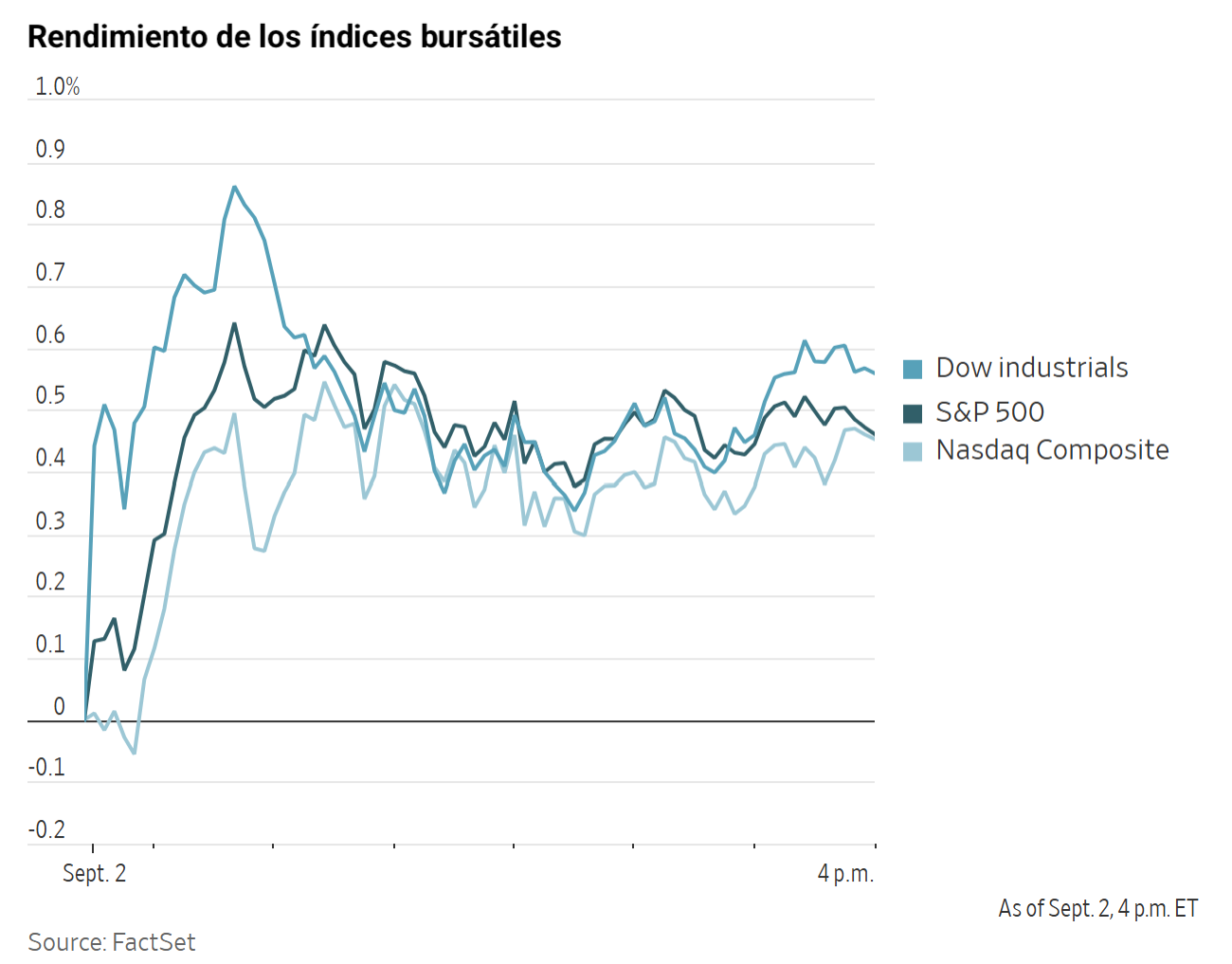
Las acciones estadounidenses cerraron al alza ayer, impulsadas por las ganancias de los sectores de materiales y de servicios de comunicación, que avanzaron más de un 1 % cada uno. Dentro del S&P 500, el sector inmobiliario fue el único que cerró en negativo, con una caída del -0,79 %. El S&P 500 subió un +0,46 %, el Dow Jones Industrial Average ganó un +0,56 %, o 295,07 puntos, y el Nasdaq Composite avanzó un +0,45 % hasta los 26.217,83 puntos.
En cuanto a noticias corporativas, Elliott Investment Management ha adquirido una participación considerable en Deutsche Telekom y ha instado a la operadora alemana de telecomunicaciones a abandonar una posible fusión con su filial estadounidense, T-Mobile US, según fuentes conocedoras del asunto citadas por Bloomberg. Elliott también está presionando a Deutsche Telekom para que evalúe medidas alternativas con las que aumentar el valor para los accionistas, entre ellas recompras de acciones de mayor tamaño.
Un juez federal ha dictaminado que Google debe modificar determinadas prácticas relacionadas con su tecnología publicitaria, aunque ha descartado ordenar la escisión forzosa de la compañía.
Barrick Mining está considerando retrasar hasta el año que viene la prevista salida a bolsa de su negocio de oro en Norteamérica, según una persona conocedora del asunto citada por Bloomberg. La compañía trabaja con Goldman Sachs Group en la operación y mantiene conversaciones con bancos adicionales sobre sus posibles papeles en la salida a bolsa. En la conferencia de resultados de Barrick del 10 de agosto, el director ejecutivo de la compañía, Mark Hill, ha dicho que dirigiría la unidad norteamericana tras la OPV, mientras que Sebastiaan Bock pasaría a ser director ejecutivo del resto de las operaciones de la compañía.
Índices bursátiles europeos
El CAC 40 -0,26 %
El DAX -0,50 %
El FTSE 100 -0,30 %
Materias primas
El oro al contado +1,36 % hasta situarse en 4.387,86 $ la onza
La plata al contado +0,59 % hasta situarse en 64,97 $ la onza
El West Texas Intermediate -0,06 % hasta situarse en 90,63 $ el barril
El crudo Brent +0,05 % hasta situarse en 95,24 $ el barril
El oro rebotó el miércoles desde un mínimo de casi un mes, apoyado por el retroceso del dólar estadounidense y de los rendimientos del Tesoro desde sus máximos recientes.
El oro al contado subió un +1,36 % hasta los 4.387,86 $ por onza, tras recuperar terreno durante la sesión desde su nivel más bajo desde el 7 de agosto.
El dólar estadounidense también cedió terreno tras rozar su máximo de casi tres semanas.
La plata al contado ganó un +0,59 % hasta los 64,97 $ por onza.
Los precios del petróleo, por su parte, cerraron ayer prácticamente sin cambios, mientras los inversores evaluaban el riesgo de que la reanudación de los ataques militares entre EE. UU. e Irán pudiera interrumpir los flujos de suministro en Oriente Próximo.
Los futuros del crudo Brent subieron 5 centavos, un +0,05 %, hasta los 95,24 $ por barril, mientras que los futuros del West Texas Intermediate estadounidense cayeron 5 centavos, un -0,06 %, hasta situarse en los 90,63 $ por barril.
Los últimos ataques representaron el intercambio de fuego más significativo entre EE. UU. e Irán desde julio, en un conflicto que ya se prolonga durante siete meses.
Las fuerzas estadounidenses atacaron el martes más de 100 objetivos iraníes en represalia por los ataques de Irán contra buques comerciales en el estrecho de Ormuz. Irán respondió durante la noche con el lanzamiento de misiles y drones contra países vecinos, entre ellos Kuwait y los Emiratos Árabes Unidos.
El presidente de EE. UU. declaró más tarde ese mismo día que el país está preparado para llevar a cabo otro ataque contra Irán, al tiempo que señaló que la nueva campaña no se prolongará durante mucho tiempo.
El Brent y el WTI fluctuaron durante la sesión de negociación anterior, y los máximos de la sesión de ambos índices de referencia fueron los más altos desde el 24 de julio.
Es probable que el grupo de siete países de la OPEP+ mantenga sin cambios su política de producción petrolera para octubre en la reunión del domingo, según tres fuentes cercanas al asunto citadas por Reuters.
Los precios del diésel en Nueva York se cotizaron el miércoles en 201 $ por barril, y más altos en otras plazas, mientras que el diferencial de refino entre el WTI y el diésel alcanzó los 106 $ por barril.
El informe semanal sobre la situación del petróleo del Departamento de Energía de EE. UU. (DOE, por sus siglas en inglés), que fue publicado el miércoles, mostró un descenso de las reservas de crudo de 4,45 millones de barriles, frente a la caída de 1,1 millones prevista, el primer descenso de las reservas en cinco semanas.
Las reservas de gasolina cayeron en 1,17 millones de barriles, mientras que las de destilados aumentaron en 800.000 barriles. Aunque las reservas totales de destilados crecieron, las de la región PADD 1 cayeron a mínimos históricos. La utilización de las refinerías subió hasta el 98,0 %, su nivel más alto desde agosto de 2018, mientras que la producción de combustible de aviación se mantuvo por encima de los 2,0 millones de barriles diarios durante la decimoctava semana consecutiva.
Se espera que China mantenga estables este mes sus exportaciones de productos refinados respecto a agosto, lo que permitirá a las refinerías beneficiarse de unos márgenes internacionales más sólidos, a medida que Pekín continúa flexibilizando los controles a la exportación, según cinco fuentes del sector informadas sobre el asunto y citadas por Reuters.
El tráfico marítimo a través del estrecho de Ormuz y de Bab el-Mandeb se mantuvo reducido. Kpler registró el martes el paso de cuatro buques de materias primas por el estrecho de Ormuz, frente a los 10 del lunes, mientras que 18 buques de materias primas cruzaron Bab el-Mandeb, por debajo de la media de los últimos 10 días, que se situó en 24.
Los datos semanales de almacenamiento de la EIA correspondientes a la semana que terminó el 28 de agosto se publicarán mañana, con unas previsiones de mercado de +30.000 millones de pies cúbicos, frente a la media de los últimos cinco años de +37.000 millones de pies cúbicos.
El TTF subió un +1,8 % hasta los 73,50 € por MWh, su nivel más alto en 44 meses.
Nota: los datos corresponden al 2 de septiembre de 2026 a las 16.00 EDT
Divisas
El EUR -0,03 % para situarse en 1,1586 $
La GBP -0,24 % para situarse en 1,3479 $
El bitcoin +0,15 % para situarse en 77.303,68 $
El ethereum -1,02 % para situarse en 2.390,10 $
El yen japonés se fortaleció con fuerza frente al dólar estadounidense el miércoles, después de haber retrocedido anteriormente cerca de la mitad de las ganancias registradas tras la infrecuente intervención conjunta de Washington y Tokio a finales de julio.
El motivo del movimiento no estaba claro en un principio. Antes de la intervención, el yen se había depreciado hasta un mínimo de 40 años de 163,98 yenes por dólar, para después recuperarse hasta los 155,21 yenes y ceder parte del avance. Durante la jornada, se apreció un +0,92 % hasta los 158,68 yenes por dólar.
El miembro del consejo del BoJ, Hajime Takata, de perfil restrictivo, afirmó el miércoles que el banco central debería subir los tipos de interés con mayor rapidez para contrarrestar la intensificación de las presiones inflacionistas, en lugar de ceñirse al ritmo semestral que el mercado había anticipado en general.
Sigue siendo difícil determinar el motivo del movimiento del dólar-yen, aunque parece más coherente con una consulta sobre el tipo de cambio que con una intervención directa destinada a cambiar la tendencia general, especialmente porque la intervención más reciente no consiguió hacerlo.
En una consulta de tipo de cambio, un Gobierno o un banco central pide a las entidades financieras que coticen un tipo de cambio sin llevar a cabo compras o ventas directas.
El gobernador del BoJ, Kazuo Ueda, también señaló el martes que una subida de tipos este mes seguía siendo una posibilidad firme. El secretario del Tesoro de EE. UU., Scott Bessent, expresó su respaldo a medidas de política monetaria decididas para hacer frente a la debilidad del yen durante una reunión con Ueda, según informó el Departamento del Tesoro.
Al yen le ha costado mantener el apoyo dado el amplio diferencial de tipos de interés entre EE. UU. y Japón, ya que la divisa volvió a depreciarse hasta los 160,39 yenes al inicio de la sesión del miércoles, su nivel más débil desde la intervención.
El índice del dólar cayó un -0,10 % hasta 99,56, mientras que el euro retrocedió un -0,03 % hasta 1,1586 $.
La libra esterlina se depreció un -0,24 % hasta 1,3479 $.
Renta fija
El bono estadounidense a 10 años -1,3 pb hasta el 4,784 %
El bono alemán a 10 años +3,0 pb hasta el 3,339 %
El gilt británico a 10 años +1,1 pb hasta el 5,161 %
Los rendimientos del Tesoro estadounidense retrocedieron el miércoles desde máximos de varios años, ya que el rendimiento a 10 años puso fin a una racha de cinco sesiones consecutivas al alza.
Los últimos datos del mercado laboral llegaron después de la encuesta JOLTS (encuesta sobre ofertas de empleo y rotación laboral) del martes, que apuntó a un contexto de empleo lento pero estable. El informe de nóminas del viernes se seguirá con especial atención por sus implicaciones para la trayectoria de política monetaria de la Fed.
El bono estadounidense a 10 años cayó -1,3 pb hasta alcanzar el 4,784 %, lo que puso fin a su racha alcista diaria más larga desde marzo. Anteriormente en la sesión, el rendimiento había llegado a los 4,818 %, su nivel más alto desde el 1 de noviembre de 2023.
El bono a 30 años cayó -1,7 puntos básicos hasta alcanzar el 5,260 %, tras tocar anteriormente en la sesión un máximo de dos semanas en el 5,296 %.
El presidente de la Fed de Nueva York, John Williams, dijo que la subida de los rendimientos de los bonos a largo plazo no obedecía a preocupaciones por la inflación, sino que reflejaba la fortaleza de la economía. También señaló que todavía está recabando información de cara a su próxima decisión de política monetaria.
Varios responsables de la Fed han indicado durante la última semana que otra subida de tipos podría ser adecuada si persisten las presiones inflacionistas.
La curva de rendimientos de los bonos del Tesoro estadounidense a dos y diez años se situó en 39,6 pb, 0,9 pb más amplia que el martes.
Los mercados anticipaban una probabilidad del 62,3 % de al menos una subida de tipos de 25 pb por parte de la Fed en la reunión de septiembre, según la herramienta FedWatch de CME Group, frente al 36,6 % de la semana anterior.
El rendimiento del bono estadounidense a dos años, que suele reflejar las expectativas sobre el tipo de los fondos federales, cayó -2,2 pb hasta el 4,388 %, después de haber subido anteriormente hasta el 4,410 %, su nivel más alto desde enero de 2025.
En su último Libro Beige, la Reserva Federal indicó que la actividad económica estadounidense aumentó de forma moderada, el empleo creció ligeramente y los precios subieron de manera moderada en las últimas semanas.
Los rendimientos de los bonos de la eurozona subieron el miércoles por sexta sesión consecutiva.
El bono alemán a 10 años subió hasta el 3,339 %, su nivel más alto desde 2011, antes de recortar parte del avance.
La venta masiva de deuda pública del miércoles se sumó a una caída global más amplia que ha llevado los costes de financiación a máximos de varias décadas.
Los datos publicados el martes mostraron que la inflación de la eurozona se aceleró hasta el 3,3 % en agosto, desde el 2,9 % de julio, impulsada casi en su totalidad por el encarecimiento de la energía, ya que subieron los precios del petróleo y del gas natural y las refinerías ampliaron sus márgenes.
El rendimiento del bono alemán a dos años, que es más sensible a las expectativas sobre el tipo de depósito del BCE, superó el 3 % por primera vez desde 2024 y cerró la jornada con una subida de +4,4 pb, hasta alcanzar el 3,007 %. En el extremo largo de la curva, el rendimiento del bono alemán a 30 años subió +1,4 puntos básicos hasta el 3,837 %.
Los mercados monetarios descontaban una probabilidad cercana al 100 % de una subida de tipos de interés del BCE en su reunión de este mes, así como una alta probabilidad de otra subida antes de que termine el año.
El BTP italiano a 10 años avanzó +4,0 pb hasta el 4,214 %, mientras que el OAT francés a 10 años subió +4,7 puntos básicos hasta el 4,253 %.
Nota: los datos corresponden al 2 de septiembre de 2026 a las 16.00 EDT
Aunque se han hecho todos los esfuerzos posibles para verificar la exactitud de esta información, EXT Ltd. (en adelante, "EXANTE") no se hace responsable de la confianza que cualquier persona pueda depositar en esta publicación o en cualquier información, opinión o conclusión contenida en ella. Las conclusiones y opiniones expresadas en esta publicación no reflejan necesariamente la opinión de EXANTE. Cualquier acción realizada sobre la base de la información contenida en esta publicación es estrictamente bajo su propio riesgo. EXANTE no se hará responsable de ninguna pérdida o daño relacionado con esta publicación.
Este artículo se presenta a modo informativo únicamente y no debe ser considerado una oferta ni solicitud de oferta para comprar ni vender inversión alguna ni los servicios relaciones a los que se pueda haber hecho referencia aquí. Operar con instrumentos financieros implica un riesgo significativo de pérdida y puede no ser adecuado para todos los inversores. Los resultados pasados no garantizan rendimientos futuros.




Regístrese para recibir perspectivas de los mercados
Regístrese
para recibir perspectivas
de los mercados
Suscríbase ahora Suscríbase ahora


Creado por profesionales. Para profesionales.
