

The squeeze on the yen


 S&P 500 -0.13% last month to 7,489.72US 10-year yield +27.0 basis points last month to 4.740%Spot gold +0.82% last month to $4,040.29 an ounceDXY -1.35% last month to 99.80
What to look out for today
Companies reporting on Monday, 3 August: Diamondback Energy, Loews, Marriott International, ON Semiconductor, Palantir Technologies, TKO Group Holdings, Tyson Foods, Vertex Pharmaceuticals
Key data to move markets today
EU: German Retail Sales, HCOB Spanish, Italian, German and Eurozone Manufacturing PMIs
UK: S&P Global Manufacturing PMI
USA: Loan Officer Survey (Q2), S&P Global Manufacturing PMI, ISM Manufacturing PMI, Prices Paid, Employment Index and New Orders Index
Global Macro Updates
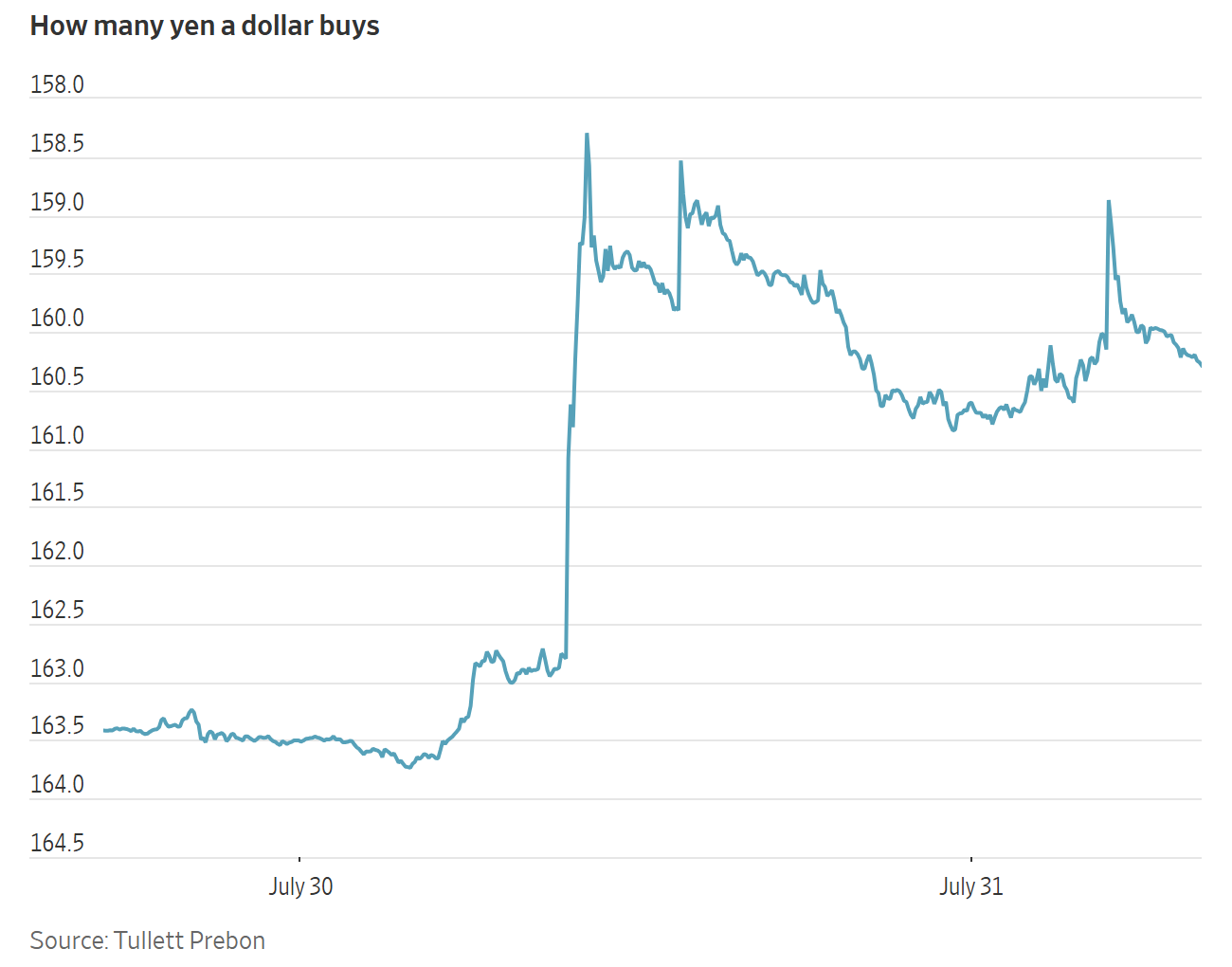
US and Japan confirm coordinated intervention. The yen extended its gains on Monday, approaching its strongest level against the dollar since February, as markets remained alert to the possibility of continued intervention.
In a post on X, Treasury Secretary Scott Bessent confirmed coordinated US - Japan action on Friday to counter ‘disorderly yen movements’ and stated that the Treasury would not hesitate to participate in further joint intervention if necessary. Japan’s Finance Minister Satsuki Katayama echoed this message, emphasising that the intervention was intended to address excessive volatility and that authorities remained prepared to take additional action. A Japanese government official also told Reuters that the operation remained ongoing.
Bessent referred to the Fed’s Foreign and International Monetary Authorities (FIMA) Repo Facility as an important backstop. Japan’s Ministry of Finance noted that the facility can provide temporary dollar liquidity against Treasury securities. The reference to FIMA was interpreted as a signal that Japan can access dollars by pledging Treasuries as collateral, rather than relying on outright sales that could add upward pressure to rates.
Speculation about coordinated intervention intensified late last week after Reuters published a photo of a notepad on Bessent’s desk at Camp David showing a ‘to do’ item to buy $5 to $10 billion in yen. US banks had reportedly been notified of pending action, with the New York Fed conducting rate checks. Nikkei sources said authorities intervened for a second session on Friday, while FT sources reported that the New York Fed sold euros for yen as part of the intervention effort. Analysts using official data and broker estimates said Thursday’s intervention by Japanese authorities was likely around ¥8.45 trillion.
Reports broadly emphasised that the coordination itself was more significant than the size of the operation. Japan's Vice Finance Minister for International Affairs Atsushi Mimura again refrained from commenting directly on the latest developments, although he said on Friday, ‘We are receiving more than just moral support from US authorities.’ The Ministry of Finance also issued a statement on X stressing that authorities have ‘a broad range of tools to address market liquidity needs,’ including the Fed’s FIMA repo facility, apparently seeking to counter market skepticism about Japan’s capacity for further intervention.
The coordinated intervention has materially increased the cost of betting against the yen. It disrupted speculative positioning and heightened the risk of additional official actions. This should make investors more cautious about rebuilding aggressive short-yen positions.
However, unless it is supported by narrower rate differentials or stronger confidence in Japan’s fiscal outlook, the yen could gradually come under renewed pressure once official support fades.
Markets are likely to test the durability of these measures. Ultimately, Japanese authorities’ actions are likely to generate greater short-term volatility, which of course is in contradiction of what they are claiming to do.
BoJ leaves policy unchanged, as expected. The BoJ kept its uncollateralised overnight call rate target unchanged at 1.00%, as widely expected. The decision passed by an 8 – 1 vote, with Policy Board member Hajime Takata dissenting and continuing to advocate for rate hikes. He argued that the BoJ now needs to adopt a more nimble approach in response to upside risks to prices, including those arising from overseas demand shocks and changes in global financial conditions.
In the Outlook Report, revisions to the economic forecasts were modest. GDP growth was raised by one-tenth for 2026 and lowered by one-tenth for 2027, changes the BoJ appeared to view as broadly inconsequential. The 2026 core CPI inflation forecast was revised down more noticeably, to 2.5% from 2.8%, mainly reflecting the impact of government electricity and gas subsidies during the summer.
The guidance section noted that, with underlying inflation approaching 2% and financial conditions remaining accommodative, the BoJ will continue to raise rates in response to economic and financial developments. The Bank will assess the timing and pace of future adjustments while examining the likelihood that its baseline scenario will materialise. The BoJ also reiterated the need to remain vigilant to the risk that underlying inflation may overshoot the 2% target.
At the post-meeting press conference, BoJ Governor Kazuo Ueda addressed the ‘timing and pace’ of policy adjustment, indicating that the basis for rate hikes would be discussed rigorously from the next Monetary Policy Meeting in September and beyond, according to Nikkei. He reaffirmed that the BoJ would closely monitor developments in the Middle East, AI-related demand growth and exchange rates. The impact of the Kumamoto earthquake remains unclear, but is also an area of focus.
US Stock Indices
Dow Jones Industrial Average +0.53%
Nasdaq 100 +0.60%
S&P 500 +0.70%, with 4 of the 11 sectors of the S&P 500 up
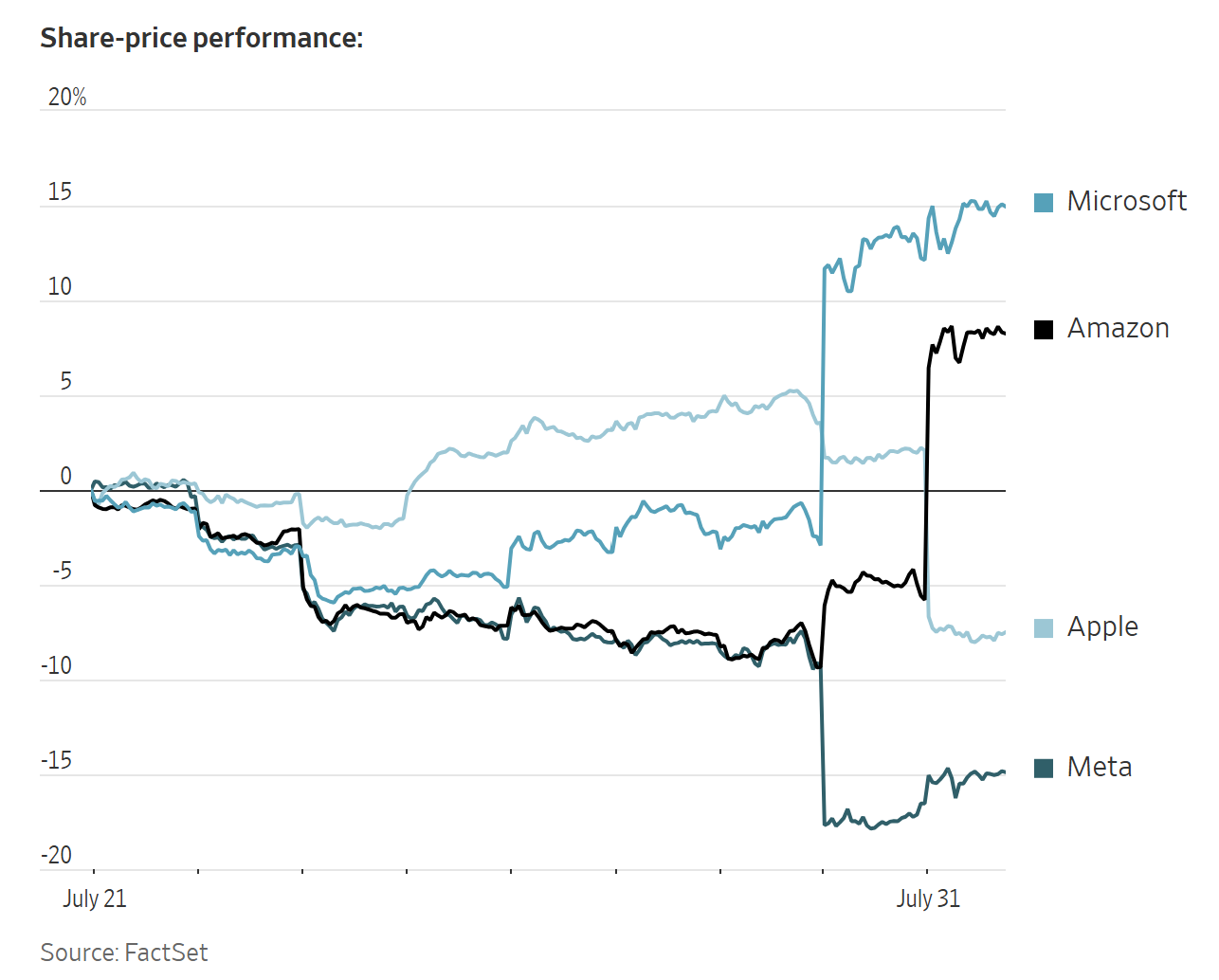
The Nasdaq Composite was +1.00% on Friday, but underneath the gain was a tug-of-war between Apple, which fell -7.35%, and Amazon, which surged +15.32%.
Apple lost $357.8 billion in market capitalisation, its largest one-day market-cap decline on record and the third-largest for any US company. The post-earnings selloff, Apple’s steepest since 2014, followed Q3 guidance that fell short of Wall Street expectations.
Amazon shares surged after the company reported accelerating cloud-computing sales. The rally delivered the cloud provider and retailer its largest market-cap gain on record.
The S&P 500 technology sector, which includes Apple, ended the day -0.54% lower, while the consumer discretionary sector, which includes Amazon, surged +6.07%. Overall, the S&P 500 rose +0.70%, while the Dow Jones Industrial Average advanced +0.53%, or 276.93 points.
Friday’s gains were sufficient to push the Dow into positive territory for the month. The blue-chip index added +0.32% in July, while the S&P 500 edged down -0.13% and the Nasdaq slipped -3.20%.
In corporate news, Moonshot secured a computing-power agreement with Alibaba to access about 20,000 Nvidia chips for its Kimi models. This highlights China’s continued dependence on Western semiconductors to support AI development, according to people familiar with the companies’ operations, as reported by Bloomberg news.
Corporate Earnings Reports
Posted on Friday, 31 July from The Pulse, our real-time AI-driven news tool. Available exclusively on the EXANTE Web Platform
ExxonMobil reported Q2 non-GAAP EPS of $3.52, missing the $3.54 consensus by -$0.11, while revenue of $116.02bn beat the $103.1bn estimate. Upstream production hit 4.514m boepd, a twenty-year high, and free cash flow reached $17.2bn. Refinery throughput of 3.562m bpd missed estimates due to maintenance. Mid-east disruptions reduced year-to-date earnings by $1.8bn. CEO Darren Woods said the quarter 'was shaped by disruption, but defined by execution.'
Chevron reported Q2 earnings. Adjusted EPS was $6.06 vs $5.65 expected. Revenue was $70.1bn, up +56% y/y. Net income was $12bn. Record US production rose +20%. The company ran US refineries at 97% capacity. It signed a 20-year power deal with Microsoft for a West Texas data centre. A $3bn cost-reduction target was hit six months early. CEO Mike Wirth said the strong performance was driven by disciplined investment and strong execution that drove record US upstream production, record crude throughput in US refineries, and exceptional reliability across key assets. Separately, Chevron expects to recover its Venezuela debt by early 2027 and sees potential to raise Venezuelan output to 400,000 bbl/day by 2028.
Eaton reported Q2 2026 results. Adj EPS was $3.15 vs $3.08 expected, on net sales of $8.5bn vs $8.13bn expected. The company guided Q3 organic revenue growth of +13.5% to +15.5% (est +10.6%), and Q3 adj EPS of $3.46 to $3.56 (est $3.50). CEO commented that Eaton accelerated its momentum in Q2, delivering record sales and solid earnings from strong organic growth, adding that while data centres remain a key driver, the company benefits from robust demand across end markets.
AbbVie reported Q2 2026 earnings with revenue of $16.99bn (up +10.2% y/y) vs $16.77bn consensus and adjusted EPS of $3.65 (up +22.9% y/y) vs $3.60 estimates. The immunology portfolio grew +15.1% y/y to $8.79bn, driven by Skyrizi at $5.51bn (+24.4% y/y) and Rinvoq at $2.53bn (+24.5% y/y), while Humira fell -35.9% y/y to $756mn. Management cut FY26 adjusted EPS guidance to $13.87-$14.07 from $13.91-$14.11, including a -$0.58/share unfavourable impact from IPR&D and a -$0.14/share dilutive impact from the proposed Apogee Therapeutics acquisition, expected to close in Q3. CEO said the deal bolsters immunology leadership and creates significant shareholder value.
European Stock Indices
CAC 40 +0.28%
DAX +0.07%
FTSE 100 -0.27%
Commodities
Gold spot -1.51% to $4,040.29 an ounce
Silver spot -1.68% to $57.63 an ounce
West Texas Intermediate +3.43% to $86.84 a barrel
Brent crude +0.75% to $90.09 a barrel
Gold fell by more than one percent on Friday due to profit-taking and continuing concerns around interest rates.
Spot gold declined -1.51% to $4,040.29 per ounce after falling as much as two percent earlier in the session. On a weekly basis, prices were down -0.30%. However, gold advanced +0.82% in July, marking its strongest monthly increase since February.
Spot silver fell -1.68% to $57.63 per ounce, contributing to a weekly decline of -0.92%. For the month, silver was down -1.61%.
WTI and Brent both advanced on Friday. Brent futures settled at $90.09 per barrel, up 67 cents, or +0.75%, while WTI futures ended at $86.84 per barrel, up $2.88, or +3.43%.
For the week, both benchmarks declined, with Brent down -8.45% and WTI lower by -4.01%. For the month, however, WTI advanced +23.99% and Brent traded +23.55% higher.
WTI and Brent began last lower after the US and Iran paused military attacks. The benchmarks declined further on Tuesday as tanker data showed increased traffic through both the Strait of Hormuz and the Bab al-Mandib Strait, while the US president made optimistic remarks about a potential deal. Prices rose on Wednesday after Iran resumed attacks on US forces in the Gulf and the US and Saudi Arabia struck targets in Iran, reversing the earlier improvement in traffic through those waterways.
Last week also brought new pressures after Saudi energy facilities and a tanker were targeted by Yemen’s Houthis on Tuesday. Reports on Thursday indicated that Saudi Arabia was preparing for a possible land offensive against the Houthi movement.
Separately, the conflict expanded to the Mediterranean for the first time, with an LNG tanker struck at Egypt’s Damietta port. The US paused strikes from Thursday into Friday, while Iran launched additional attacks toward Jordan. Several Saudi oil tankers were seen reversing course away from the Bab al-Mandib and indicating plans to travel around Africa to Asia. Saudi Arabia is also building a multinational maritime defense coalition to protect shipping in the Red Sea.
Russian fuel shortages remained in focus as Ukraine resumed strikes against Russian refineries, with at least six facilities hit, while Moscow extended export bans on gasoline and diesel. Kazakhstan’s energy ministry told Reuters that the country is in talks with Russia to process Russian oil at its refineries, with the resulting products to be sold domestically and back to Russia.
Sources familiar with the matter told Reuters that Russia imported its first gasoline cargo from Morocco. Separately, Interfax reported that Kyrgyzstan agreed to sell Russia 100,000 tons of fuel and lubricants per month through year-end as shortages persist.
The Caspian Pipeline Consortium (CPC) terminal resumed exports last Tuesday after recovering from drone strikes, but the restart proved short-lived following additional strikes from Wednesday night into Thursday. CPC may indefinitely halt oil and tanker operations until it receives safety guarantees, with a decision expected later today.
OPEC+ approved an oil production quota increase of approximately 188,000 barrels per day from September, the producer group said on Sunday, completing the unwinding of one layer of voluntary output cuts.
Because export disruptions from the Gulf, Russia and Kazakhstan have been caused by the Iran and Ukraine wars, successive monthly OPEC+ increases have remained largely on paper and have had limited market impact.
The September increase agreed by core OPEC+ members, Saudi Arabia, Russia, Iraq, Kuwait, Algeria, Kazakhstan and Oman, completes the phased rollback of a 1.65 million bpd supply cut originally agreed in 2023, when the group still included the United Arab Emirates, which left OPEC in May.
With September’s output increase now approved, OPEC+ still has one additional layer of cuts in place for most members. These reductions, totalling roughly 2 million bpd, date back to 2022 and are scheduled to remain in effect through year-end.
The seven OPEC+ members are scheduled to hold their next meeting on 6 September.
Note: As of 4 pm EDT 31 July 2026
Currencies
EUR +0.16% to $1.1544
GBP +0.15% to $1.3480
Bitcoin -2.76% to $62,906.26
Ethereum -3.01% to $1,859.74
The dollar declined broadly on Friday, with the dollar index down -0.21% on the day and -1.64% for the week.
The yen appreciated +1.34% on the day, contributing to a weekly gain of +3.85% against the US dollar as coordinated intervention efforts supported the Japanese currency.
The euro traded +0.16% higher at $1.1544 on Friday, while the pound also rose, gaining +0.15% to $1.3480. Both currencies advanced against the dollar for the week, with the euro up +1.56% and the pound higher by +1.21%.
For July, the dollar index declined -1.35%, while the euro advanced +1.08%, the yen rose +3.09%, and the pound gained +1.71%.
Fixed Income
US 10-year Treasury +6.3 basis points to 4.740%
German 10-year Bund +4.7 basis points to 3.229%
UK 10-year Gilt +7.2 basis points to 5.061%
US long-term bond yields recorded monthly gains, with the 30-year yield reaching a new 19-year high as investors assessed uncertainty surrounding the Iran war and the Fed’s policy outlook.
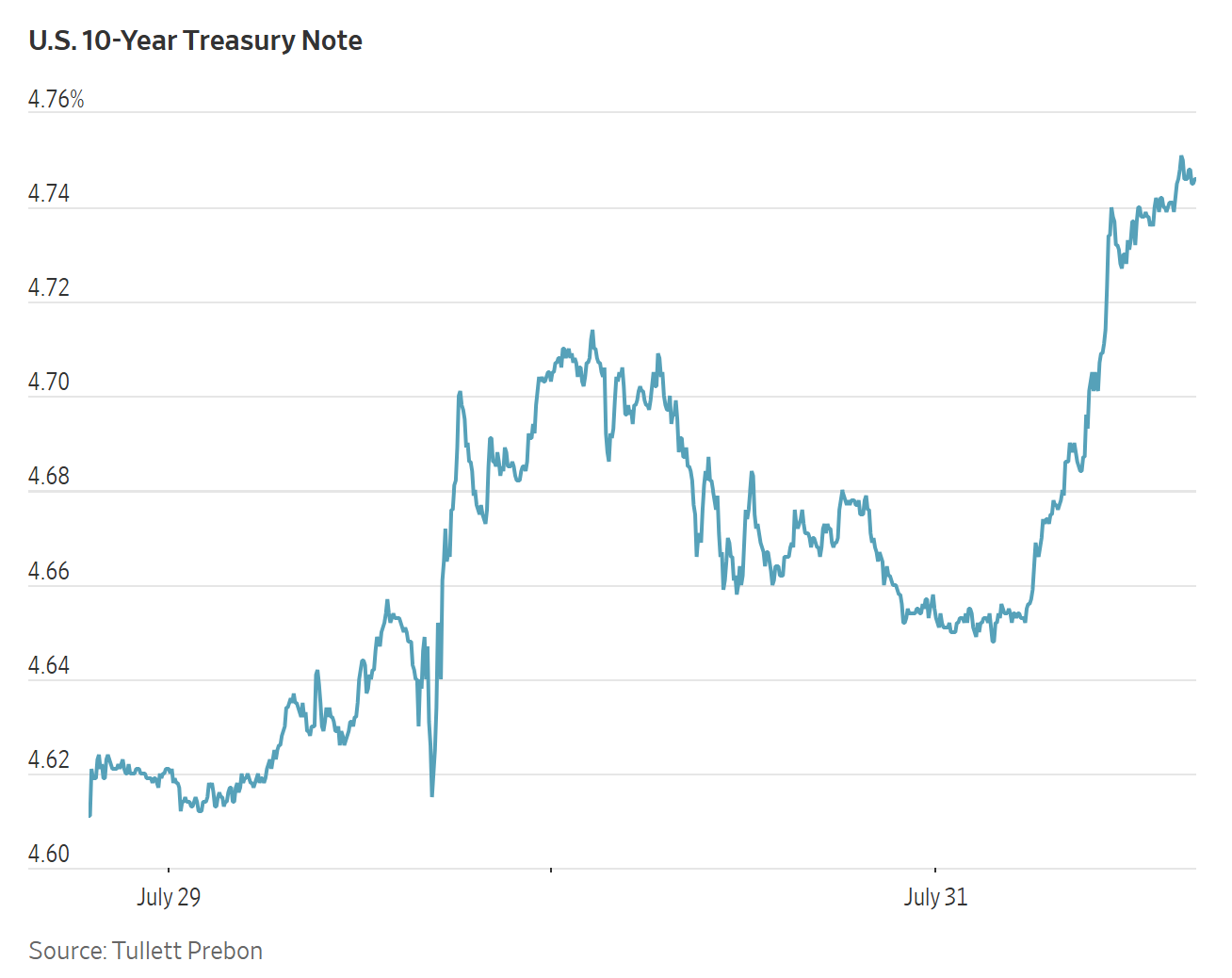
The yield on the US 10-year Treasury note rose +6.3 basis points to 4.740% after touching 4.747% earlier in the session, its highest level since January 2025. The one-day increase was the largest since 15 May. The 10-year was +5.3 bps over the week. For the month, the yield was up +27.0 bps, its largest monthly increase since March.
The yield on the 30-year bond climbed +6.2 bps to 5.280% and recorded its fourth weekly increase in the past five weeks, rising +11.7 bps. Its monthly increase of +31.5 bps was the largest since December 2024.
The two-year US Treasury yield, which typically tracks Fed funds rate expectations, rose +4.3 bps to 4.301%, although it was down -5.1 bps for the week. The two-year yield recorded its fifth consecutive monthly gain, advancing +10.6 bps, its longest streak of increases since the nine-month run that ended in April 2022.
The 2s10s curve steepened by 16.4 bps to 43.9 bps in July. A steeper curve signals market expectations for economic expansion, but also for a potential acceleration in inflation.
Rate expectations for the Fed have shifted sharply. Markets are now pricing in a 64.7% probability of a rate increase of at least 25 bps at the 16 September meeting, according to CME FedWatch, up from 55.3% a week ago but down from 67.8% at the end of June.
Eurozone bond yields also advanced on Friday. Germany’s 10-year bund yield rose +4.7 bps to 3.229%, bringing its weekly move to +2.5 bps. Shorter-dated European yields also increased on the day, with the 2-year Schatz yield up +4.3 bps to 2.831%, although it ended the week slightly lower, down -0.4 bps.
At the long end of the curve, the 30-year German bund yield rose +4.6 bps on Friday, contributing to a weekly increase of +5.5 bps.
In July, the 10-year German bund yield traded +36.5 bps higher, the 2-year Schatz advanced +29.7 bps, and the 30-year yield rose +25.0 bps. The spread between the 10-year US Treasury note and German bund yields narrowed by 9.5 bps to 151.1 bps from 160.6 bps at the end of June.
French 10-year OATs and Italian 10-year BTPs underperformed German bunds. In July, the Italian 10-year yield traded +43.3 bps higher, while the French 10-year yield rose +45.4 bps.
Note: As of 4 pm EDT 31 July 2026
While every effort has been made to verify the accuracy of this information, EXT Ltd. (hereafter known as “EXANTE”) cannot accept any responsibility or liability for reliance by any person on this publication or any of the information, opinions, or conclusions contained in this publication. The findings and views expressed in this publication do not necessarily reflect the views of EXANTE. Any action taken upon the information contained in this publication is strictly at your own risk. EXANTE will not be liable for any loss or damage in connection with this publication.
Tento článek je poskytován pouze pro informační účely a neměl by být považován za nabídku nebo výzvu k nákupu nebo prodeji jakýchkoli investic nebo souvisejících služeb, jejichž odkazy se v něm můžou vyskytovat. Obchodování s finančními nástroji je spojeno se značným rizikem ztráty a nemusí být vhodné pro všechny investory. Dřívější produktivita není spolehlivým ukazatelem budoucí produktivity.




Přihlásit se k odběru přehledů trhu
Přihlásit se k odběru
přehledů
trhu
Předplaťte si nyní Předplaťte si nyní


Založeno profesionály. Pro profesionály.
