

Are talks really happening?


 S&P 500 +1.48% to 7,600.50US 10-year yield -6.13 basis points to 4.690%Spot gold +0.33% to $4,054.44 an ounceDXY +0.26% to 99.97
What to look out for today
Companies reporting on Tuesday, 4 August: Advanced Micro Devices, Amgen, Arista Networks, Ball Corporation, Booking Holdings, BP, Caterpillar, Devon Energy, Duke Energy, Gilead Sciences, Kimberly - Clark, Lucid Group, Marathon Petroleum, McDonald’s, Merck, Pfizer, Pinterest, Prudential Financial, SpaceX, Spotify Technology, Suncor Energy, Upstart Holdings
Key data to move markets today
USA: Factory Orders and JOLTS Job Openings
Global Macro Updates
US Manufacturing expands, but war weighs on sentiment. US manufacturing activity expanded in July at the fastest pace in more than four years amid strong order growth. The Institute for Supply Management said on Monday that its manufacturing PMI increased to 55.6 last month, the highest reading since May 2022, from 53.3 in June. The New Orders Index expanded for the seventh consecutive month, coming in at 56.7, up from June's 56. The July reading of the Production Index, coming in at 58.5, higher than the 52.2 recorded in June and the highest figure since November 2021. The Prices Index remained in expansionary territory, registering 71.1, although a 1.9-percentage point decrease from June's reading of 73. The Backlog of Orders Index registered 55, up 4.5 percentage points compared to 50.5 recorded in June. Strong demand is, however, running into supply constraints. The survey's supplier deliveries index increased to 58.9 from 57.4 in June.
The Employment Index reading of 52.8 was up 3.1 percentage points from June's figure of 49.7, putting the index in expansion territory for the first time since September 2023. However, the Inventories Index was slightly down from June’s 51.4 to 51.2 and the Customers' Inventories Index reading of 40.7 was 1.6 percentage points lower compared to June’s 42.3 reading.
However, the New Export Orders Index returned to expansionary territory with a reading of 53, higher than the 48.5 registered in June. The Imports Index came in at 55.7, higher than June's reading of 52.9.
Susan Spence, MBA, Chair of the Institute for Supply Management Manufacturing Business Survey Committee, also said pricing volatility was mentioned in 57% of negative comments, the Iran war 43%, increasing lead times 22% and tariffs 18%.
The S&P Global Manufacturing PMI fell in July to 51.9, down from 52.5 in June. However, it was the ninth consecutive month of remaining in expansionary territory.
Manufacturing, which accounts for about 9.4% of the economy, has been supported by businesses front-loading orders to avoid higher prices and shortages stemming from the war hit on manufacturing from import tariffs.
The manufacturing sector has also benefitted from still resilient consumer demand, solid levels of business investment and increasing government defence spending.
US Stock Indices
Dow Jones Industrial Average +1.32%
Nasdaq 100 +1.78%
S&P 500 +1.48%, with 8 of the 11 sectors of the S&P 500 up
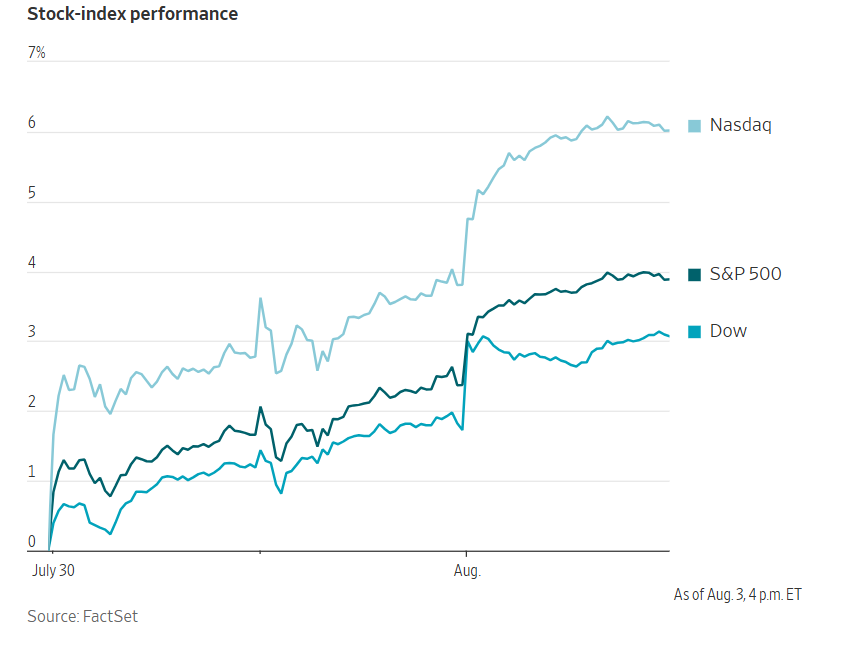
The Dow Industrials closed at a record high on Monday on signs that the war with Iran may be de-escalating. The Dow Jones rose +1.32%, or 693.18 points, to 53,178.41. The Nasdaq Composite was +2.13%, or 540.04 points, to 25,913.90. The S&P 500 was +1.48%, or 110.78 points, to 7,600.50.
Amazon advanced +4.6% and surpassed $3 trillion in market value for the first time, becoming only the fifth company to ever reach the milestone.
In corporate news, UK drugmaker AstraZeneca is in talks to merge with Bristol Myers Squibb in a deal that would create one of the world’s biggest pharmaceutical groups, valued at nearly $400 bn. Bristol Myers Squibb shares edged up +0.2% after a report about the preliminary merger talks.
Palantir Technologies raised its sales and income forecasts for the full year after posting Q2 sales far above Wall Street’s estimates. It signalled strong government and commercial demand for its data analytics software. Shares were up almost +12% in extended trading.
The Federal Aviation Administration signed off on Boeing’s 737 Max 7, ending a drawn-out certification process that was upended by two fatal crashes and quality lapses at the US planemaker.
Corporate Earnings Reports
Posted on Monday, 3 August from The Pulse, our real-time AI-driven news tool. Available exclusively on the EXANTE Web Platform
Marriott International reported Q2 adjusted EPS of $3.19, beating the $3.05 consensus, while revenue of $7.07bn missed the $7.22bn estimate. Adjusted net income came in at $844mn vs $809.1mn expected. Domestic RevPAR rose +5.0% y/y, but international fell -0.5%. The company guided Q3 EPS to $2.74-$2.82 and raised full-year adjusted EPS guidance to $11.64-$11.81, with a capital return target of over $4.5bn. Management noted that strong domestic travel demand offset softer international performance, with the US also seeing the first increase in Canadian arrivals in 15 months.
Tyson Foods reported Q3 adjusted EPS of 99c beating the 97c estimate, but sales of $13.87bn missed the $14.1bn consensus. Beef volume plunged -15.9% y/y, offset by growth in Chicken and Prepared Foods. The company guided for FY adjusted operating income of $2.1bn to $2.3bn and narrowed its capex forecast to $700mn to $900mn, with FY sales growth seen at +2.5% to +3.5%.
ON Semiconductor reported Q2 2026 revenue of $1.60bn vs $1.59bn expected, adjusted EPS of $0.74 vs $0.71 expected. Year-over-year revenue rose +9%, EPS grew +40%. Free cash flow quadrupled to $425.4mn. Q3 guidance: revenue $1.70bn (midpoint) vs $1.67bn consensus, adjusted EPS $0.87 vs $0.84 expected. The company also announced a planned acquisition of Synaptics. CEO Hassane El-Khoury stated that AI data centres remain the fastest-growing business and revenue is expected to more than double in 2026.
Snap reported Q2 revenue of $1.60bn vs $1.54bn expected, with adjusted EBITDA of $250mn vs $192.3mn expected. Daily active users reached 493mn vs 488.38mn expected. EPS was -$0.10 vs -$0.12 expected. For Q3, it guided revenue of $1.70bn-$1.74bn (in-line with $1.70bn estimate) and adjusted EBITDA of $300mn-$350mn (vs $329.9mn estimate). CEO said the company grew revenue by 19% y/y while expanding margins and improving advertising performance. Separately, on 29 July, the US FTC sued Hims & Hers for allegedly sharing user health data with Snap and Meta, citing privacy and subscription practice violations.
Palantir reported Q2 FY26 earnings after the close. Revenue was $1.94bn (vs est $1.81bn), up +92.8% y/y. Adjusted EPS was $0.41 (vs est $0.35). US commercial revenue hit $764mn, up +149% y/y. The company raised full-year guidance: revenue now $8.15bn-$8.16bn (prior $7.65bn-$7.66bn) and adjusted operating profit $4.89bn-$4.90bn. CEO Alex Karp called the quarter "otherworldly" and expressed optimism about the sovereign AI revolution. In other news, Palantir partnered with Mercury Systems under the Pentagon's Tradewind programme to automate defence manufacturing. Baird reiterated an Outperform rating with a $200 price target. Separately, NHS England will revise data on a Palantir platform after staff concerns.
European Stock Indices
CAC 40 +1.22%
DAX +1.45%
FTSE 100 -0.10%
Commodities
Gold spot +0.33% to $4,054.44 an ounce
Silver spot +0.98% to $58.19 an ounce
West Texas Intermediate -5.1% to $80.34 a barrel
Brent crude -7.0% to $83.77 a barrel
Gold prices rose on Monday as oil prices and yields fell. Markets are also watching a range of jobs reports this week to gauge the Fed’s policy path. Spot gold rose +0.33% to $4,054.44 an ounce.
Spot silver prices settled up +0.98% to $58.19 per ounce.
WTI and Brent fell on Monday to a three-week low on hopes of cooling tensions in the Middle East. However, despite President Trump’s claims of talks, Iran's Foreign Ministry spokesman Esmail Baghaei said no negotiations with the United States were taking place and no meetings were scheduled. He said that Iran had no plans to host foreign delegations or send negotiators abroad in the coming days. President Trump called the Iranian leadership “unbelievably duplicitous” by denying talks with the US and claimed Tehran had begged for a meeting. He said talks had taken place and more are scheduled. He wrote on Truth Social that “whether Iran wants to admit it or not, we are, in fact, talking of a solution.” He added Iran would remain under a naval blockade until “a Deal, or Total Surrender, is accomplished”.
Brent futures fell $6.35, or -7.0%, to settle at $83.77 a barrel. It was the lowest close for Brent since 13 July. WTI crude fell $4.33, or -5.1%, to settle at $80.34.
On Monday tracking data showed that 6 Saudi-flagged supertankers have changed course in the Gulf of Aden and are heading to southern Africa following threats by the Iran-backed Houthis in Yemen.
Russia said on Monday it was stepping up protection of ships in the Azov-Black Sea basin while also developing alternative cargo routes following an increase in attacks by sea.
Also on Monday President Trump accused ExxonMobil and Chevron of making "too much money" off higher fuel prices and said the oil giants should ‘give some of that back to the public’. Trump told reports that ‘they better cut the retail price, the consumer price” and that oil prices would "drop through the floor" when the conflict with Iran ends.
According to shipping data, Venezuela's oil exports fell slightly to 1.16 million barrels per day in July from 1.2 million bpd the previous month as the country drained fewer inventories, but exports to the US jumped to some 786,000 bpd, the highest since early 2019.
Note: As of 4 pm EDT 3 August 2026
Currencies
EUR -0.17% to $1.1507
GBP -0.37% to $1.3432
Bitcoin +0.66% to $63,857.13
Ethereum -0.66% to $1,870.18
The US dollar index was up on Monday, rising +0.26% to 99.97.
The euro edged down -0.17% to $1.1507 after hitting a fresh 1-1/2-month high at $1.1559. Sterling fell -0.37% to $1.3432.
The yen strengthened against the dollar and euro on Monday. The yen was up +0.18% at 157.05 per dollar, remaining at its strongest level in about three months following Friday’s intervention by the US Treasury and Japan’s Finance Ministry. As noted by Reuters, Japan may have spent as much as $36.58 billion to buy yen in the latest action aimed at strengthening the currency, central bank data indicated on Monday. That brings the total amount spent on its two FX interventions this year to more than $100 billion. The Federal Reserve Bank of New York sold euros for yen on behalf of the Treasury through two banks.
Analysts also said the US Treasury's reported decision to intervene through the euro was to avoid signalling a desire for broad-based dollar weakness.
The intervention underscores the challenge BoJ policymakers face of rising oil prices and a wide interest-rate differential against other major economies.
Fixed Income
US 10-year Treasury -6.13 basis points to 4.690%
German 10-year Bund -4.6 basis points to 3.17%
UK 10-year Gilt -10 basis points to 4.96%
US Treasuries yields fell on Monday as oil prices fell on hopes for a de-escalation between the US and Iran.
The yield on benchmark US 10-year notes fell -6.13 basis points to 4.690%. It reached 4.747% on Friday, the highest since January 2025. The 30-year bond yield declined -4.76 basis points to 5.2274% after peaking at 5.2811% on Friday, the highest since 2007.
The 2-year yield, which typically moves in step with Fed interest rate expectations, fell -4.2 basis points to 4.262%.
The yield curve between 2- and 10-year notes was 42.2 basis points.
Speaking to Reuters on Monday, New York Fed President John Williams said that inflation pressures are on track to ease gradually, but if they don’t, the Fed will not hesitate to respond with rate hikes to ensure price pressures return to target. “My forecast personally is for inflation to come down in the second half of this year and come down further next year,” Williams said. “I don't anticipate, at least based on what's happening so far in my base case, that we're going to see... continued inflationary push in the second half of the year or the next year from the from the conflict in the Middle East, but that's something that obviously could change depending on circumstances,” Williams said.
According to the CME Fedwatch tool, there is a 64.5% probability of rate increase in September, up from 55.7% a week ago. Fed funds futures now imply a 68% probability of a rate increase in September.
The Treasury Department is set to unveil its borrowing plans for the coming quarters this week, with investors watching closely for any signs of increased issuance of longer-dated debt.
The US government said on Monday that it expects to borrow $739 billion in the July - September quarter, assuming an end-of-September cash balance of $950 billion. The borrowing estimate is $68 billion higher than announced in May 2026, primarily due to lower projected net cash flows, partially offset by the higher-than-assumed beginning-of-quarter cash balance. Excluding the higher-than-assumed beginning-of-quarter cash balance, the current quarter borrowing estimate is $87 billion higher than announced in May. During the October – December 2026 quarter, Treasury expects to borrow $628 billion in privately-held net marketable debt, assuming an end-of-December cash balance of $850 billion.
Auction-size details will be released at 8:30 am EDT on Wednesday.
Eurozone bond yields also fell on Monday. Germany’s 10-year bond yield fell -4.6 bps to 3.15% as lower oil prices eased inflation concerns and reduced expectations of further interest rate hikes.
In the UK bond yields declined, with the 10-year UK yield sliding -10 bps to 4.96%. UK Treasury sources said the government was determined to stick with fiscal rules after UK PM Burnham and Chancellor Healey wrote to ministers telling them they must remain within existing spending limits while funding new pledges.
Note: As of 4 pm EDT 3 August 2026
While every effort has been made to verify the accuracy of this information, EXT Ltd. (hereafter known as “EXANTE”) cannot accept any responsibility or liability for reliance by any person on this publication or any of the information, opinions, or conclusions contained in this publication. The findings and views expressed in this publication do not necessarily reflect the views of EXANTE. Any action taken upon the information contained in this publication is strictly at your own risk. EXANTE will not be liable for any loss or damage in connection with this publication.
Tento článek je poskytován pouze pro informační účely a neměl by být považován za nabídku nebo výzvu k nákupu nebo prodeji jakýchkoli investic nebo souvisejících služeb, jejichž odkazy se v něm můžou vyskytovat. Obchodování s finančními nástroji je spojeno se značným rizikem ztráty a nemusí být vhodné pro všechny investory. Dřívější produktivita není spolehlivým ukazatelem budoucí produktivity.




Přihlásit se k odběru přehledů trhu
Přihlásit se k odběru
přehledů
trhu
Předplaťte si nyní Předplaťte si nyní


Založeno profesionály. Pro profesionály.
