

Still not passing the test


 S&P 500 +0.33% to 7,744.06 US 10-year yield -11.2 basis points to 5.074% Spot gold +1.59% to $4,170.25 an ounce DXY -0.50% to 102.01
What to look out for today
Companies reporting on Friday, 16th October: Citizens Financial Group, M&T Bank, Regions Financial, Travelers Companies, Truist Financial
Key data to move markets today
EU: Eurozone Core Harmonised Index of Consumer Prices, Trade Balance and Italian CPI
USA: Industrial Production and Monthly Budget Statement
GLOBAL: IMF/World Bank autumn meeting
Global Macro Updates
PPI and retail sales ahead of consensus. Producer prices rose more than expected in September, reinforcing concerns about persistent inflation after the stronger core consumer inflation reading released on Wednesday. Headline producer prices increased 1.3% m/o/m, well above the 0.5% consensus estimate and the upwardly revised 0.5% gain in August, initially reported at 0.4%. This was the largest monthly increase since March 2022. It was primarily driven by higher energy prices, including a 20.3% m/o/m rise in gasoline prices.
Core producer prices advanced 0.7% m/o/m, exceeding the 0.3% consensus estimate, while the previous month was revised to no change from a 0.2% increase. Core services posted their largest monthly gain since April, reflecting higher prices for trade services, truck transportation and food and alcohol wholesaling. Together with the firmer core consumer inflation data, the report underscored the persistence of price pressures and their broader transmission across the economy. These developments are likely to shape the Fed rate debate. The Fed will not receive its favourite inflation gauge, the latest PCE report, before its meeting on 28 October.
Retail sales also exceeded expectations in September, rising 0.8% m/o/m against a 0.3% consensus estimate after August growth was revised to 1.3% from 1.2%. Sales excluding autos increased 0.9%, above the 0.5% consensus estimate, following an unrevised 1.4% gain in August. Control group sales, which contribute to GDP, rose 0.15%, below the 0.3% consensus estimate and the revised 1.2% increase recorded in August, previously reported at 1.4%. Gas station sales climbed 6.4%, while furniture sales rose 1.3%, restaurant and bar sales increased 1.1%, health and personal care sales gained 0.7% and electronics and appliance sales advanced 0.6%. Auto sales rose 0.2% and online sales increased 0.3%, although sales excluding gasoline grew only 0.2%. Weakness was concentrated among miscellaneous retailers, where sales fell 3.0%. This was followed by declines of 0.6% in building materials and 0.5% in sporting goods. Overall, the report indicated that consumer spending remained resilient.
US Stock Indices
Dow Jones Industrial Average +1.08%
Nasdaq 100 -0.05%
S&P 500 +0.33%, with 8 of the 11 sectors of the S&P 500 up
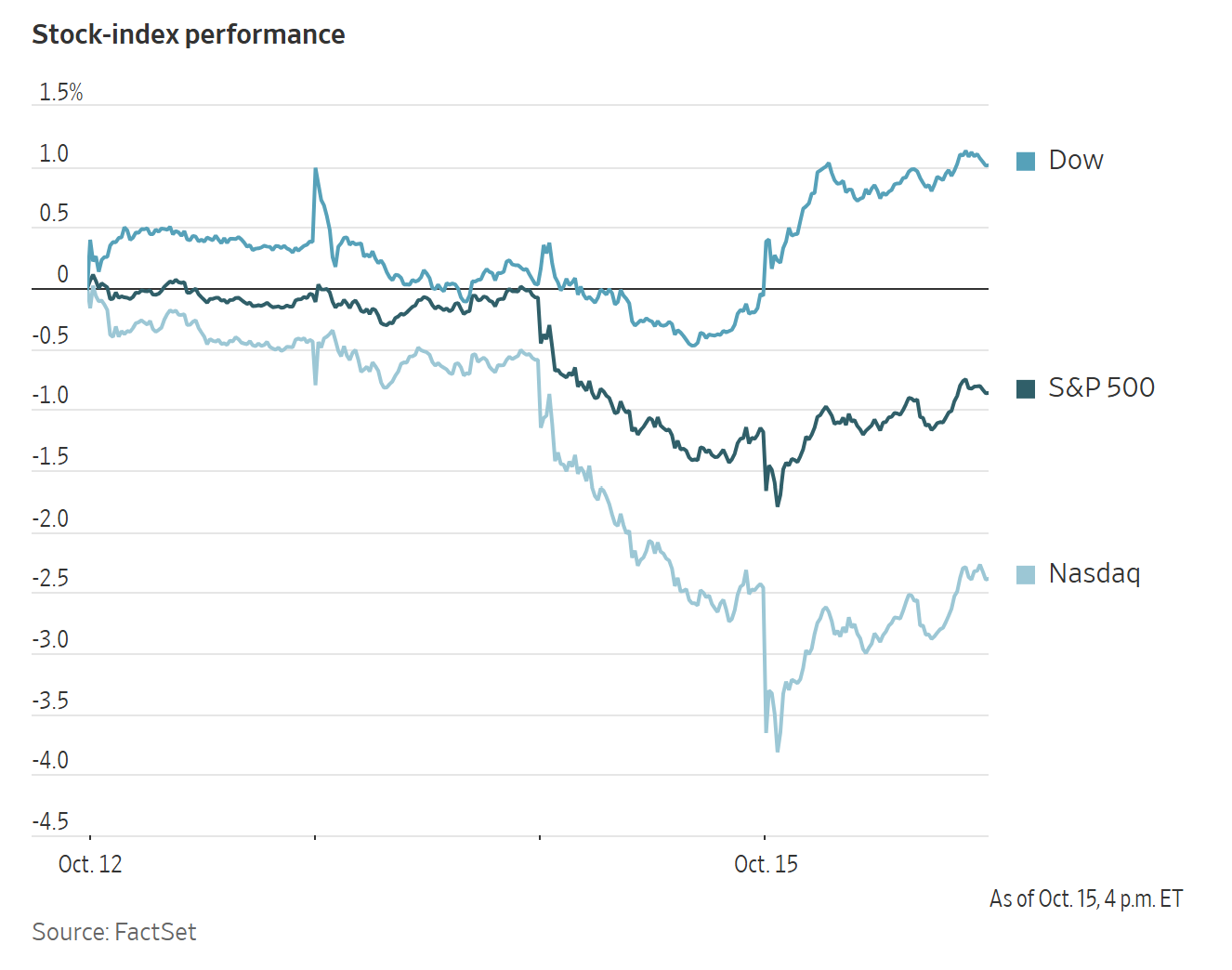
US equity indices rebounded on Thursday after the previous session’s decline. The Dow Jones Industrial Average rose +1.08%, or 556.21 points, while the S&P 500 advanced +0.33% and the Nasdaq Composite edged up +0.08%.
Broader sector participation signalled a market rotation. The equal-weighted S&P 500, which removes market-capitalisation bias, rose +1.36% and outperformed the benchmark by 1.03 percentage points.
In corporate news, Penske Automotive Group agreed to go private in a transaction with its two largest shareholders that values the company at $16.3 billion on an enterprise basis.
Motown Acquisition, jointly owned by Penske Corp. and Mitsui & Co., will acquire the dealership group for $212 per share, an 8.8% premium to its previous closing price. The all-cash deal is expected to close in Q1 2027, after which Penske Corp. will own 64% of the private company and Mitsui the remaining 36%. Financing will include up to $2.2 billion in equity from Penske Corp. and Mitsui, along with as much as $1.8 billion in debt.
Rocket Lab shares fell after the company postponed the launch of its Neutron rocket from this year to next. The company said on Wednesday that a manufacturing issue involving the rocket’s forward dome caused the delay and that a replacement is being produced using a refined process.
Corporate Earnings Reports
Posted on Thursday, 15 October from The Pulse, our real-time AI-driven news tool. Available exclusively on the EXANTE Web Platform
Bank of New York Mellon reported Q3 2026 revenue of $5.68bn vs $5.55bn expected, up +12% y/y, and adjusted EPS of $2.37 vs $2.27 expected, up +24% y/y. Net interest income rose +15% y/y to $1.42bn, whilst fee revenue increased +12% y/y to $4.08bn, bringing assets under custody and administration to $63.4trn and assets under management to $2.2trn. The chief executive officer stated that the bank delivered strong third-quarter results with broad-based growth across platforms and significant operating leverage.
Marsh & McLennan reported its Q3 2026 financial results. Revenue rose +8% y/y to $6.86bn vs $6.64bn expected, driven by underlying revenue growth of up +5% vs +3.9% expected. Adjusted EPS increased +10% y/y to $2.03 vs $1.97 expected, whilst GAAP EPS stood at $1.69. Adjusted operating income grew +6% y/y to $1.5bn with an adjusted operating margin of 22.7%. Noteworthy items totaled $170mn, including $144mn tied to shouldering a Greensill litigation settlement with Credit Suisse, $79mn in restructuring, and $35mn in McGriff integration costs, alongside $500mn in share repurchases. Leadership remarked that the firm delivered a strong third quarter marked by underlying top-line expansion and double-digit earnings growth.
PNC Financial Services Group reported Q3 2026 adjusted EPS of $5.09 vs $4.92 expected and revenue of $6.56bn vs $6.61bn expected, up +11% y/y. Net interest income reached $4.21bn vs $4.25bn expected, rising +15% y/y, whilst average loans rose +14% y/y to $372.2bn. For full-year 2026, the bank projected net interest income up about +15.5% and total revenue up about +13.7%. Separately, the Office of the Comptroller of the Currency noted PNC had debanking policies restricting cryptocurrency and other sectors between 2020 and September 2025. Chief Executive William Demchak stated that the bank delivered strong first-half momentum with an 18.3% return on average tangible common equity, but noted an artificial intelligence spending slowdown could soften lending demand across supporting industries.
Charles Schwab reported Q3 2026 net revenue of $7.17bn vs $7.17bn expected, rising +17% y/y, alongside adjusted EPS of $1.69 vs $1.65 expected, up +29% y/y. Net income rose +23% y/y to $2.91bn, while net interest revenue reached $3.48bn vs $3.52bn expected, up +14% y/y. Core net new assets grew +38% y/y to $190.4bn, expanding total client assets up +15% y/y to $13.33trn. Charles Schwab also repurchased 4.7mn common shares for $0.5bn during the quarter. Operationally, the firm introduced single stock futures on thinkorswim, announced expansion plans for Schwab Crypto, unveiled its Charley AI assistant, and partnered with Anthropic to provide Claude directly to independent financial advisers.
U.S. Bancorp reported its third-quarter financial results. Diluted EPS rose +9.8% y/y to $1.34 vs $1.33 expected, whilst total revenue increased +8.7% y/y to $7.97bn vs $8.01bn expected. Net interest income climbed +5.6% y/y to $4.49bn, non-interest income rose +13.1% y/y to $3.48bn, and capital markets revenue surged +69.3% y/y to $640mn. The bank maintained a Basel III CET1 ratio of 10.8% and announced the launch of its USBDC stablecoin alongside new small-business credit cards. The chief executive commented that strong quarterly results were driven by record net revenue, improved credit metrics, and strong capital markets performance.
Interactive Brokers reported Q3 2026 adjusted revenue of $1.87bn vs $1.89bn expected and adjusted EPS of $0.67 vs $0.68 expected, up +18% y/y. Commission revenue rose +12% y/y to $602mn, while net interest income grew +19% y/y to $1.15bn. Customer equity increased +27% y/y to $964.7bn, and customer accounts rose +35% y/y to 5.58mn. The firm raised its quarterly dividend to $0.15 per share from $0.0875. In addition, the broker launched Ethereum staking for eligible clients in partnership with zerohash, and Deutsche Bank initiated coverage with a Buy rating and a $102 price target. The Chief Executive Officer stated that global technology names remained the most actively traded assets on the platform.
J.B. Hunt Transport Services reported Q3 2026 revenue of $3.68bn vs $3.56bn expected, up +20% y/y, and EPS of $1.82 vs $1.81 expected, up +3% y/y. Operating income rose +2% y/y to $247.09mn. Segment revenue showed Intermodal rose +20% y/y to $1.83bn, Dedicated climbed +11% y/y to $960mn, Integrated Capacity Solutions surged +57% y/y to $434mn, Truckload grew +37% y/y to $261mn, and Final Mile Services fell -3% y/y to $200mn. The company repurchased approximately 704,000 shares for around $174mn during the quarter. The Chief Executive Officer stated that after four challenging years of freight recession and persistent inflationary cost pressures, the focus during the 2027 bid season is on repairing margins to earn appropriate investment returns and support future growth.
European Stock Indices
CAC 40 +0.78%
DAX +0.33%
FTSE 100 +1.08%
Commodities
Gold spot +1.59% to $4,170.25 an ounce
Silver spot +3.24% to $57.44 an ounce
West Texas Intermediate +2.50% to $97.55 a barrel
Brent crude -0.35% to $105.72 a barrel
Gold rose on Thursday, ending a three-session decline as a weaker US dollar and lower US Treasury yields supported demand.
Spot gold advanced +1.59% to $4,170.25 per ounce after falling to a one-week low in the previous session.
The US dollar index declined -0.50%, making bullion more affordable for holders of other currencies.
Spot silver gained +3.24% to $57.44 per ounce.
Oil benchmarks ended Thursday mixed and broadly unchanged as investors assessed several developments, including persistent Houthi-Saudi tensions, the US Department of Energy’s Weekly Petroleum Status Report, the IEA’s decision to accelerate diesel stockpile releases and continuing threats to tankers in the Strait of Hormuz.
Brent crude futures fell by $0.37, or -0.35%, to $105.72 per barrel, while WTI crude futures rose by $2.38, or +2.50%, to $97.55 per barrel.
Houthi attacks against Saudi Arabia continued on Thursday, targeting several cities and triggering emergency alerts throughout the day. Midday reports also indicated that an oil tanker had caught fire in the Gulf of Oman after entering an area that Iran had designated as prohibited.
Ukraine resumed attacks on Russian refineries after Ukrainian drones struck a facility in the Ryazan region. In an interview with the Financial Times published on Thursday, President Volodymyr Zelenskiy said Ukraine had paused strikes on energy infrastructure for three days at the request of the US, but would resume them because Russia continued to target Ukrainian energy assets.
The IEA Governing Board agreed on Thursday to accelerate the release of the remaining volumes under plans already in place, including more than 20 million barrels of diesel to be released as soon as possible.
The US Energy Information Administration’s Weekly Petroleum Status Report showed that crude and distillate inventories fell last week, while gasoline stocks rose, as Hurricane Isaias forced production shutdowns.
US crude inventories fell by 8.6 million barrels to 415.6 million barrels in the week ended 9 October. The hurricane shut in as much as 71.5% of oil production during the week and prompted the evacuation of numerous platforms and rigs.
Crude inventories at the Cushing, Oklahoma, delivery hub increased by 1.9 million barrels during the week. Refinery crude runs rose by 135,000 bpd, while refinery utilization increased 0.80 percentage points to 93.5%, according to the EIA.
Net US crude imports declined by 596,000 bpd last week. US gasoline inventories increased by 3.5 million barrels to 208.3 million barrels during the week. Distillate inventories, including diesel and heating oil, fell by 2.5 million barrels to 102.6 million barrels, EIA data showed.
Diesel inventories declined by 2.15 million barrels to 91.58 million barrels. Amid global shortages of the fuel used in agriculture, residential heating and trucking, stocks stood approximately twelve percent below the five-year average for October.
Note: As of 4 pm EDT 15 October 2026
Currencies
EUR +0.57% to $1.1218
GBP +0.64% to $1.3270
Bitcoin +0.63% to $82,212.83
Ethereum +1.59% to $2,455.77
The US dollar retreated from an 18-month high on Thursday.
The US dollar index fell -0.50% to 102.01 after reaching an 18-month high on Wednesday, when stronger-than-expected US inflation data supported the currency.
The euro rebounded +0.57% from an 18-month low to $1.1218, recording its largest daily gain in nearly two months. Sterling strengthened +0.64% to $1.3270 after data showed that the UK economy unexpectedly expanded 0.1% in August.
The Japanese yen appreciated +0.21% to ¥157.98 per US dollar.
Fixed Income
US 10-year Treasury -11.2 basis points to 5.074%
German 10-year Bund -5.8 basis points to 3.423%
UK 10-year Gilt -4.8 basis points to 5.381%
Longer-dated US Treasury yields declined to their lowest levels since September on Thursday.
Yields briefly pared their declines after stronger-than-expected retail sales and wholesale inflation data before resuming the downward move that began during Asian trading. The 10-year and 30-year yields subsequently reached their lowest levels since 23 September.
Markets priced in a 71.8% probability that the Fed would keep rates unchanged at its 27 – 28 October meeting. They also assigned a 92.8% probability that the Fed funds target range would be at least 25 bps higher in December, according to CME Group's FedWatch Tool.
The yield on the 10-year US Treasury note fell -11.2 bps to 5.074%. The move marked its largest daily decline since early August 2025 and its steepest three-day drop since early September 2025.
The 30-year US Treasury yield declined -11.6 bps to 5.409%. It recorded its largest one-day drop since 10 October 2025 and its steepest five-day decline since early September 2025.
The two-year US Treasury yield, which typically tracks Fed funds rate expectations, fell -6.3 bps to 4.745% after reaching its lowest level since 18 September. The move was its largest one-day decline since 1 October.
The US 2s10s yield curve stood at 32.9 bps, narrowing 4.9 bps from Wednesday.
German government bond yields declined on Thursday as investors moved into safe-haven assets.
Germany’s 10-year Bund yield fell -5.8 bps to 3.423%. At the front end, the two-year Schatz yield, which is more sensitive to policy rate expectations, declined -4.1 bps to 3.110%.
Money markets priced the ECB deposit rate at 3.21% by late 2027, compared with the current 2.50%, and at 2.73% by December.
The yield spread between 10-year French OATs and German Bunds narrowed 3.4 bps to 136.9 bps after the 10-year OAT yield fell -9.2 bps to 4.792%. The spread had reached 158.67 bps in early October, its widest level since November 2011.
The spread between Italian BTPs and German Bunds narrowed 2.4 bps to 105.5 bps after reaching 129.7 bps earlier this month, its widest level since April 2025. Italy’s 10-year BTP yield fell -8.2 bps to 4.478% on Thursday.
Note: As of 4 pm EDT 15 October 2026
While every effort has been made to verify the accuracy of this information, EXT Ltd. (hereafter known as “EXANTE”) cannot accept any responsibility or liability for reliance by any person on this publication or any of the information, opinions, or conclusions contained in this publication. The findings and views expressed in this publication do not necessarily reflect the views of EXANTE. Any action taken upon the information contained in this publication is strictly at your own risk. EXANTE will not be liable for any loss or damage in connection with this publication.
This article is provided to you for informational purposes only and should not be regarded as an offer or solicitation of an offer to buy or sell any investments or related services that may be referenced here. Trading financial instruments involves significant risk of loss and may not be suitable for all investors. Past performance is not a reliable indicator of future performance.
 Back to all insights







Created by professionals. For professionals.
