

Compute is not destiny after all


 S&P 500 -1.95% last week to 7,659.44 US 10-year yield -15.2 basis points last week to 5.085% Spot gold -0.69% last week to $4,165.01 an ounce DXY -0.44% last week to 101.78
What to look out for today
Companies reporting on Monday, 19th October: Fifth Third Bancorp, Steel Dynamics, W.R. Berkley Corp.
Key data to move markets today
EU: A speech by ECB Executive Board member Frank Elderson
CHINA: PBoC Interest Rate Decision
Global Macro Updates
Are we getting ahead of ourselves? The AI trade faces a challenge more concrete than returns on intelligence. Its infrastructure must be financed, powered and delivered before creditors demand repayment. Bankability, not demand alone, is becoming the main constraint. The Financial Times reported that at least 47 large US data centre projects have been delayed, withdrawn or blocked this year. Announced capacity does not equal operating capacity, just as contracted revenue does not amount to cash in the bank.
Physical bottlenecks deepen the financing mismatch. A JPMorgan analysis cited by The Wall Street Journal found that more than 60% of capacity scheduled for completion in 2027 had not entered construction, while another 7% was delayed. Grid connections, equipment backlogs and permitting lengthen the period between expenditure and revenue. As you know, interest payments, inconveniently, do not wait for energisation.
And credit markets are already pricing that delay. Bloomberg’s Credit Weekly reported that yields on CoreWeave junk bonds reached 15%, threatening market access for other speculative grade AI borrowers. And equity markets are reflecting the same reassessment, with CoreWeave shares down 31.50% since 6 October.
Yet, the transmission mechanism does not require an outright default. Higher refinancing costs can force neoclouds to postpone construction and equipment purchases, weakening suppliers’ order conversion and delaying customer access to computing capacity. Shared exposure across banks, private credit providers and bondholders creates another channel. Nvidia’s $6.3 billion commitment to purchase unsold CoreWeave capacity through 2032 shows how commercial support can redistribute risk across the ecosystem without eliminating it.
Memory presents a separate valuation challenge to the second layer of the AI buildout. Sherwood News has highlighted customers considering Chinese suppliers, while Reuters reported that the new CXMT platform promises at least 50% more gross dies per wafer. This development could weaken the durability of scarcity rents, though the effect is unlikely to be uniform. CXMT remains about two generations behind in high bandwidth memory. Competition in commodity Dynamic Random Access Memory(DRAM) should not be mistaken for immediate parity in High Bandwidth Memory (HBM).
Investors should therefore separate funded and powered projects from aspirational pipelines. They should also examine refinancing dates, collateral priority, customer concentration and backlog conversion, while testing supplier earnings against delayed deliveries and softer memory pricing. Strong AI demand can coexist with losses for creditors and dilution for shareholders. OpenAI’s Sam Altman said that ‘Compute is destiny’. Perhaps. But destiny offers neither a grid connection nor a refinancing guarantee. Until then, compute is a claim on future cash flows with interest payable in the present.
US Stock Indices
Dow Jones Industrial Average -0.34%
Nasdaq 100 -2.50%
S&P 500 -1.09%, with 6 of the 11 sectors of the S&P 500 down
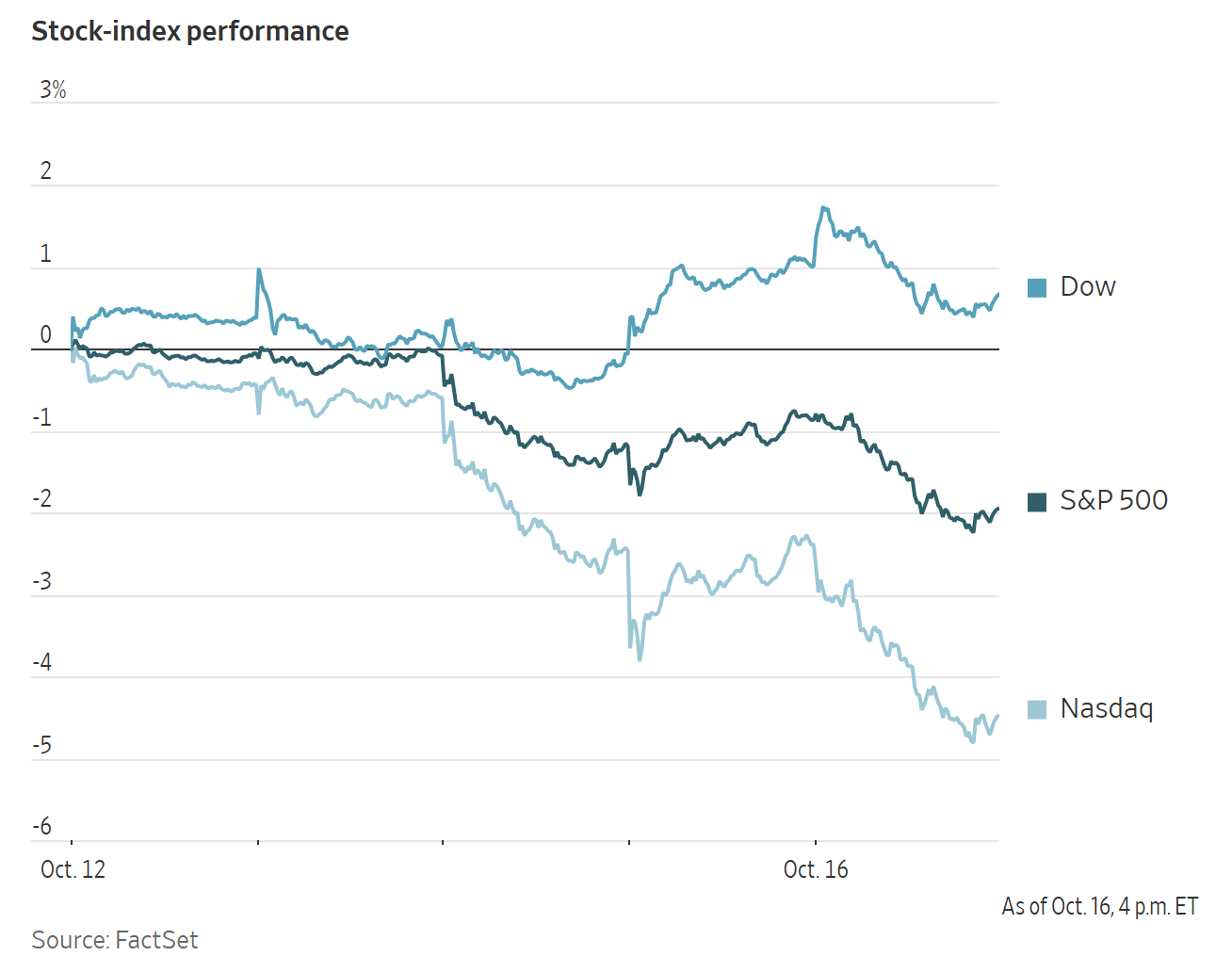
The S&P 500 fell on Friday, closing out its steepest weekly loss since June. The S&P 500 fell -1.09%. Energy led the index’s sectors with a +2.47% gain, while Information Technology lagged with a -2.54% decline.
The Nasdaq Composite dropped -2.14% and the Dow Jones Industrial Average declined -0.34%, or 175.28 points.
The three major indices posted mixed weekly results. The S&P 500 fell -1.95% and the Nasdaq Composite dropped -4.48%, while the Dow Jones gained +0.29%.
The Philadelphia Stock Exchange Semiconductor Index dropped -3.83% to 11,137.29, marking its eighth consecutive decline and longest losing streak since 2006.
In corporate news, Netflix Chief Content Officer Bela Bajaria is leaving amid slowing growth and declining customer engagement. Former 21st Century Fox and Disney executive Peter Rice will succeed her.
Varonis Systems shares rose after the cybersecurity company agreed to be acquired by Thoma Bravo-backed Proofpoint for about $6.3 billion. A Thursday securities filing said Varonis could owe a $211.7 million termination fee under certain circumstances, including ending the transaction to accept a superior offer.
Tesla unveiled its second-generation Roadster at a SpaceX testing facility in Texas on Thursday. Chief Executive Elon Musk has said it will be the last driver-operated vehicle Tesla produces, although the model is not expected to contribute significantly to the company’s overall sales volume.
Corporate Earnings Reports
Posted on Friday, 16 October from The Pulse, our real-time AI-driven news tool. Available exclusively on the EXANTE Web Platform
Travelers reported Q3 2026 revenue of $12.41bn, flat y/y, and adjusted EPS of $9.18 vs $7.27 expected, up +13% y/y. Net written premiums reached $11.48bn vs $11.38bn estimated, supported by Business Insurance premiums rising +3% y/y to $5.87bn and Bond and Specialty increasing +12% y/y to $1.21bn, while Personal Insurance fell -7% y/y to $4.40bn. Catastrophe losses were $538mn vs $695mn expected, despite rising +34% y/y. Core pre-tax income stood at $2.40bn vs $1.87bn estimated. Total capital returned reached $1.77bn, comprising $1.51bn in share buybacks and a dividend of $1.25 per share. Management stated that the firm's high-quality investment portfolio generated after-tax net investment income of $908mn, up +7% y/y.
Truist Financial reported Q3 2026 results before the market open, delivering adjusted EPS of $1.16 vs $1.11 expected, up +12% y/y, and adjusted revenue of $5.3bn vs $5.36bn expected. Taxable equivalent net interest margin reached 3.00% vs 2.98% expected, while total average deposits stood at $410.7bn vs $408.38bn expected. Fee income from wealth management rose +8.8% y/y to $407mn. During the quarter, the bank announced an agreement to sell $7.7bn of LightStream unsecured consumer loans to Carlyle Group Inc, incurred a pre-tax loss of $1.4bn on the sale of available-for-sale securities, and completed $1.2bn in share repurchases. Truist stated that it is simplifying the business and focussing resources and capital on becoming the most important financial partner to clients.
European Stock Indices
CAC 40 +0.28%
DAX +0.95%
FTSE 100 +0.38%
Commodities
Gold spot -0.13% to $4,165.01 an ounce
Silver spot -0.75% to $57.01 an ounce
West Texas Intermediate +4.40% to $101.84 a barrel
Brent crude +3.74% to $109.67 a barrel
Gold prices were broadly stable on Friday, but ended the week lower.
Spot gold fell -0.13% on Friday to $4,165.01 per ounce, bringing its weekly decline to -0.69%.
Gold traded at a premium in India this week for the first time in more than three months, as lower prices stimulated jewelry purchases.
Spot silver declined -0.75% on Friday to $57.01 per ounce, extending its weekly loss to -6.25%.
Brent reached $110 per barrel on Friday for the first time since May, as escalating tensions in the Middle East raised concerns about further supply constraints. Investors also assessed the volume of diesel that Russia could provide to the global market.
Brent crude futures settled $3.95, or +3.74%, higher at $109.67 per barrel, their highest level since 19 May. US WTI crude futures closed $4.29, or +4.40%, higher at $101.84 per barrel, their highest level since 17 September.
Over the week, Brent gained +5.04%, while WTI advanced +10.17%.
A Saudi-led coalition said it had intercepted and destroyed a ballistic missile launched toward the Red Sea city of Yanbu. The port is central to Saudi Arabia’s efforts to bypass the Strait of Hormuz and maintain oil flows to international markets. Initial reports indicated that Yanbu’s infrastructure sustained no damage, although the attacks have significantly disrupted domestic air travel.
Supply concerns intensified as attacks around the Strait of Hormuz increased over the past 10 days. Iran said it was escalating strikes in response to the US blockade of its ports and the tougher sanctions introduced last month.
Ukraine struck a Russian oil refinery on Thursday after President Volodymyr Zelenskiy announced that Kyiv was abandoning a US-brokered ceasefire covering energy sites.
Russia’s Ryazan oil refinery suspended operations at a primary crude distillation unit following a drone attack in the region on Thursday, according to two industry sources cited by Reuters.
Most market participants do not expect the potential lifting of US sanctions on the shadow tanker fleet, reported last week, to materially ease record tanker day rates. The market also remains skeptical that the US-Russia diesel agreement will have a meaningful impact.
To bolster supply, the International Energy Agency agreed on Thursday to release more than 20 million barrels of fuel into the market.
The US Department of Energy also issued a request for proposals on Friday for an exchange of up to 17 million barrels of crude oil from the Strategic Petroleum Reserve.
Washington had previously agreed to lend 172 million barrels of oil from the Strategic Petroleum Reserve as part of a broader arrangement with approximately 30 International Energy Agency member countries to release 400 million barrels from global reserves.
Note: As of 4 pm EDT 16 October 2026
Currencies
EUR +0.19% to $1.1218
GBP +0.44% to $1.3270
Bitcoin -0.75% to $81,592.71
Ethereum -1.71% to $2,413.75
The dollar weakened on Friday and posted its first weekly decline in more than a month against both the euro and the yen, as expectations for additional near-term Fed tightening faded.
The dollar index fell -0.22% to 101.78 on Friday, bringing its weekly decline to -0.44%.
Sterling posted a third consecutive weekly gain against the euro, as the single currency remained under pressure following the French bond selloff at the beginning of the month. Investors continued to monitor UK economic data and the fiscal outlook closely.
The pound reached its highest level against the dollar in more than three weeks on Friday and ended a four-week losing streak. Sterling rose +0.44% on the day to $1.3328 and gained +0.72% over the week.
The euro rose +0.19% to $1.1239 after gaining +0.57% on Thursday, which was its strongest daily advance in two months. The currency ended the week +0.34% higher.
The dollar edged +0.01% higher against the yen to ¥157.99, while the Japanese currency appreciated +0.20% over the week after four consecutive weekly declines. BoJ Governor Kazuo Ueda reiterated on Friday the risk that underlying inflation could exceed the central bank’s target.
Fixed Income
US 10-year Treasury +1.1 basis points to 5.085%
German 10-year Bund +1.7 basis points to 3.440%
UK 10-year Gilt +0.1 basis points to 5.382%
Friday’s volatile session culminated in the largest weekly decline in the 10-year US Treasury yield in more than a year.
During a volatile week, the 10-year yield traded between a high of 5.329% on Wednesday and a low of 5.037% on Thursday. It rose +1.1 bps on Friday, but fell -15.2 bps over the week. It was its largest weekly decline since the week ended 1 August 2025.
On the data front, US export prices rose 2.2% in September, exceeding the 1.0% consensus estimate and August’s upwardly revised 1.2% increase from 0.6%. US import prices also rose more than expected in September, driven by higher costs for energy products and a broad range of other goods, providing further evidence that the Middle East conflict was intensifying inflationary pressures.
Industrial output increased 0.7% in September, above economists’ expectations for a 0.4% rise.
Speaking at the International Monetary Fund summit in Bangkok on Friday, Fed Chair Kevin Warsh said he would not prejudge his position ahead of the Fed’s next policy vote. However, he added that economic conditions remained broadly consistent with policymakers’ expectations when they raised borrowing costs in September for the first time in three years.
“We came to a judgment — what are we seeing in the global economy as it affects the US?” Warsh said. “I’m going to say, broadly, over the month or so that’s transpired since then, the world has broadly conformed with our expectations.”
Nevertheless, traders strengthened their expectations on Friday that the Federal Open Market Committee would keep rates unchanged at its 27 – 28 October meeting. Markets priced an 84.5% probability of a pause, up from 82.3% the previous week, and a 91.8% probability that the December target rate would remain above the current 375–400 bps range, according to the CME FedWatch Tool.
At the long end, the 30-year US Treasury yield rose +1.6 bps to 5.425% after reaching 5.464% earlier in the session. Over the week, the yield declined -17.7 bps.
The 2-year US Treasury yield, which typically tracks expectations for the Fed funds rate, fell -3.0 bps to 4.715% after reaching 4.783% earlier in the session. Over the week, the yield declined -8.2 bps.
The US yield bull flattened last week, as short-term yields declined at a slower pace than long-term yields. Throughout the week US 2s10s yield curve contracted by 7.0 bps from 44.0 bps to 37.0 bps.
This week, the US Treasury will reopen a $13 billion 20-year bond on Wednesday, 21 October, and auction $26 billion of 5-year Treasury Inflation-Protected Securities on Thursday, 22 October.
Eurozone government bond yields were broadly stable on Friday and ended the week lower, supported by the recent safe-haven rally in sovereign debt.
Global bonds recorded their strongest weekly performance in four months, with 10-year yields in the US, UK, Germany, Italy and France declining by an average of -8.7 bps to 4.277%.
The 10-year German Bund yield, a key safe-haven benchmark for European investors, ended Friday at 3.440%. It rose +1.7 bps on the day, but fell -5.1 bps over the week. The 2-year Schatz yield declined -1.8 bps on Friday to 3.092%. It declined -2.4 bps over the week.
Government debt traditionally acts as a shock absorber during periods of stress in riskier assets. However, it has largely failed to perform that role this year, as surging energy and food prices stemming from the Middle East conflict have led investors to price in higher borrowing costs and yields.
Persistent investor concerns about the long-term fiscal position of developed-market governments have been a major source of pressure on bonds.
The 10-year French OAT yield, which has come under significant pressure amid entrenched concerns about France’s ability to address its fiscal challenges, fell -0.7 bps on Friday to 4.786%. It declined -8.1 bps over the week, its largest weekly drop since early August.
The spread between 10-year French OAT and German Bund yields stood at 134.6 bps on Friday, narrowing by 3.0 bps over the week.
Money markets indicated that traders did not expect the ECB to raise rates at its meeting this month. However, the implied probability of a December increase rose to 100% from just below that level earlier in the day, while at least one additional +25 bps increase was fully priced by next April.
Italy’s 10-year BTP yield fell -0.7 bps on Friday to 4.471%, bringing its weekly decline to -11.2 bps.
The UK 10-year gilt yield edged +0.1 bps higher on Friday to 5.382%. but declined -6.2 bps over the week.
Note: As of 4 pm EDT 16 October 2026
While every effort has been made to verify the accuracy of this information, EXT Ltd. (hereafter known as “EXANTE”) cannot accept any responsibility or liability for reliance by any person on this publication or any of the information, opinions, or conclusions contained in this publication. The findings and views expressed in this publication do not necessarily reflect the views of EXANTE. Any action taken upon the information contained in this publication is strictly at your own risk. EXANTE will not be liable for any loss or damage in connection with this publication.
This article is provided to you for informational purposes only and should not be regarded as an offer or solicitation of an offer to buy or sell any investments or related services that may be referenced here. Trading financial instruments involves significant risk of loss and may not be suitable for all investors. Past performance is not a reliable indicator of future performance.
 Back to all insights







Created by professionals. For professionals.
