

Is 25 basis points a diagnosis?

 S&P 500 -0.45% to 7,585.73 US 10-year yield +1.8 basis points to 5.006% Spot gold -0.12% to $4,292.69 an ounce DXY +0.16% at 99.63
Key data to move markets today
EU: Italian CPI, Eurozone Industrial Production and speeches by ECB’s President Christine Lagarde, Vice President Boris Vujčić and Executive Board member Frank Elderson
UK: CPI, Core CPI, PPI, Core PPI and Retail Price Index
USA: Fed Interest Rate Decision, Monetary Policy Statement, Interest Rate Projections, FOMC Economic Projections, FOMC Press Conference and Retail Sales
Global Macro Updates
FOMC preview. Today’s FOMC meeting has acquired the awkward quality of a decision that can be both surprising and fully discounted. Following August’s firmer-than-expected core CPI reading, markets now treat a 25 bps increase as close to inevitable, lifting the Fed funds target range to 3.75% – 4.00%. The interesting decision therefore sits in the dots and Fed Chair Kevin Warsh’s press conference. If they imply that the FOMC is beginning a cycle rather than purchasing credibility with one symbolic hike, markets will likely price not merely a higher policy rate, but a different reaction function.
That distinction matters most at the front end. Two-year yields have risen by 29.9 bps since 4 September, while the 2s10s spread has compressed to 33.5 bps from 41.7 bps, as investors shifted from worrying that the Fed was behind the curve to worrying that it might catch up rather enthusiastically. A genuine tightening signal should extend the bear-flattening impulse as the expected terminal rate moves higher. The Fed has, after all, rarely stopped after one increase.
The longer end is less obedient. Ten-year yields have already crossed five percent, reflecting prospective Fed tightening, firmer inflation, resilient nominal growth and greater compensation for duration risk. Additionally, half-hearted guidance could produce the more awkward combination of higher real yields, higher inflation compensation and renewed curve steepening. The bond market would then be signalling that the Fed is tightening, just not quickly enough.
For currencies, the first-order response should favour the dollar, especially against currencies backed by less hawkish central banks or economies more exposed to expensive energy. The greenback has already followed Treasury yields higher, while its rolling correlation with the 10-year yield recently reached a two-month high. But developed-market yields have risen together, making relative policy divergence more decisive. If curve flattening increasingly reflects fears of US demand destruction, dollar strength could mutate from a carry story into a haven story. Still bullish, but for less flattering reasons.
US equities face the same semantic problem. One hike is a valuation nuisance, whereas a cycle is an earnings and multiple compression event. Higher discount rates should initially pressure long-duration tech, expensive quality and leveraged small caps. Banks benefit only if curve flattening does not spoil the margin story. Yet the profits backdrop is unusually upbeat. FactSet expects S&P 500 earnings growth of 28.7% in Q3 and 26.3% in Q4, putting full-year 2026 growth at 31.6%, before moderating to a still-healthy 15.1% in 2027. Those expectations should limit the depth of any de-rating.
The benign outcome is a credible, shallow cycle that lowers inflation compensation without breaking activity. The malign one is that Fed Chair Warsh validates further hikes while markets continue marking inflation expectations upward. Then the curve will debate recession against lost credibility, the dollar will rise for increasingly defensive reasons and equities may discover that excellent earnings are not the same thing as an unlimited price.
US Stock Indices
Dow Jones Industrial Average -0.63%
Nasdaq 100 -0.65%
S&P 500 -0.45%, with 9 of the 11 sectors of the S&P 500 down
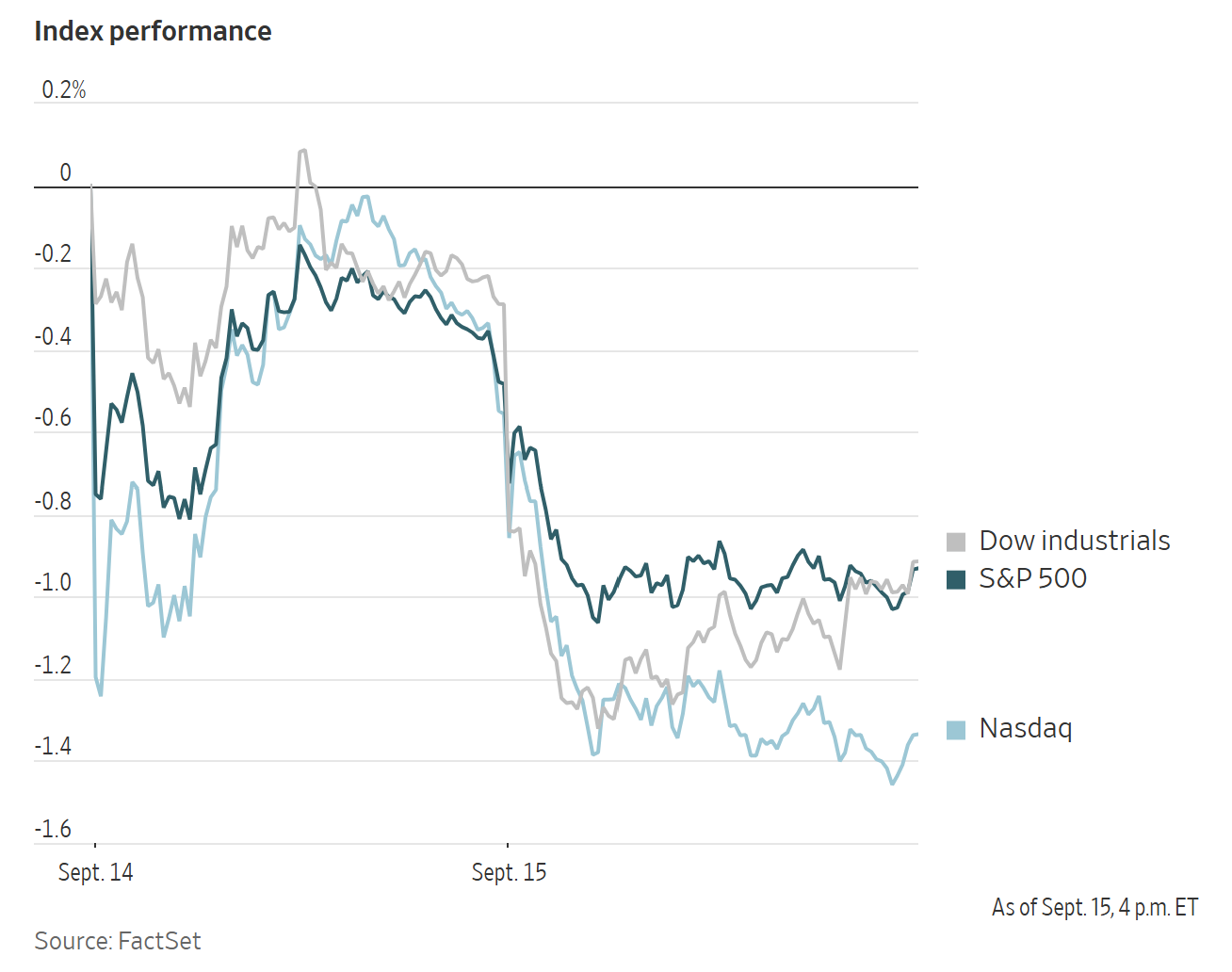
The 10-year Treasury yield closed above five percent, while equities fell for a sixth time in seven sessions. The Nasdaq led declines, down -0.78%, followed by the Dow at -0.63%, or 328.09 points, and the S&P 500 at -0.45%.
In corporate news, Semafor reported that Chipotle appointed a former KFC executive to its board as it seeks to deter potential activist investors.
Reuters reported that Waystar is exploring strategic alternatives, including a potential sale that could take the company private two years after its New York listing. The Lehi, Utah- and Louisville, Kentucky-based company has hired Evercore to advise on the process.
European Stock Indices
CAC 40 -0.34%
DAX -0.15%
FTSE 100 -0.37%
Commodities
Gold spot -0.12% to $4,292.69 an ounce
Silver spot +0.66% to $63.65 an ounce
West Texas Intermediate +3.52% to $105.48 a barrel
Brent crude +2.18% to $108.50 a barrel
Gold prices declined on Tuesday, weighed down by a firmer US dollar and elevated US Treasury yields.
Spot gold was -0.12% at $4,292.69 per ounce, after touching its lowest level since 7 August on Monday.
Spot silver rose +0.66% to $63.65 per ounce.
Oil prices were higher on Tuesday on concerns that disruptions along a critical oil-export route could persist for weeks.
Brent settled up $2.32, or +2.18%, at $108.50 per barrel. WTI closed up $3.59, or +3.52%, at $105.48 per barrel on concerns that Saudi Arabia’s supply disruptions were broadening, prompting investors to seek US crude as an alternative source of supply. Both contracts finished at their highest levels since 19 May.
The conflict has forced Saudi Arabia to reroute crude westward through the roughly 1,200-kilometer East - West Pipeline, which carries oil from the east to Yanbu on the west coast and allows exports to depart through the Red Sea without tankers transiting the strait.
However, attacks on the East - West Pipeline by Yemen’s Iran-aligned Houthis on Friday forced Saudi Arabia, the world’s largest crude exporter, to shut the key export route.
Supply concerns intensified after Houthi forces launched additional attacks on Saudi Arabia on Monday, while Gulf Arab states postponed planned discussions with Iran.
On Tuesday, shipping industry sources told Reuters that oil loadings at Saudi Arabia’s Red Sea export terminal in Yanbu had been suspended. The report followed earlier indications that Riyadh had informed European customers that some late-September crude cargoes would be cancelled.
Commodity vessel traffic through the Strait of Hormuz fell to four vessels on Monday, down from 10 a day earlier, preliminary Kpler data showed on Tuesday.
Traders have been buying WTI futures on expectations that disruptions to Saudi exports will last longer than initially anticipated. Since US refiners can switch relatively easily between crude grades, demand for sweet crude such as WTI could rise, providing additional support to prices.
In Libya, in a separate development from the Iran conflict, the National Oil Corporation said operations at three oil fields were suspended after protesting members of the Petroleum Facilities Guard shut a valve on the Hamada-Zawiya crude export pipeline.
The Petroleum Facilities Guard warned that the shutdown could be expanded if its demands are not met. The National Oil Corporation said it may declare force majeure if the valve remains closed or if additional fields are forced to halt production.
Continued attacks on energy infrastructure in Russia and Ukraine pushed US diesel futures and diesel cracks to record closing levels. Half of Russia’s six largest diesel-producing refineries were forced to sharply reduce or fully halt output in September because of damage sustained in drone attacks, according to Reuters calculations based on data from fuel-market participants.
Note: As of 4 pm EDT 15 September 2026
Currencies
EUR -0.07% to $1.1539
GBP -0.21% to $1.3496
Bitcoin -4.22% to $75,434.32
Ethereum -6.11% to $2,390.88
The dollar traded near multi-week highs against several major peers on Tuesday ahead of the Fed rate decision.
At $1.1539, the euro remained close to Monday’s one-month low of $1.1523 and traded -0.07% on the day.
The British pound remained near its lowest level in more than a month against a broadly stronger dollar on Tuesday, pressured by elevated crude oil prices ahead of this week’s interest-rate decisions from the BoE and the Fed.
Sterling fell -0.21% to $1.3496, hovering near its lowest level since 7 August.
The BoE is expected to keep rates on hold on Thursday, although traders are fully pricing in one 25 bps rate hike and see a high probability of another increase by year-end.
The Telegraph reported that the BoE is poised to announce this week that it will stop selling long-dated government bonds, which have been pressured by a global debt-market selloff, potentially freeing up liquidity for Chancellor of the Exchequer John Healey.
The dollar advanced +0.45% against the yen to ¥155.03 per dollar.
Traders see an 80% probability that the BoJ will raise rates on Friday and have priced in two 25 bps hikes by the end of January. However, some skepticism remains over whether the central bank can ultimately deliver the pace of tightening currently reflected in market pricing.
Fixed Income
US 10-year Treasury +1.8 basis points to 5.006%
German 10-year Bund +1.2 basis points to 3.545%
UK 10-year Gilt +0.7 basis points to 5.326%
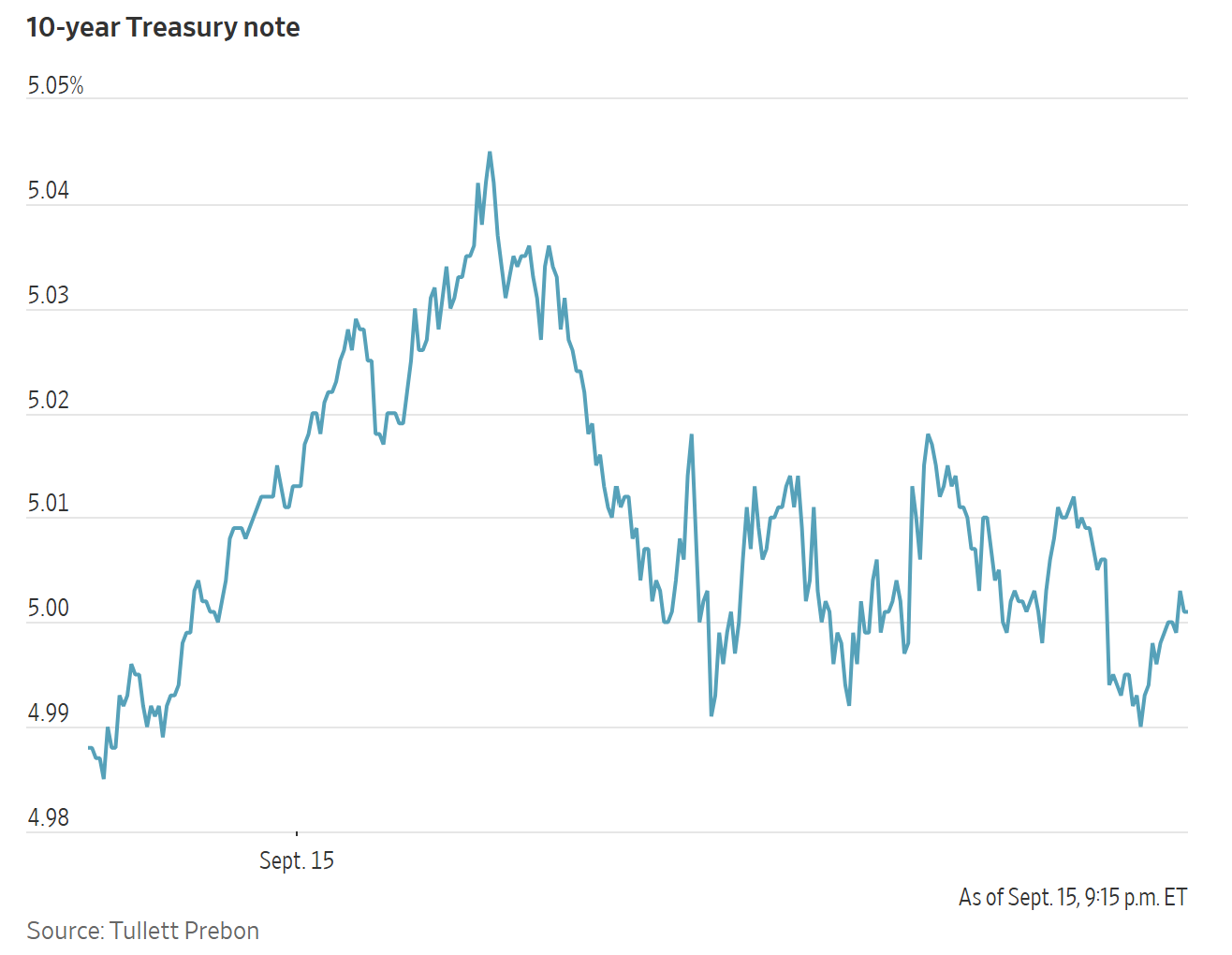
Government borrowing costs reached their highest levels since the 2008 financial crisis on Tuesday, with 10-year US Treasury yields settling above five percent, underscoring the tension between rapidly expanding global debt burdens and still-resilient economic growth.
Investors are also contending with new Fed Chair Kevin Warsh’s aversion to forward guidance, which has increased policy uncertainty, lifted volatility and reduced market willingness to give policymakers the benefit of the doubt.
The US yield curve bull steepened on Tuesday, as short-term yields declined while long-term yields rose. The US 2s10s curve steepened by 2.2 bps to 33.5 bps.
The 10-year Treasury yield reached an intraday high of 5.041%, the highest since 2007, before easing to 5.006%, up +1.8 bps on the day.
Fed funds futures traders are now pricing a 92.4% probability of a rate hike at the conclusion of the Fed’s two-day meeting today, according to CME FedWatch, up from 40.6% one week earlier. Markets are also pricing in a total of 52.1 bps of tightening by year-end, implying one additional rate increase before the end of the year.
The 2-year note yield, which typically tracks Fed funds rate expectations, traded -0.4 bps lower at 4.671%.
Demand for longer-dated debt was tested on Tuesday as the Treasury sold $13 billion in 20-year bonds. The high yield was 5.420%, up from 5.204% in August 2026 and the highest yield for the 20-year tenor since its reintroduction in 2020, comparable with levels last seen before its 1986 discontinuation.
The bid-to-cover ratio was 2.57x, indicating softer demand than the recent six-month average of 2.65x. Indirect bidders, a proxy for foreign demand, took 52.5%, below recent averages of roughly 62.9% to 68.0%.
The US Treasury will also auction $19 billion in 10-year Treasury Inflation-Protected Securities on Thursday.
Eurozone borrowing costs rose to their highest levels in 17 years on Tuesday, as a weeks-long selloff gained fresh momentum after conflict in the Middle East pushed oil prices higher.
Germany’s 10-year bond yield rose by as much as 3.9 bps to 3.572% on Tuesday, its highest level since 2011, before retreating to stand +1.2 bps higher at 3.545%. Germany’s 2-year Schatz yield, which reflects expectations for the ECB rate outlook, was +0.2 bps at 3.273%, after rising to 3.310% on Monday, its highest level in three years.
Longer-dated bonds, which reflect expectations for inflation, growth and public debt, sold off most sharply. Germany’s 30-year yield touched a 15-year peak above 3.900% before settling +3.4 bps higher on the day at 3.895%.
The EU sold €5 billion of new 30-year bonds through a syndicate of banks on Tuesday at a yield of 4.541%, the highest yield paid on any EU bond since the bloc began large-scale borrowing to support economies during the COVID-19 pandemic, according to European Commission data. The yield was up from 4.214% paid during a May tap of a 30-year bond.
The spread between French and German 10-year yields widened to its highest level since 2012 at 96.0 bps, after 10-year OAT yields rose +0.5 bps on the day to 4.505%.
Italy’s 10-year BTP yield edged +0.3 bps higher to 4.417%.
Note: As of 4 pm EDT 15 September 2026
While every effort has been made to verify the accuracy of this information, EXT Ltd. (hereafter known as “EXANTE”) cannot accept any responsibility or liability for reliance by any person on this publication or any of the information, opinions, or conclusions contained in this publication. The findings and views expressed in this publication do not necessarily reflect the views of EXANTE. Any action taken upon the information contained in this publication is strictly at your own risk. EXANTE will not be liable for any loss or damage in connection with this publication.
This article is provided to you for informational purposes only and should not be regarded as an offer or solicitation of an offer to buy or sell any investments or related services that may be referenced here. Trading financial instruments involves significant risk of loss and may not be suitable for all investors. Past performance is not a reliable indicator of future performance.







Created by professionals. For professionals.
