

Can Japan really re-direct investors?


 S&P 500 +0.42% to 7,575.39 US 10-year yield +1.2 basis points to 4.562% Spot gold -0.4% to $4,103.23 an ounce DXY +0.05% to close at 100.96
Key data to move markets today
EU: A speech by ECB Executive Board member Isabel Schnabel
UK: A speech by BoE Chief Economist Huw Pill and BRC Like-for-Like Retail Sales
US: Speeches by Fed Vice Chair for Supervision Michelle Bowman and Fed Bank Governor Christopher Waller
Global Macro Updates
Japan’s debt load revamp? Finance Minister Satsuki Katayama comments about a potential rebalancing by pension funds toward domestic assets spurred the biggest gain in Japanese government bonds (JGBs) in almost two years and a rally in the yen from near a 40-year low on Friday. This reaction was due to the fact that Japan's direct debt and ballooning interest servicing costs are putting a significant strain on the national budget, requiring a major portion of tax revenue just to pay interest.
During a press conference, Katayama said that encouraging Japanese pension funds and households “to invest more in Japanese financial assets” was a policy measure that the administration wanted to pursue.
However, any change to the investing mandate of Japan's $1.8 trillion Government Pension Investment Fund (GPIF) and other retirement vehicles is likely to be gradual and could take years as the GPIF works on a five-year cycle. As noted by the Financial Times, the GPIF’s portfolio is equally weighted between foreign and domestic bonds and foreign and domestic equities, with each asset class receiving about 25% by value. The fund made a shift from domestic bonds into overseas assets as part of a major reweighting in 2014.
According to Reuters, Japan is one of the largest global players in bond markets, holding a record 561.75 trillion yen ($3.46 trillion) in foreign assets in 2025, the third-largest such holding globally after Germany and China. About $930 billion of that amount lies with GPIF, and any change in its portfolio would likely be mirrored by other Japanese pension and insurance funds.
The possibility of a sustained repatriation of Japanese assets led by pension funds has long been seen as necessary for a full revival of Japan’s capital markets. Japanese borrowing costs have surged to 30-year highs as plans for aggressive government spending further strain the country’s high levels of debt. Following the announcement by Katayama, JGBs gained their most in almost two years. The 10-year yield dropped by 11.5 basis points to 2.76%.
US Stock Indices
Dow Jones Industrial Average +0.29%
Nasdaq 100 +0.33%
S&P 500 +0.42%, with 8 of the 11 sectors of the S&P 500 up
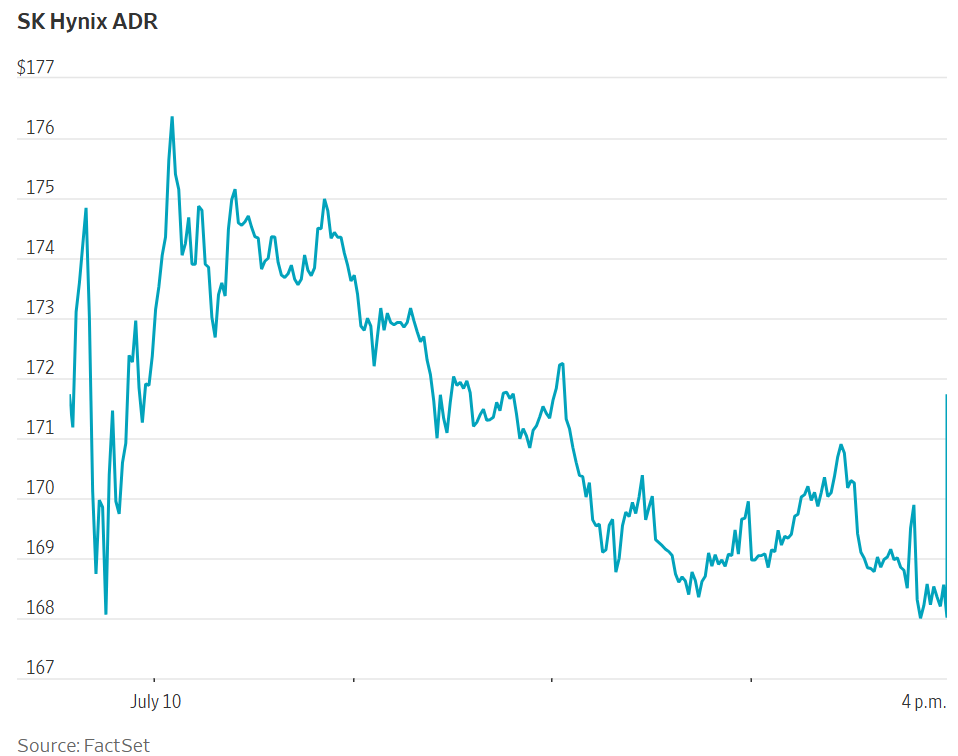
SK Hynix’s historic US trading debut boosted the AI trade on Friday. As noted by The Wall Street Journal, SK Hynix’s ADRs soared 13% Friday after the South Korean chip maker had a $26.5 billion US share sale, the largest by a foreign company in history. The company ended the day with a market value of $1.2 trillion, putting it ahead of US chip makers Micron Technology and Advanced Micro Devices. However, according to Bloomberg news, the S&P 500’s technology sector is sending a split signal. The index sits just short of a record, yet more than half its members trade at least 20% below their own 52-week highs.
On Friday, US stocks gained after President Donald Trump said that Iran had asked to continue talks and the US had agreed, but that the June ceasefire was "over." The Nasdaq Composite gained +0.29%, or 74.72 points, the Dow industrials rose +0.29%, or 149.60 points and the S&P 500 advanced +0.42%, or 31.75 points. For the week, the S&P 500 added +1.2%, the Nasdaq rose +1.7% and the Dow fell -0.5%.
In corporate news, Netflix shares fell after The Wall Street Journal reported that the company is considering steps to counter signs of declining subscriber engagement.
EasyJet shares climbed 14% after it received a fresh bid from private equity firm Apollo that beats a rival proposal from Castlelake. The shares remain below both offer prices.
Delta Air Lines reaffirmed its full-year profit guidance despite the highest fuel costs in its history, citing strong demand for premium, corporate and international travel.
Boeing formally opened its fourth 737 Max assembly line near Seattle as it tries to cash in on its growing backlog.
European Stock Indices
CAC 40 +0.15%
DAX -0.20%
FTSE 100 +0.24%
Commodities
Gold spot -0.40% to $4,103.23 an ounce
Silver spot -0.86% to $59.47 an ounce
West Texas Intermediate -0.93% to $71.41 a barrel
Brent crude -0.38% to $76.01 a barrel
Spot gold fell -0.4% to $4,103.23 per ounce on Friday. It was weighed down by escalating US - Iran tensions, which drove oil prices higher, heightening inflation concerns and increasing expectations that the Fed would maintain a tighter, more hawkish monetary policy path.
Spot silver also fell, down -0.86% to settle at $59.47 per ounce.
Crude benchmarks were down on Friday as traders grew increasingly optimistic that vessel shipping operations would normalise and resume smoothly through the critical Strait of Hormuz.
Brent futures finished at $76.01 a barrel, dropping by 29 cents, or -0.38%. US WTI crude was down - 0.93%, or 67 cents, to $71.41 a barrel.
However, according to the US Central Command, the US military launched strikes on Iran on Sunday to further weaken the country’s ability to attack civilian vessels transiting the Strait of Hormuz. This followed Iranian drone and missile attacks on neighbouring Gulf countries Kuwait and Qatar.
Note: As of 4 pm EDT 10 July 2026
Currencies
EUR -0.1% to $1.1418
GBP 0.00% to $1.3400
Bitcoin +0.9% to $63,833.76
Ethereum +2.5% to $1,790.53
The US dollar edged up slightly on Friday as investors weighed the path of Federal Reserve interest rates. The dollar index was +0.05% to close at 100.96.
The euro was down -0.1% to $1.1418. Sterling ended the day little changed at $1.3400.
The Japanese yen rose +0.4% to settle at ¥161.71 per dollar after it jumped up around 0.6% to a peak of ¥161.285 after Japan's finance minister, Satsuki Katayama, said on Friday the government aims to steer the country's state pension funds to "substantially" increase investments in domestic assets.
Fixed Income
US 10-year Treasury +1.2 basis points to 4.562%
German 10-year Bund -1.4 basis point to 3.070%
UK 10-year Gilt -2.7 basis points to 4.880%
US Treasuries slid on Friday as investors focussed on renewed tensions between the US and Iran which raised fears of higher oil prices and higher inflation.
The 10-year yield rose +1.2 bps to 4.562%, after hitting a seven-week high on Wednesday. US 30-year bond yields were +0.2 bps at 5.061% after also climbing to a seven-week peak on Wednesday. The 2-year yield, which is most sensitive to Fed fund rate expectations, rose +3.4 bps to 4.206%.
Germany’s 10-year yield fell -1.4 basis point to 3.070%, while its 2-year yield, which is sensitive to ECB interest rate expectations, fell -0.7 bps to 2.649%.
Money markets were pricing in around 32 basis points of ECB tightening by year-end on Friday, implying one further quarter-point rate increase and roughly a 30% chance of a second move. That was down from about 37 bps of additional ECB tightening on Thursday.
Note: As of 4 pm EDT 109 July 2026
While every effort has been made to verify the accuracy of this information, EXT Ltd. (hereafter known as “EXANTE”) cannot accept any responsibility or liability for reliance by any person on this publication or any of the information, opinions, or conclusions contained in this publication. The findings and views expressed in this publication do not necessarily reflect the views of EXANTE. Any action taken upon the information contained in this publication is strictly at your own risk. EXANTE will not be liable for any loss or damage in connection with this publication.
Tento článek je poskytován pouze pro informační účely a neměl by být považován za nabídku nebo výzvu k nákupu nebo prodeji jakýchkoli investic nebo souvisejících služeb, jejichž odkazy se v něm můžou vyskytovat. Obchodování s finančními nástroji je spojeno se značným rizikem ztráty a nemusí být vhodné pro všechny investory. Dřívější produktivita není spolehlivým ukazatelem budoucí produktivity.




Přihlásit se k odběru přehledů trhu
Přihlásit se k odběru
přehledů
trhu
Předplaťte si nyní Předplaťte si nyní


Založeno profesionály. Pro profesionály.
