

Earnings Scoreboard - Precision under pressure


Horacio Coutino, Multi-asset Strategist
Investor Lens
The season's arithmetic is holding up, if a little less impressively than the expectations implied.
- According to FactSet, with 9% of the S&P 500 reported, the blended Q3 earnings growth rate stood at 29.0% as of 16 October, slightly below the 29.4% recorded a week earlier, on revenue growth of 12.6%.
- The beat rate remains strong at 84.4%, but the magnitude is modest. Companies have exceeded estimates by an aggregate 2.6%, well below the five-year average of 7.5%.
- Micron Technology and Nvidia are the largest contributors to Q3 earnings growth across the S&P 500. Excluding both companies, the index’s blended growth rate would fall from 29.0% to 20.0%.
- Ten of the eleven S&P 500 sectors are reporting or expected to report y/o/y earnings growth, led by Energy, Information Technology, Communication Services and Materials. Health Care is the only sector expected to record a decline.
- Defence and aerospace enter the week with record backlogs, $289 billion at RTX and $230.4 billion at Lockheed Martin, but the constraint has moved from demand to production. Margin conversion, supply-chain capacity and free cash flow, rather than order intake, will determine the extent to which rearmament translates into earnings.
- Commodity windfalls should be treated as capital-allocation tests. Valero Energy and Newmont should be judged on cash retained after operating and sustaining costs, rather than on stronger realisations alone. Disciplined distributions, debt reduction and investment that remains viable at less favourable prices would make exceptional earnings more valuable than an exceptional quarter alone.
This week brings the busiest stretch yet, with 79 S&P 500 companies scheduled to report, five of them Dow components, and a docket that spans the second-largest advertising platform in the world, the most debated automaker, the defence primes, the commercial aerospace aftermarket, wafer-fabrication equipment, gold, refining and on-site power.
The Week Ahead
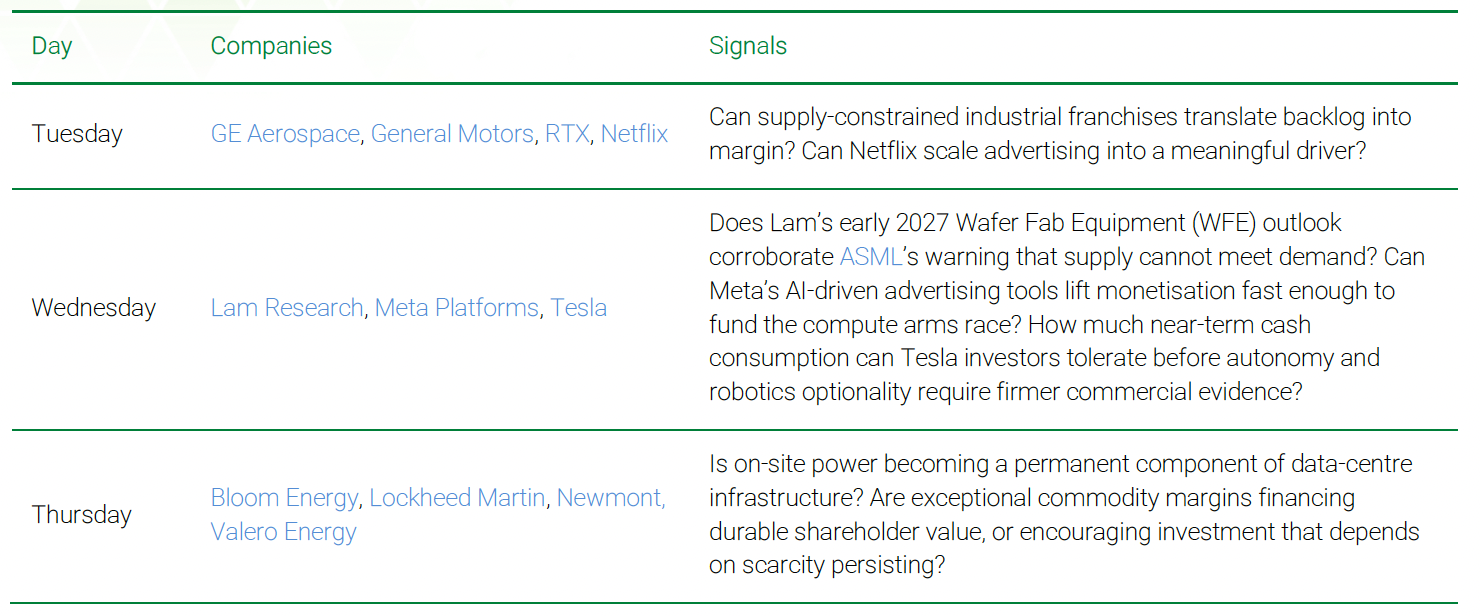
Questions Earnings Will Answer
Can AI growth finance its next investment cycle?
Last week’s semiconductor results established that demand for advanced capacity remains strong; this week tests whether the buyers can finance it on acceptable terms. Meta and Tesla report on Wednesday with consensus projecting combined Q3 Capital Expenditure (CapEx) near $49 billion and Free Cash Flow (FCF) outflows above $13 billion, while Lam Research is expected to grow revenue 52.9% on the equipment those budgets buy.
If Meta frames 2027 spending with discipline and Lam confirms an accelerating equipment cycle, last week’s sell-off reads as a financing scare. If spending rises again and leans further on joint ventures and debt, the market will treat AI CapEx as a credit question rather than a growth story. Tesla poses a sharper version of the question, with capital spending projected at 3.5x the year-ago level while its core automotive margin keeps compressing.
Lam Research and Bloom Energy highlight two constraints: manufacturing complexity and power access. The key distinction is between demand backed by executable contracts and demand contingent on customers securing financing, electricity or permits.
In defence and aerospace, who retains scarcity profits as industrial capacity expands?
Aerospace and defence face the shared challenge of exceptional demand colliding with a production system that cannot expand frictionless. Backlogs have never looked better, at $289 billion for RTX and $230.4 billion for Lockheed Martin, but the binding constraint is now the factory floor. Consensus expects Lockheed’s Missiles and Fire Control revenue to grow 18.7%, and GE Aerospace’s defence revenue 22.2%. However, the latter is projected to lose 155 basis points of margin, a sign that expediting fees, labour and supplier support are absorbing the benefit of volume.
Execution should therefore be assessed through incremental margins, working capital and cash milestones together. Faster engine or missile deliveries can initially absorb cash, while customer advances can improve cash flow before profits arrive. RTX-owned Pratt's costs for mandatory inspections and customer payouts will reduce its aftermarket revenue. The strongest evidence would combine greater output with fewer operational disruptions and cash generation that does not depend disproportionately on advance payments. Backlog is valuable visibility, but it is neither immediate liquidity nor a guaranteed margin expansion.
Major Earnings on the Docket
GE Aerospace
The installed base earns its keep
GE Aerospace reports Tuesday before the open, with the call scheduled at 7:30 am EDT. Consensus centres on revenue of $12.876 billion and EPS of $2.01, increasing 13.9% and 21.0% y/o/y, respectively. The company has beaten EPS expectations in each of the last fifteen reported quarters.
Commercial Engines & Services remains the centre of gravity. The Street has pencilled in $9.120 billion in revenue for the segment, up 11.7% y/o/y, coupled with $2.720 for the segment’s operating income, reflecting an estimate operating margin 27.4%, the same level as a year ago. The aftermarket is the driver because GE Aerospace earns most of its profit not from selling engines, but from servicing them. Investors should watch LEAP time-on-wing improvements, Leading Edge Aviation Propulsion (LEAP) delivery cadence to Airbus and Boeing, General Electric Next-generation (GEnx) engine availability for the 787 ramp and any evidence that elevated fuel prices are causing airlines to defer maintenance.
Defence & Propulsion Technologies supplies the second leg. Consensus anticipates the segment’s Q3 revenue to increase 22.2% y/o/y to $3.454 billion and an operating margin of $418 million, reflecting an operating margin contraction of 155 bps y/o/y to 12.1%. Military engine demand is firm, but output depends on many of the same specialised suppliers as commercial aerospace. Segment revenue without margin expansion would suggest GE is paying higher expedite fees, labour and supplier support to satisfy simultaneous commercial, aftermarket and defence demand.
A beat with stronger LEAP deliveries and higher FCF would show that GE can monetise scarcity without sacrificing customer relationships. A beat driven mainly by pricing, while weak engine deliveries or high supplier costs weigh on margins, would confirm that backlog quality remains strong, but conversion is still the key valuation constraint.
General Motors
Defending the margin, financing the transition
GM also reports Tuesday before the open at 6:30 am EDT and the call at 8:30 am EDT. Consensus looks for $48.783 billion of revenue and $3.69 of EPS, versus $48.591 billion and $2.80 a year earlier. A nearly flat top-line comparison alongside a 31% increase in expected EPS directs investor attention to portfolio mix, incentives, tariff mitigation, restructuring and the pace of EV loss reduction.
GM North America will carry the print. Pickup and large-SUV mix, transaction prices, incentives and dealer inventory will show if US consumers can sustain high monthly payments without steep discounts. The Street anticipates the segment’s revenue to decline 0.2% y/o/y to $40.485 billion with an 8.3% operating margin, implying a 214 bps margin expansion y/o/y.
GM International, dependent on equity income from its China joint ventures, and GM Financial, whose earnings provide a counter-cyclical cushion, complete the picture.
GM's results have become the industry's clearest evidence that domestic manufacturers can hold pricing against tariff costs. This quarter tests the durability of that claim against surging fuel costs. Raised cash-flow guidance, which currently stands at $9.5 to $11.5 billion for the year, resilient North American pricing and an additional reduction in EV losses would make the reset look disciplined.
RTX
Three businesses, two super cycles, one legacy bill
RTX reports Tuesday before the open, followed by an 8:30 am EDT call. Consensus calls for is approximately $24.109 billion in revenue and $1.78 of EPS. RTX had an exceptionally strong Q2: revenue reach $24.708 billion. sales growth was14.5% y/o/y, FCF was $2.878 billion and it had a record backlog of $289 billion, of which roughly $170 billion was commercial and $119 billion defence. Management raised full-year guidance to $95 to $96 billion, EPS to between $7.10 and $7.25 and FCF between $8.5 to $8.75 billion.
RTX comprises three segments, each reflecting a distinct investment theme. Collins Aerospace should remain the clearest driver of Q3 earnings, supported by aftermarket demand, aircraft production and content across avionics, interiors, power and controls. Revenue is projected to rise 7.5% y/o/y to $8.193 billion, while operating income is expected to increase 16.8% to $1.394 billion, implying an operating margin of 17.0%. Collins also serves as an indirect proxy of Boeing and Airbus production.
Pratt & Whitney presents the company’s most complex challenge, combining the Geared Turbofan (GTF) programme, whose powder metal inspections have grounded numerous aircraft and prompted airline compensation, with the F135 engine for the F-35. Progress in reducing aircraft-on-ground counts and the cost of the inspection programme remain the swing factors for the segment's margin. Consensus expects Q3 revenue to rise 6.1% y/o/y to $8.934 billion and Operating Income to increase 2.8% to $772 million, implying an Operating Margin of 8.6%.
Raytheon, anchored by Patriot, the GEM T interceptor and the Standard Missile family, is RTX’s munitions and air defence franchise and the clearest beneficiary of the replenishment cycle. Its principal risk has shifted from demand to production. A record backlog near $289 billion provides visibility, but the cash benefit depends on milestone structure and execution. For Q3, the Street has pencilled in the segment’s revenue growth of 9.3% y/o/y at $7.702 billion and Operating Income of $972 million, up 13.2% y/o/y.
A beat supported by clearer GTF visibility, Collins aftermarket strength and Raytheon capacity production expansion would be supportive to RTX. Conversely, any extension of GTF disruption or working-capital absorption would keep excellent demand from converting into equally excellent FCF.
Netflix
The next growth engine needs an earnings script
Netflix closes Tuesday after the market, with the earnings release at 4:00 pm EDT and the earnings call at 4:45 pm EDT. Consensus calls for $12.869 billion of revenue, EPS of $0.82, Operating Income of $4.257 billion, up 31.1% y/o/y and an expansion of 486 bps in Operating Margin to 33.1%. This is broadly in line with management's Q3 guidance of $12.860 billion in revenue and an operating margin of 33.2%. Full-year guidance is $51.0 to $51.4 billion of revenue and a 31.5% operating margin.
With subscriber counts no longer disclosed, the investment case now depends on revenue generated per member, with investor attention increasingly shifted to advertising. Advertising is expected to become Netflix’s next growth driver as the ad supported tier and in house technology contribute a larger share of revenue.
Live programming, including boxing, wrestling and holiday National Football League (NFL) games, can deepen engagement and attract advertisers. Yet, it also raises content costs and introduces exposes Netflix to rights inflation that could constrain margin expansion, which depends on disciplined content amortization.
Reports of a 5-6% workforce reduction suggest management is defending margin against slower top-line growth. In-line revenue paired with vague ad disclosure would leave Netflix looking like an exceptionally profitable streaming model whose next episode remains mostly promised.
Tesla
The never-ending sci-fi story continues
Tesla reports Wednesday after the close, with the webcast expected at 5:30 pm EDT. Tesla’s Q3 print comes less than a week after the unveiling of its second generation Roadster. Consensus anticipates $27.935 billion of revenue, down 0.6% y/o/y, and EPS of 45 cents, implying a contraction of 10.4% y/o/y. Tesla has already reported Q3 operating data. Deliveries reached 486,532 vehicles, including 478,237 Model 3 and Model Y units, exceeding the company compiled consensus of 461,974 by 5.3% but falling 2.1% short of the prior year record of 497,099. Production totalled 464,391 vehicles, about 22,100 fewer than deliveries, marking a second consecutive quarter in which sales exceeded output. Energy storage deployments reached 13.7 gigawatt hours.
Automotive gross margin excluding regulatory credits is the first number to read. This quarter’s delivery beat raises many questions. A second consecutive inventory drawdown typically suggests that units are being sold through price cuts or incentives. Automotive gross margin excluding credits will reveal the cost of achieving that volume.
For Q3, the Street expects Gross Margin and Operating Margin to contract by 51 bps and 52 bps y/o/y to 5.3% and 17.5%, respectively. More consequential is the prospect of higher CapEx alongside a sharp deterioration in FCF as Tesla invests in AI compute, the Cybercab robotaxi and the Optimus humanoid robot. The Street forecasts a Q3 FCF outflow of $4.285 billion, following an outflow of $1.092 billion in Q2. Q3 CapEx is projected at $7.901 billion, up 36.5% q/o/q and 3.51x the year ago figure of $2.248 billion.
Another quarter in which the automotive segment experiences further margin pressure as autonomy aspirations demand higher investment would force investors to rely increasingly on distant optionality. This at a time when the cost of capital is not especially patient.
Meta Platforms
The advertising engine underwrites the AI ambition
Meta reports Wednesday at 4:00 pm EDT, with the call at 4:30 pm EDT. Management guided Q3 revenue to $61 to $64 billion, including a roughly one percent foreign-exchange headwind. The Street has pencilled in $63.343 billion of revenue, increasing 23.6% y/o/y and EPS of $6.62.
Three issues will shape the market reaction. The first is the 2027 CapEx framework. Any indication that spending will rise materially above the 2026 range would meet a market already wary of AI financing risk. The company’s growing reliance on joint ventures and external capital to fund data centres would attract closer scrutiny.
The second issue is the expense trajectory, as severance related headcount reductions should begin to appear in the cost base. The third is the Family of Apps segment, which remains the primary source of funding for AI investment. The Street expects ad impressions delivered to rise 11.5% y/o/y in Q3, following 14.0% growth in Q2, while average price per ad is projected to increase 11.0% after rising 12.0% in the previous quarter.
Reality Labs losses, hardware roadmaps and evidence of demand for AI glasses will determine whether the non-advertising option set looks credible or simply expensive.
Meta’s balance sheet remains sound, with $125.475 billion of current assets against $84.877 billion of total debt in Q2, but its FCF profile has deteriorated sharply. The Street expects a Q3 FCF outflow of $9.249 billion, compared with positive FCF of $10.625 billion a year earlier and $784 million in Q2. CapEx is the principal driver, with Q3 spending projected to reach $41.017 billion, up 36.2% q/o/q and 117.8% y/o/y.
Lam Research
Memory, logic and the next capacity constraint
Lam Research earnings release is scheduled at 4:05 pm EDT and the call at 5:00 pm EDT. Management guided to revenue of $8.1 billion, plus or minus $400 million, with gross margin of 52.0% and operating margin of 39.5%, each plus or minus one point, and EPS of $2.15, plus or minus 15 cents. The Street has pencilled in Q3 revenue of $8.142 billion, up 52.9% y/o/y and EPS of $2.18, up 73.2% y/o/y. Margin expansion is also part of Lam’s story in Q3. Operating margin is anticipated to expand by 460 bps to 39.6%, while Gross Margin is expected to expand by 128 bps to 51.9%.
Lam is the first WFE maker to report since ASML's warning that its supply would fall short of demand through 2028. The print needs to confirm the strength described by equipment suppliers and customers while reassuring investors that last week’s selloff was about financing sentiment rather than fundamentals.
Lam Research’s leadership in semiconductor etching and deposition positions it to capitalise on the hardware technologies most critical to AI. The company benefits from the rise of high-bandwidth memory (HBM), which relies on vertically stacked Dynamic Random Access Memory (DRAM) dies. Lam is also highly exposed to the industry's shift toward Gate-All-Around (GAA) transistors at advanced logic nodes. Furthermore, as surging storage prices turn routine upgrades into capacity expansions, the company benefits from the growing demand for NAND flash memory. Lam also plays a crucial role in advanced packaging, the intricate technology that physically links AI accelerators directly to memory chips.
Lockheed Martin
The replenishment cycle meets the production constraint
Lockheed reports Thursday before the open with the call at 8:30 am EDT. Consensus expects $20.476 billion of revenue and $7.52 of EPS, increasing 10.5% and 8.2% y/o/y, respectively. Q2 set a record backlog of $230.4 billion on orders of $65 billion during the quarter, including the $35 billion multi-year Terminal High Altitude Area Defence (THAAD) interceptor contract. Management raised its full-year framework after Q2 to sales of $79.75 to $81.75 billion, EPS of $29.95 to $30.65 and FCF of $7.0 to $7.2 billion.
Missiles and Fire Control is where geopolitical demand is creating Lockheed’s growth engine. The segment’s revenue is anticipated to reach $4.302 billion, up 18.7% y/o/y after having grown 19.5% y/o/y in Q2. The segment’s Operating Income is projected to increase 15.5% y/o/y to $589 million. The focus will be the ramp of Patriot Advanced Capability-3 (PAC-3) interceptors, THAAD and the Precision Strike Missile, with the segment's capacity expansion as a key driver.
The F-35 dominates Aeronautics, where the familiar programme issues remain delivery cadence, completion of the Tech Refresh 3 (TR 3) hardware and software upgrade and contracting for production lots. Aeronautics’ Q3 revenue is pencilled in at $8.042 billion, up 10.8% y/o/y, with an Operating Margin of 9.3%, following a slight contraction of 12 bps y/o/y.
The Rotary and Mission Systems segment needs to prove that Sikorsky and its mission systems are not dragging down overall performance. Meanwhile, the Space segment faces a mixed outlook. Management lowered profit expectations for Space in July due to reduced earnings from the United Launch Alliance (ULA) following the Vulcan rocket anomaly. However, the company's strong position in developing Next-Generation Interceptors (NGI) partially offsets these losses.
Lockheed offers the clearest listed exposure to the munitions replenishment cycle, with its interceptor outlook carrying implications across the air-defence supply chain.
Valero Energy
A refining quarter that may be too good to be true
Valero reports Thursday before the open at 6:30 am EDT, with the call at 10:00 am EDT. Consensus calls for $42.728 billion of revenue, up 32.8% y/o/y and EPS of $21.07, 1.73x the record $12.54 EPS reported in Q2.
The print will focus on Refining. Disruption in the Strait of Hormuz has redirected export demand toward US Gulf Coast refineries, while global product inventories remain depleted and diesel cracks have stayed at levels rarely seen outside acute crises.
For Q3, Refining Operating Income is projected to be $7.897 billion, up 4.83x y/o/y and 77.7% q/o/q. Throughput is anticipated to reach 2.917 million barrels per day (bpd), declining 5.5% y/o/y, with a Refining Gross Margin of $37.21 per barrel, following Q2’s $23.62 and against $13.14 a year earlier. Operating Expenses (OpEx) are projected to be $4.73 per barrel, up 0.2% y/o/y, with management guiding Q3 OpEx to $4.75 per barrel.
Regional configuration is important, particularly after the closure of the Benicia refinery. Gulf Coast complexity and access to discounted heavy and sour crude can create a structural advantage when crude differentials widen, while Mid Continent and West Coast operations are more sensitive to logistics and local product scarcity.
Newmont
The gold price is not the whole margin
Newmont reports Thursday after the close at 4:05 pm EDT, with the earnings call at 5:30 pm EDT. Consensus calls for EPS of $1.95, with a range across estimates from $1.75 to $2.19, on revenue of $6.300 billion, up 14.0% y/o/y and 3.0% q/o/q. Q2 EPS of $2.10 exceeded expectations, but revenue of $6.118 billion missed the $6.354 billion consensus.
The margin is the story. The spread between gold, remaining above $4,000 per ounce, and All In Sustaining Costs (AISC) below $1,800, is generating FCF for debt reduction, dividends and buybacks.
The realised gold price will flatter the comparison, so operating data deserve precedence. Spot gold, $4,165 on 16 October, sits below the Q2’s realised price of $4,414, so Q3 realisations may be flat to lower sequentially.
On costs, a higher gold price raises royalty expenses, while labour, consumables, diesel, stripping and sustaining capital can absorb more of the windfall than headline revenue implies. AISC are anticipated to be $1,783 per ounce in Q3, rising 36.8% y/o/y.
The demand backdrop remains supportive, with gold ETFs holdings reaching a record of 4,256 tonnes in September and central bank gold purchases at record levels. For Q3, the Street anticipates total gold production to reach $1.329 million ounces, up sequentially, 2.9% q/o/q, but down 6.5% y/o/y.
Development expenditure and tailings work compete directly with dividends and buybacks. Investors should look for a capital allocation framework that preserves balance sheet flexibility while ensuring adequate investment in mine life and infrastructure. A beat with stable-to-improving production with contained AISC would show genuine operating leverage to gold.
Bloom Energy
Grid delay becomes product-market fit
Bloom Energy reports on Thursday after the close, with the call at 5:00 pm EDT. Management has raised its full-year revenue guidance three times this year, from $3.1 to $3.3 billion in February to $3.4 to $3.8 billion in April and to $3.9 to $4.2 billion in July, alongside a Gross Margin of 34.0%, Operating Income of $800 to $900 million and EPS of $2.55 to $2.85. Consensus calls for Q3 revenue of $1.064 billion, up 104.9% y/o/y and EPS of 69 cents, compared to 15 cents the prior year.
Bloom’s outlook has been transformed by a single constraint: the electrical grid cannot connect new data centres as quickly as they are built. Interconnection queues now stretch for years and Bloom's solid-oxide fuel cells, which generate electricity on site from natural gas and can be deployed in months rather than years, have become one of the few ways to bring AI capacity online on the timelines hyperscalers demand.
The company's partnerships with utilities, infrastructure investors and cloud providers have converted that scarcity into an order book, and the print will be read for bookings, backlog and the pace of new data-centre agreements. Manufacturing capacity is the operational constraint, and progress toward the company's expanded production targets will determine how much of that demand can be converted into revenue. A beat accompanied by positive operating cash flow, diversified customer wins and firm backlog would validate Bloom as an AI-power infrastructure provider.
What changed last week
Strong activity, harder underwriting
Last week’s reports showed that activity remains strong, but its breadth, financing and conversion into durable returns matter more than the headline beat. Across the Big Six banks, equities financing and wealth gathering supplied much of the momentum. Across AI infrastructure, demand continued to outrun available capacity.
For the Big Six, the first takeaway is that the capital-markets recovery has narrowed. Equities trading carried the quarter, and within it the financing and prime-brokerage businesses that lend to hedge funds, a balance-sheet-intensive revenue stream that has proven more dependable than intermediation. Fixed-income trading was flat to lower almost everywhere, and investment-banking backlogs began to fade even as advisory fees reached records at the strongest franchises.
The second takeaway is that net interest income is following the yield curve’s signal. Fixed-rate assets accumulated during the low-rate era continue to reprice, lifting margins and prompting the most rate-sensitive lenders to guide for further growth through 2027. However, higher yields can lift asset income while simultaneously increasing funding costs and weakening borrowers’ capacity to refinance.
The third is that credit risk remains benign, but is no longer invisible. Card charge-offs are running below guidance, yet reserves are being built on wholesale exposures, while commercial real-estate and corporate charge-offs have ticked up. JP Morgan said it was tightening standards because terms, covenants and financing structures had become too loose.
AI’s strongest evidence came from the production frontier. ASML posted record sales of €11.662 billion, guided Q4 revenue to €14.2 to €15.2 billion and said planned capacity for 2027 and 2028 would not meet demand, with customers already discussing orders for 2029 and 2030. Its system sales split almost evenly between logic and memory, evidence that the buildout is pulling compute and memory together rather than sequentially. Installed-base upgrades showed that customers are paying to extract more wafers from tools they already own, because time-to-capacity has become strategically valuable.
TSM confirmed the industry’s signal is demand for increasingly advanced manufacturing. Revenue of $46.720 billion exceeded its guidance, while high-performance computing accounted for 68% of sales after growing 22% q/o/q. Q4 guidance of up to $54.3 billion implies growth of nearly 58% y/o/y.
Supply tightness requires careful interpretation. Capacity plans are not guaranteed orders and customer demand indications are not equivalent to unconditional cash commitments. Advanced-node transitions and overseas manufacturing expansion can also dilute margins even as revenue accelerates.
Collectively, the reports shifted the focus from the presence of demand to its financial durability. Banks are benefiting from financing activity, while AI suppliers are gaining from customer investment commitments. Both remain sensitive to the availability and cost of capital.
While every effort has been made to verify the accuracy of this information, EXT Ltd. (hereafter known as “EXANTE”) cannot accept any responsibility or liability for reliance by any person on this publication or any of the information, opinions, or conclusions contained in this publication. The findings and views expressed in this publication do not necessarily reflect the views of EXANTE. Any action taken upon the information contained in this publication is strictly at your own risk. EXANTE will not be liable for any loss or damage in connection with this publication.
This article is provided to you for informational purposes only and should not be regarded as an offer or solicitation of an offer to buy or sell any investments or related services that may be referenced here. Trading financial instruments involves significant risk of loss and may not be suitable for all investors. Past performance is not a reliable indicator of future performance.
 Back to all insights







Created by professionals. For professionals.
