

Will growing pressure move the Fed?


 S&P 500 -1.11% to 7,718.94 US 10-year yield -3.7 basis points to 5.186% Spot gold -1.34% to $4,105.12 an ounce DXY +0.30% to 102.52
What to look out for today
Companies reporting on Thursday, 15th October: Interactive Brokers, Prologis, Bank of New York Mellon, Charles Schwab, US Bancorp
Key data to move markets today
EU: French CPI, Eurozone Industrial Production, German Bundesbank “Buba” Monthly Report and a speech by Bundersbank President Joachim Nagel
UK: GDP, Industrial Production, Manufacturing Production and a speech by BoE Governor Andrew Bailey
USA: Initial and Continuing Jobless Claims, NY Empire State Manufacturing Index, Philadelphia Fed Manufacturing Survey, Producer Price Index (PPI), Core PPI, Retail Sales, Retail Sales Control Group, Monthly Budget Statement and speeches by Fed Chair Kevin Warsh and Cleveland Fed President Beth Hammack
GLOBAL: IMF/World Bank autumn meeting
Global Macro Updates
The September CPI reality check. September’s CPI report delivered a distinctly hawkish jolt to the market. The print revealed a resurgence in inflation that dispels the narrative of a localised flare up.
Headline figures climbed 0.6% m/o/m, a move predictably propelled by the recent surge in gasoline prices. The true discomfort lies beneath the hood. Core inflation printed at 0.3%, clearing the 0.2% consensus and dragged the annualised rate up to 2.6%. This firming was uncomfortably egalitarian across both goods and services. Strength was widespread across shelter, used vehicles, hospitality, medical care, apparel and tech goods. Only food and select household categories offered any meaningful disinflationary solace.
Sell side reactions reflect a swift recalibration of terminal rate expectations. Bank of America noted that September’s pressures were far more structural than those seen in August, pointing to an exhaustion of the rent disinflation trend and the bleeding of AI CapEx into consumer goods pricing. Bank of America is holding the line on its call for an October hike. Citi has capitulated on its ‘no further tightening this year’ stance, shifting its forecast to a December hike.
This CPI print forces two questions upon the Federal Open Market Committee.
First, the tactical question is timing. Can the Fed afford to wait until December? Fed officials have spent recent weeks telegraphing a lack of urgency and implying a pause at the upcoming meeting. If the Committee privately expects to hike again, delaying action until December seems purely optical.
Second, the strategic question centres on the ultimate destination for the policy rate. The terminal level now depends on whether secondary effects from elevated energy prices and the AI CapEX hypercycle are spreading into the broader economy. For the Treasury market, the verdict is unambiguous, putting renewed upward pressure on yields across the curve as traders price out the prospect of an early plateau.
The bigger picture is the balance of risks. Resilient economic growth provides the committee with ample runway to prioritise price stability, without fracturing the job market. Yesterday’s warmer core reading bolsters the case for further tightening. However, recent dovish overtures from New York Fed President John Williams and Fed Vice Chair Philip Jefferson suggest that bar for an immediate hike this month remains formidably high.
US Stock Indices
Dow Jones Industrial Average -0.09%
Nasdaq 100 -2.02%
S&P 500 -1.11%, with 8 of the 11 sectors of the S&P 500 down
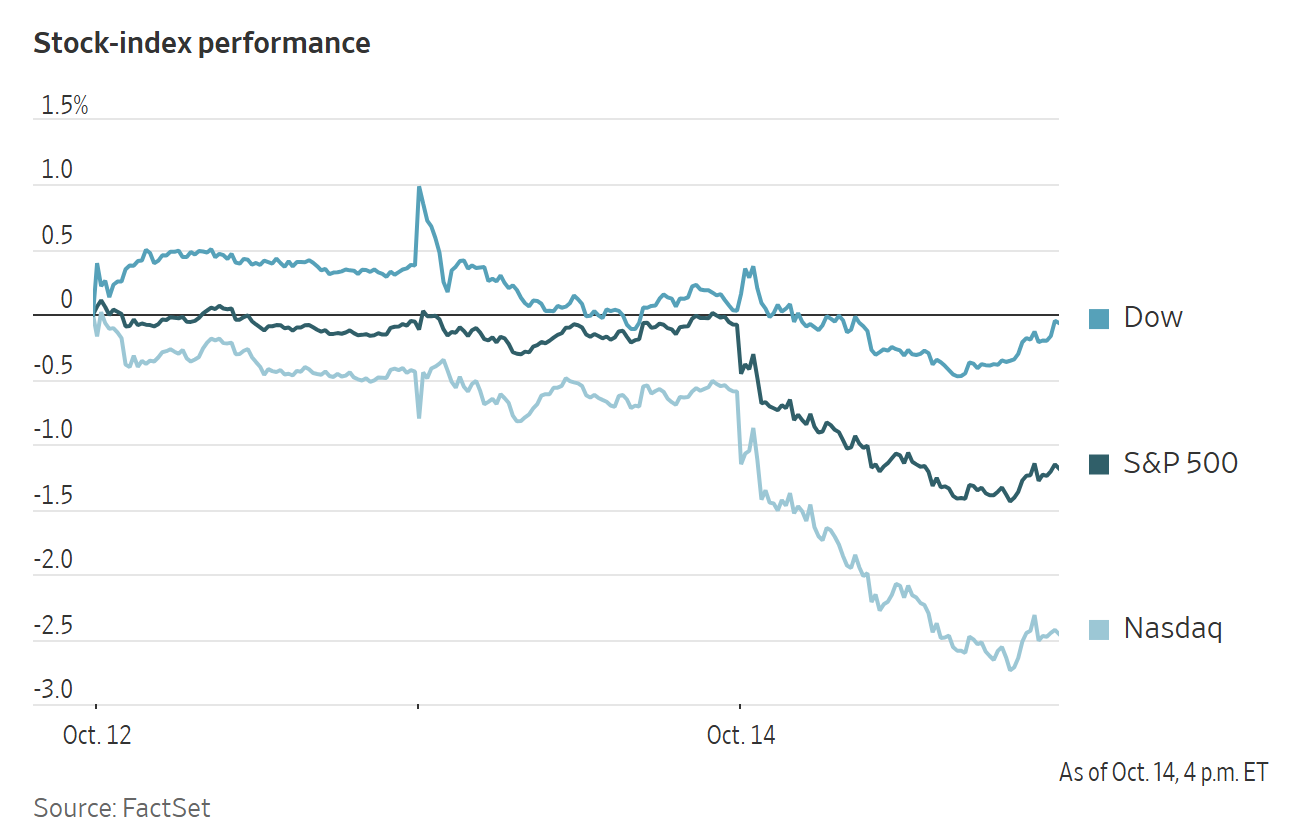
Bond yields swung sharply after a hotter-than-expected September inflation report, before a technology selloff drove investors toward defensive assets.
Despite remaining near record highs, markets were volatile, highlighting Wall Street’s sensitivity to persistently high interest rates and economic growth reliant on a single trade.
By the close, the Nasdaq Composite and the S&P 500 had posted their largest one-day declines since July, falling -1.88% and -1.11%, respectively. The Dow Jones Industrial Average slipped -0.09%, or 48.62 points.
In corporate news, Nvidia Chief Executive Jensen Huang unveiled plans to invest $2 billion in European transactions and announced new funding for French startups Doctolib, Genesis AI, Pigment and Entalpic. The pledge adds to the $8 billion Nvidia has invested in Europe over the past year.
Netflix is cutting 6% of its global workforce, or about 1,000 jobs, as growth slows. An email from co-Chief Executive Officers Greg Peters and Ted Sarandos said the reductions will affect the product, technology, legal and human resources teams.
Anduril Industries is allowing employees to sell shares through a tender offer that could value the defence technology startup at about $90 billion. Current and former employees in 16 countries may sell shares for $94.80 each, with the offer capped at approximately $1.3 billion and scheduled to close on 9 November.
Bending Spoons shares surged after Berkshire Hathaway invested an additional $330 million in the company, following a $600 million investment during its July IPO. Securities filings show that Berkshire’s stake now stands at 4%.
Corporate Earnings Reports
Posted on Wednesday, 14 October from The Pulse, our real-time AI-driven news tool. Available exclusively on the EXANTE Web Platform
Bank of America reported third-quarter results, missing Wall Street expectations. Revenue fell short at $29.96bn vs $30.76bn expected, while adjusted EPS was $1.08 vs $1.16 expected. Net income dropped -17% y/y to $6.9bn, heavily impacted by a $1.2bn regulatory fine from the US Treasury over anti-money laundering and sanctions compliance failures. In operational developments, the bank hired 1,000 contractors to patch software flaws exposed by Anthropic. Chief Executive Officer Brian Moynihan stated that rising interest rates had slowed fixed-income trading activity, though commercial lending grew across all client segments.
BlackRock reported Q3 2026 adjusted EPS of $15.93 vs $14.12 expected, with revenue rising +19% y/y to $7.75bn vs $7.52bn expected. Total net inflows reached $205.47bn during the quarter, driving assets under management up +15% y/y to $15.49trn. The adjusted operating margin expanded to 47.8%, while technology services annual contract value rose +12% y/y. The Chief Executive Officer stated that increasing numbers of organisations are accessing capital markets, placing the firm at the centre of these transactions following substantial net inflows across all asset classes.
Fastenal reported its Q3 2026 financial results, with revenue rising up +15.5% y/y to $2.46bn vs $2.44bn expected. Diluted EPS reached $0.35 vs $0.34 expected, up +19.8% y/y. Operating income grew to $530.8mn vs $511mn expected, whilst operating margin expanded to 21.5% vs 20.9% expected. Gross margin came in at 44.8% vs 44.4% expected, though down -40 bps y/y due to customer mix shifts towards larger accounts despite product pricing contributing approximately +240 bps to net sales. For FY26, the company lowered its device signings target to between 27,000 and 29,000 MEUs from 28,000 to 30,000 MEUs, with net capital expenditure guided between $310.0mn and $330.0mn. During the quarter, Fastenal returned $328.4mn to shareholders through dividends and share repurchases.
Morgan Stanley reported Q3 2026 net revenue of $20.34bn vs $19.95bn expected, up +12% y/y, and EPS of $3.03 vs $2.94 expected, up +8% y/y. Equity trading revenue jumped +41% to $5.80bn vs $4.90bn expected, while Wealth Management added $232.4bn in net new assets. FICC trading revenue delivered $2.01bn vs $2.22bn expected, and the bank executed $1.5bn in share repurchases. The chief executive officer commented that the firm delivered another strong quarter and remained overweight on the artificial intelligence opportunity set.
State Street reported its Q3 2026 financial results, posting revenue of $4.004bn vs $4.028bn expected and adjusted EPS of $3.69 vs $3.67 expected, which rose +33% y/y. Net interest income reached $864mn vs $852.9mn expected. For the full year, the company forecast fee revenue up about +13% to +14% y/y and net interest income up about +15% to +16% y/y. In corporate activity, the company announced an agreement to acquire the Santander CACEIS Latam Securities Services joint venture and secured its first Wealth Services mandate with a large US registered investment advisor client. The chief executive commented that the company entered the final quarter of the year with strong momentum.
European Stock Indices
CAC 40 +0.58%
DAX +0.15%
FTSE 100 +0.70%
Commodities
Gold spot -1.34% to $4,105.12 an ounce
Silver spot -6.54% to $55.64 an ounce
West Texas Intermediate +0.40% to $95.10 a barrel
Brent crude -0.24% to $106.09 a barrel
Gold fell by more than one percent on Wednesday, extending its decline for a third consecutive session.
Spot gold declined -1.34% to $4,105.12 per ounce, its lowest level since 7 October.
The US dollar index advanced +0.30%, making dollar-denominated gold more expensive for holders of other currencies.
Spot silver dropped -6.54% to $55.64 per ounce.
Oil benchmarks ended mixed and little changed on Thursday as investors weighed supply risks from attacks on shipping through the Strait of Hormuz against US efforts to reduce petroleum transport costs by easing sanctions on vessels.
Brent crude futures fell by 26 cents, or -0.24%, to $106.09 per barrel. WTI crude futures rose by 38 cents, or +0.40%, to $95.10 per barrel.
A container ship and a dry bulk carrier sank near the strait during the previous 24 hours after projectiles struck them in separate incidents, the International Maritime Organization and the UK Maritime Trade Operations agency said on Wednesday.
Attacks around the waterway have intensified over the past 10 days. Iran said it was escalating strikes in response to the US blockade of its ports and the tougher sanctions introduced last month. According to CBS, UK Maritime Trade Operations reported that at least 10 vessels had been attacked in or near the Strait of Hormuz since Sunday, the highest pace since the war began.
As the war with Iran disrupts shipping and pushes freight costs to record highs, the Trump administration is considering easing sanctions on shadow-fleet vessels that have transported oil and petroleum products from Russia, Iran and Venezuela to help lower prices, a US official said on Wednesday.
Higher output from Russia and the Middle East has limited price gains. Russia’s crude oil production increased by 65,000 bpd in September to 8.43 million bpd, although it remained 870,000 bpd lower y/o/y, the International Energy Agency (IEA) said on Wednesday.
The IEA also reported that crude oil exports from Middle East Gulf producers increased by 4.4 million bpd in September, reaching seventy five percent of prewar levels.
Chinese customs data showed that crude imports rose by approximately 1.0% m/o/m in September to 9.06 million bpd, while Oilchem estimated that refinery utilisation increased by two percentage points m/o/m to 66.4%. However, Vortexa recorded a 57 million-barrel decline in onshore Chinese crude inventories, while Kpler reported a 47.5 million-barrel draw in September. Both providers recorded the largest monthly inventory declines since their respective data series began in 2019 and 2017.
Note: As of 4 pm EDT 14 October 2026
Currencies
EUR -0.38% to $1.1154
GBP -0.48% to $1.3185
Bitcoin -2.13% to $81,697.46
Ethereum -3.70% to $2,417.28
The US dollar strengthened against major currencies on Wednesday after data showed that consumer prices rose in September, driven by higher gasoline costs.
The dollar edged +0.01% higher against the yen to ¥158.31, while the US dollar index gained +0.30% to 102.52.
The euro fell -0.38% to $1.1154, its weakest level since May 2025.
The British pound also weakened, declining -0.48% against the dollar to $1.3185.
Fixed Income
US 10-year Treasury -3.7 basis points to 5.186%
German 10-year Bund +0.5 basis points to 3.481%
UK 10-year Gilt -2.7 basis points to 5.429%
US Treasuries rallied sharply on Wednesday afternoon, reversing an earlier selloff triggered by the latest elevated inflation reading. Long-end yields closed lower, while front-end yields edged higher.
The Labor Department’s Bureau of Labor Statistics reported that the Consumer Price Index rose 0.6% in September after increasing 0.4% in August. On a 12-month basis, CPI advanced 3.7%, above economists’ expectations of 3.6% and the 3.4% increase recorded in August.
Following the release, the 2-year US Treasury yield climbed to its highest level in more than two weeks before retreating from its session peak alongside longer-dated yields.
The 2-year US Treasury yield, which typically tracks expectations for the Fed funds rate, rose by +1.1 bps to 4.808% after reaching 4.952% earlier, its highest level since 29 September.
The 10-year US Treasury yield fell by -3.7 bps to 5.186% after reaching 5.329% in morning trading.
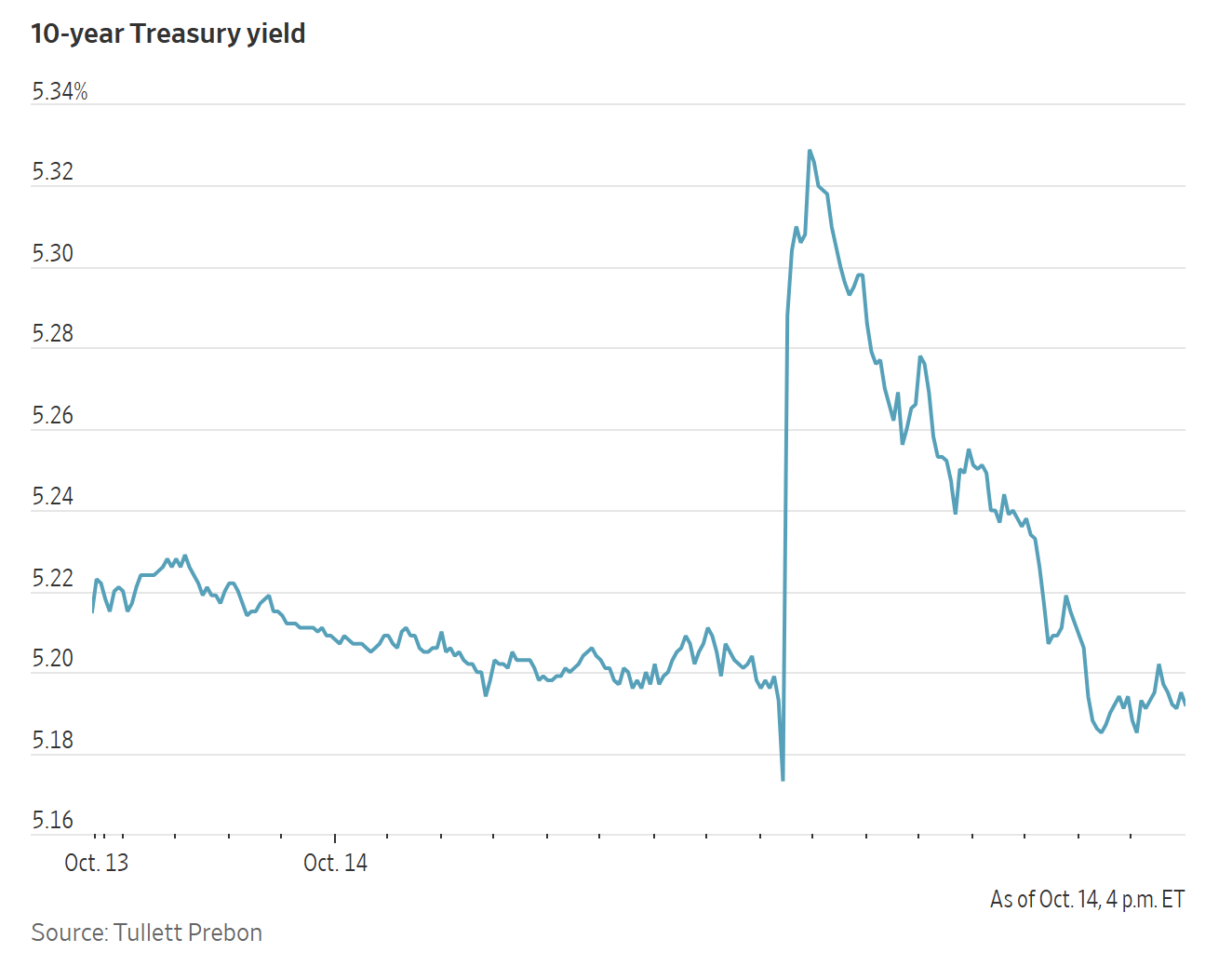
The 30-year US Treasury yield declined by -3.8 bps to 5.525%, marking its fourth consecutive daily decrease, after rising to 5.628% earlier in the session.
Despite the hot CPI print, traders continued to expect the FOMC to keep rates unchanged and defer its next increase until December. The implied probability of an October increase stood at 27.1%, while the probability of Fed funds rate target to be at least 25 bps above in December was 86.3%, according to CME Group's FedWatch Tool.
The US 2s10s yield curve stood at 37.8 bps, 4.8 bps narrower than Tuesday.
Eurozone government bond yields rose on Wednesday.
Germany’s 10-year Bund yield rose by +0.5 bps to 3.481%. At the short end, the 2-year Schatz yield declined by -0.4 bps to 3.151%, while the 30-year Bund yield advanced by +0.9 bps to 3.825%.
The spread between French 10-year OATs and German Bunds stood at 140.3 bps. The 10-year OAT underperformed its European peers as its yield rose by +4.9 bps to 4.884%.
Italy’s 10-year BTP yield also increased, rising by +3.2 bps to 4.560% and leaving its spread over German Bunds at 107.9 bps.
Note: As of 4 pm EDT 14 October 2026
While every effort has been made to verify the accuracy of this information, EXT Ltd. (hereafter known as “EXANTE”) cannot accept any responsibility or liability for reliance by any person on this publication or any of the information, opinions, or conclusions contained in this publication. The findings and views expressed in this publication do not necessarily reflect the views of EXANTE. Any action taken upon the information contained in this publication is strictly at your own risk. EXANTE will not be liable for any loss or damage in connection with this publication.
This article is provided to you for informational purposes only and should not be regarded as an offer or solicitation of an offer to buy or sell any investments or related services that may be referenced here. Trading financial instruments involves significant risk of loss and may not be suitable for all investors. Past performance is not a reliable indicator of future performance.







Created by professionals. For professionals.
