

Can the front end trust the doves?


 S&P 500 +0.19% at 7,666.45 US 10-year yield -4.9 basis points to 5.242% Spot gold +0.52% to $4,177.77 an ounce DXY +0.57% to 102.05
Key data to move markets today
EU: Eurozone Harmonised Index of Consumer Prices and Core Harmonised Index of Consumer Prices, Italian Retail Sales and speeches by ECB Vice President Boris Vujčić and Executive Board member Piero Cipollone and Bundesbank President Joachim Nagel
USA: Nonfarm Payrolls, Labour Force Participation, Average Hourly Earnings, U6 Underemployment Rate, Unemployment Rate and Factory Orders
Global Macro Updates
Fed patience is not disinflation. Fedspeak has turned cautious, but not exactly dovish. Fed Vice-Chair Philip Jefferson said the Committee may need more time before its next move, echoing New York Fed President John Williams’s view that there is no need for urgency. Fed Governor Michelle Bowman similarly sees no pressing case for immediate action. Yet the broader chorus remains uncomfortable. Minneapolis Fed President Neel Kashkari expects further tightening, Boston’s Susan Collins says inflation is still too high and Kansas City’s Jeffrey Schmid argues that the problem extends well beyond energy. This is patience over timing, not a quarrel with the destination.
The August PCE handed the patient camp provisional support. Headline inflation rose 0.3% m/o/m and 3.4% y/o/y, while core PCE increased 0.2% and 3.0%, respectively, both below expectations. But the optical improvement deserves an asterisk. Methodology changes shaved roughly 36 bps from annual core inflation, while gasoline prices rebounded 4.4% and transportation services jumped 1.4%. The data softened the print, not necessarily the process.
Nor has the demand backdrop that troubled Fed Chair Warsh at Jackson Hole meaningfully cooled. August consumer spending surged 0.9%, or 0.6% in real terms, while the saving rate fell to 4.1%. Q2 GDP was revised up to 2.2%, with consumption growing 3.8% and final sales to private domestic purchasers advancing 4.6%. Meanwhile, core capital-goods orders rose 1.6% in August, consistent with the AI-led investment impulse Fed Chair Warsh highlighted.
The labour picture is softer at the margin, but hardly cracking. August vacancies fell to 7.08 million and consumer confidence slumped; nevertheless, initial claims remained near 57-year lows at 197,000, while continuing claims fell to their lowest level since April 2023. In other words, weaker hiring appetite is coexisting with unusually low dismissals.
For investors, the distinction matters. Williams and Jefferson have reduced the case for a back-to-back October increase, but resilient demand, firm energy costs and elevated short-term inflation expectations leave December very much alive. Front-end relief may therefore prove tactical. The more durable risk is that the terminal rate, and the term premium embedded farther along the Treasury curve, will likely remain higher for longer.
US Stock Indices
Dow Jones Industrial Average +0.04%
Nasdaq 100 +0.31%
S&P 500 +0.19%, with 5 of the 11 sectors of the S&P 500 up
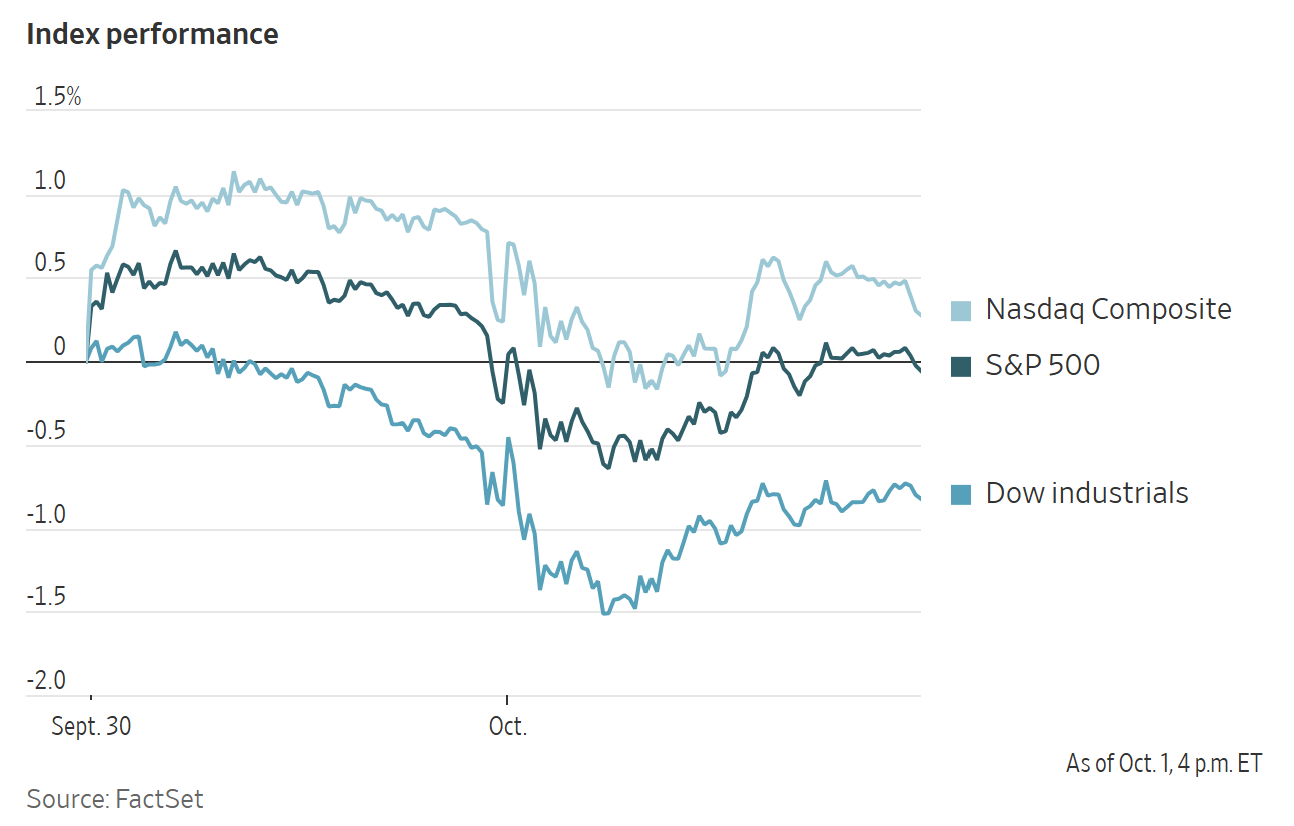
On Thursday, stocks rebounded from early losses. The S&P gained +0.19%, while the Dow Jones Industrials Average rose +0.04%, or 20.51 points, and Nasdaq Composite also rose by +0.04%.
In corporate news, The Wall Street Journal reported that Authentic Brands approached Mattel about a potential takeover that could value the toy maker at more than $20 per share, or at least $6 billion. On Wednesday, Mattel named Condé Nast Chief Executive Roger Lynch as its next CEO, succeeding Ynon Kreiz.
Lynas Rare Earths agreed to acquire Meteoric Resources in an all-share transaction valuing the Australian-listed explorer at approximately $672 million. The acquisition gives Lynas control of Brazil’s Caldeira rare-earths project, which is expected to require more than $500 million to develop. Under the terms announced Thursday, Meteoric shareholders will receive 0.0207 Lynas shares for each Meteoric share held, representing a 68% premium to Meteoric’s previous close.
Sanofi and Regeneron Pharmaceuticals will broaden their partnership to jointly develop and commercialise new immunology treatments. Regeneron will receive $1 billion upfront from Sanofi and could earn up to $7 billion in additional milestone payments. The expanded alliance will add four next-generation immunology candidates developed by Regeneron. One is in early-stage trials for atopic dermatitis, or eczema, while the other three are expected to enter clinical trials next year. Regeneron will also have the option to add Sanofi’s lunsekimig, which is being evaluated for chronic obstructive pulmonary disease.
European Stock Indices
CAC 40 -1.62%
DAX -1.03%
FTSE 100 -1.68%
Commodities
Gold spot +0.52% to $4,177.77 an ounce
Silver spot +0.75% to $60.86 an ounce
West Texas Intermediate +2.84% to $92.91 a barrel
Brent crude +4.37% to $102.25 a barrel
Gold prices edged higher on Thursday.
Spot gold rose +0.52% to $4,177.77 per ounce.
Spot silver gained +0.75% to $60.86 per ounce.
Oil prices surged on Thursday after reports that the US was deploying additional troops and aircraft carriers to the Middle East. In addition, China had suspended exports of oil products. The developments heightened concerns that global fuel shortages could worsen.
The new front-month December Brent crude contract settled at $102.25 per barrel, up +4.37%, or $4.28. WTI futures closed at $92.91 per barrel, up +2.84%, or $2.57.
It has been reported that the US was sending a third aircraft carrier, the USS Theodore Roosevelt, and as many as 10,000 additional troops to the Middle East, as the US president considered resuming strikes on Iran after the US midterm elections if a satisfactory deal was not reached with Tehran.
Together with China’s suspension of fuel exports, the deployment report drove a volatile trading session. Oil prices initially fell one percent, but reversed course after Reuters, citing four people familiar with the matter, reported that Chinese refiners had suspended exports of oil products to destinations other than Hong Kong and Macau until further notice. The restriction will take effect after the Golden Week holiday ends on 7 October.
Although crude supplies continue to reach the market, diesel and other refined products remain scarce following damage to refinery infrastructure in the Gulf and Russia.
Global diesel inventories are already tight after Russia, one of the world’s leading fuel exporters, banned exports through October. President Vladimir Putin said Russia would not supply diesel to global energy markets until sanctions against Moscow were lifted.
To ease the pressure, the EU energy task force is considering a potential release of diesel stockpiles. Reuters sources also said Washington had urged Berlin and Paris to draw down emergency diesel inventories or risk a potential US ban on diesel exports.
On Tuesday, three Liberian-flagged oil tankers were struck by unidentified projectiles while transiting the Strait of Hormuz, shipping intelligence service Marisks said in a report published Wednesday.
Jet fuel inventories at the Amsterdam-Rotterdam-Antwerp refining and storage hub fell 14% w/o/w to their lowest level in more than six years, according to data from Dutch consultancy Insights Global.
Note: As of 4 pm EDT 1 October 2026
Currencies
EUR -0.79% to $1.1239
GBP -0.52% to $1.3191
Bitcoin +0.99% to $84,539.42
Ethereum +0.38% to $2,692.85
The US dollar rose to a 17-month high against the euro on Thursday.
Earlier in the session, the euro fell below $1.1215 against the US dollar for the first time since May 2025.
The euro settled -0.79% against the US dollar at $1.1239.
The euro also weakened against the yen and Swiss franc and remained only marginally higher against the pound.
Sterling fell -0.52% against the US dollar to $1.3191. It was broadly unchanged against the euro, which declined to 85.18 pence, its weakest level against the pound since late June.
The Japanese yen weakened -0.46% against the US dollar to ¥158.07 per dollar.
Fixed Income
US 10-year Treasury -4.9 basis points to 5.242%
German 10-year Bund -7.4 basis points to 3.526%
UK 10-year Gilt -2.6 basis points to 5.401%
A wave of investor buying reversed an early selloff in US Treasuries on Thursday, offering relief to bondholders after long-term yields climbed to their highest levels in 24 years following stronger-than-expected economic data.
The reversal provided an encouraging start to October after the 10-year yield posted its largest quarterly increase since 1994, a year known on Wall Street as the great bond massacre.
Yields on 10- and 30-year Treasuries reached their highest levels since spring 2002 in midmorning trading after the Institute for Supply Management reported that US manufacturing activity was little changed in September, while input prices surged amid strong demand, signalling persistent inflationary pressure.
The strongest buying was concentrated in 2-year Treasuries, whose yields recorded their steepest one-day decline since August 2025. The 2-year note yield, which typically tracks expectations for the Fed funds rate, fell -10.6 bps to 4.802%.
The US 10-year Treasury yield fell -4.9 bps to 5.242% after earlier reaching 5.345%, its highest level since April 2002.
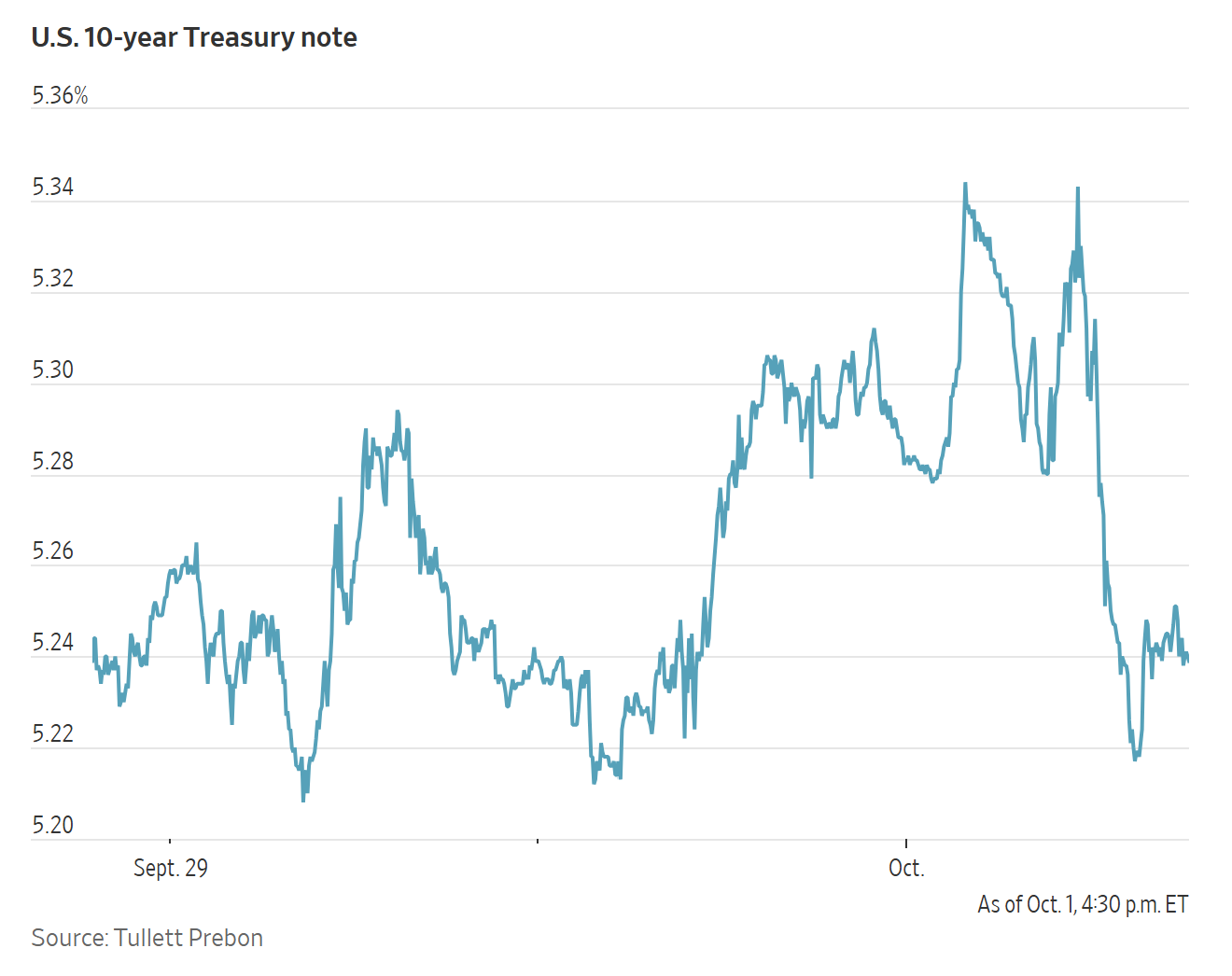
The 30-year Treasury yield declined -1.3 bps to 5.621% after touching 5.694% earlier in the session.
The US 2s10s yield curve stood at 44.0 bps, widening by 5.7 bps from Wednesday’s 38.3 bps.
Eurozone government bond trading diverged sharply on Thursday.
During a volatile session, eurozone bond yields initially rose broadly before paring their gains. French and Italian yields subsequently moved higher, whereas German and Dutch yields remained lower on the day.
The divergence was evident at the 10-year tenor, with the Bund yield falling -7.4 bps to 3.526%, while Italy’s 10-year BTP yield rose +9.5 bps to 4.699%.
France’s 10-year OAT yield rose +5.7 bps to 4.699% following another volatile session.
The spread between 10-year OAT and Bund yields widened to 137.6 bps, its highest level since May 2012.
The yield on Germany’s 2-year government bond fell -11.6 bps to 3.088%.
Money markets pared back expectations for further ECB rate hikes on Thursday and no longer fully priced in another increase this year.
Note: As of 4 pm EDT 1 October 2026
While every effort has been made to verify the accuracy of this information, EXT Ltd. (hereafter known as “EXANTE”) cannot accept any responsibility or liability for reliance by any person on this publication or any of the information, opinions, or conclusions contained in this publication. The findings and views expressed in this publication do not necessarily reflect the views of EXANTE. Any action taken upon the information contained in this publication is strictly at your own risk. EXANTE will not be liable for any loss or damage in connection with this publication.
本文提供给您仅供信息参考之用,不应被视为认购或销售此处提及任何投资或相关服务的优惠招揽或游说。金融工具交易存在重大亏损风险,未必适合所有投资者。过往表现并非未来业绩的可靠指标。








由专业人士创建。 为专业人士。
