

What signal will Chair Warsh send?

 S&P 500 -0.57% to 7,511.35 US 10-year yield -3.6 basis points to 4.445% Spot gold +0.50% to $4,330.13 an ounce DXY -0.11% to 99.56
Key data to move markets today
EU: Eurozone Harmonised Index of Consumer Prices and Core Harmonised Index of Consumer Prices, and speeches by Dutch Central Bank President Olaf Sleijpen and ECB Executive Board member Piero Cipollone
UK: CPI and Core CPI, PPI Input, Output and Core Output and Retail Price Index
US: Fed Interest Rate Decision, Fed Monetary Policy Statement, FOMC Economic Projections, Interest Rate Projections, FOMC Press Conference, Retail Sales, Retail Sales Control Group, Retail Sales ex-Autos and Pending Home Sales
Global Macro Updates
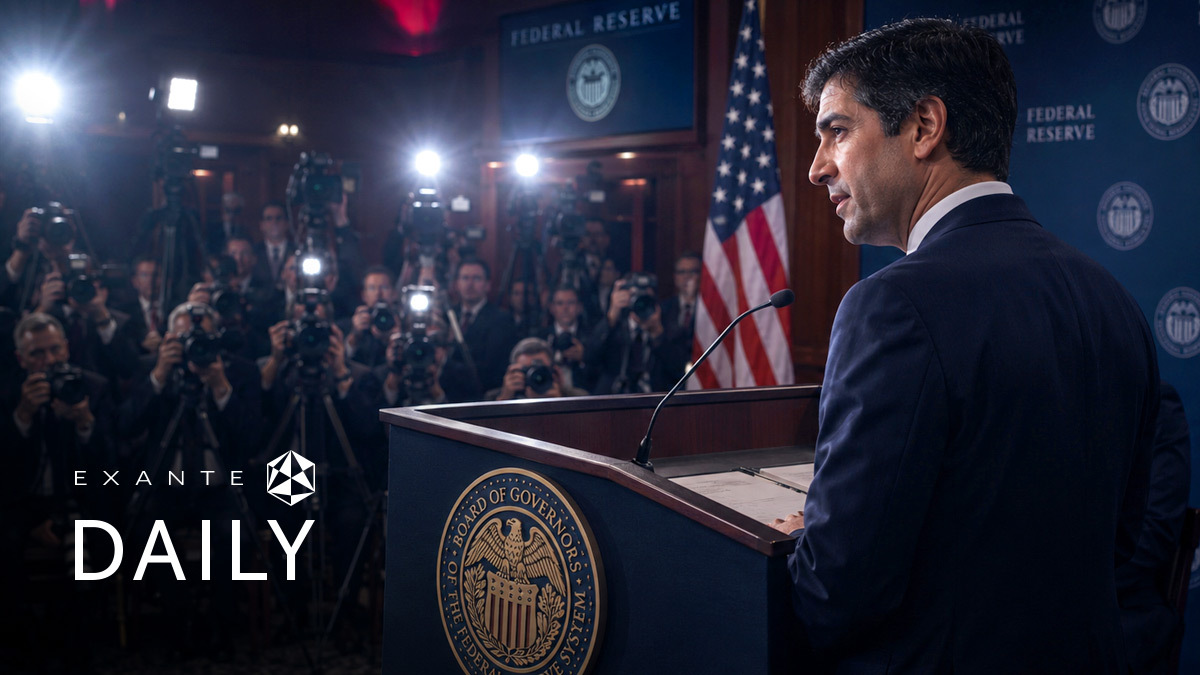
Preview: June FOMC meeting. The Fed is holding its June FOMC meeting this week, with the policy statement and the latest Summary of Economic Projections scheduled for release at 2:00 pm EDT today, followed by Chair Kevin Warsh’s inaugural press conference at 2:30 pm. Analysts have focused heavily on the possibility of changes to the statement, projections and communication framework under the new chairmanship.
No change in interest rates is expected at this meeting and dissenting votes are generally not anticipated. However, the statement may undergo notable revisions. Labour-market language could be upgraded in response to recent strength in employment data, while particular attention is being paid to the future of the forward-guidance language. Given Warsh’s past criticism of forward guidance, along with recent remarks from policymakers about removing implicit policy signals, analysts have outlined several possibilities ranging from modest wording changes to the complete removal of the sentence on ‘additional adjustments.’ Some observers have also raised the prospect of a broader revision to the statement, although Bank of America has argued that Warsh may not yet have had sufficient time to engineer such an overhaul.
Most analyst previews do not expect significant changes to, or the removal of, the Summary of Economic Projections at this meeting, although some believe adjustments could come in future meetings given Warsh’s prior criticism of the framework. Opinion is divided over whether the new chair will submit his own dot projection. Some analysts also note that the Fed completed a comprehensive communications review only last year, and that forcing major changes now could be viewed as unnecessarily disruptive.
The economic outlook forecasts are generally expected to show lower growth projections and higher inflation estimates, particularly for headline PCE. In the dot plot, the prevailing view is that the 2026 rate cut implied by the March median projection may be removed, while a small number of projections could shift toward additional tightening. Expectations for 2027 remain mixed, with views split between no change and a single 25 bps cut. Analysts are likewise divided on whether the longer-run policy rate will rise to 3.250% or remain at 3.125%.
There is also considerable speculation about how Chair Warsh will handle the press conference, given his past criticism that Fed officials communicate too frequently. The broad expectation is that he will initially retain the format used by Jerome Powell, including an opening statement and a question-and-answer session. However, he may signal future adjustments such as a return to quarterly press conferences. Goldman Sachs has suggested that it may be difficult to move quickly toward a less transparent communications approach.
Warsh is widely expected to avoid language that could be interpreted as forward guidance. Even so, his overall tone may lean somewhat dovish, potentially referencing measures such as the Dallas Fed trimmed mean PCE, challenges in inflation measurement, limited wage-driven inflation pressure and the possible benefits of productivity gains from AI. Analysts also expect him to face questions about how he intends to translate his earlier comments regarding ‘regime change’ at the Fed into practical policy and communications changes.
US Stock Indices
Dow Jones Industrial Average +0.64%
Nasdaq 100 -1.89%
S&P 500 -0.57%, with 4 of the 11 sectors of the S&P 500 down
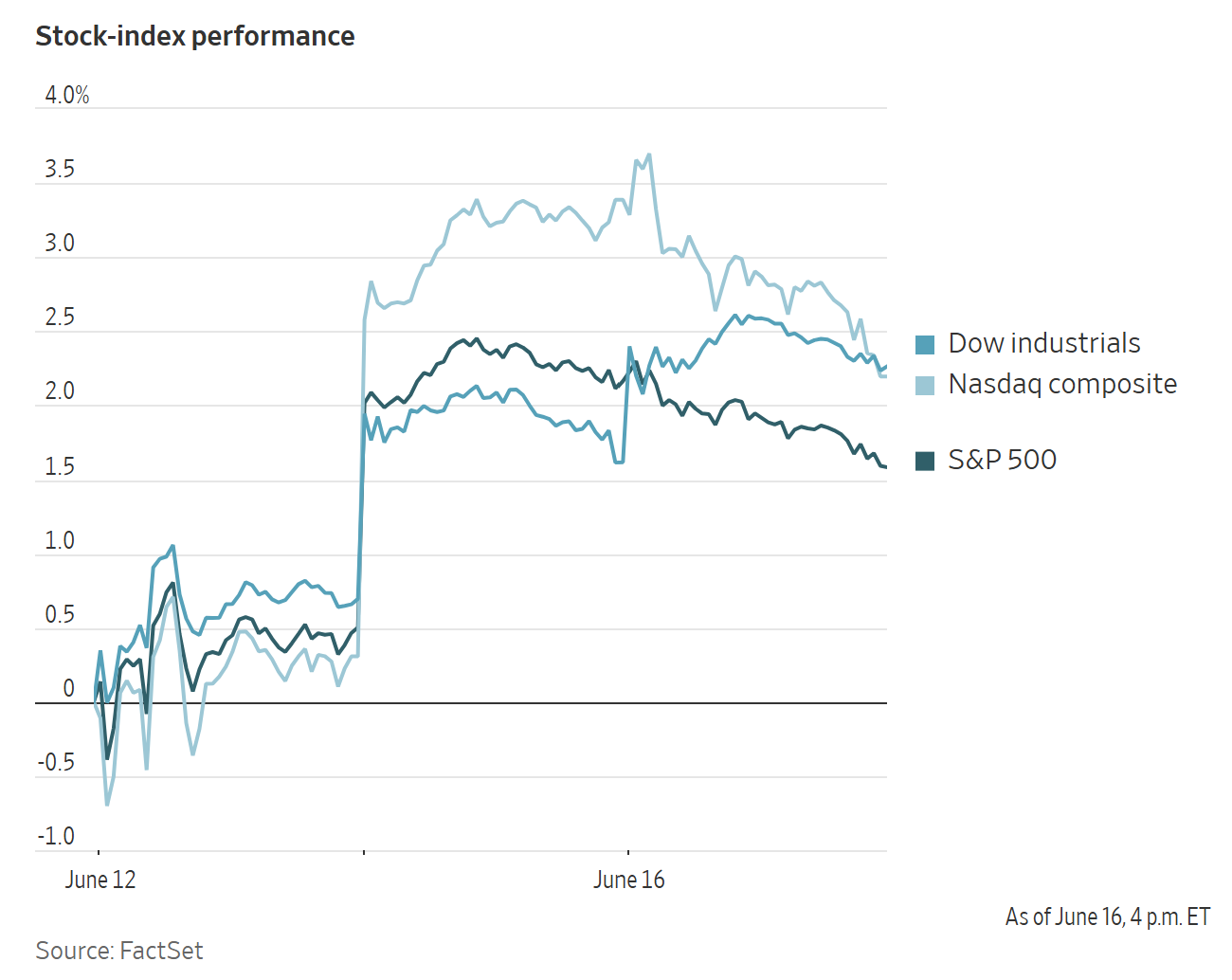
US stock indices were mixed on Tuesday after Monday’s sharp rally. The Nasdaq Composite fell -1.15%, while the Dow rose +0.64% to 51,999.67, marking its 17th record close of the year. The S&P 500 declined -0.57% to 7,511.35.
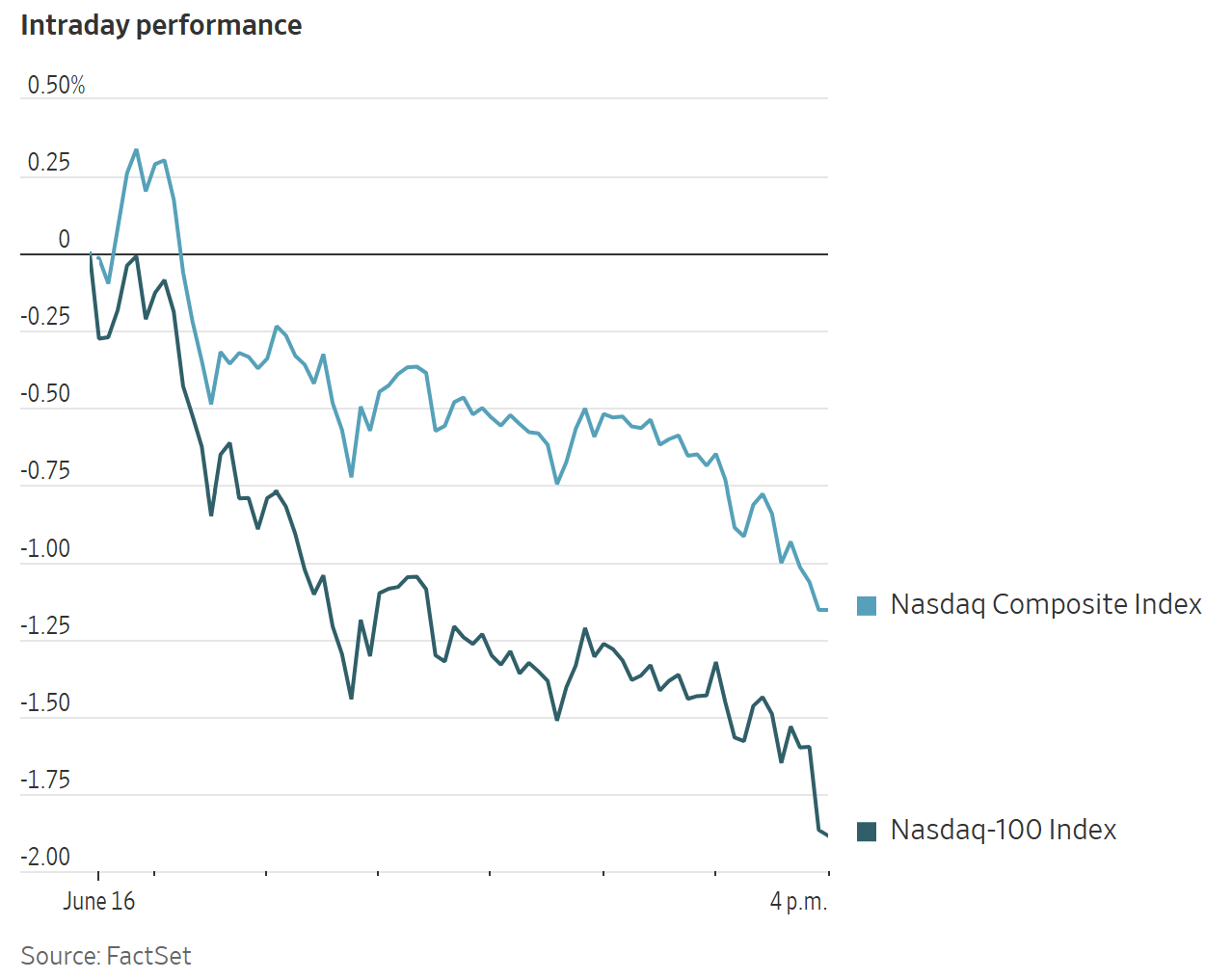
SpaceX’s Nasdaq effect. The two principal Nasdaq equity benchmarks are expected to incorporate SpaceX in notably different ways during the initial period following its listing. The Nasdaq Composite, which includes nearly all companies listed on the Nasdaq exchange, has already added SpaceX and assigned it a weighting based on the company’s market capitalisation of nearly $2.790 billion.
As a result, SpaceX has immediately become one of the largest constituents of this broad benchmark. This treatment is consistent with Nasdaq’s longstanding practice of adding newly listed companies to the Composite on their second day of trading.
The Nasdaq 100, by contrast, is expected to add SpaceX no earlier than July. The index, which tracks approximately 100 of the largest non-financial companies listed on the exchange, recently shortened its waiting period for new entrants to 15 trading days from the previous three months.
This distinction is significant because, unlike the Nasdaq Composite, which contains more than 3,000 constituents, the Nasdaq 100 is widely followed by index funds, including Invesco’s $500 billion QQQ ETF.
Even when SpaceX is added to the Nasdaq-100, however, its initial influence on the index is likely to be considerably smaller. This is because the Nasdaq-100 adjusts constituent weightings based on free float, or the proportion of shares that trade publicly. At present, less than 10% of SpaceX shares are publicly available, although that share is expected to increase in the coming months as lockup periods expire and employees and insiders become able to sell stock.
SpaceX rose +4.83% on Tuesday, contributing to a clear outperformance of the Nasdaq Composite relative to the Nasdaq 100.
In corporate news, Microsoft is considering offering a Microsoft-hosted version of DeepSeek as a lower-cost model option.
Netflix is reportedly considering an acquisition of Lionsgate Studios after losing the contest for Roku to Fox.
SpaceX has formally agreed to acquire Cursor for $60 billion, as expected.
Apple plans to launch its first AI-focussed wearable in 2027, alongside camera-equipped AirPods.
Rivian announced hundreds of layoffs across service, customer support, sales and marketing.
Yum! Brands is selling the Pizza Hut chain for $2.7 billion, with LongRange Capital acquiring the business outside China.
S&P 500 Best performing sector
Financials +1.49%, with Fiserv +4.01%, JPMorgan Chase +3.68% and Moody’s +3.16%
S&P 500 Worst performing sector
Information Technology -2.32%, with Monolithic Power Systems -9.29%, Intel -8.45% and KLA -7.44%
Mega Caps
Alphabet +1.09%, Amazon -0.04%, Apple +0.95%, Meta Platforms +1.13%, Microsoft -1.48%, Nvidia -2.37% and Tesla -1.58%
Information Technology
Best performer: Western Digital +4.22%
Worst performer: Monolithic Power Systems -9.29%
Materials and Mining
Best performer: Vulcan Materials +2.68%
Worst performer: Mosaic -3.69%
European Stock Indices
CAC 40 +0.75%
DAX +0.07%
FTSE 100 +0.61%
Commodities
Gold spot +0.50% to $4,330.13 an ounce
Silver spot -0.16% to $69.92 an ounce
West Texas Intermediate -5.59% to $76.62 a barrel
Brent crude -4.78% to $79.49 a barrel
Gold prices advanced on Tuesday, with spot gold rising +0.50% to $4,330.13 per ounce, after reaching its highest level since 5 June in the previous session.
By contrast, spot silver edged down -0.16% to $69.92 per ounce.
Oil prices fell for a second consecutive session on Tuesday, reaching a three-month low as details emerged of an interim agreement aimed at ending the war with Iran and reopening the Strait of Hormuz, including provisions that would permit Iran to resume oil sales.
Brent crude futures declined by $3.99, or -4.78%, to settle at $79.49 per barrel, while US WTI crude fell by $4.54, or -5.59%, to close at $76.62 per barrel.
These marked the lowest closing levels for Brent since 2 March and for WTI since 4 March. The US-Iran conflict began on 28 February. On the preceding day, 27 February, Brent had closed at $72.48 per barrel and WTI at $67.02.
Under the proposed arrangement, the fragile ceasefire announced in April would be extended by a further 60 days and the Strait of Hormuz would reopen after having been effectively blocked by Iran since the initial attacks by the US and Israel.
According to White House memorandum talking points, the proposed peace framework would allow Iran to resume oil exports immediately, ease banking and transport sanctions to facilitate transactions and release $100 billion in frozen funds. Iran’s foreign minister stated that formal talks would begin on the day the memorandum is signed, followed by an additional 60 days of negotiations.
Nevertheless, uncertainty surrounding the agreement remained elevated, with analysts warning that shipping flows and energy exports could take several weeks to normalise. In Lebanon, the Iran-backed Hezbollah group stated that it does not expect Iran to sign a final nuclear agreement unless Israel withdraws from Lebanese territory.
Some developments were interpreted as constructive. Bloomberg news reported that at least two Iranian very large crude carriers had crossed the US Navy blockade line, while Windward indicated that several Very Large Crude Carriers (VLCCs) were signalling plans to transit the Strait toward the UAE. At the same time, the US President indicated that waivers on sanctions related to Russian energy may be allowed to expire.
Elsewhere, following a temporary lull over the weekend, Ukrainian forces resumed strikes on Russian energy infrastructure, reportedly hitting an oil depot and forcing the closure of the 250,000 bpd Moscow refinery, one of the country’s largest.
Note: As of 4 pm EDT 16 June 2026
Currencies
EUR +0.18% to $1.1606
GBP +0.13% to $1.3426
Bitcoin -0.96% to $65,709.06
Ethereum -0.89% to $1,794.38
The US dollar weakened on Tuesday, although it remained near the upper end of its recent trading range against both the euro and the Japanese yen, as energy prices are expected to stay elevated for some time.
The dollar index fell -0.11% to 99.56, while the euro gained +0.18% to trade at $1.1606.
The Japanese yen weakened marginally by -0.02% to ¥160.38 per dollar after the BoJ, as widely expected, raised its benchmark interest rate by 25 bps to 1.0%. The move, which lifted rates to their highest level since 1995, reflected efforts to contain inflationary risks linked to the Iran conflict. However, the board’s 7 – 1 vote left some uncertainty regarding the timing of any further tightening.
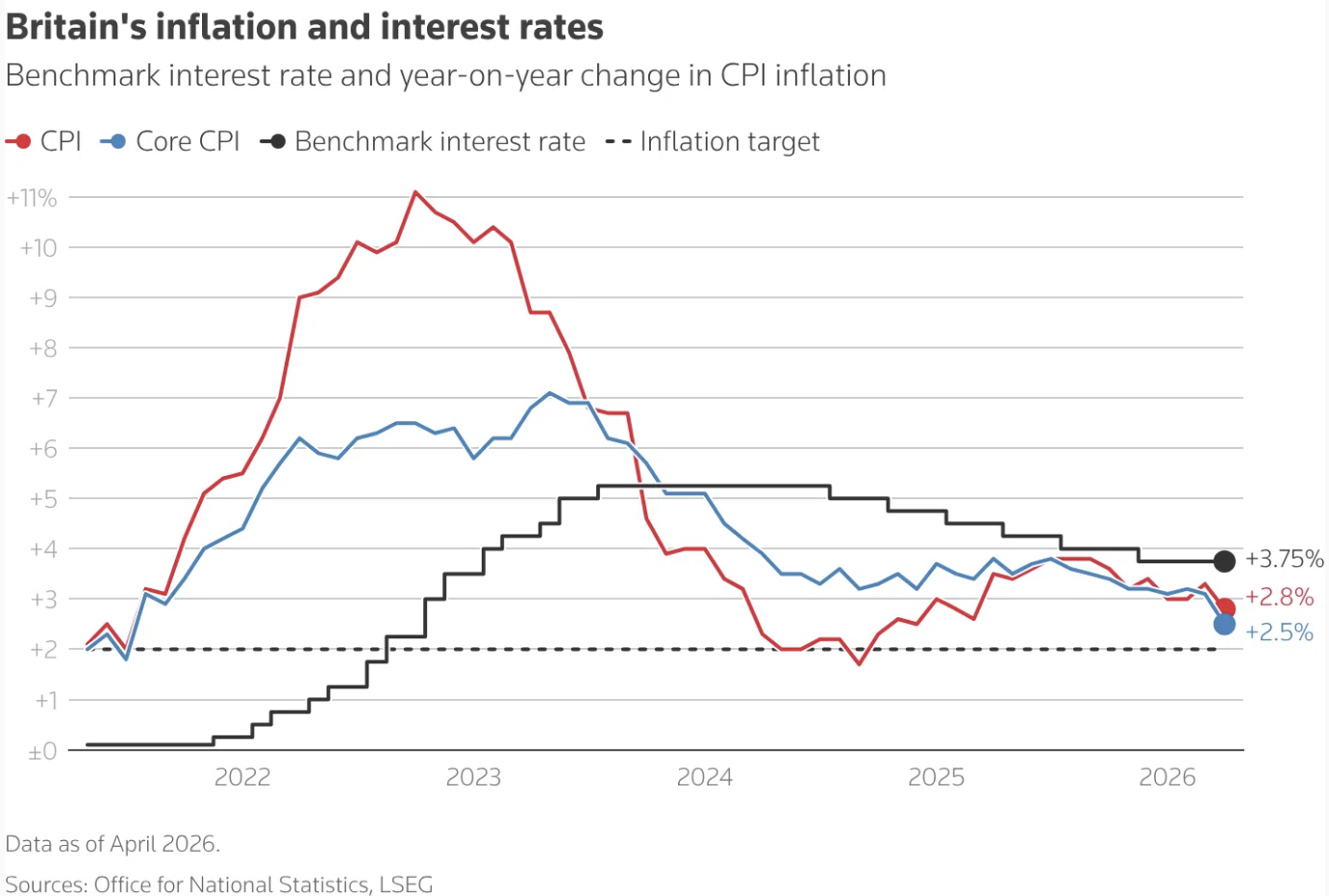
Sterling rose +0.13% against the US dollar to $1.3426. Market participants expect the BoE to leave interest rates unchanged when it announces its latest policy decision on Thursday.
Fixed Income
US 10-year Bond -3.6 basis points to 4.445%
German 10-year Bund -2.3 basis points to 2.935%
UK 10-year Gilt -2.7 basis points to 4.792%
US Treasury yields declined for a third consecutive session on Tuesday.
The 10-year Treasury yield fell -3.6 bps to 4.445%. A $13 billion auction of 20-year notes was well received, with the 20-year yield, after peaking at 4.938% during the session, easing to 4.930%. The two-year Treasury yield, particularly sensitive to expectations for the Fed funds rate, declined -1.3 bps to 4.068%.
At the long end of the curve, the 30-year yield fell -3.4 bps to 4.946%.
The spread between the two-year and 10-year Treasury yields narrowed by 2.3 bps to 37.7 bps, indicating a modest flattening of the curve.
The Fed is widely expected to leave interest rates unchanged on Wednesday and may remove its reference to an easing bias. Investors will closely monitor the policy statement, updated economic projections and comments from Chair Kevin Warsh during his post-meeting press conference.
According to CME Group's FedWatch Tool, Fed funds futures traders are pricing 19.5 bps of rate hikes in 2026, lower than the 24.4 bps priced in a week ago. Fed funds futures traders are now pricing in a 0.5% probability of a 25 bps rate hike at the end of today’s FOMC meeting, compared to 0.8% probability of a rate cut last week.
Eurozone government bond yields fell across countries and maturities for a fourth consecutive day on Tuesday, reaching multi-week lows.
Germany’s 10-year Bund yield declined -2.3 bps to 2.935% after touching 2.925%, its lowest level since 8 April. Italy’s 10-year BTP yield fell -2.4 bps to 3.645% after reaching 3.639%, its lowest since 18 March, leaving the spread over Bunds at 71.0 bps.
Germany’s two-year yield, sensitive to shifts in ECB rate expectations, fell -1.0 bps to 2.576%, after declining to a two-week low of 2.547% on Monday. At the longer end, the 30-year yield eased -3.0 bps to 3.496%.
Last week, the ECB became the first major central bank to tighten monetary policy since the outbreak of the war with Iran, followed on Tuesday by the BoJ.
Even so, investors have pared back expectations for further ECB tightening following the memorandum of understanding between Washington and Tehran, despite the lack of clarity around its terms. Money market futures are now fully pricing in 30 bps of additional tightening by year-end, implying one quarter-point rate increase and roughly a 20% probability of a second move.
In an interview with France Culture, ECB President Christine Lagarde welcomed the US-Iran ceasefire agreement on Monday, particularly if it results in the reopening of the Strait of Hormuz. At the same time, she maintained a firm hawkish stance on inflation, signalling a notable shift in tone from Thursday’s press conference. Lagarde warned that high energy prices were beginning to filter through to other parts of the economy and said the ECB would respond if second-round effects, such as stronger wage growth, became more evident. She also defended the recent rate increase against criticism that it could undermine growth.
In addition, Lagarde argued that the Capital Markets Union, now referred to as the Savings and Investment Union, will only succeed fully if supported by a mutualised debt instrument that can provide greater market depth and liquidity. While the ceasefire has raised hopes of easing energy costs, Lagarde and other policymakers, including Bundesbank President Joachim Nagel, emphasised on Tuesday that the ECB remains prepared to tighten policy further if necessary.
ECB Chief Economist Philip Lane stated at a Reuters NEXT event on Tuesday that the central bank would remain ‘proactive’ in its efforts to contain inflation, which is still expected to remain well above the 2% target for the next year. He said monetary policy would continue to respond in line with how inflation risks evolve.
Note: As of 4 pm EDT 16 June 2026
While every effort has been made to verify the accuracy of this information, EXT Ltd. (hereafter known as “EXANTE”) cannot accept any responsibility or liability for reliance by any person on this publication or any of the information, opinions, or conclusions contained in this publication. The findings and views expressed in this publication do not necessarily reflect the views of EXANTE. Any action taken upon the information contained in this publication is strictly at your own risk. EXANTE will not be liable for any loss or damage in connection with this publication.
This article is provided to you for informational purposes only and should not be regarded as an offer or solicitation of an offer to buy or sell any investments or related services that may be referenced here. Trading financial instruments involves significant risk of loss and may not be suitable for all investors. Past performance is not a reliable indicator of future performance.








Created by professionals. For professionals.
