

Will durability be priced into a fragile peace?


 S&P 500 +0.35% last week to 7,431.46 US 10-year yield -3.3 basis points last week to 4.489% Spot gold -2.54% last week to $4,218.77 an ounce DXY -0.20% last week to 99.81
Key data to move markets today
EU: Eurozone Industrial Production and Trade Balance and speeches by ECB President Christine Lagarde, Bundesbank President Joachim Nagel and ECB Executive Board Member Piero Cipollone
US: NY Empire State Manufacturing Index and Industrial Production
JAPAN: BoJ Interest Rate Decision and Monetary Policy Statement
Global Macro Updates
Peace deal announced. The US and Iran have confirmed that they reached an agreement to end the conflict, with a signing ceremony scheduled for 19 June in Switzerland. Preparatory meetings with each side will take place in Doha this week ahead of the official signing in Switzerland and the start of the technical talks. Under the arrangement, the Strait of Hormuz is expected to reopen once the agreement is signed, although the US President indicated that additional time will be required to clear mines before shipping can fully resume. He also stated that maritime traffic would restart without tolls and that the US would immediately end its naval blockade. Even so, uncertainty remains over how the reopening of the Strait will align with Iran’s continued assertion of sovereignty and its claimed right to collect transit fees.
Few details have been released regarding the memorandum of understanding, which Iran has said will be published only after the signing ceremony. According to earlier press reports, the memorandum is expected to establish a 60-day extension of the ceasefire, during which discussions will continue over Iran’s nuclear programme. Draft provisions reportedly include an Iranian commitment not to acquire nuclear weapons, while US officials have suggested that the agreement could eventually lead to the dismantling of Iran’s nuclear programme. The minimum commitment would be for all uranium to be diluted on site under the supervision of the International Atomic Energy Agency. The framework also addresses uranium stockpiles, potentially through the downblending of material inside Iran under UN supervision. As noted by the Financial Times, Iran has a stockpile of more than 9,000kg of enriched uranium. Most of it is at low enrichment levels, but 440kg is enriched to near weapons-grade. The US President said the US would address the stockpiles in the coming months, but added that there was no immediate urgency.
The extent of sanctions relief remains unclear. Iranian media have claimed that $24 billion would be released over the 60-day period, with half of that amount made available before formal talks begin. Iran is also expected to receive some relief from oil sanctions. The US President, however, said that Iran would not receive direct cash payments, while acknowledging that other sanctions could be eased. US officials have maintained that any sanctions relief will depend on Iran meeting its obligations under the agreement. The deal is also said to include an economic reconstruction framework valued at no less than $300 billion.
The agreement nevertheless faced a last-minute complication after an Israeli strike in Beirut prompted threats of retaliation from Iran, before President Trump publicly urged Israel to halt its attacks. The arrangement is also expected to include an end to fighting in Lebanon. However, Iran’s missile programme and its support for proxy groups would remain outside the scope of the 60-day agenda. In addition, the US is expected to reduce its military presence around Iran.
US Stock Indices
Dow Jones Industrial Average +0.70%
Nasdaq 100 +0.64%
S&P 500 +0.50%, with 10 of the 11 sectors of the S&P 500 up
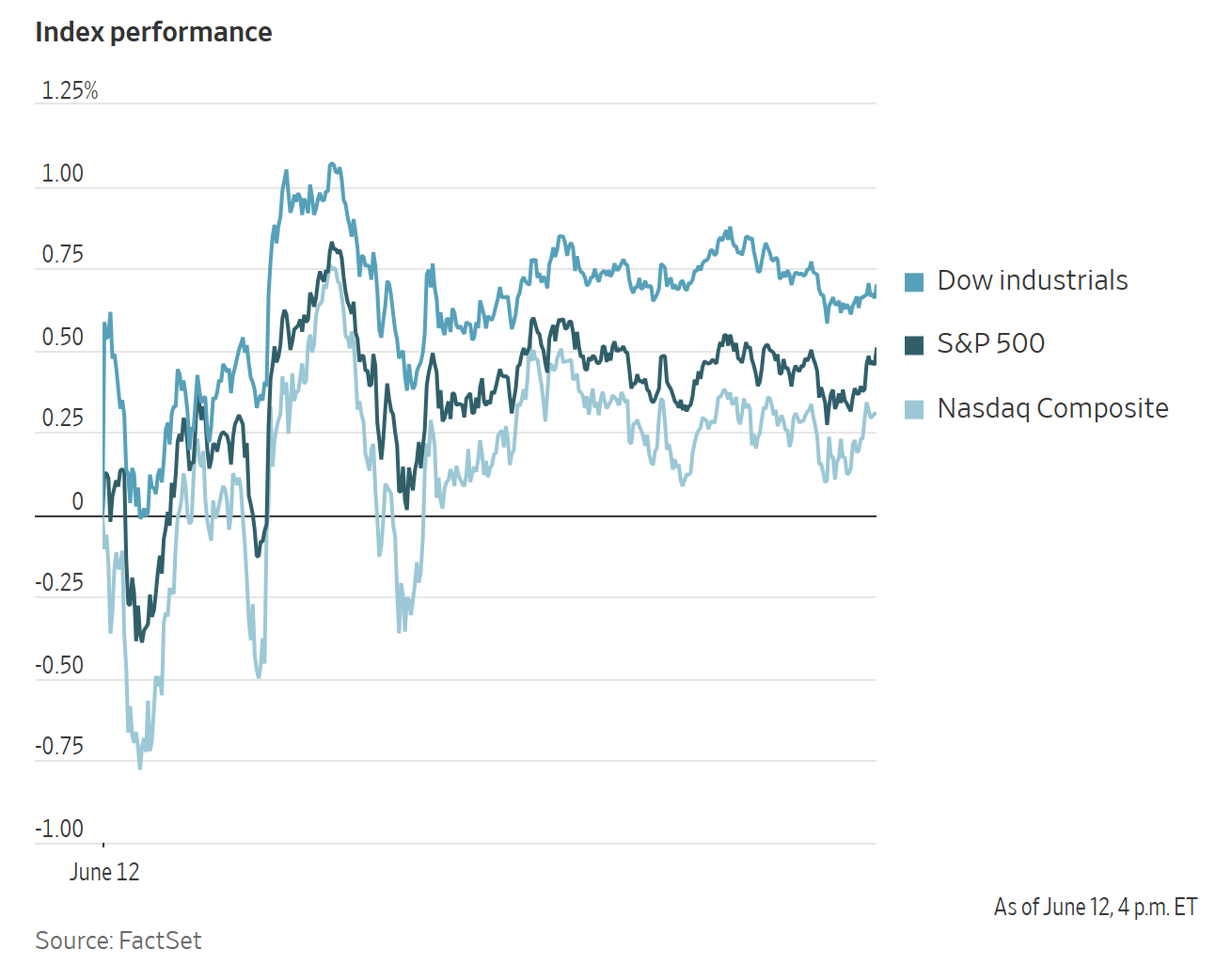
US equities advanced as hopes for a diplomatic breakthrough to end the conflict in Iran weighed on oil prices and improved broader market sentiment. Investor enthusiasm was further supported by the strong trading debut of SpaceX, which added momentum to Wall Street’s gains.
A sharp rise in financial stocks helped lift the Dow Jones Industrial Average, which gained 353.46 points, or +0.70%. The S&P 500 advanced +0.50%, while the Nasdaq Composite rose +0.31%.
The Russell 2000 added +0.79%, reaching a fresh record high of 2,943.99.
For the week, the S&P 500 gained +0.35%, the Nasdaq Composite slipped -0.16%, the Dow Jones rose +0.82% and the Russell 2000 advanced +3.10%.
SpaceX shares surged on their first day of trading, in a debut that fully matched market expectations. The stock was priced at $135 per share and rose +19.22% to close at $160.95. The offering became the largest IPO on record, and by the end of the day SpaceX ranked as the sixth-largest listed company in the US. The debut also made Elon Musk the world’s first trillionaire.
In corporate news, according to Bloomberg news, Roku is reportedly in discussions to sell the company, according to people familiar with the matter.
Exxon Mobil is also assessing potential acquisition targets, including Australia’s Woodside Energy Group, as the company explores ways to expand its exposure to liquefied natural gas and strengthen its position in Asian markets, according to people familiar with the matter.
Blackstone is in early-stage discussions regarding a possible acquisition involving H&R REIT, a Canadian owner of apartment buildings and other real estate assets.
Flutter Entertainment announced plans to delist from the London Stock Exchange, roughly two years after shifting its primary listing to New York. The move marks another example of a company leaving the UK market in favour of prioritising US trading activity.
S&P 500 Best performing sector
Materials +1.83%, with Mosaic +7.59%, Albemarle +7.42% and FMC +5.15%
S&P 500 Worst performing sector
Health Care -0.16%, with Eli Lilly & Co -2.41%, Zoetis -2.25% and Revvity -1.83%
Mega Caps
Alphabet +0.45%, Amazon -1.23%, Apple -1.52%, Meta Platforms -0.36%, Microsoft +0.10%, Nvidia +0.16% and Tesla +1.82%
Information Technology
Best performer: Seagate Technology +7.25%
Worst performer: Adobe -6.76%
Materials and Mining
Best performer: Mosaic +7.59%
Worst performer: Sherwin-Williams +0.13%
European Stock Indices
CAC 40 +1.83%
DAX +1.76%
FTSE 100 +1.63%
Commodities
Gold spot +0.21% to $4,218.77 an ounce
Silver spot +0.90% to $67.98 an ounce
West Texas Intermediate -2.39% to $84.29 a barrel
Brent crude -2.63% to $86.76 a barrel
Gold was +0.21% higher at $4,218.77 per troy ounce on Friday, having touched its lowest level since November at $4,022 on Thursday. For the week, gold declined -2.54%.
Expectations for US monetary tightening and a strong dollar have taken some wind out of the perfect storm powering an upswing in gold since 2023.
Gold's reversal has raised questions over the longevity of its record-breaking rally even as geopolitical risk, fiscal deficits and central bank buying continue to support the longer-term case for bullion.
After hitting a record $5,594.82 in January, spot gold has fallen -24.60%, as the Iran war spurred an oil-price rally and boosted bets on rate hikes.
Strong US jobs data lifted rate-hike bets and sent gold below its 200-day moving average for the first time in 2-1/2 years.
That closely watched key technical level, now acting as resistance at $4,446, suggests that the dynamic of the market has potentially changed.
Outflows from gold-backed ETFs totalled 16 tons in May and 7 tons in the first week of June.
Silver spot prices advanced +0.90% on Friday to $67.98. On a weekly basis, silver advanced +0.24%.
Brent crude prices fell to their lowest level since early March as traders grew increasingly confident that a peace agreement between the US and Iran could be reached in the near term.
Brent futures settled at $86.76 per barrel, down $2.34, or -2.63%, on the day.
US WTI crude ended the session at $84.29, a decline of $2.06, or -2.39%. This marked WTI’s lowest closing level since 17 April.
On a weekly basis, both Brent and WTI recorded losses of -6.60%.
Sentiment was influenced by geopolitical developments after the US President withdrew threatened air strikes against Iran on Thursday. At the same time, Iran’s Mehr news agency reported that final negotiations on the memorandum would focus on nuclear and economic matters, while excluding discussions related to Iran’s missile programme.
Iran’s IRNA news agency also reported that nuclear talks would take place within 60 days of the memorandum being signed.
Even so, a key constraint remains that global and regional oil inventories are still low and may decline further. Any agreement would still require time to translate into uninterrupted supply flows, limiting the immediate downside for prices.
The week began under heightened tension after Iran downed a US helicopter and an unmanned drone, while also launching missiles and drones at US military bases in neighbouring countries. US forces responded by striking Iranian radar systems and missile sites, and the US President at one stage threatened to target Iranian civilian infrastructure and invade Kharg Island. Israeli attacks on positions in Lebanon also added to concerns that a potential deal could yet be undermined.
Ukrainian attacks on Russian refineries continued, with at least six facilities reportedly hit during the week. This pushed Russian refinery utilisation firmly below 4.0 million bpd. Strikes on oil depots and ports have also weighed on export flows, with shipments from Russia’s western ports this month tracking toward 1.7 million bpd, approximately 800,000 bpd below May levels.
Further reports indicated that a growing number of tankers switched off their transponders and successfully navigated the Strait. In Asia, China’s crude imports for May fell to their lowest level in more than eight years, broadly in line with earlier tanker-tracking data.
In North America, production outages in Alberta caused by a facility fire and adverse weather conditions may intensify draws at Cushing. Total US crude, product and SPR stockpiles have fallen by more than 128 million barrels, or 7.6%, since the week ended 3 April.
Saudi Arabia cut its official selling price for Arab Light to Asia by $6.00 per barrel, while OPEC-7 raised combined production quotas by a further 188,000 bpd effective from July.
Note: As of 4 pm EDT 12 June 2026
Currencies
EUR -0.02% to $1.1575
GBP -0.10% to $1.3402
Bitcoin +0.22% to $63,478.57
Ethereum -0.45% to $1,663.44
The US dollar index rose +0.12% on Friday to 99.81 after touching a one-week low on Thursday. Despite that rebound, the index still ended the week down -0.20%.
The euro slipped -0.02% to $1.1575, remaining close to a one-week high. It nevertheless recorded a weekly gain of +0.49% following the ECB’s first interest rate increase in three years on Thursday.
Sterling fell -0.10% on Friday to $1.3402. Data showing that the UK economy contracted in April had little immediate effect on the currency. Over the week, however, the pound advanced +0.47% against the US dollar.
The US dollar rose +0.19% against the Japanese yen to ¥160.21, remaining near a level that frequently prompts concern about possible intervention from Tokyo. On a weekly basis, however, the greenback edged down -0.05% against the yen.
Fixed Income
US 10-year Bond +1.7 basis points to 4.489%
German 10-year Bund -3.5 basis points to 3.000%
UK 10-year Gilt -7.0 basis points to 4.837%
US Treasury yields rose from one-week lows on Friday as investors turned their attention to this week’s FOMC policy meeting, the first to be held under the leadership of Kevin Warsh.
The 2-year Treasury yield, which typically moves closely with expectations for the Fed funds rate, rose +2.1 bps to 4.093%.
The yield on the US 10-year Treasury rose +1.7 bps to 4.489%, while at the long end of the curve the 30-year yield increased +1.4 bps to 4.973%.
The spread between 2-year and 10-year Treasuries bull steepened by 2.9 bps last week to 39.6 bps, up from 36.7 bps the previous week.
On a weekly basis, the 2-year yield fell -6.2 bps, the 10-year yield declined -3.3 bps and the 30-year yield eased -2.6 bps.
The FOMC is widely expected to leave interest rates unchanged on Wednesday. However, investors will be watching closely for any sign that the committee may remove its easing bias from the statement, particularly given recent labour market strength and inflation that remains well above the Fed’s 2.0% target. Any discussion around reducing the size of the balance sheet is also likely to attract market attention.
Markets will also focus on Warsh’s communication during the press conference. Jerome Powell will remain at the Fed as a governor and will continue to vote on interest rate decisions.
According to CME Group's FedWatch Tool, Fed funds futures traders are pricing 20.0 bps of rate hikes in 2026, lower than the 25.8 bps priced in a week ago. Fed funds futures traders are now pricing in a 1.5% probability of a 25 bps rate cut at June’s FOMC meeting, compared to a 2.8% probability of a rate cut last week.
Eurozone government bond yields moved lower on Friday.
Shorter-dated bonds, typically more sensitive to central bank policy, led the rally. Germany’s 2-year yield fell -6.0 bps to 2.638%, having earlier touched its lowest level in 10 days at 2.581%. At the long end of the curve, the 30-year yield declined -1.6 bps.
The 10-year German Bund yield fell -3.5 bps to 3.000%. Italy’s 10-year BTP yield declined 6.1 bps, leaving the spread over Bunds at 73.5 bps, which was 2.0 bps narrower than the previous week’s 75.5 bps. Over the course of the week, the 10-year BTP yield fell by -6.9 bps.
On a weekly basis, the German curve also bull steepened, with short-dated yields falling more quickly than longer maturities. Germany’s 2-year Schatz yield declined by -6.9 bps, the 10-year Bund yield fell by -4.9 bps and the 30-year yield dropped -2.8 bps.
Bond markets have continued to react closely to war-related headlines, as investors assess the risk of a prolonged closure of the Strait of Hormuz. Sustained disruption and higher oil prices could feed into broader inflation pressures and force central banks to maintain or tighten policy further.
That risk was underscored by the ECB’s rate increase on Thursday, which was intended to contain inflation before higher fuel costs spread more broadly through the economy.
At her post-decision press conference, ECB President Christine Lagarde offered limited guidance on the future policy path, reiterating that the central bank would remain data-dependent and proceed on a meeting-by-meeting basis.
Money markets are currently pricing in roughly a 30% probability of an ECB rate increase in July, while a move by September is seen as almost fully priced in.
Note: As of 4 pm EDT 12 June 2026
While every effort has been made to verify the accuracy of this information, EXT Ltd. (hereafter known as “EXANTE”) cannot accept any responsibility or liability for reliance by any person on this publication or any of the information, opinions, or conclusions contained in this publication. The findings and views expressed in this publication do not necessarily reflect the views of EXANTE. Any action taken upon the information contained in this publication is strictly at your own risk. EXANTE will not be liable for any loss or damage in connection with this publication.
This article is provided to you for informational purposes only and should not be regarded as an offer or solicitation of an offer to buy or sell any investments or related services that may be referenced here. Trading financial instruments involves significant risk of loss and may not be suitable for all investors. Past performance is not a reliable indicator of future performance.








Created by professionals. For professionals.
