

Is higher-for-longer testing AI conviction?


 S&P 500 -0.80% last week to 7,656.98 US 10-year yield +18.7 basis points last week to 4.976% Spot gold -1.82% last week to $4,347.32 an ounce DXY -0.06% last week at 99.10
Key data to move markets today
EU: Speeches by ECB President Christine Lagarde and Executive Board members Isabel Schnabel and Piero Cipollone
CHINA: Industrial Production and Retail Sales
Global Macro Updates
August CPI. Friday’s CPI report reinforced the case for the Fed to tighten, although the details stopped short of signalling a broad-based resurgence in underlying inflation. Headline prices rose 0.4% m/o/m in August, matching consensus, while the annual rate held at 3.4%. Core CPI, however, advanced an unrounded 0.29% m/o/m, exceeding the 0.2% forecast and marking its firmest monthly increase since April. Annual core inflation eased to 2.4%, its lowest level since March 2021.
The composition was mixed. Primary rents and owners’ equivalent rent each rose 0.2%, preserving shelter disinflation. By contrast, non-housing services accelerated, led by airfares, hotels and education. Wireless telephone services surged 5.9% and alone added roughly one-tenth of a percentage point to core CPI, a carrier-related adjustment unlikely to recur. Nevertheless, the stronger supercore reading matters because it captures domestically generated services pressure.
The release also lifted estimates for the Fed’s preferred inflation gauge. Goldman Sachs raised its August core PCE tracking estimate by two basis points to 0.26%, Citi by nine basis points to 0.29% and Bank of America by four basis points to 0.30%.
The policy path beyond September remains considerably less settled. Bank of America expects additional hikes in October and December, whereas Citi anticipates an immediate increase followed by an extended pause, provided subsequent releases confirm that underlying inflation is moderating. August CPI arguably clears the threshold for near-term action, but its one-offs offer less compelling evidence for a sustained tightening cycle.
Energy, however, threatens that benign interpretation. Gasoline rose 3.9% in August and generated more than one-third of the headline increase. The protracted conflict with Iran creates broader transmission channels. Restricted Hormuz traffic constrains crude, refined products and LNG, raising gasoline, diesel, jet-fuel and electricity costs. Higher freight, insurance and feedstock expenses then propagate through supply chains.
Corporate buffers are also thinning after months of disruption. Marine-fuel markets have found replacement barrels, but benchmark bunkering costs remain more than sixty percent above pre-war levels. Regional product exports are running near one-quarter of their former pace. Chemicals producers face scarcer naphtha and gas inputs, while fertiliser makers confront constrained supplies of ammonia, urea and sulphur. With rerouting, inventories and margin absorption offering diminishing relief, firms must increasingly pass costs onward, curtail output or delay investment. The August report therefore leaves the Fed facing an uncomfortable mix of cooling housing inflation, firmer services prices and an energy shock that could spill into goods, transportation and ultimately food prices.
US Stock Indices
Dow Jones Industrial Average +0.98%
Nasdaq 100 +0.91%
S&P 500 +0.86%, with 9 of the 11 sectors of the S&P 500 up
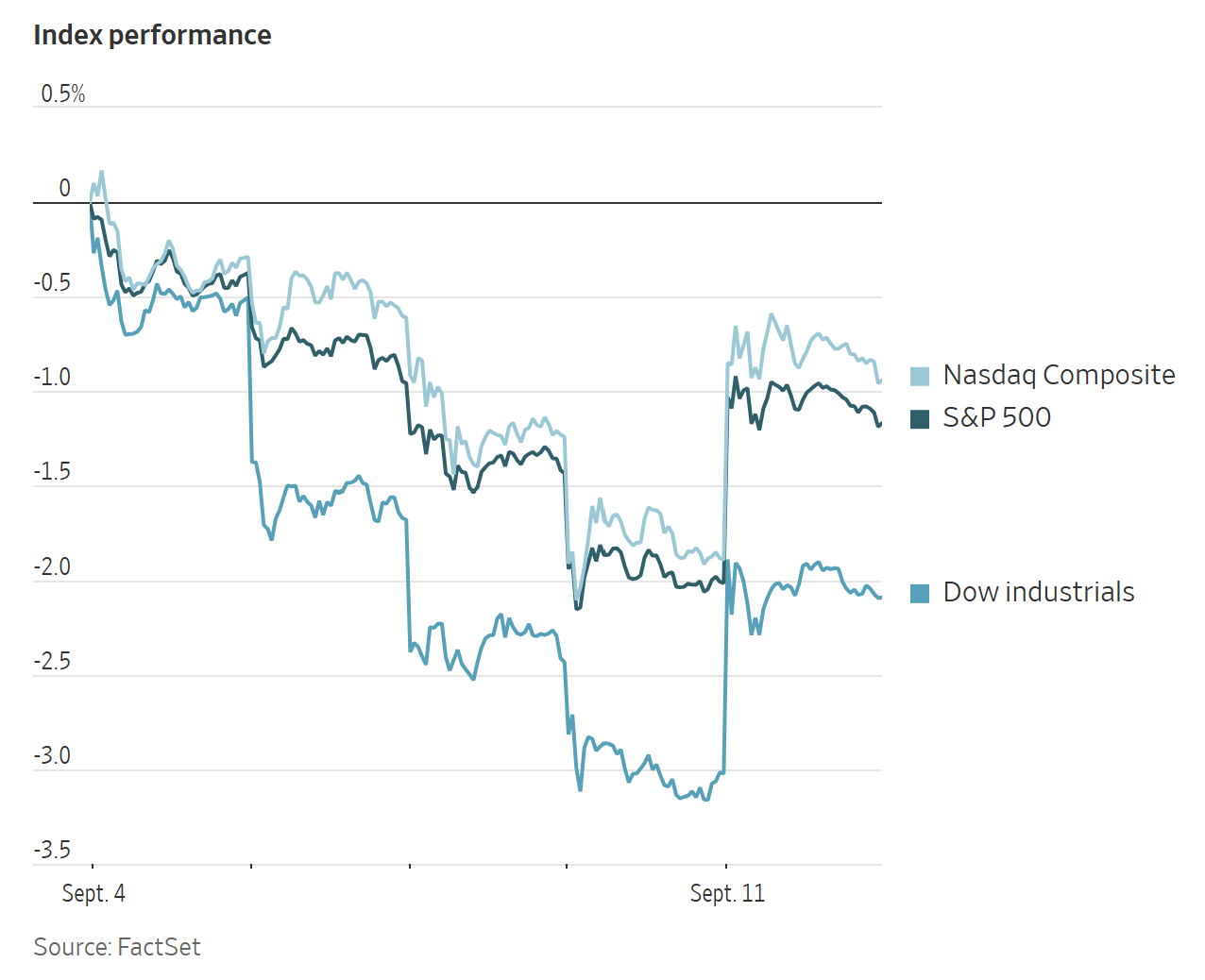
US stocks ended a four-session losing streak as a pause in the sharp rise in oil prices outweighed higher consumer inflation data.
The Dow Jones Industrial Average gained 509.19 points, or +0.98% on Friday, to 52,573.29. The S&P 500 rose 65.28 points, or +0.86%, to 7,656.98, while the tech-heavy Nasdaq Composite added 251.31 points, or +0.96%, to 26,333.04.
For the week, US indices finished lower. The S&P 500 declined -0.38%, the Dow Jones fell -1.57% and the Nasdaq Composite slipped -0.66%.
In corporate news, Bloomberg news reported that Apollo Global Management is in talks to acquire Johnson & Johnson’s orthopedics unit, DePuy Synthes. The discussions value the unit at nearly $20 billion, with a potential agreement possible within weeks. Johnson & Johnson could also spin off the business as a publicly traded company and has said DePuy Synthes would be the world’s largest orthopedics company if it becomes independent.
The Financial Times reported that GE Healthcare is in talks to acquire Sofie Biosciences for $1 billion.
Corporate Earnings Reports
Posted on Friday, 11 September from The Pulse, our real-time AI-driven news tool. Available exclusively on the EXANTE Web Platform
Kroger reported Q2 revenue of $34.6bn (vs $34.58bn est.), up +2% y/y, and adjusted EPS of $1.09 (vs $1.06 est.), up +5% y/y. The company lowered its FY identical sales growth (ex-fuel) forecast to +0.2% to +0.8%, down from +1.0% to +2.0%, citing consumer pressure from higher fuel prices and reduced SNAP benefits. Adjusted e-commerce sales rose +20% y/y. The FY adjusted EPS guidance of $5.10-$5.30 was reaffirmed. A $1bn share repurchase was completed. Management stated they were updating identical sales guidance while reaffirming adjusted profit and EPS forecasts.
European Stock Indices
CAC 40 +0.78%
DAX +0.82%
FTSE 100 +0.39%
Commodities
Gold spot +0.73% to $4,347.32 an ounce
Silver spot +1.43% to $64.46 an ounce
West Texas Intermediate -3.79% to $99.99 a barrel
Brent crude -4.18% to $104.42 a barrel
Gold prices strengthened on Friday as dip-buying took place after prices dropped earlier last week, finding a short-term floor.
Spot gold rose +0.73% to $4,347.32 per ounce; however, it declined -1.82% for the week.
Spot silver advanced +1.43% to $64.46 per ounce, although it fell -2.62% over the week.
Oil prices declined on Friday, but still posted a weekly gain of more than eight percent. US diesel prices reached a record high as attacks along Middle East shipping routes intensified concerns over prolonged supply disruptions.
Brent crude futures settled at $104.42 per barrel, down $4.55, or -4.18%.
US West Texas Intermediate crude finished at $99.99 per barrel, down $3.94, or -3.79%. During the session, both benchmarks touched their highest levels since mid-May.
For the week, Brent advanced +8.94% and WTI rose +9.61%.
The benchmarks reversed earlier gains after the Financial Times reported that Middle Eastern foreign ministers were seeking a temporary arrangement with Iran to manage shipping through the Strait of Hormuz.
On Thursday, Brent and WTI each rose more than six percent following an escalation in regional shipping attacks.
Satellite imagery on Thursday showed smoke near Saudi Arabia’s East-West Pipeline, a critical route that enables the kingdom to divert crude exports away from the Strait of Hormuz.
Saudi Arabia’s crude supply fell by 2.3 million bpd month over month to 6 million bpd in August, its lowest level in more than three decades, the International Energy Agency said on Friday, citing attacks on Saudi energy facilities.
Adding to concerns over regional oil flows, Yemen’s Iran-aligned Houthis reached Perim Island in the Bab el-Mandeb Strait on Friday, four Yemeni government sources told Reuters. This potentially tightens their position along one of the world’s most important shipping routes.
Iran said it had attacked 10 ships near the Strait of Hormuz on Wednesday after the US struck five Iranian oil tankers. Iran’s Islamic Revolutionary Guard Corps said it would escalate its response to any further attacks.
Preliminary ship-tracking data released on Friday showed vessel transits through the Strait of Hormuz fell to seven on Thursday from 11 the previous day.
Note: As of 4 pm EDT 11 September 2026
Currencies
EUR -0.08% to $1.1598
GBP +0.12% to $1.3518
Bitcoin -0.23% to $77,062.75
Ethereum +2.19% to $2,514.74
The US dollar edged higher against the euro on Friday after US inflation data showed consumer prices increased.
The euro declined -0.08% to $1.1598 and recorded a weekly loss of -0.04%.
The dollar index rose +0.02% to 99.10 on Friday. However, it fell -0.06% for the week, marking its second consecutive weekly decline.
The yen posted a second consecutive weekly gain against the US dollar, rising +1.73% for the week after strengthening +0.51% on Friday to ¥153.54 per dollar.
The BoJ is expected to raise interest rates this week and could signal a faster pace of future tightening if rising price pressures increase the risk of inflation overshooting its target.
Japan’s currency strengthened further after data showed that Japanese wholesale inflation remained elevated in August, reinforcing the case for a rate hike this month.
The British pound advanced +0.12% against the US dollar on Friday, bringing its weekly gain to +0.04%.
Fixed Income
US 10-year Treasury +0.7 basis points to 4.976%
German 10-year Bund +0.8 basis points to 3.520%
UK 10-year Gilt -3.6 basis points to 5.278%
The global bond selloff paused on Friday after a widely anticipated US inflation report came in line with expectations.
The two-year Treasury yield, which is particularly sensitive to Fed funds rate expectations, rose +3.2 bps to 4.620%. For the week, the two-year yield advanced +24.8 bps.
The 10-year Treasury yield increased +0.7 bps to 4.976%. Over the week, the 10-year yield advanced +18.7 bps.
The 30-year Treasury yield declined -1.0 bps to 5.358%. However, over the week, it rose +11.1 bps.
The US 2s10s yield curve stood at 35.6 bps, narrowing by -6.1 bps from 41.7 bps in the prior week.
Markets are pricing a 86.2% probability of a 25 bps hike at this week’s FOMC meeting, up from 59.4% the prior week, according to CME FedWatch.
Eurozone government bond prices steadied on Friday, although the broader global debt market has one of its weakest weekly performances since the start of the Iran war.
On Thursday the ECB increased eurozone rates by 25 bps, as expected, while raising its inflation forecast and lowering its growth projection.
German two-year bond yields were -3.4 bps lower on Friday at 3.210%, after trading as much as 3.0 bps higher earlier in the session. For the week, they rose +25.9 bps, the largest weekly increase since the first week of the war in early March.
The 10-year Bund yield rose +0.8 bps on Friday to 3.520%, contributing to a weekly increase of +16.6 bps, also the largest since early March.
Ten-year Italian BTP yields rose +6.2 bps on Friday and advanced +20.3 bps for the week to 4.354%, leaving the spread over Bunds at 83.4 bps, 3.7 bps wider than the prior week’s 79.7 bps.
French 10-year OAT yields traded +1.5 bps higher on Friday at 4.451%, contributing to a weekly rise of +24.4 bps.
Note: As of 4 pm EDT 11 September 2026
While every effort has been made to verify the accuracy of this information, EXT Ltd. (hereafter known as “EXANTE”) cannot accept any responsibility or liability for reliance by any person on this publication or any of the information, opinions, or conclusions contained in this publication. The findings and views expressed in this publication do not necessarily reflect the views of EXANTE. Any action taken upon the information contained in this publication is strictly at your own risk. EXANTE will not be liable for any loss or damage in connection with this publication.
本文提供给您仅供信息参考之用,不应被视为认购或销售此处提及任何投资或相关服务的优惠招揽或游说。金融工具交易存在重大亏损风险,未必适合所有投资者。过往表现并非未来业绩的可靠指标。








由专业人士创建。 为专业人士。
