

The calm before the storm?

 S&P 500 -0.48% to 7,619.98 US 10-year yield +1.2 basis points to 4.988% Spot gold -1.14% to $4,297.89 an ounce DXY +0.38% at 99.47
Key data to move markets today
EU: French CPI, Spanish CPI and Harmonised Index of Consumer Prices, German ZEW Survey of Current Situation and Economic Sentiment, Eurozone ZEW Survey of Economic Sentiment, Eurozone Trade Balance and a speech by ECB Executive Board member Piero Cipollone
UK: ILO Unemployment Rate, Claimant Count Rate and Change and Average Earnings
USA: ADP Employment Change 4-week average and New York Empire State Manufacturing Index
JAPAN: Merchandise Trade Balance, Adjusted Merchandise Trade Balance, Imports and Exports
Global Macro Updates
The dots and the new price of money. Five percent is beginning to look less like a market accident than a regime change. The 10-year Treasury has crossed that threshold for the second time since 2007, while borrowing costs across Germany, Britain, Japan and Australia sit near multi-decade highs. Bond markets are testing higher yields for longer, tighter policy across developed markets and less forgiving term premia.
That makes this week’s FOMC meeting consequential. Markets expect a quarter-point increase, but the real information will sit in Fed Chair Kevin Warsh’s language and the plot dot. Warsh omitted his projection in June, while half of participating officials then favoured at least one 2026 increase. His press conference must clarify if restraint is tactical or instead signals the opening chapter of a higher rate era. The dot plot can provide the clearest signal, pointing to one hike, a sequence of hikes or broad institutional hesitation.
This time, the main culprit driving inflation expectations higher is a war with no clear end in sight. Europe offers the sharpest transmission channel. Natural-gas prices rose more than four percent in the latest session as disrupted Hormuz traffic, scant US - Iran diplomatic progress and signs of an expanding Saudi-Houthi confrontation reinforced supply anxiety before winter. European prices are near their highest since late 2022, while storage is roughly 68% full, about 17 percentage points below seasonal norms. The buffer is uneven, as Reuters notes, Italy’s stands at 83%, Spain’s at 73% and France’s at 71%, while Germany’s and the Netherlands’ hover near 50%.
The bearish case for bonds may still contain a silver lining under a more constructive scenario. Some investors argue that the US economy can absorb a 5% yield without a sharp slowdown, supported by nominal growth slightly above 6%, unemployment at 4.1% and still-strong AI CapEx cycle. Still, the question remains, what catalyst could drive rates materially lower? Beyond a traditional recession, that catalyst is difficult to find.
The rise in yields may represent a partial normalisation and a return to the pre 2008 environment, before central bank bond buying and ultralow rates made cheap money feel constitutional. Yet, resilience remains concentrated at the top. High earners account for nearly half of consumption, lower income households are retrenching, existing home sales are at a yearly low and mortgage affordability has deteriorated.
The last underlying upward pressure is fiscal restraint, or more precisely, the lack of it. Large deficits, heavier sovereign issuance and AI-related capital demand are competing for duration. Fed Chair Warsh and the newly updated dots can validate the new price of money; reversing it may require the recession investors cannot otherwise find.
US Stock Indices
Dow Jones Industrial Average -0.29%
Nasdaq 100 -0.82%
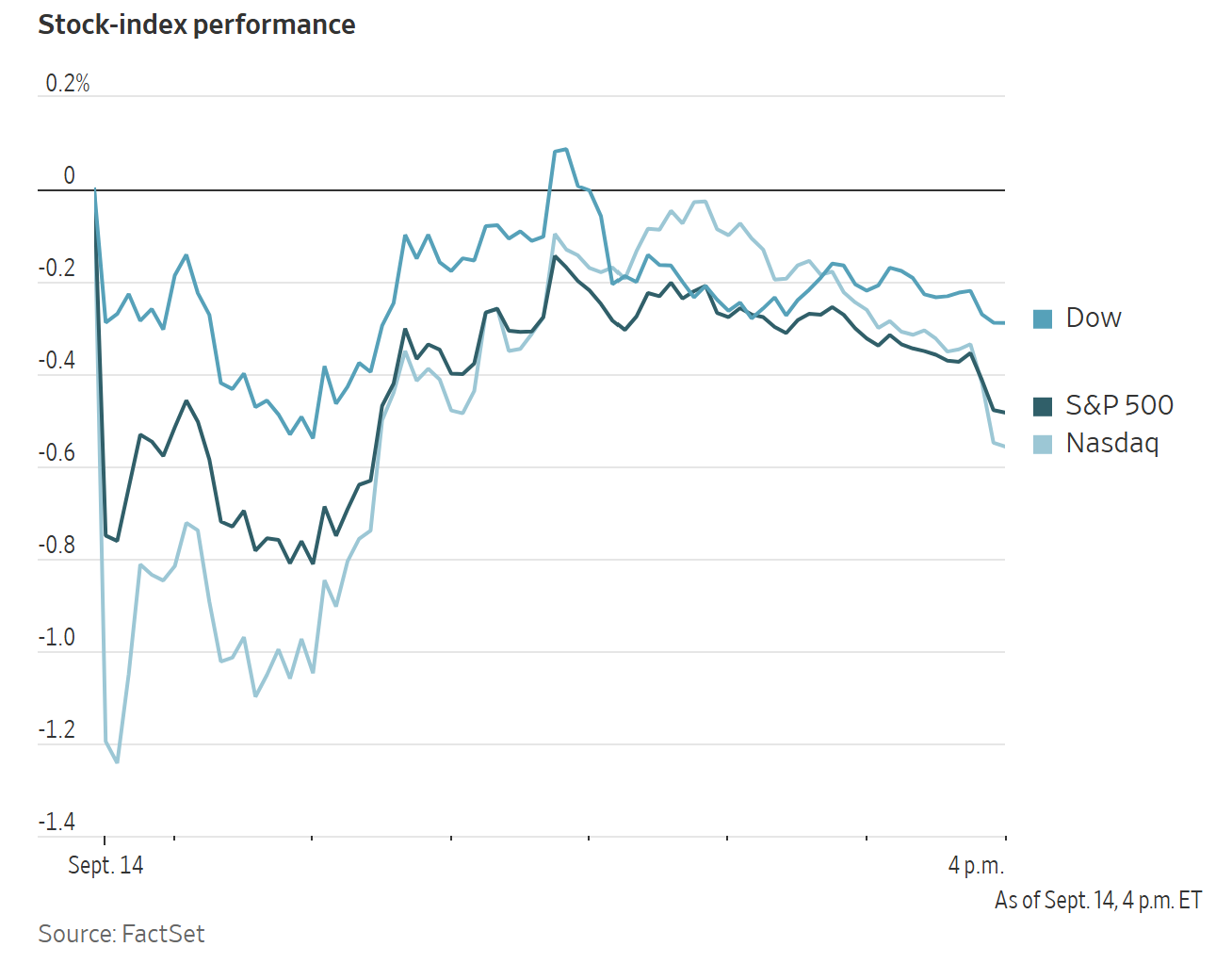
S&P 500 -0.48%, with 9 of the 11 sectors of the S&P 500 down
The heads of three of the largest AI companies broadly agreed that the industry may need to slow the pace of development before advances in the technology create risks that are difficult to control.
The remarks marked a rare display of alignment among Elon Musk, Sam Altman and Dario Amodei, whose companies have been committing tens of billions of dollars to build increasingly powerful AI models. Altman also suggested that OpenAI may need to delay its highly anticipated IPO in order to prioritise safety considerations.
Investors, however, appeared unwilling to wait for industry leaders to translate those concerns into action. Shares of companies exposed to a potential slowdown in AI demand came under pressure on Monday, while software firms whose business models could be disrupted by AI moved higher.
The Nasdaq Composite was down -0.56% on the day after earlier falling as much as 1.30%. The Dow Jones Industrial Average fell 152.09 points, or -0.29%. Information Technology was the weakest sector in the S&P 500, declining -1.67%. The S&P 500 fell -0.48%.
In corporate news, Bank of America CEO Brian Moynihan said, at the Barclays Global Financial Services Conference in New York, that trading revenue is expected to be relatively flat versus Q3 of last year, while investment banking fees are likely to decline by more than ten percent from the year-earlier period.
Reuters reported that Kimberly-Clark is preparing concessions to address EU antitrust concerns related to its $40 billion bid for Kenvue.
Sequence Holdings and DFO Management, Michael Dell’s family office, announced on Monday that they had reached an agreement to acquire Baldwin Insurance Group for $7.7 billion. Baldwin shareholders will receive $32.50 per share in cash, representing a 9.6% premium to Friday’s closing price.
European Stock Indices
CAC 40 -0.76%
DAX -0.50%
FTSE 100 +0.44%
Commodities
Gold spot -1.14% to $4,297.89 an ounce
Silver spot -1.90% to $63.23 an ounce
West Texas Intermediate +1.90% to $101.89 a barrel
Brent crude +1.69% to $106.18 a barrel
Gold prices declined on Monday as the US dollar strengthened. Spot gold fell -1.14% to $4,297.89 per ounce.
Spot silver fell by -1.90% to $63.23 per ounce.
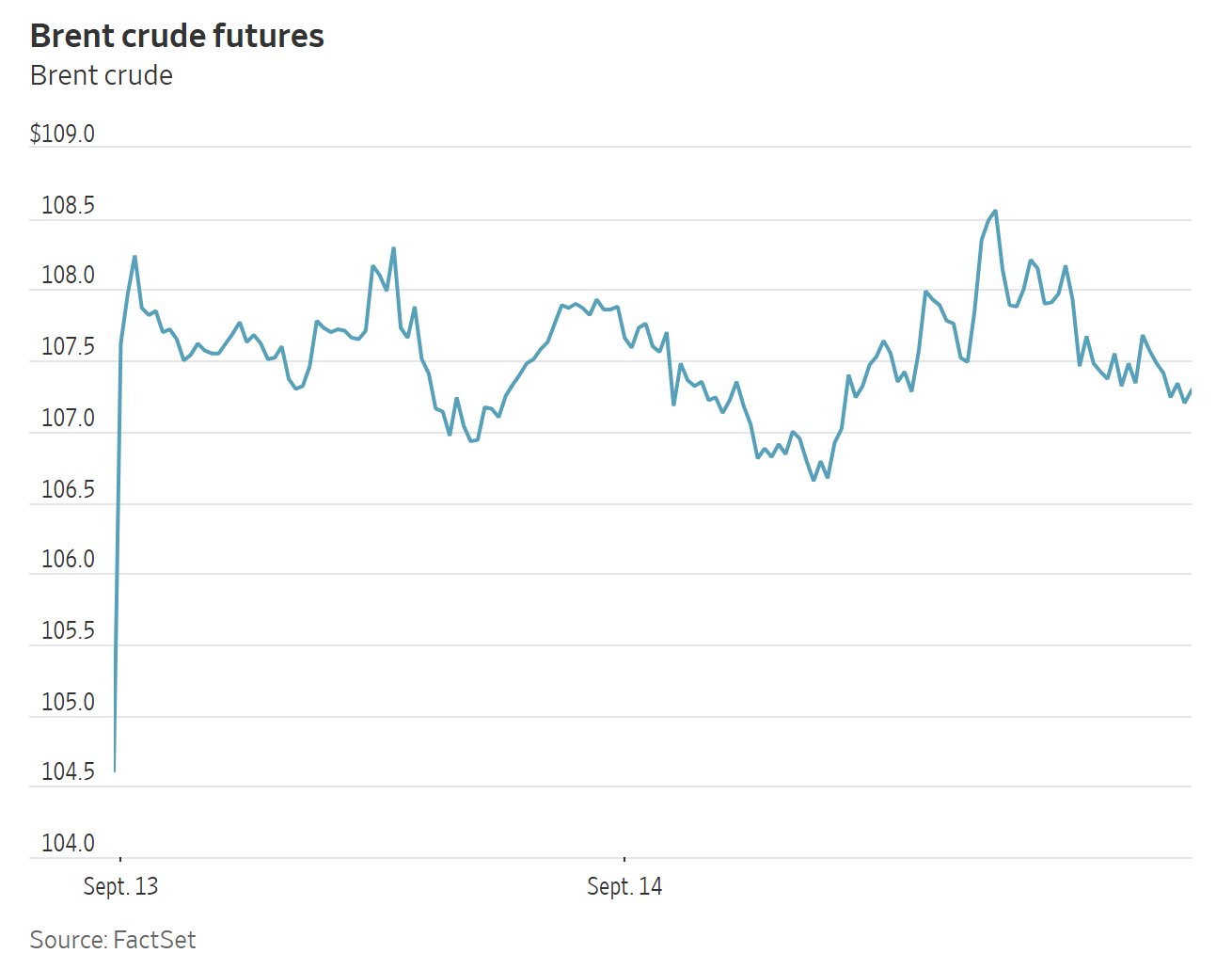
Oil prices advanced on Monday as concerns over potential supply disruptions persisted after attacks on Saudi Arabian energy infrastructure left the kingdom’s East - West pipeline offline and raised doubts about efforts to reduce shipping risks in the Gulf.
Brent crude futures rose $1.76, or +1.69%, to $106.18 per barrel, while US WTI futures traded $1.90 higher, or +1.90%, at $101.89 per barrel.
Iran-backed Houthi forces in Yemen launched renewed attacks on Saudi Arabia on Monday, while Gulf Arab states postponed planned discussions with Iran. This reinforced concerns that the Middle East conflict could broaden and disrupt global oil supplies.
The Houthis carried out a missile and drone strike on the Khamis Mushait military airbase in southern Saudi Arabia, hitting aircraft hangars, radar systems, runways and ammunition depots in retaliation for Saudi strikes in Yemen.
The latest escalation followed Friday’s attacks on Saudi Arabia, which Riyadh attributed to Iranian-backed fighters in Iraq. These disrupted the country’s East - West pipeline, a key route that enables oil exports to bypass the blockaded Strait of Hormuz.
With the East - West pipeline offline and stockpiles at the Red Sea port of Yanbu limited, Saudi Red Sea exports could cease within three to five days. Over the weekend, Yemen’s Houthis also captured additional positions in and around the Bab al-Mandib Strait.
The world’s largest exporter has used the pipeline to reroute approximately 4 million bpd, equivalent to roughly four percent of global supply, to Yanbu on the Red Sea.
Separately, President Volodymyr Zelenskiy said on Monday that Kyiv was prepared to support a US proposal for a Russia - Ukraine ceasefire covering energy sites only if Washington could confirm that Moscow was genuinely willing to end its war against Ukraine. If sustained, such an agreement could eventually increase global supplies of diesel and other fuels, although it may take months for additional supply to reach international markets.
Note: As of 4 pm EDT 14 September 2026
Currencies
EUR -0.44% to $1.1547
GBP -0.16% to $1.3496
Bitcoin +2.20% to $78,755.06
Ethereum +1.27% to $2,546.59
The dollar edged higher on Monday, trading near a two-week high. The dollar index was +0.38% higher at 99.47.
The euro was -0.44% weaker against the US dollar at $1.1547.
The yen retreated from a seven-month high, trading -0.51% lower at ¥154.33 ahead of an expected BoJ rate hike on Friday. Market sentiment toward the yen has begun to shift, with speculators moving to a net long position in the Japanese currency for the first time since February.
The pound fell to its lowest level in more than a month on Monday, with sterling declining -0.16% to $1.3496, its weakest level since 7 August.
Sterling traded -0.10% lower against the euro at 85.61 pence.
The BoE is expected to keep rates on hold on Thursday, although traders now anticipate an increase later this year and further tightening in 2027.
Data released on Friday showed UK GDP expanded 0.4% in July, above economists’ consensus expectations for no growth.
Fixed Income
US 10-year Treasury +1.2 basis points to 4.988%
German 10-year Bund +1.3 basis points to 3.533%
UK 10-year Gilt +4.1 basis points to 5.319%
The 10-year Treasury yield passed the key psychological threshold of five percent on Monday for the first time since October 2023, ahead of this week’s FOMC meeting.
The yield later moved back below five percent and was +1.2 bps on the day at 4.988%, after reaching an intraday high of 5.014%.
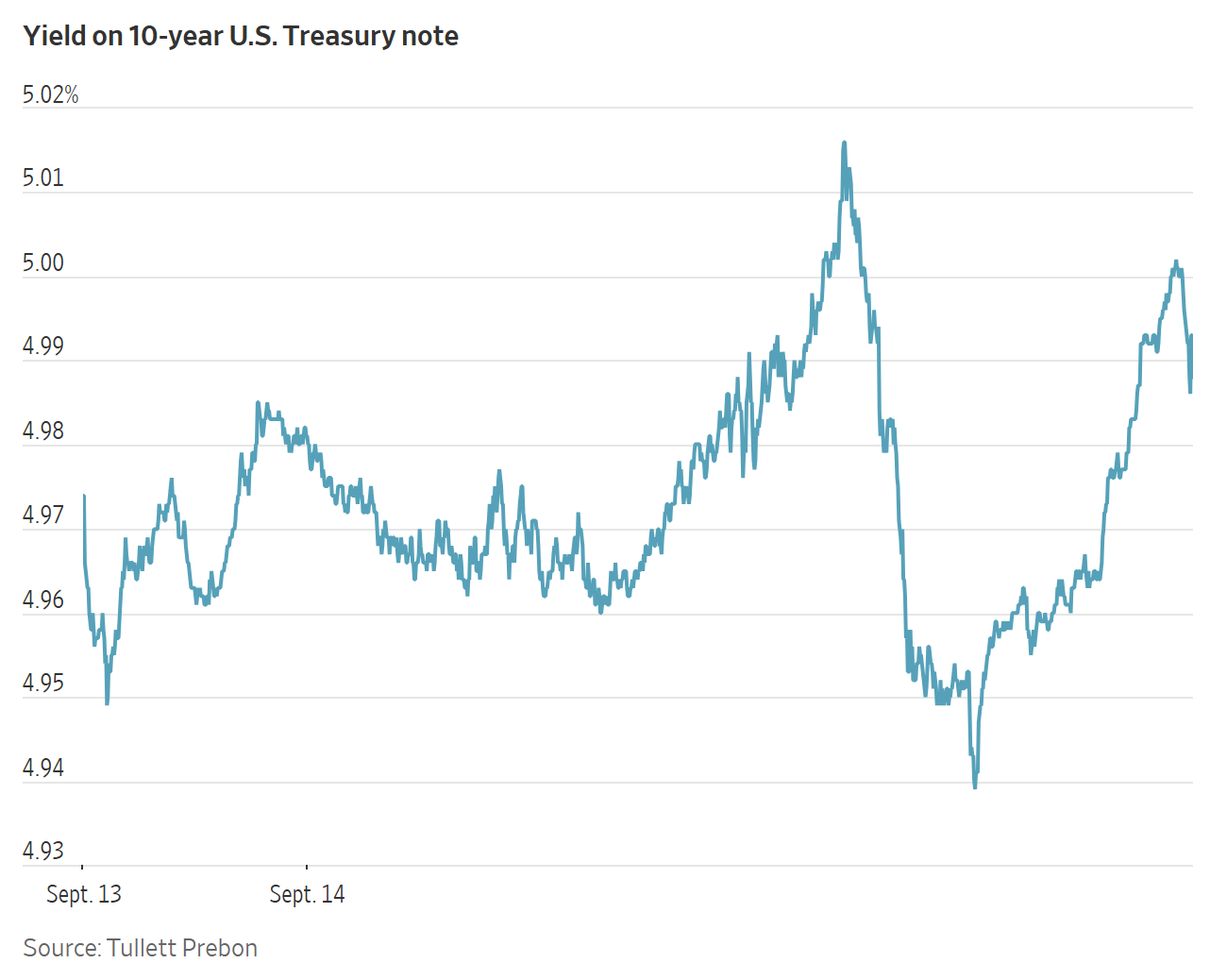
The 10-year yield traded above five percent only briefly in 2023. A move above that year’s peak of 5.021% would mark the highest level since 2007.
Yields rose after data released on Friday showed US CPI accelerated in August, strengthening expectations that the Fed will raise rates to curb inflation that remains well above its two percent annual target.
A resilient labour market, with employers adding 162,000 jobs last month, further supported that view.
Fed funds futures traders are now pricing a 92.4% probability of a rate hike at the end of the Fed’s two-day meeting on Wednesday, according to CME FedWatch.
Traders will also focus on the Fed’s updated interest-rate projections in the dot plot for signs of possible future rate hikes. The previous quarterly projections, released at the Fed’s June meeting, showed that nine officials anticipated a rate increase by year-end.
The 2-year note yield, which typically moves in line with Fed funds rate expectations, traded +5.5 bps higher at 4.675%, after earlier reaching 4.679%, its highest level since July 2024.
The US 2s10s yield curve flattened to 31.3 bps.
Demand for longer-dated debt will also be tested as the Treasury sells $13 billion in 20-year bonds today. The US Treasury will also auction $19 billion in 10-year Treasury Inflation-Protected Securities on Thursday.
Eurozone bond yields rose broadly on Monday, with Germany’s 10-year yield reaching its highest level since mid-2009.
Germany’s 10-year bond yield climbed +18.7 bps last week, its largest weekly increase since the first week of March, shortly after the Iran war began.
On Monday, it reached a more than 17-year high of 3.554% before settling at 3.533%, up +1.3 bps on the day.
Markets are expecting rate hikes from the Fed and BoJ, while the BoE is expected to leave policy unchanged in what is likely to be a close decision.
Several ECB policymakers on Monday expressed concern about higher energy prices and other inflation indicators. Benchmark Dutch and British wholesale gas prices reached their highest intraday levels since late 2022 on Monday.
Bank of Latvia Governor Martins Kazaks told Reuters that there may be scope for additional incremental hikes as energy prices and broader inflation remain elevated.
‘The case is building for further tightening,’ he said, while noting that the ECB could proceed without rushing.
Reuters also noted that the ECB is increasingly focussed on European natural gas prices as it assesses their impact on inflation. ECB Executive Board member Isabel Schnabel highlighted oil price developments, but emphasised that gas is especially important for Europe and has also reached very high levels. Separately, National Bank of Slovakia Governor Peter Kazimir underscored upside inflation risks.
The yield on Germany’s 2-year Schatz, which is more sensitive to ECB deposit-rate expectations, was +6.1 bps on the day at 3.271%, its highest level since late 2023.
Money markets are pricing at least one additional ECB rate hike this year. Two further 25 bps hikes are fully priced by February 2027, with a possibility of additional tightening later next year.
Note: As of 4 pm EDT 14 September 2026
While every effort has been made to verify the accuracy of this information, EXT Ltd. (hereafter known as “EXANTE”) cannot accept any responsibility or liability for reliance by any person on this publication or any of the information, opinions, or conclusions contained in this publication. The findings and views expressed in this publication do not necessarily reflect the views of EXANTE. Any action taken upon the information contained in this publication is strictly at your own risk. EXANTE will not be liable for any loss or damage in connection with this publication.
本文提供给您仅供信息参考之用,不应被视为认购或销售此处提及任何投资或相关服务的优惠招揽或游说。金融工具交易存在重大亏损风险,未必适合所有投资者。过往表现并非未来业绩的可靠指标。







由专业人士创建。 为专业人士。
