

What will be the next catalyst?


 S&P 500 +0.65% to 7,798.99 US 10-year yield -4.6 basis points to 4.647% Spot gold -1.29% to $4,350.16 an ounce DXY -0.05% to 99.96
Key data to move markets today
EU: French CPI and Eurozone GDP, Trade Balance and Employment Change
USA: Retail Sales, Michigan Consumer Sentiment and Expectations Indices and UoM 1- and 5-year Consumer Inflation Expectations
Global Macro Updates
July PPI cooler than expected, Fedspeak flags upside inflation risks. July core PPI rose 0.2% m/o/m, below consensus of 0.3% and June's revised 0.4% gain, with the annual rate easing to 4.2% from 4.7% in June, in line with expectations. Headline PPI was flat versus a forecast 0.1% rise and June's revised 0.1% decline. This took the annual pace down to 4.7% from 5.5%, also cooler than the 4.9% consensus.
Final demand services increased 0.2%. This was led by a 0.6% rise in services excluding trade and transportation. Final demand goods fell 0.7% on weaker energy and food prices, with gasoline down 5.7%. Among components feeding into PCE, portfolio management rose 6.5% and hospital outpatient care gained 0.9%, while airline passenger services fell 3.4% and physician care slipped 0.1%.
Fed officials continued to flag inflation risks despite the softer print. Cleveland Fed President Hammack, a FOMC voter this year, said she is skeptical the recent cooling will prove durable enough to bring inflation back to the 2% target and reiterated her call for the Fed to act now. She had earlier told Yahoo Finance that a single 25 bps hike would not be sufficient and that further moves are likely needed, though she declined to specify how far the Fed will ultimately go.
Richmond Fed President Barkin, a non-voter, said it remains an open question whether further rate hikes will be necessary to meet the inflation goal. He attributed current price pressures to supply shocks, oil prices and the AI buildout, all of which could ease naturally over time. Still, Barkin warned that above-target inflation risks becoming more entrenched and flagged the danger of an upward shift in inflation expectations among firms and consumers.
UK GDP surprises to the upside in June. UK monthly activity data surprised to the upside in June, with GDP expanding 0.3% versus expectations for a 0.1% contraction and May's downwardly revised flat reading. On a quarterly basis, Q2 GDP rose 0.4%, matching consensus and slowing from Q1's 0.6% gain, while annual growth accelerated to 1.2% from 0.9%, ahead of the 1.1% expected.
June's growth was driven by a 0.4% rise in services output, partially offset by declines of 0.2% in production and 0.1% in construction. Over the quarter, services output grew 0.5% while production was flat and construction rose 0.3%. The ONS noted that 10 of 14 services subsectors expanded, led by information and communication, up 2.7%, professional, scientific and technical activities, up 1.7%, and transport and storage.
The economy has held up well despite the energy shock, with household demand and business activity resilient even as confidence indicators took a hit following the outbreak of the Iran conflict. Still, the BoE and sell-side economists expect momentum to slow in coming months, with the central bank's July Monetary Policy Report forecasting flat growth in Q3 as the conflict's effects on demand feed through.
US Stock Indices
Dow Jones Industrial Average +0.13%
Nasdaq 100 +1.15%
S&P 500 +0.65%, with 7 of the 11 sectors of the S&P 500 up
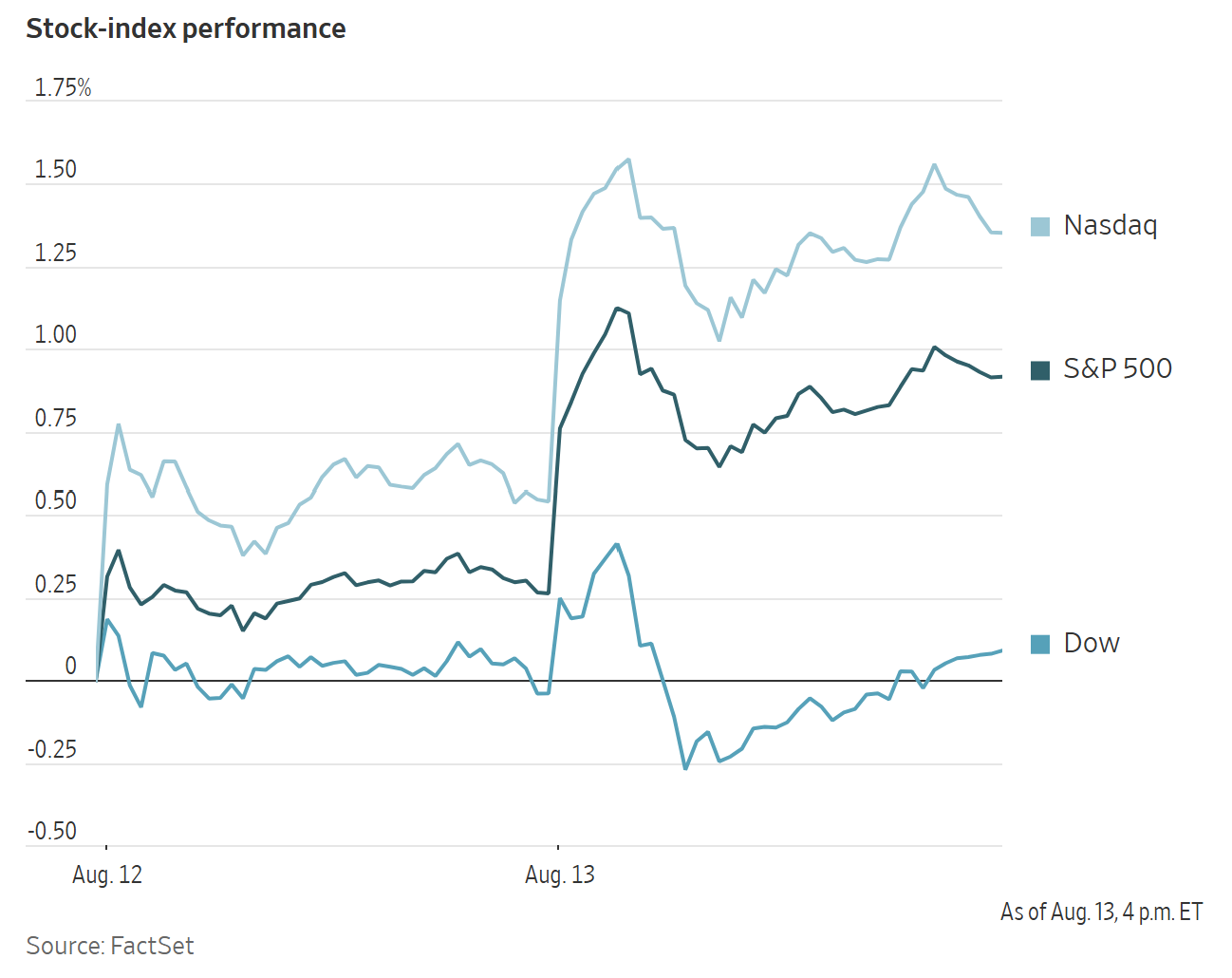
Cooling inflation signals supported a broader risk-on tone on Thursday, helping lift the S&P 500 to a record high.
US equities advanced while Treasury yields declined after producer price data came in softer than expected. This reinforced Wednesday’s benign consumer inflation reading and strengthened investor confidence that the Fed is unlikely to raise rates imminently.
The S&P 500 rose +0.65% to a new all-time high of 7,798.99, while the Nasdaq Composite gained +0.81%. The Dow Jones Industrial Average added +0.13%, or 69.72 points.
In corporate news, Tyson Foods announced plans to close a major beef-processing plant in Illinois, sell a facility in Washington and shut a packaging facility in Utah. Together with a prior closure and production reduction, the planned exits this year would reduce Tyson’s beef-processing footprint by roughly one-third.
AMD raised $4.75 billion in its largest-ever US dollar bond offering, adding to the recent wave of debt issuance linked to the artificial intelligence boom. The company said proceeds from the sale would be used for general corporate purposes, including potential debt repayment. AMD issued high-grade notes across four tranches with maturities ranging from three to 10 years. Pricing on the longest tranche tightened by about 25 bps from initial talk to 90 bps over Treasuries, according to Bloomberg news. The transaction comes ahead of $875 million of AMD bonds maturing next month and follows the company’s prior investment-grade issuance in March 2025, when it raised $1.5 billion.
Corporate Earnings Reports
Posted on Thursday, 13 August from The Pulse, our real-time AI-driven news tool. Available exclusively on the EXANTE Web Platform
Intuitive Machines reported Q2 revenue of $206mn vs $216mn consensus, with EPS of -$0.29 vs -$0.10 expected. Net loss was -$62.8mn. Cash stood at $367mn. Backlog reached a record $1.8bn, up $1.5bn from year-end. Q2 bookings were $920mn plus $300mn Q3-to-date. National Security revenue mix surged from 3% to 30% y/y. FY 2026 guidance targets revenue of $900mn-$1bn and positive Adjusted EBITDA. The company secured a $600mn+ contract for three GEO satellites, a July award for 18 spacecraft supporting the AMDT3 Golden Dome constellation, and its sixth NASA CLPS lunar mission. CEO Steve Altemus said the company is building a next-generation space prime across civil, commercial, and national security markets. Separately, Stifel upgraded the stock to Buy and cut its price target to $26 from $32.
Applied Materials reported Q3 earnings on 13 Aug 2026. Revenue was $9.12bn (up +25% y/y) vs $9.02bn consensus, and adjusted EPS was $3.50 (up +41% y/y) vs $3.39 expected. Q4 guidance includes revenue of $9.75bn to $10.75bn (vs $9.62bn est) and adjusted EPS of $4.02 (vs $3.69 est). The company achieved record cash from operations of $3.04bn, returned $860mn to shareholders, launched six new chipmaking systems, invested $500mn in Singapore expansion, and signed a joint development agreement with EssilorLuxottica for AI smart eyewear. Management raised Semiconductor Systems revenue expectations for calendar 2026. CEO Gary Dickerson said AI is driving unprecedented demand for the company’s materials engineering solutions.
JD reported Q2 2026 earnings. Revenue was RMB346.4bn (down -2.9% y/y) vs RMB344.62bn expected. Non-GAAP EPS was RMB6.29 vs RMB5.57 expected, up from RMB4.97 last year. Operating income was RMB4.5bn vs RMB4.9bn expected, compared with a -RMB0.9bn loss a year ago. Non-GAAP net income was RMB8.9bn vs RMB7.85bn expected. CEO Sam Su commented that despite near-term revenue headwinds, the company achieved strong bottom-line growth, marking a clear inflection in its profit trajectory.
European Stock Indices
CAC 40 -0.28%
DAX -0.12%
FTSE 100 -0.56%
Commodities
Gold spot -1.29% to $4,350.16 an ounce
Silver spot -0.81% to $64.72 an ounce
West Texas Intermediate -2.01% to $81.21 a barrel
Brent crude -1.88% to $86.95 a barrel
Gold prices declined on Thursday, retreating from an earlier session high as momentum faded. Spot gold fell -1.29% to $4,350.16 per ounce, after touching $4,449.39 per ounce, its highest level since 5 June.
Spot silver also weakened, declining -0.81% to $64.72 per ounce.
Crude benchmarks settled lower on Thursday, pressured by persistent concerns over a weaker demand outlook for this year and rising US crude inventories. Prices pared part of their early decline after reports that Yemen’s Houthis targeted a Saudi Aramco refinery with drones, renewing concerns over supply disruptions in an already tight global market.
Brent futures ended $1.67, or -1.88%, lower at $86.95 per barrel, following a six-session rally. US WTI crude closed down $1.67, or -2.01%, at $81.21 per barrel, after advancing for five consecutive sessions.
Geopolitical risks remained central to market sentiment. The Persian Gulf Strait Authority stated on X that the Strait of Hormuz remains blocked and will not be reopened until Iran’s conditions are accepted. Separately, Iran’s military rejected US claims that vessels are passing through the Strait of Hormuz, stating that the waterway remains under Iran’s control and management.
US Defense Secretary Pete Hegseth said the US military could maintain a blockade on Iranian ports for as long as needed. Traders continued to assess the potential scale of disruption after US Energy Secretary Chris Wright said about 9 million bpd was moving through the strait weekly. Kpler shipping data showed vessel crossings, excluding container ships, fell to five on Wednesday, the lowest level in three weeks.
Supply concerns were further amplified after Yemen’s Houthi-run Saba news agency reported that the group attacked Saudi Aramco’s Jazan refinery with two drones. The Jazan refinery has capacity to produce 250,000 bpd of ultra-low sulfur diesel, according to Saudi Aramco’s website. Reports of the attack pushed diesel cracks to an all-time high.
A Houthi military source said the attack was in response to what the group described as Saudi violations of Yemeni airspace and sovereignty in Saada and Hajjah provinces. Bloomberg news also reported that a second supertanker appeared moored at Saudi Arabia’s main oil export terminal inside the Persian Gulf. This suggests loadings at the hub may be recovering as alternative routes remain exposed to significant threats.
CNBC reported that Saudi Arabia has increased oil exports through a pipeline running across Egypt to the Mediterranean Sea to avoid Red Sea attacks. Exports from Egypt’s Mediterranean port of Sidi Kerir more than doubled to around 2.3 million bpd in August, compared with roughly 1 million bpd in the prior month, according to Kpler data.
Elsewhere, Russia’s Orsk refinery, damaged by a Ukrainian drone attack, could reportedly take up to six months to repair. Russia’s diesel and gasoil exports fell to just 80,000 bpd in the first seven days of August, according to Vortexa data compiled by Bloomberg, compared with more than 1 million bpd at the end of last year. Reuters also reported that Russia’s seaborne oil products exports fell -33% m/o/m in July to about 3.9 million metric tons, reflecting lower fuel production.
Diesel cargoes are also trading above jet fuel in Europe for the first time in more than a year, according to LSEG data.
Note: As of 4 pm EDT 13 August 2026
Currencies
EUR +0.05% to $1.1528
GBP -0.03% to $1.3484
Bitcoin -0.18% to $63,340.13
Ethereum +0.27% to $1,887.48
The US dollar edged lower on Thursday after data showed producer prices were unchanged in July, reinforcing the view that inflation pressures may be easing at the margin.
The dollar index declined -0.05% to 99.96, after briefly falling to 99.80 following the PPI release. The euro gained +0.05% to $1.1528.
The Japanese yen weakened -0.03% to ¥159.48 per dollar, while sterling eased -0.03% to $1.3484.
Fixed Income
US 10-year Treasury -4.6 basis points to 4.647%
German 10-year Bund -2.4 basis points to 3.150%
UK 10-year Gilt -1.9 basis points to 4.957%
US Treasuries rallied across the curve on Thursday, although a lackluster 30-year bond auction briefly interrupted the move. The 30-year bond auction priced at 5.216%, the highest yield since 2001 and slightly above market expectations, indicating that investors sought a modest concession to absorb the supply.
Despite the soft auction, the broader market tone remained biased toward lower yields.
In afternoon trading, the US 2-year yield, which is sensitive to the rate outlook, fell to its lowest level since mid-July, down -5.7 bps to 4.155%. The 10-year yield declined -4.6 bps to 4.647%, while the US 30-year yield was down -3.9 bps to 5.216%.
The yield curve steepened after the PPI data, with the 2s10s spread widening to 49.2 bps. This was its widest level since 22 May. It was 48.1 bps on Wednesday.
After the report, according to the CME FedWatch tool, US fed funds futures priced in a 34.8% probability of a rate increase at the September Fed meeting, down from 40.6% late Wednesday.
With the US data released, investors turned their focus to the $25 billion auction of new 30-year bonds, which produced mixed results. The bid-to-cover ratio was 2.39x, slightly below the six-auction average of 2.43x, while indirect bidders, including foreign investors, took 66.8% of the supply, modestly below the recent average of 67.0%. The yield on Thursday’s auction compares with 5.06 per cent at the previous 30-year sale in July.
Eurozone bond yields also declined on Thursday as markets continued to assess the policy outlook ahead of next month’s ECB meeting.
Germany’s 10-year yield fell -2.4 bps to 3.150%, while the 2-year yield, which is more sensitive to changes in policy expectations, declined -1.9 bps to 2.772%.
Markets are pricing in around a 90% probability of a 25 bps rate hike at the next ECB meeting.
Note: As of 4 pm EDT 13 August 2026
While every effort has been made to verify the accuracy of this information, EXT Ltd. (hereafter known as “EXANTE”) cannot accept any responsibility or liability for reliance by any person on this publication or any of the information, opinions, or conclusions contained in this publication. The findings and views expressed in this publication do not necessarily reflect the views of EXANTE. Any action taken upon the information contained in this publication is strictly at your own risk. EXANTE will not be liable for any loss or damage in connection with this publication.
本文提供给您仅供信息参考之用,不应被视为认购或销售此处提及任何投资或相关服务的优惠招揽或游说。金融工具交易存在重大亏损风险,未必适合所有投资者。过往表现并非未来业绩的可靠指标。








由专业人士创建。 为专业人士。
