

Will retail earnings tell a different story for investors?


 S&P 500 +0.36% last week to 7,785.76 US 10-year yield +4.6 basis points last week to 4.697% Spot gold +0.79% last week to $4,375.89 an ounce DXY +0.03% last week to 99.64
Key data to move markets today
EU: A speech by ECB Chief Economist Philip Lane
USA: New York Empire State Manufacturing Index
Global Macro Updates
July retail sales unexpectedly declined. Headline retail sales fell 0.6% m/o/m in July, compared with consensus expectations for a 0.1% increase and June’s unrevised 0.2% rise, marking the softest reading since May 2025. Retail sales excluding autos declined 0.3% m/o/m, versus expectations for a 0.2% gain and June’s unrevised 0.2% decline. It was the second consecutive monthly contraction and the weakest ex-auto reading since January 2025.
Control-group sales, which feed into GDP, declined 0.4% m/o/m, compared with consensus expectations for a 0.4% increase and June’s 0.4% rise.
Sales declined across several categories, led by online stores at 2.2%, motor vehicle and parts dealers at 1.8%, gas stations at 0.9%, and electronics and appliance stores at 0.5%. By contrast, gains were recorded at clothing and accessories stores at 1.9%, health and personal care stores at 0.7%, bars and restaurants at 0.5%, miscellaneous retailers at 0.5%, furniture and home furnishings stores at 0.3%, and building materials and garden supply stores at 0.3%. Sales were flat at food and beverage stores, as well as at sporting goods and hobby retailers.
The downside surprise had been partly anticipated, as previews had flagged risks from lower oil prices, weaker card-spending data, Prime Day payback and seasonal factors. Bank of America noted that any weakness was likely to be temporary, with resilient consumer fundamentals and low unemployment continuing to support spending.
UoM consumer inflation expectations. Preliminary August consumer sentiment came in below consensus, while near-term inflation expectations edged higher.
The preliminary University of Michigan consumer sentiment index fell to 51.0 in August, below consensus expectations of 54.5. The July preliminary reading was 54.4 and the final reading was 55.2.
The Current Economic Conditions Index declined to 51.8 from July’s final 54.8, while the Index of Consumer Expectations fell to 50.6 from 55.4.
Year-ahead inflation expectations increased to 4.3% from 4.2% in July and remained well above the 3.4% level recorded before the Iran conflict in February. Long-run inflation expectations were unchanged at 3.3% for a third consecutive month.
Sentiment weakened broadly, led by 11% and 17% declines in short- and long-term business expectations, respectively. The deterioration was particularly pronounced among older consumers, lower-income households and respondents without a college degree. Only 8% expected income growth to outpace inflation over the year ahead, down from 18% in December 2024.
US Stock Indices
Dow Jones Industrial Average -0.20%
Nasdaq 100 -0.13%
S&P 500 -0.17%, with 5 of the 11 sectors of the S&P 500 down
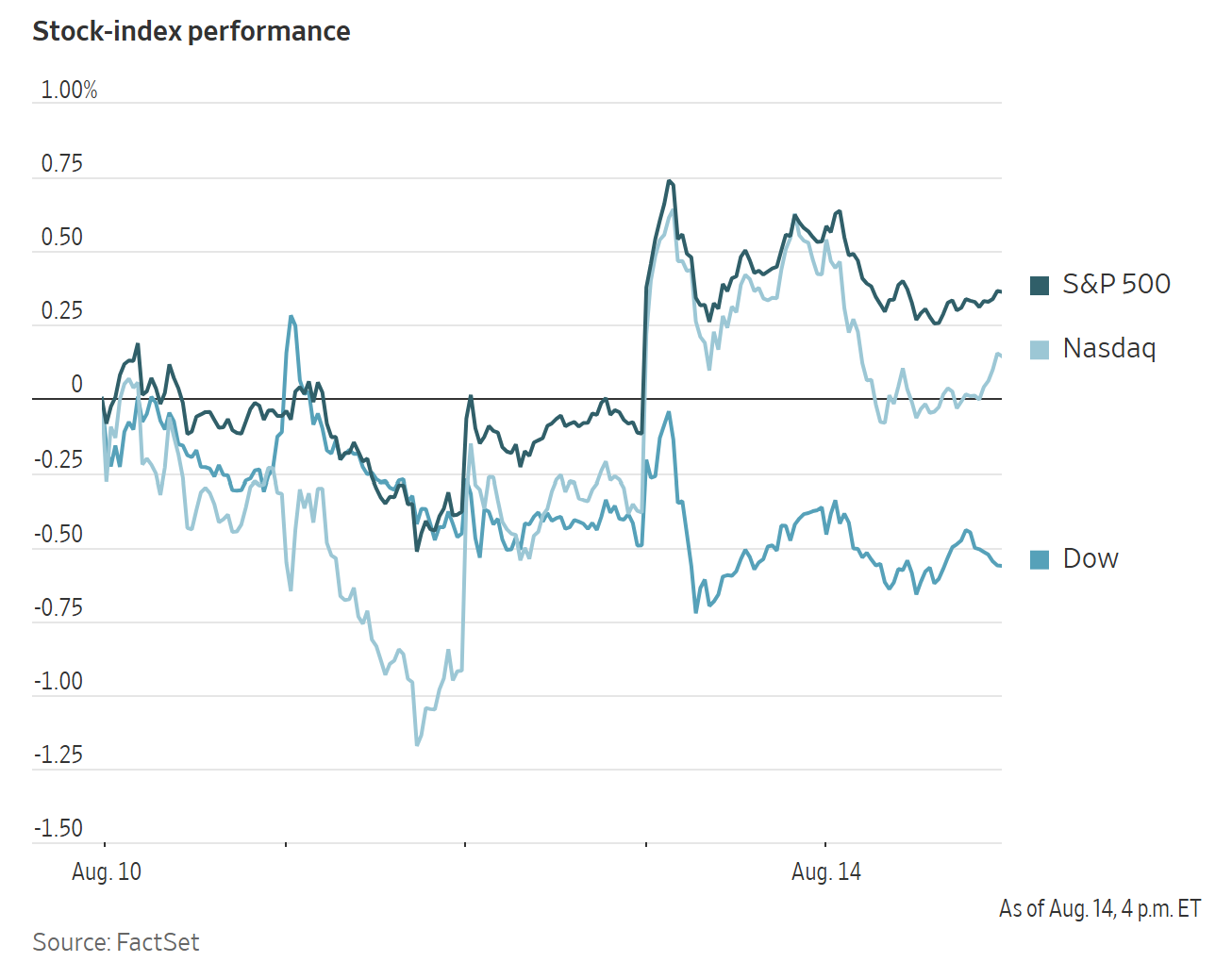
US equities declined on Friday, but the S&P 500 still ended the week near records. The benchmark US index opened higher on Friday but settled in negative territory after closing at a record high in the previous session, its 27th all-time high of the year.
The S&P 500 declined -0.17% to 7,785.76, while the Nasdaq Composite lost -0.28%. The Dow Jones Industrial Average lost -0.20%, or 107.58 points. For the week, the S&P 500 advanced +0.36%, the Nasdaq Composite rose +0.14%, while the Dow Jones Industrial Average fell -0.56%.
In corporate news, The Wall Street Journal reported that PayPal is in discussions to sell itself to a consortium that includes Stripe and private-equity firm Advent International. In July, Stripe and Advent proposed acquiring PayPal for $60.50 per share, an offer the company considered inadequate. The parties have since continued negotiations over a potentially higher price, and an agreement could be reached in the coming weeks. Before the July proposal, which valued PayPal at approximately $53 billion, the company’s shares had been trading near historic lows, implying a market capitalisation of about $40 billion. By comparison, PayPal reached its Covid-era peak of more than $300 per share in 2021, when its market value exceeded $280 billion.
The Financial Times reported that Jane Street recorded a roughly $15 billion loss in July after turmoil at AI-focussed hedge fund Situational Awareness wrongfooted the US trading firm. The New York-based company disclosed the figure to lenders as part of an agreement to transfer its approximately $11 billion public debt pile to private investors, including Pimco, according to people familiar with the matter. Despite the July loss, Jane Street has generated more than $40 billion in net trading revenue in the year to Friday, exceeding its entire 2025 total, according to one person familiar with the matter.
Separately, Reddit will join the S&P 500 in an off-cycle index change, replacing AvalonBay Communities. The company will be added to the benchmark before trading begins on 18 August, according to the index provider. Equity Residential is acquiring AvalonBay Communities. Following the merger, the combined company will be renamed Vivmark Residential and will remain in the S&P 500.
European Stock Indices
CAC 40 -0.16%
DAX +0.53%
FTSE 100 -0.21%
Commodities
Gold spot +0.59% to $4,375.89 an ounce
Silver spot -0.10% to $64.66 an ounce
West Texas Intermediate +1.47% to $82.40 a barrel
Brent crude +1.92% to $88.62 a barrel
Gold advanced on Friday and ended the week higher, supported by a softer US dollar, which aided non-USD buyers.
Spot gold rose +0.59% to $4,375.89 per ounce. Spot gold was +0.79% for the week.
Spot silver slipped -0.10% to $64.66 per ounce, but still posted a +1.74% weekly gain.
Crude oil futures rose on Friday, supported by tanker attacks, mounting supply risks and limited progress toward a peace agreement between the US and Iran.
Brent settled at $88.62 per barrel, up $1.67, or +1.92%. US WTI finished at $82.40 per barrel, up $1.19, or +1.47%. For the week, Brent and WTI gained +7.74% and +6.90%, respectively.
The US President indicated that the administration was prepared to allow economic pressure to build on Iran rather than launch a new wave of military strikes, according to Axios. Iranian officials reiterated that the Strait of Hormuz would not return to pre-war conditions and that only shipping routes agreed by Iran and Oman would be recognised.
The US and Iran issued competing claims over operational control of the Strait of Hormuz during the week, while the US warned that it could maintain a naval blockade of Iranian ports indefinitely. Shipping traffic through the strait fell below the monthly average toward the end of the week, according to Kpler data.
Houthi forces launched attacks on Saudi Aramco’s Jazan refinery for the second time in a week, while Ukrainian attacks on Russian refineries continued. Two vessels from the state-owned Abu Dhabi National Oil Company were also attacked while transiting the strait on Thursday, the United Arab Emirates’ state news agency WAM said. The UAE government condemned the incident as an Iranian attack.
According to a Reuters’ report, crude oil exports from Russia’s Sheskharis terminal at the Black Sea port of Novorossiysk were suspended on Friday following a drone attack, adding to disruptions at one of the country’s key export outlets. The attack was also cited by market participants as a factor supporting prices.
While Middle Eastern supply risks remained elevated, OPEC forecasts pointed to softer demand growth. US crude inventories recorded their largest weekly build in more than three years.
The Trump administration extended the Jones Act waiver for an additional 90 days, with a focus on energy and commodities.
Oil exports from Egypt’s Mediterranean port of Sidi Kerir more than doubled to about 2.3 million bpd in August from around 1.0 million bpd in the prior month, according to Kpler data. Russia’s diesel and gasoil exports fell to just 80,000 bpd in the first seven days of August, according to Vortexa data compiled by Bloomberg.
In Europe, diesel cargoes traded above jet fuel for the first time in more than a year, according to LSEG data, underscoring tightening product-market conditions.
Note: As of 4 pm EDT 14 August 2026
Currencies
EUR +0.36% to $1.1569
GBP +0.34% to $1.3484
Bitcoin -0.76% to $62,859.22
Ethereum +0.27% to $1,877.57
The US dollar weakened on Friday after US retail sales unexpectedly declined in July, lifting the euro and sterling to multi-month highs as investors reassessed the economic outlook and the potential path for Fed policy.
The dollar index declined -0.32% to 99.64, though it remained +0.03% higher on the week.
The euro rose +0.36% to $1.1569 after reaching $1.1585, its strongest level since 17 June. For the week, the single currency advanced +0.10%.
Sterling gained +0.34% to $1.3530, after touching $1.3561, its highest level since 12 May. For the week, the pound rose +0.31%.
The Japanese yen strengthened +0.11% to ¥159.30 per US dollar. It still posted a -0.96% weekly decline as the impact of recent US and Japanese intervention continued to fade.
Reuters reported that the BoJ could raise rates as soon as September and was considering a more aggressive tightening path. Since exiting its decade-long stimulus framework in 2024, the BoJ has raised interest rates at a pace of roughly twice per year. In June it lifted rates to a 31-year high of 1.00%.
Fixed Income
US 10-year Treasury +5.0 basis points to 4.697%
German 10-year Bund +7.5 basis points to 3.225%
UK 10-year Gilt +9.7 basis points to 5.054%
US Treasuries weakened on Friday, as an initial rally following weaker-than-expected retail sales data faded and yields moved higher across the curve.
In afternoon trading, the US 2-year yield, which is sensitive to expectations for Fed policy, rose +2.7 bps to 4.182%. Over the week, however, the yield fell -2.4 bps, marking a third consecutive weekly decline.
Earlier in the session, the 2-year yield fell to its lowest level since late May following the retail sales release.
The US 10-year yield increased +5.0 bps to 4.697%, while the US 30-year yield rose +4.6 bps to 5.262%, its largest one-day increase since late July. The 30-year yield has now risen in three of the past four weeks due to mounting concerns over US debt levels. Over the prior week, the US 10-year yield advanced +4.6 bps and the 30-year yield gained +5.9 bps.
After the retail sales report, US rate futures priced a 33.1% probability of a Fed rate hike at next month’s policy meeting, down from 34.8% late on Thursday, according to CME FedWatch tool.
The yield curve bear-steepened over the week, with the 2s10s spread widening to 51.5 bps, its broadest level since May, from 44.5 bps the prior week.
Eurozone bond yields rose on Friday, extending the weekly advance as markets reassessed duration risk and the outlook for ECB policy.
Germany’s 10-year Bund yield rose +7.5 bps to 3.225%, contributing to a +7.7 bps weekly increase. The spread between US 10-year Treasuries and Bunds narrowed 3.1 bps over the week to 147.2 bps.
Germany’s 2-year Schatz yield, which is sensitive to ECB deposit-rate expectations, rose +3.9 bps to 2.811% and ended the week +5.5 bps higher.
Italy’s 10-year BTP yield rose +6.0 bps on Friday and finished the week +7.0 bps higher. France’s 10-year OAT yield increased +10.2 bps on Friday, contributing to a +13.7 bps weekly advance.
The OAT-Bund spread widened 6.0 bps from the prior week to 83.0 bps, while the BTP-Bund spread narrowed 0.7 bps over the week to 74.2 bps.
Note: As of 4 pm EDT 14 August 2026
While every effort has been made to verify the accuracy of this information, EXT Ltd. (hereafter known as “EXANTE”) cannot accept any responsibility or liability for reliance by any person on this publication or any of the information, opinions, or conclusions contained in this publication. The findings and views expressed in this publication do not necessarily reflect the views of EXANTE. Any action taken upon the information contained in this publication is strictly at your own risk. EXANTE will not be liable for any loss or damage in connection with this publication.
本文提供给您仅供信息参考之用,不应被视为认购或销售此处提及任何投资或相关服务的优惠招揽或游说。金融工具交易存在重大亏损风险,未必适合所有投资者。过往表现并非未来业绩的可靠指标。






由专业人士创建。 为专业人士。
