

SpaceX’s escape velocity or hard landing?


 S&P 500 +1.75% to 7,394.30 US 10-year yield -8.7 basis points to 4.472% Spot gold -3.35% to $4,210.06 an ounce DXY -0.36% to 99.69
Key data to move markets today
EU: German and Spanish CPI and Harmonised Index of Consumer Prices, French CPI, Ecofin Meeting and speeches by De Nederlandsche Bank President Olaf Sleijpen and Bundesbank President Joachim Nagel
UK: GDP, Industrial Production, Manufacturing Production and Consumer Inflation Expectations
US: Michigan Consumer Expectations and Sentiment Indices and UoM 1- and 5-year Consumer Inflation Expectations
Global Macro Updates
ECB raises rates and signals higher inflation alongside weaker growth. The ECB raised its key policy rates by 25 bps, in line with expectations, citing inflation pressures generated by the Middle East conflict. The Governing Council said the decision was robust across a range of scenarios assessing how the shock could affect the euro area’s medium-term outlook.
Updated staff projections showed headline inflation averaging 3.0% in 2026, 2.3% in 2027 and 2.0% in 2028. Forecasts for 2026 and 2027 were revised higher from March, reflecting higher energy prices and the expected pass-through to food, goods and services. At the same time, growth projections for 2026 and 2027 were revised lower, as the conflict weighs on commodity markets, real incomes and confidence. The ECB now sees growth averaging 0.8% in 2026, 1.2% in 2027 and 1.5% in 2028.
The statement reiterated that the outlook remains highly uncertain, with upside risks to inflation and downside risks to growth. Policymakers said the full implications of the conflict will depend on the intensity and duration of the energy price shock, as well as the scale of any indirect or second-round effects. There was no change to the Bank’s rate guidance, with the statement maintaining a data-dependent, meeting-by-meeting approach and stressing that policymakers are not pre-committing to any particular rate path.
President Lagarde emphasised that the move was not an insurance cut and said there had been no discussion of the neutral rate. She added that the decision had been taken in response to a persistent energy shock and that the ECB would continue to evaluate its consequences closely.
US Stock Indices
Dow Jones Industrial Average +1.86%
Nasdaq 100 +3.29%
S&P 500 +1.75%, with 8 of the 11 sectors of the S&P 500 up
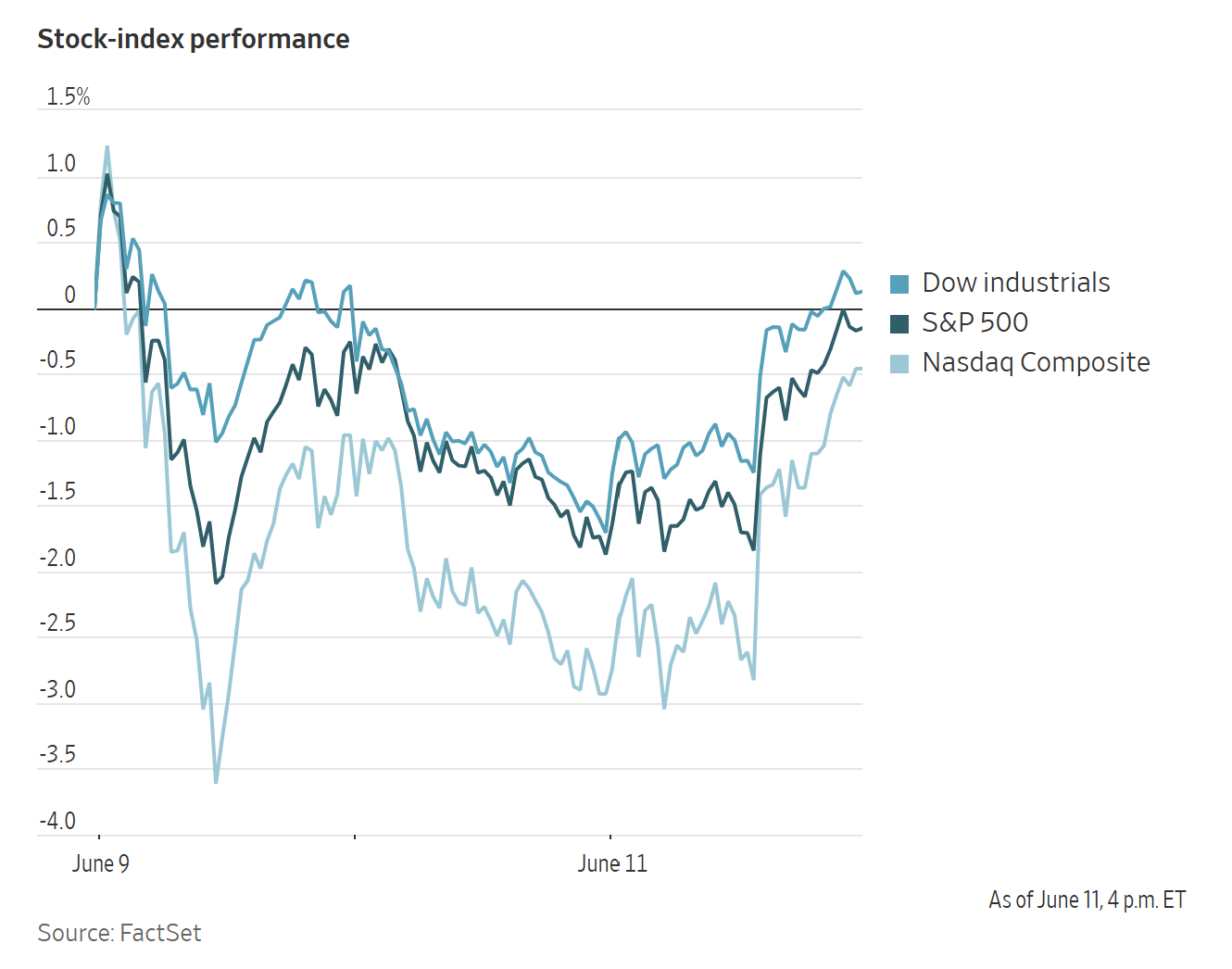
US equities rebounded sharply on Thursday, with all three major indices posting their strongest daily gains in two months. The Nasdaq Composite rose +2.54%, the S&P 500 gained +1.75% and the Dow Jones Industrial Average advanced +1.86%, or 929.97 points.
SpaceX's landmark IPO. Priced at $135 per share and targeting $75 billion in gross proceeds, it marks not only the largest IPO in global stock market history, but also a moment of profound geopolitical consequence. The company, listing on Nasdaq under the ticker SPCX at a valuation of approximately $1.77 trillion, attracted extraordinary investor enthusiasm, with retail orders alone surpassing $100 billion against a total offering nearly 4x oversubscribed. Plans to allocate up to 30% of shares to individual investors represent a striking departure from the institution-heavy norms that have long governed large-cap listings.
Yet beneath the record-breaking capital markets spectacle lies a deeper structural concern. Alessio Terzi, Assistant Professor at the Bennett School of Public Policy at the University of Cambridge, and Stefano Marcuzzi, Assistant Professor in History of International Relations at the Centre for Higher Defence Studies (CASD), draw a compelling parallel between SpaceX and the East India Company in an article for Project Syndicate, warning that the firm's command of nearly 80% of global payload launches and 94% of US launches mirrors the monopolistic grip once wielded over maritime trade routes. The economics of reusable rocketry, they argue, entrench a winner-takes-most dynamic that gradually erodes sovereign oversight. Governments, ensnared in a geopolitical competition with China, have little incentive to constrain SpaceX, yet every year of inaction narrows the window for meaningful regulatory intervention.
In corporate news, Frasers Group offered €1.98 billion to acquire the 74% stake it does not already own in German premium apparel company Hugo Boss. Hugo Boss said the bid was unsolicited, while its shares rose 6% in European morning trading. Frasers Group’s offer of €38 per share represents a 4.2% premium, with completion expected in the second half of the year.
Eaton agreed to merge its mobility business with Dana in a transaction valuing the combined company at approximately $10 billion, including debt. The deal will combine Eaton’s commercial vehicle transmissions, engine and emissions operations with Dana’s powertrain, thermal and sealing technologies. Eaton will receive a cash distribution of around $1.1 billion, and its shareholders will own just over half of the merged entity.
S&P 500 Best performing sector
Information Technology +2.94%, with KLA +12.92%, Lam Research +12.65% and Micron Technology +11.66%
S&P 500 Worst performing sector
Energy -2.06%, with Devon Energy -4.27%, ConocoPhillips -3.80% and APA -3.21%
Mega Caps
Alphabet +0.92%, Amazon +1.47%, Apple +1.39%, Meta Platforms -0.45%, Microsoft -1.77%, Nvidia +2.22% and Tesla +4.60%
Information Technology
Best performer: KLA +12.92%
Worst performer: PTC -12.36%
Materials and Mining
Best performer: International Paper Company +9.73%
Worst performer: LyondellBasell Industries -2.58%
Corporate Earnings Reports
Posted on Thursday, 11 June from The Pulse, our real-time AI-driven news tool. Available exclusively on the EXANTE Web Platform
Adobe reported Q2 fiscal 2026 revenue of $6.62bn vs $6.46bn expected and EPS of $5.96 vs $5.82 expected, with AI-first annual recurring revenue crossing $500mn (up +200% y/o/y). The company raised its full-year 2026 revenue target to $26.6bn and EPS to $24.40, above consensus. CFO Dan Durn announced his departure effective 15 June 2026; CEO Shantanu Narayen stated that record Q2 revenue reflected strong AI-driven demand.
European Stock Indices
CAC 40 +0.48%
DAX +0.06%
FTSE 100 +0.48%
Commodities
Gold spot +3.35% to $4,210.06 an ounce
Silver spot +5.75% to $67.37 an ounce
West Texas Intermediate -5.99% to $86.35 a barrel
Brent crude -5.95% to $89.10 a barrel
Precious metals advanced on Thursday, with gold and silver both posting strong gains.
Spot gold rose +3.35% to $4,210.06 per ounce after earlier falling to its lowest level since late November.
Spot silver also strengthened, rising +5.75% to $67.37 per ounce.
Oil prices, by contrast, settled more than five percent lower after the US President cancelled planned strikes on Iran within hours, reinforcing expectations that a deal could bring an end to more than three months of conflict.
Brent crude fell $5.64, or -5.95%, to settle at $89.10 per barrel, while US WTI crude declined $5.50, or -5.99%, to $86.35 per barrel.
In a social media post, the US President said he had called off the strikes because discussions had progressed to the highest levels of Iran’s leadership and a broad coalition of regional powers. However, he did not provide details on the final points he said had been approved by the coalition.
Iran’s semi-official Fars news agency, meanwhile, reported that Tehran had not approved the text of any agreement. The US President has repeatedly said that a deal with Iran is close, only to renew threats when Tehran does not accept his demands.
Earlier in the day, President Trump had threatened to strike Iran ‘very hard.’ Even so, Iranian sources and Western officials said indirect talks on a preliminary peace arrangement had intensified.
Separately, India reported an incident involving a vessel off the Port of Shinas in Oman, the third such event this week. Nonetheless, Indian refiners told Reuters that they had secured sufficient crude supplies to meet demand through at least August.
According to Reuters data and sources, Saudi crude exports to China are holding near record lows this month at just under 400,000 bpd, with Sinopec taking no Saudi supply for a second consecutive month.
In its Monthly Oil Market Report, OPEC said the 2026 global demand growth estimate was revised to 970,000 bpd, compared with 1.17 million bpd in the previous report. The 2027 global demand growth forecast was increased by 200,000 bpd m/o/m. Non-DoC (Declaration of Cooperation) global production in both 2026 and 2027 is still expected to grow by around 600,000 bpd, unchanged m/o/m.
In May, non-OPEC DoC member production averaged 14.303 million bpd, broadly unchanged m/o/m, while total OPEC production averaged 18.829 million bpd, down 177,000 bpd m/o/m. Including the 2.110 million bpd attributed to UAE production, group production would technically average 16.719 million bpd. Iran recorded the largest decline, with output down 545,000 bpd. Preliminary data for April 2026 also showed that OECD commercial oil inventories fell by 48.4 million barrels.
Separately, the US Central Command said American forces disabled the oil tanker Jalveer in the Gulf of Oman after it allegedly violated the blockade on Iran by transporting Iranian oil. Two missiles struck the vessel’s engine room after the crew reportedly ignored orders, making it the third commercial ship disabled this week.
Bloomberg news also reported that major commodity traders are redirecting Venezuelan crude to Asia as the Middle East conflict continues to reshape global oil flows.
In Singapore, oil product stockpiles declined by a further 3.735 million barrels last week to 34.408 million, following a drop of more than 6.0 million barrels in the previous week.
Note: As of 4 pm EDT 11 June 2026
Currencies
EUR +0.39% to $1.1577
GBP +0.37% to $1.3416
Bitcoin +3.33% to $63,339.77
Ethereum +3.79% to $1,670.93
The US dollar weakened against its major peers on Thursday, as foreign exchange markets responded to shifting monetary policy expectations and broader geopolitical developments. The dollar index fell -0.36% to 99.69, reaching a near one-week low.
The euro rose +0.39% to $1.1577, reversing earlier losses in subdued trading after the ECB raised interest rates for the first time in nearly three years in an effort to contain energy-driven inflation linked to the Iran conflict.
Sterling also strengthened, rising +0.37% against the dollar to $1.3416 after reversing earlier declines.
Attention is also turning to next week’s BoJ meeting, where policymakers are expected to raise rates. However, Governor Kazuo Ueda will miss the 15 - 16 June policy meeting after being hospitalised for medical treatment.
The Japanese yen appreciated +0.34% against the greenback to ¥159.91 per dollar, remaining close to levels that could prompt official intervention from Tokyo.
Fixed Income
US 10-year Bond -8.7 basis points to 4.472%
German 10-year Bund -4.4 basis points to 3.035%
UK 10-year Gilt -3.2 basis points to 4.907%
US Treasury yields declined across the curve on Thursday, reflecting a rally in government bonds as markets reassessed the outlook for monetary policy and risk sentiment.
The 2-year Treasury yield, sensitive to expectations for the Fed funds rate, fell -8.6 bps to 4.072%, while the 10-year yield declined -8.7 bps to 4.472%. The 30-year yield was -7.3 bps lower at 4.959%.
As a result, the spread between 2-year and 10-year Treasuries narrowed slightly, with the curve flattening by 0.1 bps to 40.0 bps.
Primary market activity was more mixed throughout the week. The Treasury saw soft demand for its $22 billion auction of 30-year bonds on Thursday, the final leg of this week’s $119 billion in coupon-bearing supply. The bonds were awarded at a high yield of 5.020%, more than 1 bps above their pre-auction level, while the bid-to-cover ratio came in below average at 2.33x.
By contrast, the Treasury’s $39 billion sale of 10-year notes on Wednesday drew solid demand, while Tuesday’s $58 billion auction of 3-year notes was met with average interest.
According to CME Group's FedWatch Tool, Fed funds futures traders are pricing 17.7 bps of rate hikes in 2026, higher than the 15.5 bps priced in a week ago. Fed funds futures traders are now pricing in a 1.5% probability of a 25 bps rate cut at June’s FOMC meeting, compared to a 4.6% probability of a rate cut last week.
In Europe, the ECB reinforced market expectations of further tightening after raising borrowing costs for the first time since 2023 in response to inflation pressures linked to the Iran war. Sovereign yields across the eurozone moved lower across maturities.
Some analysts said the ECB’s communication increased the likelihood of an additional move later this year, an outcome markets had already been leaning toward, while also raising concerns that policymakers may be underestimating downside risks to growth.
The ECB also revised its macroeconomic projections, lifting inflation forecasts while lowering growth estimates, underscoring the difficult trade-off created by the energy shock triggered by the conflict.
The baseline market view now appears to be shifting toward somewhat more tightening, potentially as early as July but more likely in September, unless the conflict and broader energy situation improve materially.
Following ECB President Christine Lagarde’s press conference, money markets priced in just over 40 bps of additional tightening this year, beginning in September. This implies a fully priced 25 bps increase and more than a 60% probability of another move thereafter, little changed from levels seen before the meeting. Markets also assign roughly a 30% chance to a move in July.
Among core eurozone bonds, Germany’s 2-year yield fell -2.8 bps to 2.698%, while the 10-year yield declined -4.4 bps to 3.035%. At the long end of the curve, the 30-year Bund yield also fell -4.4 bps to 3.566%.
Italy’s 10-year BTP yield declined -4.0 bps to 3.796%, leaving the spread over Bunds at 76.1 bps, or 0.4 bps wider than Wednesday’s 75.7 bps.
France’s 10-year OAT yield fell -4.4 bps to 3.687%.
Note: As of 4 pm EDT 11 June 2026
While every effort has been made to verify the accuracy of this information, EXT Ltd. (hereafter known as “EXANTE”) cannot accept any responsibility or liability for reliance by any person on this publication or any of the information, opinions, or conclusions contained in this publication. The findings and views expressed in this publication do not necessarily reflect the views of EXANTE. Any action taken upon the information contained in this publication is strictly at your own risk. EXANTE will not be liable for any loss or damage in connection with this publication.
This article is provided to you for informational purposes only and should not be regarded as an offer or solicitation of an offer to buy or sell any investments or related services that may be referenced here. Trading financial instruments involves significant risk of loss and may not be suitable for all investors. Past performance is not a reliable indicator of future performance.








Created by professionals. For professionals.
