

Can the BoE really ease?


 S&P 500 -0.14% to 7,498.96 US 10-year yield +3.9 basis points to 4.668% Spot gold +1.33% to $4,129.35 an ounce DXY -0.05% to 101.13
What to look out for today
Companies reporting on Thursday, 23 July: Allegion, Blackstone, Digital Realty Trust, Dow, Freeport-McMoRan, Honeywell, Intel, Lockheed Martin, Newmont, PG&E, RTX, T-Mobile US, Union Pacific, VeriSign
Key data to move markets today
EU: ECB’s Rate on Deposit Facility, Monetary Policy Statement, Main Refinancing Operations Rate and Press Conference and Eurozone Consumer Confidence
UK: GfK Consumer Confidence
USA: Initial and Continuing Jobless Claims
JAPAN: National CPI and National Core CPI
Global Macro Updates
UK inflation slowed to its weakest pace since March 2025. The June inflation figures offered some relief on the headline measure, but did little to ease concerns about persistent underlying inflation. UK headline inflation eased to 2.6% y/o/y in June from 2.8% in May, slightly below the 2.7% consensus, and its lowest level since March 2025. This was due to lower fuel prices and softer food inflation. However, the underlying details were less reassuring. Core CPI rose to 2.6% from 2.5%, exceeding the 2.5% consensus. Services inflation edged down only modestly to 3.6% from 3.7%, remaining above expectations of 3.5%.
Services inflation is likely to remain a key concern for BoE policymakers and some of the downward pressure on headline CPI may prove temporary. Household energy bills increased in July after the latest Ofgem price-cap adjustment, while the recent jump in energy prices following renewed US - Iran hostilities could add to inflation pressure in the months ahead.
These dynamics could complicate the BoE’s path toward further policy easing. Sticky services prices and concerns about higher energy costs may feed into inflation expectations and wage growth, supporting a cautious policy stance. However, BoE rate expectations have moved only modestly so far despite the recent firming in energy prices. Markets continue to price only one rate increase by year-end, slightly more aggressive than sell-side expectations.
US Stock Indices
Dow Jones Industrial Average -0.01%
Nasdaq 100 -0.54%
S&P 500 -0.14%, with 5 of the 11 sectors of the S&P 500 down
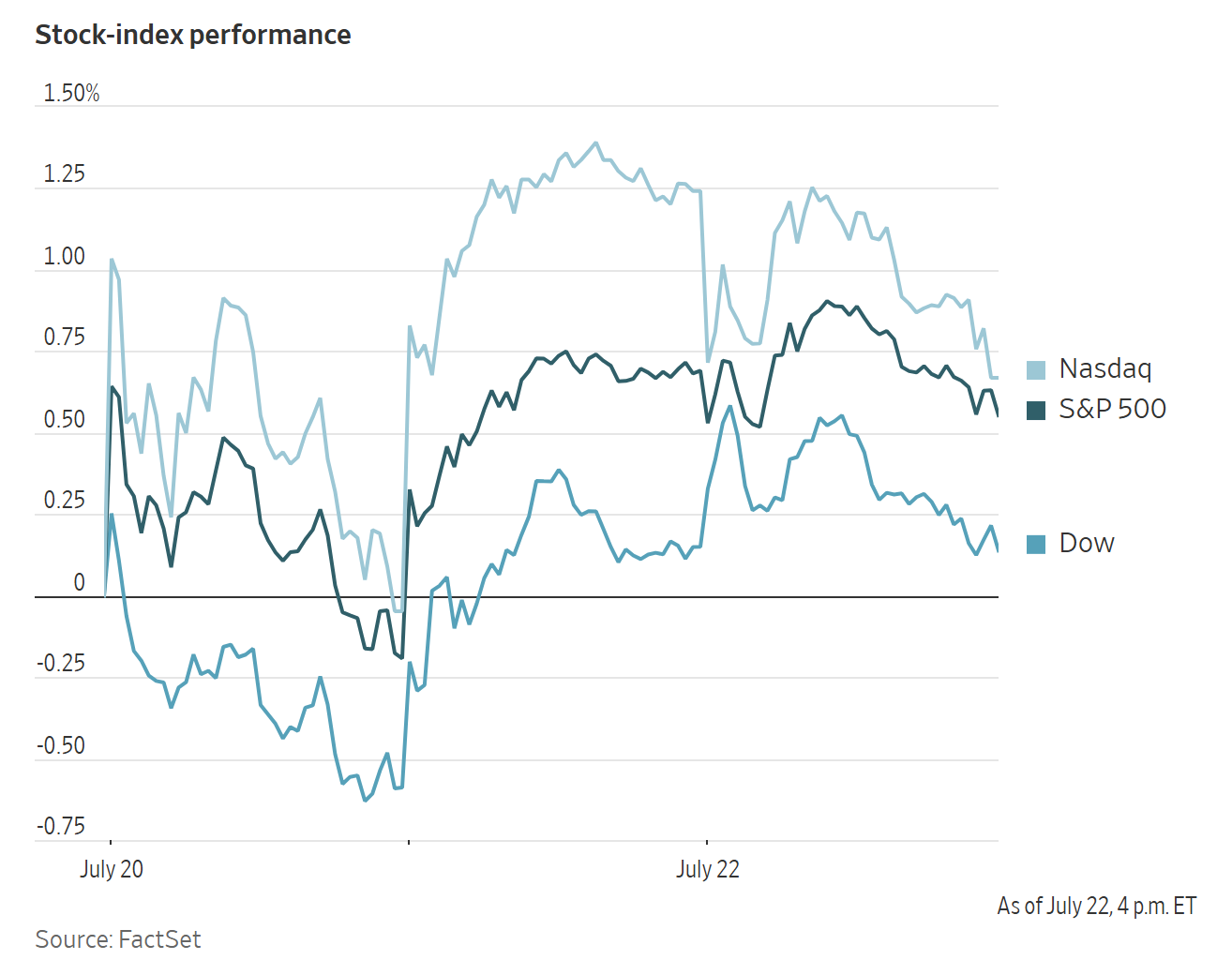
US equity markets were subdued on Wednesday, with the Nasdaq Composite declining -0.57%. The S&P 500 slipped -0.14%, while the Dow Jones Industrial Average was little changed, edging down 6.06 points, or -0.01%.
In corporate news, Segro shares rose after Prologis improved its takeover offer to nearly $19 billion.
Paramount Skydance’s $81 billion bid to acquire Warner Bros. Discovery received EU approval on Wednesday after the companies offered concessions to address regulatory concerns. Paramount committed to divesting its stake in United International Pictures in the European Economic Area within 13 months of the transaction’s closing. The company also agreed not to enter into any joint film co-distribution arrangement with NBCUniversal in the European Economic Area for 10 years and offered additional commitments related to theatrical distribution in the region.
Anthropic plans to deploy up to 2GW of AMD Instinct MI450, or Helios, chips beginning in 2027. AMD will also invest up to $5 billion in Anthropic and is reportedly in discussions to backstop part of Anthropic’s data-centre lease costs. The agreement supports the broader AI compute and CapEx demand narrative, while also reinforcing the chip-diversification and Nvidia-challenger themes. However, it may invite continued scrutiny of vendor financing and circular deal structures.
Corporate Earnings Reports
Posted on Wednesday, 22 July from The Pulse, our real-time AI-driven news tool. Available exclusively on the EXANTE Web Platform
Alphabet reported Q2 2026 earnings. Revenue was $119.8bn, beating estimates of $117bn, while EPS of $9.11 included a $6.26 benefit from unrealised gains on equity securities. Cloud revenue surged +82% y/y to $24.8bn, beating estimates of $22.5bn, with an operating margin of 35.6%. The Cloud backlog reached $514bn. Search revenue grew +17% y/y to $63.3bn. CapEx was $44.9bn, and free cash flow was -$5.9bn. The company raised its FY2026 CapEx guidance to $195bn-$205bn. CEO Sundar Pichai said the company is supply-constrained, with demand for models translating to strong token usage, and that Gemini 4 pre-training is underway.
Tesla reported Q2 revenue of $28.24bn (up +26% y/y), beating estimates of $26.32bn, while adjusted EPS of $0.33 missed the $0.51 consensus, falling -18% y/y. Gross margin was 16.8% (est. 19.4%). Automotive revenue was $20.52bn, energy revenue $3.14bn, and services revenue $4.58bn. Deliveries reached 480,126 units, up +25% y/y. Cybercab production began at Gigafactory Texas, with capacity above 125K units per year. Robotaxi operations are ramping up in six US metros. Tesla did not sell any of its Bitcoin holdings. The company provided no new numerical guidance for deliveries, earnings, or full-year capex. CEO Elon Musk stated: 'Q2 was a strong quarter for our core vehicle, energy and services businesses as well as our manufacturing, infrastructure and AI initiatives.'
ServiceNow reported Q2 2026 earnings after close on 22 July. Revenue was $3.99bn (+24% y/y) vs $3.92bn consensus, with adjusted EPS of $0.90 vs $0.86 expected. Current RPO reached $13.20bn vs $13.03bn estimate. Q3 subscription revenue guidance of $4.0bn was slightly below consensus, but cRPO growth guidance of +19.5% beat estimates. FY2026 subscription revenue guidance was raised to $15.76-$15.78bn. ServiceNow AI ACV crossed $1bn in Q2. CEO Bill McDermott said the company is operating to the Rule of 56, progressing toward the Rule of 60, with agentic AI deployments increasing ninefold in nine months.
GE Vernova reported Q2 2026 earnings before the open. Revenue was $11.1bn, up +22% y/y and above the $10.8bn consensus, while EPS of $2.47 missed expectations of $3.10 but rose +33% y/y. The company raised its full-year 2026 revenue guidance to $45.5bn–$46.5bn, up from $45bn, and lifted free cash flow guidance to $11.5bn–$12.5bn from $6.5bn–$7.5bn. The backlog stood at $176bn, with orders of $24.2bn, up +88% organic. Data centre orders exceeded $5bn YTD, more than double the 2025 total. Wind segment revenue fell -11% organic and segment EBITDA loss widened to $275m. The estimated cost impact from global tariffs in 2026 is $100m–$200m. CEO: 'With a backlog of $176bn, continued revenue growth and margin expansion, and significant free cash flow generation, GE Vernova’s momentum is building, and we are raising our 2026 financial guidance.'
AT&T reported Q2 results. Revenue was $31.6bn, missing estimates of $31.7bn, but up +2.3% y/y. Adjusted EPS of $0.65 beat the $0.59 consensus, rising +20.4% y/y. Free cash flow reached $4.7bn, above the $4.51bn estimate, up +7% y/y. Adjusted EBITDA of $12.3bn also beat. Postpaid phone net adds of 432,000 exceeded forecasts. The company affirmed its full-year guidance, including adjusted EPS of $2.25-$2.35 and free cash flow of at least $18bn. Management accelerated share repurchases to approximately $10bn for 2026. The CEO stated that the accelerated growth demonstrates their structural advantages and confidence in their market position.
Philip Morris reported Q2 2026 earnings on 22 July with adj EPS of $2.20 vs $2.04 expected and net revenue of $11.19bn vs $10.61bn expected, up +10.4% y/y. Organic revenue growth was +7.6% vs estimates of +4.91%. The smoke-free business contributed approximately 42% of total net revenues, with Zyn volumes rising +1.8% y/y to 2.9bn cans. FY26 adj EPS guidance was set at $8.26-$8.41, with the midpoint below consensus of $8.41. CEO stated the company delivered outstanding results in Q2 with net revenues surpassing $11bn for the first time. A $511mn non-cash RBH equity impairment weighed on reported EPS.
TE Connectivity reported Q3 results before the open. Revenue was $5.16bn (vs $5.01bn expected), up +14% y/y. Adj EPS of $2.94 (vs $2.85 expected) rose +22% y/y. Orders reached $5.7bn, up +27% y/y. The adjusted operating margin expanded 90bps to 22%. For Q4, the company guided revenue of ~$5.25bn (vs $5.15bn expected) and adj EPS of ~$3.05 (vs $2.96 expected). TE Connectivity also announced the acquisition of Astrodyne TDI for $1.4bn, expected to contribute over $250mn in annual sales to Industrial Solutions. The CEO noted the Industrial team delivered sales growth of over 20%, while Transportation grew 5% organically, outperforming end markets.
IBM reported preliminary Q2 revenue of $17.20bn (up +1% y/y) and operating EPS of $2.93 (up +5% y/y), missing consensus estimates of $17.86bn and $3.01. This followed a pre-announcement in which CEO Arvind Krishna stated the company had 'faltered' due to customers redirecting spending toward servers and storage amid semiconductor supply constraints. Analysts Stifel and Argus both maintained Buy ratings but cut price targets to $235 and $280 respectively, citing reduced growth expectations.
CSX reported Q2 results after the close. Revenue was $3.94bn, beating the $3.9bn consensus. Adjusted EPS of 54c rose +10c y/y and exceeded estimates. Operating income of $1.51bn also surpassed the $1.44bn forecast. No guidance or CEO commentary was provided in the release.
European Stock Indices
CAC 40 +0.89%
DAX +0.58%
FTSE 100 +1.24%
Commodities
Gold spot +1.33% to $4,129.35 an ounce
Silver spot +1.51% to $59.71 an ounce
West Texas Intermediate +2.09% to $86.48 a barrel
Brent crude +2.68% to $93.89 a barrel
Gold advanced to a two-week high on Wednesday, supported by a softer US dollar and technical buying.
Spot gold rose +1.33% to $4,129.35 per ounce after reaching an intraday peak of $4,165.87 per ounce, its highest level since 7 July.
Spot silver gained +1.51% to $59.71 per ounce.
Oil prices closed at their highest levels since early June, as the conflict with Iran continued to disrupt regional shipping routes. Tanker traffic through the Strait of Hormuz and the Bab el-Mandeb Strait came to a halt, while the DOE Weekly Petroleum Status Report showed simultaneous builds in crude, gasoline and distillate inventories for the first time since January.
Brent crude futures settled $2.45, or +2.68%, at $93.89 per barrel, after reaching a session high of $95.47. US WTI crude climbed $1.77, or +2.09%, to $86.48 per barrel.
The Brent crude three-month time spread widened to $9.26 per barrel, its largest since 22 May, reflecting deeper backwardation amid rising supply risks. Backwardation occurs when prompt crude trades above later-dated barrels and typically signals tighter near-term supply.
Geopolitical risk remained elevated. The US military said it conducted an 11th consecutive night of strikes against Iran, shortly after Kuwait reported that its air defences were intercepting Iranian drones. US Central Command said Iran launched additional drones toward Kuwait, Jordan and Bahrain.
The US President said on Truth Social that, going forward, any Iranian attack on ships in the Strait of Hormuz would be met with the destruction of an Iranian bridge or power plant. Iran later warned it would target energy assets, including electricity infrastructure, belonging to US allies in the region if one of its power plants were hit. Iran’s top negotiator, Mohammad Ghalibaf, said that if Iran could not sell its oil, no one in the region would.
In a post on X, Iran’s Revolutionary Guards warned shipping companies that the southern route of the Strait of Hormuz had been mined. Separately, the EU’s naval force Aspides said vessels linked to Israel, the US or Saudi Arabia faced a higher risk of attack by Yemen’s Iran-aligned Houthi militia and should avoid voyages through the Red Sea and Gulf of Aden.
The DOE Weekly Petroleum Status Report showed crude inventories rising by +2.01 million barrels, gasoline inventories by 765,000 barrels and distillate inventories by 1.5 million barrels, while Cushing stockpiles fell to 19.4 million barrels. Jet fuel inventories declined by 1.0 million barrels, and jet fuel production remained above 2.0 million bpd for a 12th consecutive week. July distillate production is tracking toward a record for the month.
Just over 5 million barrels were released from the SPR during the week. The DOE also told media outlets that the SPR’s true operational floor, set by ‘cavern mechanics,’ is roughly 70 million barrels, well below the 250 to 300 million barrels the oil industry has historically viewed as the practical limit.
Bloomberg news reported that Russian regions are cautiously indicating an easing in the gasoline crisis after Ukraine’s military shifted its focus from major oil refineries to tankers in the Sea of Azov and the Black Sea.
Reuters reported that Iranian drone attacks on CIA facilities in the Gulf have prompted US intelligence analysts to investigate whether Russia assisted Iran by providing targeting information or advanced drone technology, citing four people familiar with US intelligence. EU ambassadors also failed on Wednesday to agree on a 21st package of sanctions against Russia over its invasion of Ukraine, according to an EU diplomat.
Separately, overnight reports indicated that China is reselling oil cargoes, while month-to-date Chinese crude imports are tracking fifty percent below pre-war levels.
Kpler estimated global oil on water at a record 1.350 billion barrels, above the late-2025 peak of 1.330 billion barrels.
Note: As of 4 pm EDT 22 July 2026
Currencies
EUR +0.04% to $1.1405
GBP -0.04% to $1.3370
Bitcoin -0.48% to $66,040.73
Ethereum +0.77% to $1,938.00
The US dollar eased slightly from a one-week high on Wednesday after four consecutive daily gains, while the yen recovered modestly from its weakest level in nearly four decades.
The dollar index slipped -0.05% to 101.13, while the euro edged up +0.04% to $1.1405.
Sterling declined -0.04% to $1.3370, marking a fifth consecutive daily loss and its longest losing streak since mid-May. UK inflation cooled more than expected last month, as a brief de-escalation in the Iran conflict lowered fuel prices. The slowdown is likely to provide only temporary relief for Prime Minister Andy Burnham as he seeks to ease living costs.
The Japanese yen strengthened +0.02% against the dollar to ¥163.11 per US dollar, as an earlier move to ¥162.77 faded. Traders continued to assess the likelihood of intervention from Tokyo and the potential for faster BoJ rate hikes.
Japanese Prime Minister Sanae Takaichi’s administration has struggled to dispel expectations that it may pressure the BoJ to delay additional rate hikes.
Markets are pricing in roughly 25 bps of BoJ tightening this year. Reuters reported that the BoJ remains alert to upside inflation risks that could require faster rate hikes than markets currently expect, citing three sources familiar with the central bank’s thinking.
Fixed Income
US 10-year Treasury +3.9 basis points to 4.668%
German 10-year Bund +1.3 basis points to 3.202%
UK 10-year Gilt +0.5 basis points to 5.040%
The 2-year note yield, which typically tracks Fed funds rate expectations, rose to a 17-month high on Wednesday, ending the day +2.4 bps to 4.302% after reaching 4.311%, its highest level since February 2025. The US 10-year yield rose +3.9 bps to 4.668%, the highest since 20 May.
Fed funds futures traders now assign a 35.8% probability of a rate hike at the conclusion of the Fed’s two-day meeting on 29 July, up from 25.7% on Tuesday and 10.7% a week earlier. According to the CME FedWatch tool, markets are pricing in 41.8 bps of rate hikes by year-end, compared with 25.2 bps last week.
The US Treasury saw soft demand at Wednesday’s $13 billion sale of 20-year bonds. The debt cleared at a high yield of 5.163%, or 0.4 bps above the pre-auction level, while demand was below its recent bid-to-cover average at 2.64x. The US government is also scheduled to sell $21 billion of 10-year TIPS today.
In Europe, German two-year borrowing costs reached a fresh two-year high, while French longer-dated yields briefly rose above four percent for the first time since June 2009.
German two-year yields, which are more sensitive to ECB deposit-rate expectations, rose +3.3 bps to 2.843%, their highest level since July 2024.
Money markets indicated that the ECB deposit rate would rise to 2.70% in December and 2.78% in February 2027, compared with 2.25% currently. They also fully priced a rate hike in September, although market participants continued to expect the ECB to leave rates unchanged at today’s policy meeting.
Germany’s 10-year government bond yield increased +1.3 bps to 3.202%, its highest level since May 2011.
Long-dated borrowing costs in France and Italy remained close to four percent. Italy’s 10-year yield rose +0.9 bps to 3.997%. The spread between Italian government bonds and Bunds stood at 79.5 bps, its widest since early May.
France’s 10-year yield reached 4.0% earlier in the session for the first time since June 2009 before ending at 3.988%, up +3.0 bps on the day.
In the UK, fiscal concerns remained in focus, with the gilt-Bund yield spread at 183.8 bps. The UK 10-year gilt yield was +0.5 bps to a fresh two-month high at 5.040%.
Note: As of 4 pm EDT 22 July 2026
While every effort has been made to verify the accuracy of this information, EXT Ltd. (hereafter known as “EXANTE”) cannot accept any responsibility or liability for reliance by any person on this publication or any of the information, opinions, or conclusions contained in this publication. The findings and views expressed in this publication do not necessarily reflect the views of EXANTE. Any action taken upon the information contained in this publication is strictly at your own risk. EXANTE will not be liable for any loss or damage in connection with this publication.
本文提供給您僅供資訊參考之用,不應被視為認購或銷售此處提及任何投資或相關服務的優惠招攬或遊說。金融商品交易涉及重大損失風險,可能不適合所有投資者。過往績效不代表未來表現。








由專業人士建立。為專業人士打造。
