

What is the term premium on US - China détente?

 S&P 500 +1.21% last week to 7,743.41 US 10-year yield +16.8 basis points last week to 5.165% Spot gold -2.07% last week to $4,286.25 an ounce DXY +0.82% last week at 101.04
Key data to move markets today
UK: A speech by BoE Deputy Governor Dave Ramsden
Global Macro Updates
Trump - Xi: détente with an expiry date. As expected, the Trump - Xi summit produced détente’s favourite deliverable: more time. Three days of ceremony, White House talks and a state dinner rich in tech symbolism yielded little beyond a two-month extension of the Busan trade truce, now expiring on 10 January. Treasury Secretary Scott Bessent says Beijing still has homework outstanding under the existing accord, while no fresh purchase commitments emerged. In other words, escalation has only been postponed.
That matters because the armistice covers actual industrial choke points, not merely tariff theatre. China remains dominant in rare-earth processing and magnets, while US aerospace and chipmaking companies still struggle to secure materials. Renewed restrictions would hit autos, EVs, defence, wind power, electronics and semiconductor equipment first, before cascading through inventories and production schedules. Washington’s corresponding leverage lies in advanced semiconductors and manufacturing equipment. Neither leader showed an appetite to slow the AI race or construct meaningful guardrails. This left chip-export controls and Chinese retaliation through critical minerals as the most combustible supply-chain feedback loop.
The commercial cupboard was similarly bare. Boeing’s hopes for orders beyond the 200 aircraft covered by May’s agreement have faded, leaving aerospace suppliers without the demand signal they wanted. Agriculture received no new commitments either: a residual 10% Chinese tariff continues to disadvantage US soybeans against Brazilian supply, keeping private crushers cautious and exposing grains, meat and farm logistics to another round of politically calibrated buying. Energy remains caught in the same limbo, with tariffs having halted direct Chinese purchases of US oil and gas even as contracted LNG cargoes are resold elsewhere.
Taiwan introduced a more pronounced geopolitical risk. Xi urged Trump to ‘oppose’ Taiwanese independence instead of merely ‘not support’ it, a significant strengthening of Beijing’s requested language. However, there was no indication that Washington would revise its wording. The underlying risk remains unchanged. Taiwan is still the main manufacturing hub for the advanced chips that power AI, so any deterioration would quickly spread from foundries to cloud computing, consumer electronics, autos and defence.
In the end the summit bought time instead of producing the anticipated deal between the two leaders. The practical test remains exacting across rare-earth licences, chip controls, soybean shipments and Boeing deliveries. Pageantry can steady sentiment, but, apparently, it cannot clear customs.
US Stock Indices
Dow Jones Industrial Average +0.93%
Nasdaq 100 +0.42%
S&P 500 +0.51%, with 8 of the 11 sectors of the S&P 500 up
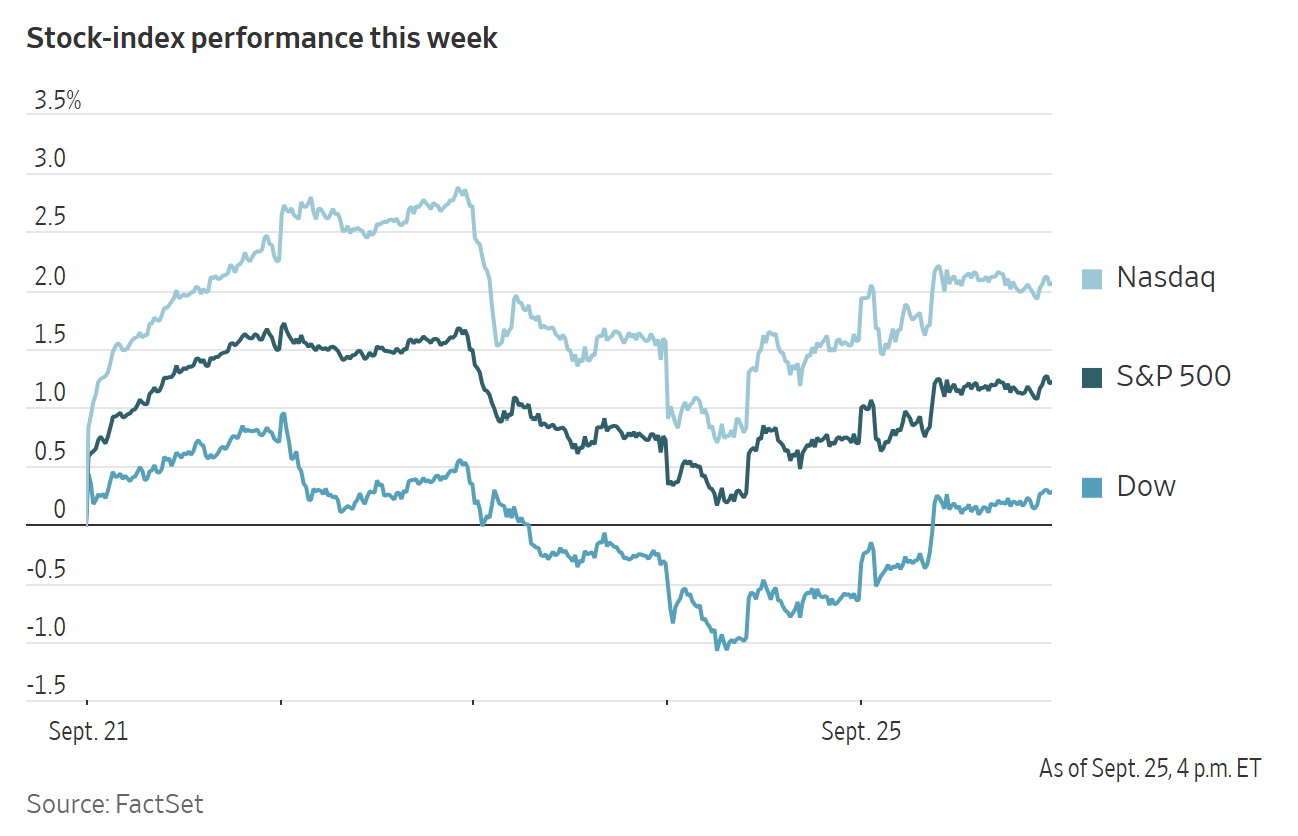
US equities ended an eventful week higher as investors looked beyond rising yields, volatile oil prices and uncertainty surrounding the Middle East conflict.
The Dow Jones Industrial Average gained 478.64 points, or +0.93%, to close at 51,829.62 on Friday, ending a three-day losing streak. The S&P 500 rose 39.28 points, or +0.51%, to 7,743.41, while the Nasdaq Composite added 129.34 points, or +0.48%, to 27,068.72.
Despite a midweek selloff, all three indexes posted weekly gains: the S&P 500 rose +1.21%, the Dow Jones advanced +0.28% and the Nasdaq Composite climbed +2.06%.
In corporate news, the Federal Aviation Administration is investigating a software glitch in certain Boeing 737 Max jets that could cause the automated flight-guidance system to disengage during an aborted landing, or go-around. Southwest Airlines and United Airlines have told Boeing they will not accept new aircraft equipped with that operating system and will instead use an earlier version.
SpaceX is scheduled to attempt Starship’s first orbital launch today, with plans to deploy the inaugural batch of next-generation Starlink internet satellites. Liftoff is expected within a 75-minute window opening at 8:15 AM ET. A successful test flight could move Starship closer to full operations and enable the deployment of new space-based technologies, including upgraded Starlink satellites designed to expand the capacity of SpaceX’s global internet network.
Bloomberg news reported that Saudi Aramco has hired Evercore to advise on a major restructuring that would establish a standalone gas division and potentially pave the way for a future listing. The separation could attract new investment or lead to an IPO or minority listing valuing the business at more than $100 billion.
Aramco is also seeking to sell up to $35 billion in assets to fund state projects and dividend payments, including a possible portion of its extensive real estate portfolio and a stake in its oil export and storage terminals.
Reuters reported that SK Hynix is considering a separate US listing for Solidigm that could value the unit at up to $150 billion. Initial pitch meetings with major investment banks began in late September 2026, and the listing could take place as early as 2027.
A standalone IPO could unlock substantial value and provide SK Hynix with liquidity to expand capital-intensive manufacturing and strengthen its position in the competitive AI hardware market. To meet rising demand and reduce exposure to geopolitical trade tensions, Solidigm is also exploring its first US flash-memory factory, or NAND fab, which would lessen its dependence on its primary NAND plant in Dalian, China.
European Stock Indices
CAC 40 -0.04%
DAX +0.56%
FTSE 100 +0.14%
Commodities
Gold spot +0.15% to $4,286.25 an ounce
Silver spot +0.55% to $64.26 an ounce
West Texas Intermediate -2.45% to $92.44 a barrel
Brent crude -2.45% to $104.41 a barrel
Gold prices edged higher on Friday but ended the week lower.
Spot gold rose +0.15% to $4,286.25 per ounce, but declined -2.07% for the week.
Spot silver gained +0.55% to $64.26 per ounce, although it fell -2.98% over the week.
Oil prices fell on Friday amid growing expectations of a truce between the US and Iran and reports of a possible US ban on diesel exports. Nevertheless, traders remained concerned that escalating Houthi attacks on Saudi Arabia could disrupt supply from the Middle Eastern producer.
Brent futures fell $2.62, or -2.45%, to settle at $104.41 per barrel, while WTI crude declined $2.32, also -2.45%, to $92.44 per barrel.
For the week, Brent gained +1.13%, whereas WTI fell -7.12%. The Brent premium over WTI widened for a third consecutive day on Friday to its highest level since May.
US and Iranian negotiators in New York are exploring a phased path out of the conflict under which Tehran would reopen the Strait of Hormuz and Washington would lift its economic blockade of Iran.
Iran, however, said it would show no flexibility on its nuclear programme even if the US accepted its proposal to reopen the Strait of Hormuz, which includes lifting the US naval blockade of Iranian ports.
The military chiefs of Saudi Arabia, Turkey and Pakistan are set to discuss assistance for Saudi Arabia as the country faces attacks by Yemen’s Iran-aligned Houthis.
Crude oil flows through the Strait of Hormuz reached 33.7 million barrels in the week beginning 20 September, according to preliminary ship-tracking data from Kpler, leaving exports broadly in line with the previous week.
The US has proposed that the United Arab Emirates host a trilateral meeting with Ukraine and Russia to discuss efforts to end their 4½-year war, Ukrainian President Volodymyr Zelenskiy said.
Russian President Vladimir Putin said all proposals to settle the 4½-year war with Ukraine remained on the table, although Moscow still needed to determine what best served its interests, Russian news agencies reported.
A drone attack damaged Russia’s Novoshakhtinsk oil refinery, forcing a temporary suspension of operations, Governor Yuri Slyusar said. The strike followed discussions at UN headquarters in New York on a potential energy-related ceasefire between Kyiv and Moscow.
Separately, Bloomberg news reported that sales of Venezuelan oil for October loading had stalled after shipping costs more than doubled from end-August, reducing the crude’s competitiveness against Canadian barrels for US refiners and complicating transactions.
The dispute threatens a key source of crude for US refiners amid record diesel prices and ahead of the US midterm elections. Commodity traders including Vitol and Trafigura, which were enlisted by the US to help market Venezuelan oil, have a broad arrangement (but no obligation) to purchase crude from Petróleos de Venezuela.
Venezuelan oil for October loading is currently being offered at a discount of about $14 per barrel to ICE Brent. With freight to the US Gulf Coast near $7 per barrel, the crude arrives in Texas and Louisiana at a discount of approximately $7 per barrel, making it at least $5 per barrel more expensive than competing Canadian supplies.
Additionally, total oil-product stockpiles at the port of Fujairah increased by 3.838 million barrels, or +59.4% w/o/w, to 10.296 million barrels in the week ended 21 September, according to S&P Global. Meanwhile, oil-product inventories at the port of Singapore fell by 2.925 million barrels w/o/w to 39.683 million barrels.
GL Consulting reported that China’s gasoline stockpiles were at 15-year lows, while diesel inventories had fallen to their lowest level in more than a decade, according to Reuters.
South Korea’s Industry Ministry said on Friday that the country aims to reduce its reliance on Middle Eastern crude to 50% by 2035, from 70% in 2025.
Note: As of 4 pm EDT 25 September 2026
Currencies
EUR +0.13% to $1.1391
GBP +0.32% to $1.3251
Bitcoin -0.65% to $83,786.99
Ethereum -0.20% to $2,680.94
The dollar ended a four-day winning streak on Friday, with the dollar index falling -0.20% to 101.04. It was its largest daily percentage decline in three weeks. For the week, it advanced by +0.82%, its second consecutive week of advancement on expectations of further rate hikes.
The euro rose +0.13% to $1.1391, but posted a third consecutive weekly decline, its longest losing streak since the beginning of the year. It was -0.82% for the week.
Sterling strengthened +0.32% to $1.3251, supported by hawkish remarks from BoE Governor Andrew Bailey, but remained near the three-month low reached on Thursday. For the week, the pound declined -1.06%.
The yen strengthened +0.96% to ¥157.26 per dollar, ending a four-day losing streak and recording its largest daily gain against the dollar since 7 September.
The currency advanced after Japan’s Finance Minister Satsuki Katayama said the US president had raised concerns about yen weakness during a summit with Japanese Prime Minister Sanae Takaichi earlier in the week.
Katayama and US Treasury Secretary Scott Bessent spoke on Friday and reaffirmed that yen undervaluation remained a concern and that both countries intended to strengthen cooperation, Japan’s Finance Ministry said.
Nevertheless, the yen posted a second consecutive weekly decline, falling -0.26%, as markets viewed the BoJ’s rate hike to a 31-year high and its latest guidance as insufficiently hawkish.
Fixed Income
US 10-year Treasury -4.0 basis points to 5.165%
German 10-year Bund -0.1 basis points to 3.600%
UK 10-year Gilt -3.0 basis points to 5.355%
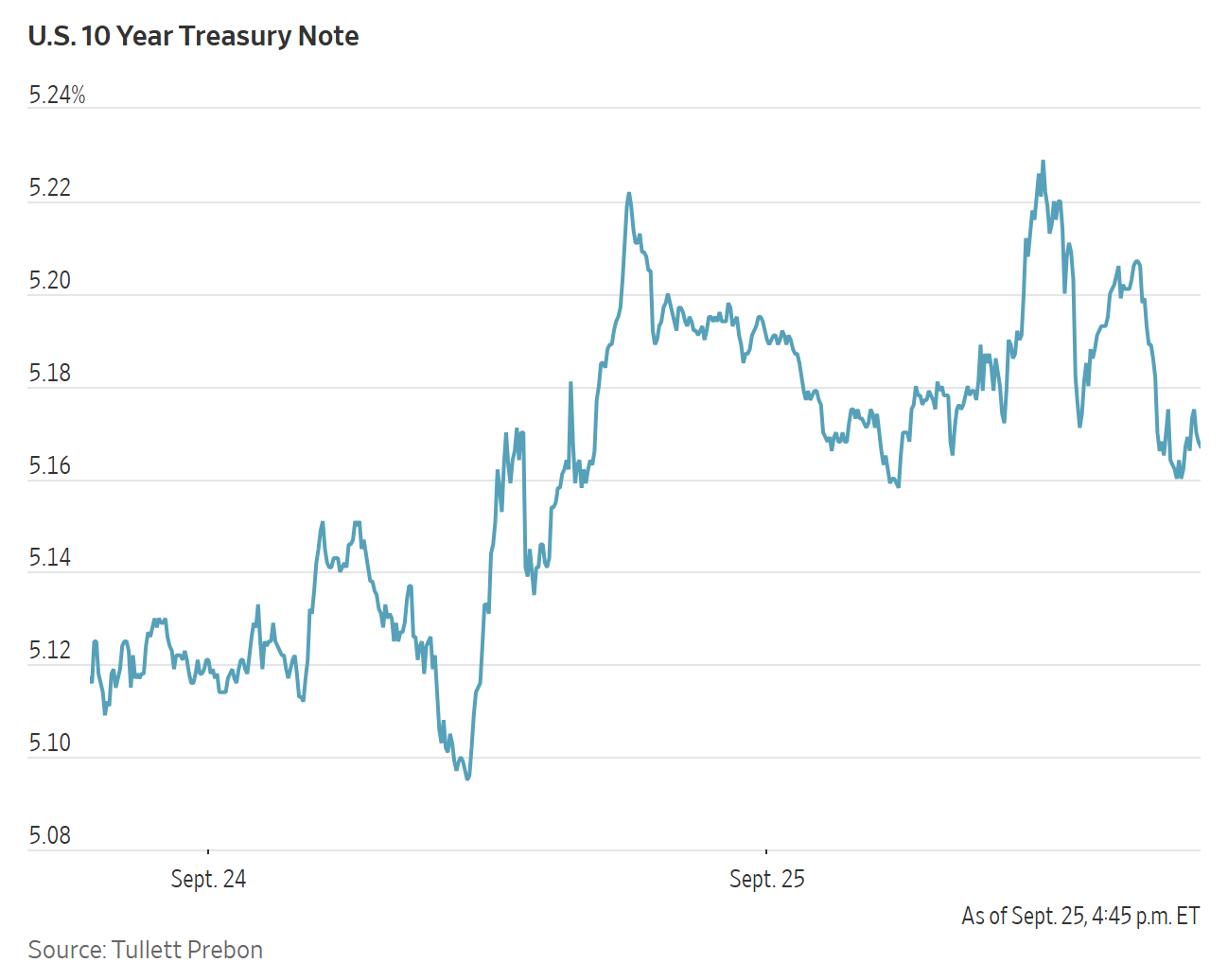
Longer-dated US Treasury yields rose again on Friday. The 30-year US Treasury yield reached a fresh 22-year high, while the benchmark 10-year yield climbed to a new 19-year high.
New orders for key US-manufactured capital goods rose more than expected in August, and the previous month’s figures were revised sharply higher, signalling another quarter of robust equipment spending amid the AI buildout.
The stronger data increased expectations of another Fed rate hike. According to CME Group’s FedWatch, traders now assign a 64.2% probability to an increase at the October FOMC meeting, up from approximately 57.2% one week earlier.
The Fed raised rates last week for the first time since 2023 in an effort to contain inflation. Fed commentary was decisively hawkish, with several FOMC members indicating that further rate increases might be required to curb price growth.
Weak demand at last week’s $70 billion auction of five-year notes added to the bond-market selloff.
Long-term yields also continued to rise for most of last week despite another Treasury buyback operation, which the government said was intended to support market liquidity.
The 30-year Treasury yield rose +1.6 bps to 5.496%, after reaching 5.532% earlier in the session, its highest level since 2004. Over the week, the yield increased +17.1 bps.
The 10-year US Treasury yield fell -4.0 bps to 5.165%, after touching 5.230% earlier in the session, its highest level since 2007. For the week, the yield rose +16.8 bps.
The US 2s10s yield curve stood at 29.7 bps, 5.2 bps wider than a week earlier.
The two-year US Treasury yield, which typically tracks expectations for the Fed funds rate, fell -6.7 bps to 4.86% on Friday but ended the week +11.6 bps higher.
This week’s calendar includes the September US payrolls report and the monthly personal consumption expenditures price index (PCE).
Across the Atlantic, eurozone government bond yields recorded a seventh consecutive weekly increase on Friday.
On Friday, the 10-year Bund yield edged down -0.1 bps to 3.600%, its highest level since June 2009, but ended the week +7.0 bps higher.
The 2-year Schatz yield, more sensitive to ECB deposit rate expectations, declined by -5.2 bps to 3.277%, after hitting 3.327% the day before, its highest level since September 2023. For the week, it declined by -1.6 bps.
French and Italian bonds diverged on Friday. France 10-year OAT yield was slightly higher by +0.2 bps to 4.726% and ended the week +15.2 bps higher. The spread between 10-year OAT and Bund yields rose for a fourth straight week, widening by 8.2 bps to 112.6 bps, after hitting 114.06 bps earlier on Friday, its highest level since June 2012.
Italy’s 10-year BTP yield declined by -3.1 bps on Friday to 4.541%, however, it advanced +10.0 bps last week.
The Italian spread was wider across the week after hitting 99.9 earlier in the week, the widest since March 2026. It was 94.1 bps on Friday, 3.0 bps wider than the prior week.
Money markets priced the ECB’s deposit rate at 2.84% by December, implying one quarter-point rate hike with a chance of a second move. They also saw the policy rate at 3.44% by late 2027, compared with 2.50% currently.
Note: As of 4 pm EDT 25 September 2026
While every effort has been made to verify the accuracy of this information, EXT Ltd. (hereafter known as “EXANTE”) cannot accept any responsibility or liability for reliance by any person on this publication or any of the information, opinions, or conclusions contained in this publication. The findings and views expressed in this publication do not necessarily reflect the views of EXANTE. Any action taken upon the information contained in this publication is strictly at your own risk. EXANTE will not be liable for any loss or damage in connection with this publication.
本文提供給您僅供資訊參考之用,不應被視為認購或銷售此處提及任何投資或相關服務的優惠招攬或遊說。金融商品交易涉及重大損失風險,可能不適合所有投資者。過往績效不代表未來表現。







由專業人士建立。為專業人士打造。
