

Is bad news still good news for bonds?


 S&P 500 -0.17% to 7,670.84 US 10-year yield +0.5 basis points to 5.249% Spot gold +1.62% to $4,180.79 an ounce DXY +0.20% at 101.39
Key data to move markets today
EU: German CPI, Harmonized Index of Consumer Prices, Retail Sales, Unemployment Rate and Unemployment Change, French CPI and Producer Prices, Italian CPI, Non-Monetary Policy ECB Meeting and a speech by ECB Executive Board member Isabel Schnabel
UK: GDP
USA: ADP Employment Change, GDP, Personal Consumption Expenditures (PCE) Price Index, Core PCE Price Index, Personal Income and Spending, Chicago PMI and speeches by Fed Governor Lisa Cook, Chicago Fed President Austan Goolsbee and Minneapolis Fed President Neel Kashkari
JAPAN: Tankan Large Manufacturing Index and Outlook and All Industry Capex
CHINA: Banks will be closed due to National Day
Global Macro Updates
Consumers blink, inflation does not. September’s surveys revealed a shared transatlantic theme, with households becoming more cautious as inflation risks complicate the path toward easier monetary policy.
In the eurozone, the European Commission’s Economic Sentiment Indicator slipped 0.5 points to 97.9, ending a four-month recovery and remaining below its long-run average. Consumer weakness was broad-based, with confidence declining across assessments of household finances, the broader economy and major purchases. Industry confidence, by contrast, rose 1 point to -3.8 as production expectations and order books improved. Spain was the conspicuous outperformer, while France and Italy lost ground.
The uncomfortable bit for the ECB is that softer sentiment has not translated into softer pricing signals. Selling-price expectations increased sharply in industry and construction, while households’ 12-month inflation expectations rose for a second month. Additionally, eurozone employment expectations fell 1.3 points to 97.5, a weaker reading than the EU-wide decline of 0.6 points cited in some summaries.
Across the Atlantic, US consumer confidence dropped to 81.9, its lowest since 2014, while August job openings declined to 7.079 mn. Openings now stand at just 1.01 per unemployed worker, suggesting the post-pandemic excess demand for labour has largely disappeared, although JOLTS’ declining response rate warrants some caution.
For investors, this is a mildly stagflationary combination. Weaker household demand and cooling employment should support duration, but resilient corporate pricing intentions and energy-sensitive inflation expectations limit how quickly both the Fed and ECB can oblige. The more immediate equity implication is a widening bifurcation between firms with pricing power and businesses exposed to discretionary consumption.
Gilts find their price. Britain’s latest gilt auction offered a blunt reminder that fiscal credibility now comes with a visible price tag. The Debt Management Office sold £4.25 bn of July 2036 bonds at an average yield of 5.383%, up from 5.16% at the previous sale and the highest 10-year auction yield since 1999.
The result crystallises Britain’s problem. Higher energy prices, persistent inflation and an overshoot in government borrowing have eroded fiscal headroom ahead of the October Budget. Borrowing during the first five months of the fiscal year was £8.1 bn above the official forecast, while rising debt-service costs have reportedly more than halved the government’s room for manoeuvre.
Chancellor John Healey’s renewed commitment to fiscal discipline provided some relief, as did the BoE’s decision to stop active sales of long-dated gilts. But the auction suggests investors still require compensation for inflation and policy risk. The key test for sterling assets is the Budget’s ability to steady borrowing without tightening fiscal policy enough to worsen the consumer slowdown.
US Stock Indices
Dow Jones Industrial Average -0.26%
Nasdaq 100 +0.21%
S&P 500 -0.17%, with 7 of the 11 sectors of the S&P 500 down
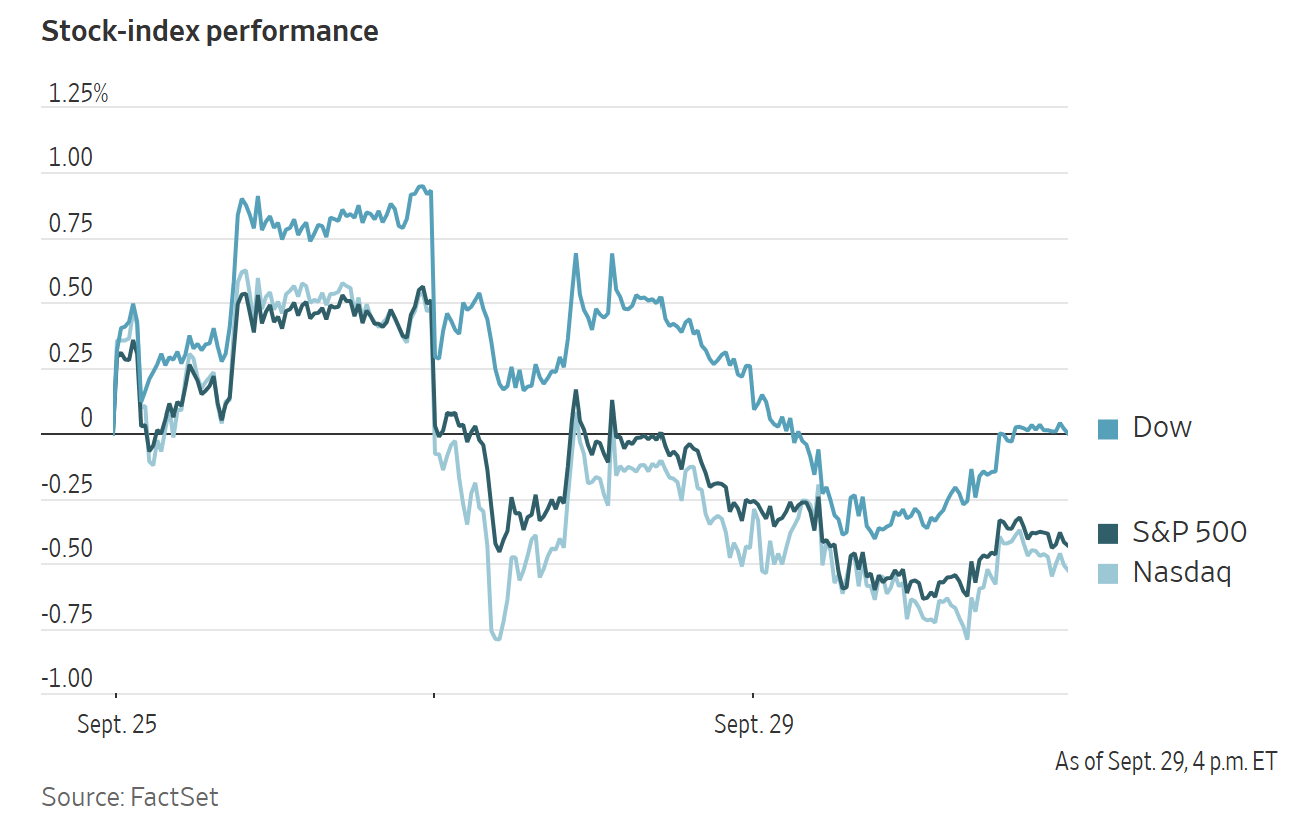
US equities closed lower on Tuesday but finished above session lows. Losses were relatively contained, although market breadth remained firmly negative. The Nasdaq Composite declined -0.09%, the S&P 500 fell -0.17% and the Dow Jones Industrial Average lost -0.26%, or 131.59 points.
In corporate news, Reuters reported details from Anthropic’s IPO prospectus, although its S-1 had yet to appear on SEC’s EDGAR. Key disclosures included $518 billion in future cloud and infrastructure commitments and two customers accounting for nearly 25% of revenue. Anthropic also launched Claude Sonnet 5.5, which is more than 30% faster than Sonnet 5, performs within a few points of Opus 5.5 on most benchmarks and costs significantly less.
OpenAI cancelled the planned October launch of GPT-6.1 Astra, citing concerns related to deception and control.
AMD agreed to acquire Fei-Fei Li’s World Labs for $8.2 billion in stock. Li will become AMD’s executive vice president and chief scientist, reporting to CEO Lisa Su. World Labs develops spatial and 3D technology for simulation, robotics and physical AI.
AT&T entered a $3 billion multiyear agreement with Corning to supply fiber and cable for its network expansion.
Bloomberg news reported that Piper Sandler is in talks to acquire Perella Weinberg Partners.
Smart-ring maker Oura postponed its previously announced IPO, citing market uncertainty. The company had been expected to seek a valuation well above the $11 billion secured in last year’s funding round. On Tuesday, Oura said it was delaying the listing despite strong demand because of uncertainty in the IPO market.
European Stock Indices
CAC 40 -0.53%
DAX +0.10%
FTSE 100 -0.45%
Commodities
Gold spot +1.62% to $4,180.79 an ounce
Silver spot +1.65% to $61.45 an ounce
West Texas Intermediate -4.66% to $88.94 a barrel
Brent crude -3.34% to $102.56 a barrel
Gold gained more than one percent on Tuesday, rebounding from the more than seven-week low reached in the previous session, although it remained below its 100-day moving average.
Spot gold rose +1.62% to $4,180.79 per ounce. Tuesday’s session low was $4,112.97, marginally above Monday’s more than seven-week low of $4,110.55.
Spot silver advanced +1.65% to $61.45 per ounce.
Oil prices settled lower on Tuesday as investors focussed on signs of recovering crude exports from the Middle East. Nevertheless, prices remained on track for monthly gains amid persistent concerns about supply disruptions during the US - Israeli war on Iran.
Brent crude futures settled down $3.54, or -3.34%, at $102.56 per barrel. US WTI declined $4.35, or -4.66%, to settle at $88.94 per barrel. The November Brent contract expires this afternoon, while the December contract closed at $96.16 per barrel.
Brent remained on track for a 13.00% monthly gain so far, while WTI is up 3.05% for the month.
Saudi Arabia resumed oil-tanker loadings at its Red Sea port of Yanbu after restarting operations on the East-West Pipeline, according to trade sources and shipping data, improving the outlook for Middle Eastern oil exports.
Crude oil exports from Middle Eastern producers rebounded to 16.328 million bpd in September, the highest level since the US - Israeli war on Iran began on 28 February, Kpler data showed on Monday.
The White House urged the EU to draw down emergency diesel inventories in an effort to reduce global prices, according to sources. The Trump administration said several EU member states had released less oil and refined products from reserves than they had pledged.
Additionally, the White House is considering regulatory relief that would permit broader sales of red-dyed diesel as part of efforts to curb surging prices, according to people familiar with the discussions. They noted that the measure could enable some buyers to avoid the federal fuel tax. The proposal has emerged as a leading alternative to a diesel export ban.
The US Department of Energy today announced an offer to exchange 40 million barrels of crude from the Strategic Petroleum Reserve, with bids due on 6 October. This represents the final portion of the 172 million barrels authorised for release following the start of the war in Iran.
OPEC-7 sources said this afternoon that the group is likely to maintain its current production policy when it meets on Sunday.
IEA Executive Director Birol said today that member countries may discuss whether to release additional strategic reserves.
Note: As of 4 pm EDT 29 September 2026
Currencies
EUR -0.19% to $1.1343
GBP -0.23% to $1.3224
Bitcoin +0.33% to $83,477.06
Ethereum +0.19% to $2,679.05
The US dollar rose to a 16-month high against the euro on Tuesday.
The euro fell to $1.1312 during Tuesday’s session, its lowest level against the US dollar since May 2025, before paring losses. It was down -0.19% on the day at $1.1343.
The US dollar index rose +0.20% to 101.39, reaching its highest level since 28 July.
The Japanese yen was broadly steady against the US dollar, appreciating +0.04% to ¥157.29 per dollar, as markets assessed recent warnings of possible coordinated intervention by Tokyo and Washington.
The British pound declined -0.23% against the US dollar to $1.3224.
Fixed Income
US 10-year Treasury +0.5 basis points to 5.249%
German 10-year Bund -1.8 basis points to 3.632%
UK 10-year Gilt -0.8 basis points to 5.414%
The yield on the rate-sensitive 2-year US Treasury note declined on Tuesday.
According to CME’s FedWatch, traders reduced expectations for an October increase and were last pricing a 50.4% probability of a 25-bps rate hike at the Fed’s next meeting, based on fed funds futures, down from 70.9% on Monday.
The 2-year yield moved lower in late-afternoon trading after reaching its highest level since May 2024 earlier in the session. Meanwhile, the 30-year US Treasury yield touched its highest level since 2002.
Earlier on Tuesday, a Conference Board report showed that US consumer confidence fell to its lowest level in more than 12 years in September, as households anticipated weaker business conditions and labour-market conditions over the next six months.
In the labour market, August job openings declined to 7.08 million, below the consensus estimate of 7.23 million and July’s 7.34 million.
The 10-year US Treasury yield rose +0.5 bps to 5.249% after touching 5.293% earlier in the session, its highest level since mid-June 2007.
The 30-year US Treasury yield increased +1.9 bps to 5.571% after reaching its highest level since June 2002 in morning trading.
The 2-year US Treasury yield, which typically tracks expectations for the Fed funds rate, fell -5.2 bps to 4.883% after touching 4.960% earlier in the session, its highest level since May 2024.
The US 2s10s yield curve stood at 36.6 bps.
The selloff in eurozone bonds paused on Tuesday, although yields remained near multiyear highs.
Germany’s 10-year government bond yield fell -1.8 bps to 3.632%, marking its first decline in six sessions after reaching a 17-year high of 3.653% on Monday.
On Monday, ECB President Christine Lagarde said the central bank considered a measured response appropriate to keep inflation under control. She also noted that bond-market developments, particularly rising long-term yields, could weigh on growth.
Money-market traders were pricing nearly four additional 25-bps rate hikes, following the two increases implemented over the summer. Futures implied an approximately 45% probability of a rate hike next month.
Germany’s 2-year government bond yield, the most sensitive to changes in ECB deposit-rate expectations, declined -0.5 bps to 3.305% after reaching a three-year high in the previous session.
Concerns about debt sustainability also contributed to lower bond prices, particularly in countries with strained fiscal positions, including France.
France remained a particular focus as it approached the 2027 presidential election with a substantial primary deficit and a fragmented parliament.
French bonds were among the worst performers in September. The 10-year French yield increased +63.3 bps during the month, placing it on track for its largest monthly rise since December 2022 and well above the G7 average increase of 38 bps.
France’s 10-year OAT yield rose +3.5 bps on Tuesday to 4.811%, remaining close to the previous day’s 18-year high. The spread between 10-year OATs and Bunds widened +5.3 bps to 117.9 bps, its widest level since 2012.
Across the English Channel, the UK issued 10-year gilts on Tuesday at the highest yield for securities of that maturity since 1999.
The UK Debt Management Office said it sold £4.25 billion of the 4.875% July 2036 gilt at an average yield of 5.383%, the highest yield at any 10-year bond auction since September 1999, when 10-year debt was sold at a yield of 5.694%.
The bid-to-cover ratio was 3.34x, consistent with the relatively strong investor demand seen at gilt auctions this year.
On Monday, the 10-year gilt yield in the secondary market reached 5.441%, its highest level since July 2007, before declining -0.8 bps on the day to 5.414%.
Note: As of 4 pm EDT 29 September 2026
While every effort has been made to verify the accuracy of this information, EXT Ltd. (hereafter known as “EXANTE”) cannot accept any responsibility or liability for reliance by any person on this publication or any of the information, opinions, or conclusions contained in this publication. The findings and views expressed in this publication do not necessarily reflect the views of EXANTE. Any action taken upon the information contained in this publication is strictly at your own risk. EXANTE will not be liable for any loss or damage in connection with this publication.
本文提供給您僅供資訊參考之用,不應被視為認購或銷售此處提及任何投資或相關服務的優惠招攬或遊說。金融商品交易涉及重大損失風險,可能不適合所有投資者。過往績效不代表未來表現。








由專業人士建立。為專業人士打造。
