

ECB holds, but risks are rising

 S&P 500 -1.21% to 7,408.30 US 10-year yield +3.2 basis points to 4.700% Spot gold -2.00% to $4,046.74 an ounce DXY +0.30% to 101.44
What to look out for today
Companies reporting on Friday, 24 July: American Express, Charter Communications, NextEra Energy, SLB and Verizon
Key data to move markets today
EU: German GfK Consumer Confidence Survey, French, German and Eurozone HCOB Composite, Manufacturing and Services PMIs and a speech by ECB Chief Economist Philip Lane
UK: Retail Sales and Retail Sales ex-Fuel and S&P Global Composite, Manufacturing and Services PMIs
USA: S&P Global Composite, Manufacturing and Services PMIs and New Home Sales
Global Macro Updates
The ECB hold and data dependency. The ECB raised rates in June and signalled that more increases could follow. However, a series of benign readings on prices, wages, economic activity and inflation expectations had reduced the urgency of a near-term follow-up move.
As expected, the ECB kept its key policy rates on hold. The statement preserved the bank’s longstanding data-dependent approach, while making several adjustments to policy language.
The ECB said energy prices remain close to the baseline in its June staff projections, although still well above pre-conflict levels. It said inflation should stabilise at 2.0% over the medium term, but added that it would closely monitor the intensity and duration of the shock. Energy prices have been highly volatile since the June decision; after pulling back sharply from their highs, Brent prices have risen 37.86% in July.
The statement offered few signals on the future policy path, as expected, and markets continue to price in further ECB tightening in September.
The return of oil prices to $100 per barrel, as the US - Israeli war with Iran disrupts shipping, prompted discussion of policy tightening at this month’s meeting, ECB President Christine Lagarde said, reinforcing market expectations for a September rate hike.
‘Yes, it was a unanimous decision. But I'm going to qualify that, because there were some governors who asked themselves whether we should not consider a hike – in other words, raising the three interest rates on the occasion of that meeting,’ Lagarde stated at the press conference.
‘As we stand now today, the milder scenario looks quite unlikely, let’s face it,’ Lagarde said. ‘The full effects of the energy shock have yet to play out.’
The Fed and BoE, both of which announce rate decisions next week, are also assessing the timing of potential hikes in the months ahead.
The central reason the ECB was in no rush to act on Thursday was that long-feared second-round effects from the energy price spike have yet to materialise. ‘Second-round effects: we are not seeing it. Believe me, we are really scrutinising the emergence of second-round effects, but we are not seeing it,’ Lagarde said.
Firms surveyed by the ECB did not report such effects in pricing or wage-setting decisions, and wage growth continues to slow, in line with the bank’s long-standing forecast. ‘None of those elements for the moment are giving us second-round effects indications,’ Lagarde said.
Trade tensions, high energy costs and China’s expansion into key European export markets suggest that the bloc’s industries will likely continue to face pressure, weighing on labour demand.
US Stock Indices
Dow Jones Industrial Average -0.97%
Nasdaq 100 -1.87%
S&P 500 -1.21%, with 7 of the 11 sectors of the S&P 500 down
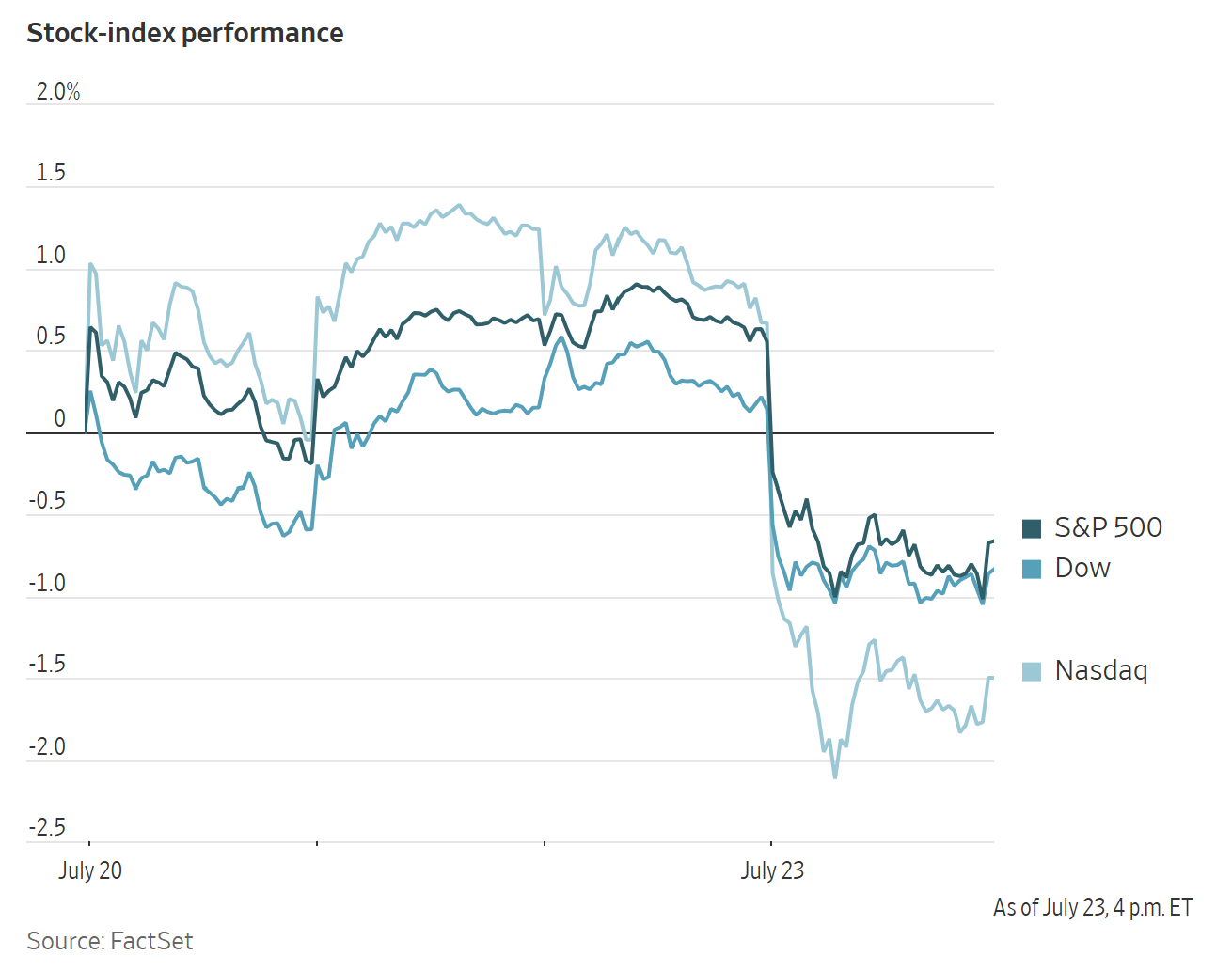
US equities declined as earnings from Alphabet and Tesla renewed concerns over Big Tech’s AI-related capital spending despite both companies reporting strong revenue growth. Alphabet fell -6.89% after raising its full-year CapEx forecast, while Tesla closed at $319.69 per share, down -14.52% on the day, erasing $214.5 billion in market value and making it the worst performer in the S&P 500. The weakness weighed on major indices, with the Nasdaq Composite down -2.15%, the Dow Jones Industrial Average lower by 506.93 points, or -0.97%, and the S&P 500 down -1.21%.
Alphabet’s finance chief said free cash flow would remain under pressure as the company expands its AI initiatives, while the company lifted its capital spending forecast to as much as $205 billion this year. On Thursday the European Commission fined Alphabet’s Google €460 mn for the search breach and €430 mn for the steering issues. The company will have 60 days to propose solutions or face potential daily fines if the company does not abide by EC rules.
Tesla is also increasing investment as it pivots toward autonomous vehicles and robotics, including development of Terafab, a chip-manufacturing facility being built in partnership with SpaceX and Intel.
In corporate news, Advanced Micro Devices announced new data-centre products that it said would outperform rival Nvidia’s offerings, as the company seeks to gain share in the fast-growing AI computing market.
The US Defense Department signed a nearly $7 billion contract with Oracle, with a term of up to 10 years, aimed at consolidating fragmented software licensing and improving intra-agency efficiency. The government said the agreement would optimise services and generate hundreds of millions of dollars in taxpayer savings.
Corporate Earnings Reports
Posted on Thursday, 23 July from The Pulse, our real-time AI-driven news tool. Available exclusively on the EXANTE Web Platform
American Airlines reported Q2 earnings. Revenue was $16.74bn (vs $16.71bn expected), up +16.3% y/y. Adjusted EPS was $0.15 (vs $0.03 expected), down -84% y/y. Fuel expense rose +83% y/y to $4.88bn. For Q3, the company guided for an adjusted loss per share of $0.10 to $0.70 (vs an estimated profit of $0.28), with fuel expense expected to increase $1.7bn y/y. The full-year 2026 adjusted EPS guidance was a loss of $0.65 to a profit of $0.65 (vs an estimated profit of $0.61). CEO Robert Isom stated that revenue growth exceeded initial expectations and that higher fares offset nearly half of the $2.2bn fuel headwind.
Blackstone reported Q2 earnings before the open. Revenue was $5.04bn, adjusted EPS $1.52 vs $1.32 expected, up +26% y/y. Total AUM reached $1.35trn, up +11% y/y, with inflows of $68.3bn vs $53.87bn expected. Fee-related earnings were $1.78bn vs $1.59bn. The CEO said the company delivered an outstanding second quarter, with strong growth in earnings and nearly $70bn of inflows, adding that leaning into the AI megatrend is creating extraordinary opportunities. The pace of withdrawals at the flagship private credit fund is slowing.
Lockheed Martin reported Q2 earnings with EPS of $7.94, up from $1.46 y/y, on net sales of $20.06bn (est $19.33bn). New orders were $65bn, pushing the backlog to a record $230bn, up +38% y/y. The company raised its FY26 guidance, now expecting EPS of $29.95-$30.65 (est $29.85), net sales of $79.75bn-$81.75bn (est $79.13bn), and FCF of $7.00bn-$7.20bn. CEO Jim Taiclet said the strong performance gave confidence to raise full-year guidance.
Tractor Supply reported Q2’26 revenue of $4.54bn (vs $4.64bn estimate), up +2.3% y/y, and adjusted EPS of $0.81 (vs $0.83 estimate). Comparable store sales fell -1.5%. Gross margin improved +20bps y/y to 37.1%, but operating income fell -19.2% y/y to $467.1mn. For FY26, the company guided adjusted EPS of $1.90-$2.00 (vs $2.03 estimate), net sales growth of +2.5% to +3.5%, and comparable store sales of -1% to flat. The CEO said, “While we are not satisfied with our performance, we believe there are discrete headwinds impacting the majority of our end markets.”
Intel reported Q2 FY26 results. Revenue was $16.1bn, up +25% y/y, and non-GAAP EPS was $0.42, both beating consensus. The Data Centre & AI segment generated $6.3bn in revenue. For Q3 FY26, the company guided revenue of $15.8-16.8bn and non-GAAP EPS of $0.38. CEO Lip-Bu Tan said the results represent the strongest revenue growth in more than fifteen years, enabled by greater speed, accountability, and customer focus. Intel also announced a partnership with Fortinet to develop a security processor, raised its 2026 capex to $20bn, and stated that 2027 capex would be significantly above that level, funded by liquidity and potential capital markets access. The company committed to volume production of 14A chips in 2028. Separately, it denied reports of selling its Ohio campus to SK Hynix. Additional layoffs in the data centre group were also reported as part of a restructuring.
European Stock Indices
CAC 40 -1.64%
DAX -1.56%
FTSE 100 -0.73%
Commodities
Gold spot -2.00% to $4,046.74 an ounce
Silver spot -3.61% to $57.55 an ounce
West Texas Intermediate +6.80% to $92.36 a barrel
Brent crude +7.07% to $100.53 a barrel
Gold declined on Thursday as a stronger US dollar weighed on bullion demand.
Spot gold fell -2.00% to $4,046.74 per ounce, after touching its highest level since 7 July on Wednesday.
The US dollar advanced +0.30%, making dollar-denominated bullion more expensive for overseas buyers.
Among other precious metals, spot silver fell -3.61% to $57.55 per ounce.
Brent futures settled above $100 per barrel on Thursday for the first time since May, after Yemen’s Houthis said they attacked two Saudi oil tankers in the Red Sea. The attacks added to global supply concerns following a near-halt in trade through the Strait of Hormuz.
Brent futures closed $6.64 higher, or +7.07%, at $100.53 per barrel, marking their highest settlement since 22 May. US WTI crude rose by $5.88, or +6.80%, to settle at $92.36 per barrel, its highest close since 4 June.
Yemen’s Houthis opened a new front in the Iran conflict by targeting vessels carrying Saudi oil in the Bab el-Mandeb Strait after saying they would impose a naval blockade on shipments from Saudi Arabia. The group said it attacked two Saudi Arabian oil tankers in a military operation. Saudi state news agency SPA later confirmed that one of the two vessels was ablaze after an assault while sailing in the Red Sea. SPA did not identify the attacker.
Iran’s Revolutionary Guards (IRGC) said an oil tanker caught fire after an explosion while attempting to follow a mined route in the southern part of the strait near Oman’s coast, and that two other vessels had turned back.
The IRGC said the strait was under their control and ‘completely closed’ while US actions continued in the region, warning that no tanker would be allowed to enter or leave without coordination with Iran.
Iranian strikes on vessels crossing the strait have reduced the number of non-Iranian oil tankers transiting the waterway. Meanwhile, the reintroduction of a US naval blockade targeting Iranian ports has likely pushed Iranian oil loadings to zero from 1.5 to 2.0 million bpd at the start of the month.
As fewer shipments have exited the strait, Gulf loading activity has fallen to 2.5 million bpd over the past seven days, compared with 6.0 million bpd averaged over the past 30 days.
To support supplies, seven core OPEC+ members, Saudi Arabia, Russia, Iraq, Kuwait, Algeria, Kazakhstan and Oman, are expected to consider raising their September output target by about 188,000 bpd when they meet on 2 August, three sources told Reuters, even as the war limits some members’ ability to increase production.
Despite the attacks, two Chinese supertankers carrying a combined 4.0 million barrels of Saudi Arabian oil exited the Red Sea via the Bab el-Mandeb Strait on Thursday, shipping data showed. Tanker traffic through the Strait of Hormuz remains largely limited to vessels heading to China, while Gulf production and crude loadings continue to slow. Updated estimates suggest more than 11.0 million bpd of Gulf production is shut in due to the renewed conflict. The US President said that if the Houthis fire on Saudi vessels again, the US would hold Iran responsible and impose major military consequences.
Reuters reported that Iran flew IRGC commanders, military advisers and missile- and drone-related equipment into Yemen this month. Separately, a fire was reported at Kuwait’s largest power plant. The US State Department advised US citizens in the Middle East to prepare for emergency travel.
Kazakhstan’s oil production reportedly fell to just over 400,000 bpd yesterday, down from an average of 925,000 bpd in July, following Ukrainian attacks on the CPC terminal in the Black Sea. Bloomberg’s Javier Blas posted on X that North Sea and Mediterranean physical oil markets surged as European refiners sought to replace Kazakhstan supply, with differentials up by $3 to $6 per barrel.
Interfax reported that Russia is discussing extending its diesel export ban by another month and its gasoline export ban by another six months.
Note: As of 4 pm EDT 23 July 2026
Currencies
EUR -0.26% to $1.1375
GBP -0.42% to $1.3314
Bitcoin -1.31% to $65,174.03
Ethereum -2.92% to $1,881.44
The US dollar strengthened to a fresh 40-year high against the yen and advanced against the euro on Thursday, while the ECB left interest rates unchanged.
The dollar index rose +0.30% to 101.44, its largest daily percentage gain in a month. The euro declined -0.26% to $1.1375. Sterling fell -0.42% to $1.3314.
The Japanese yen weakened -0.40% against the greenback to ¥163.76 per dollar after touching ¥163.98, its weakest level since November 1986. The move reflected expectations that the BoJ will take a more gradual approach to rate hikes than other major central banks. Markets are pricing in about 25 bps of BoJ hikes this year.
Japan’s finance minister reiterated that the government was prepared to take decisive action in foreign exchange markets if needed, after yen-buying operations in April and May, as the currency weakened beyond the ¥160 level.
Fixed Income
US 10-year Treasury +3.2 basis points to 4.700%
German 10-year Bund +2.8 basis points to 3.230%
UK 10-year Gilt +6.3 basis points to 5.103%
The US 10-year Treasury yield climbed on Thursday to its highest level since January 2025. The US 10-year note yield rose +3.2 bps to 4.700% and reached an intraday high of 4.714%.
The 2-year note yield, which typically tracks Fed funds rate expectations, rose +5.3 bps to 4.355% after reaching 4.370%, its highest level since February 2025.
The 2s10s Treasury curve flattened to 34.5 bps from 36.6 bps on Wednesday.
The 30-year bond yield rose +1.2 bps to 5.165% after reaching 5.194%, its highest level since 20 May. The 30-year yield has traded above five percent for fourteen consecutive days, the longest such stretch since 2007.
The Treasury saw soft demand for a $21 billion sale of 10-year Treasury Inflation-Protected Securities (TIPS) on Thursday. The debt was awarded at a high yield of 2.438%, 2.5 bps above where it traded before the auction. Demand was below its recent average, with the bid-to-cover ratio at 2.30x.
The government also saw mediocre demand for a $13 billion sale of 20-year bonds on Wednesday.
The ECB kept interest rates unchanged as expected on Thursday, but left the door open to another increase in September. The breakdown of the ceasefire between Iran and the US has largely erased hopes of a quick moderation in energy costs.
Markets are now pricing in a 71% probability of an ECB rate hike at the September meeting.
In Europe, Germany’s 10-year yield reached a 15-year peak on Thursday, while the 2-year yield touched a two-year high.
The German 2-year yield, which is highly sensitive to ECB policy, rose +4.6 bps to 2.889%, its highest level since July 2024. The 10-year Bund yield rose +2.8 bps to 3.230%, surpassing its May peak and reaching its highest level since 2011.
France’s 10-year yield gained +4.5 bps to 4.033%, its highest level since 2009. Italy’s 10-year BTP yield rose by a larger +7.4 bps to 4.071%, though it remains below its March highs. The spread over Bunds stood at 84.1 bps.
Note: As of 4 pm EDT 23 July 2026
While every effort has been made to verify the accuracy of this information, EXT Ltd. (hereafter known as “EXANTE”) cannot accept any responsibility or liability for reliance by any person on this publication or any of the information, opinions, or conclusions contained in this publication. The findings and views expressed in this publication do not necessarily reflect the views of EXANTE. Any action taken upon the information contained in this publication is strictly at your own risk. EXANTE will not be liable for any loss or damage in connection with this publication.
本文提供給您僅供資訊參考之用,不應被視為認購或銷售此處提及任何投資或相關服務的優惠招攬或遊說。金融商品交易涉及重大損失風險,可能不適合所有投資者。過往績效不代表未來表現。







由專業人士建立。為專業人士打造。
