

Is German sentiment turning on reform optimism?


 S&P 500 +0.89% to 7,509.20 US 10-year yield +3.2 basis points to 4.629% Spot gold +1.74% to $4,075.24 an ounce DXY +0.19% to 101.19
What to look out for today
Companies reporting on Wednesday, 22 July: Alphabet, AT&T, CME Group, Crown Castle, GE Vernova, IBM, Las Vegas Sands, Philip Morris International, Raymond James Financial, ServiceNow, Texas Instruments Incorporated
Key data to move markets today
UK: CPI, PPI, Retail Price Index
Global Macro Updates
German investor sentiment strengthens on reform optimism. German investor morale improved in July, as the ZEW Indicator of Economic Sentiment rose 15.8 points to 26.3, above the 17.5 consensus estimate. The increase marked the strongest monthly gain in more than a year and moved expectations firmly into positive territory for the first time in several months for Europe’s largest economy. While the current economic situation indicator remained deeply negative at -77.6, it improved by 3.4 points, suggesting analysts increasingly view the worst of the downturn as behind them.
ZEW President Wambach attributed the improved tone to Chancellor Merz's recent reform package covering pensions, taxes, labour-market rules and red-tape reduction, which appears to be supporting forward-looking assessments. Sector-level data showed broad-based improvement, led by mechanical engineering and domestic demand-oriented sectors such as retail and construction. The automotive sector deteriorated further to -46.6, underscoring persistent weakness in Germany's traditional export engine. Inflation expectations cooled noticeably, while expectations for euro-area rate hikes declined sharply.
The improvement came despite lingering concerns over the Iran conflict and oil-price volatility, which ZEW identified as key risks to the recovery outlook. Markets will now look to upcoming IFO and PMI readings for confirmation that the recent improvement in sentiment is gaining traction.
More tariffs on the way? The Financial Times reported that the US could announce new Section 301 tariffs on dozens of countries as soon as this week, as the administration's 10% global duties, imposed after the Supreme Court's February decision, are set to expire on Friday. The report said the new tariffs would likely range from 10% to 12.5% and noted the administration may remain sensitive to cost pressures ahead of November's midterm elections.
On Monday the White House announced additional 50% tariffs on certain Canadian imports under Section 338 of the Tariff Act of 1930. The duties cover goods such as milk, beer and plywood, which together account for more than 5% of Canadian exports, but exclude energy, minerals and categories already subject to specific tariffs.
The tariffs will apply even to shipments that comply with USMCA rules. USTR Greer said the new duties respond to Canada's retaliation against earlier US tariff measures. In a statement, Canada's PM Carney said Canada acted within its rights in matching prior tariff actions, while remaining ready to engage with the US on trade issues. Separately, the US and Mexico are scheduled to hold bilateral talks this week on revising the USMCA, without Canada's participation.
President Trump appears to be reaffirming his commitment to tariffs, despite voter concerns about the cost of living heading into November’s midterm elections. As noted by Bloomberg news, critics of his policies argue that import taxes raise the price of consumer goods, but the president and top administration officials say that tariffs are necessary to rebuild American manufacturing might and protect domestic industries. The reports follow the Trump administration's announcement on Monday of measures aimed at addressing the threat from aluminum imports. Last week the US also announced its intention to apply a 25% tariff on many Brazilian products.
US Stock Indices
Dow Jones Industrial Average +0.74%
Nasdaq 100 +1.93%
S&P 500 +0.89%, with 9 of the 11 sectors of the S&P 500 up
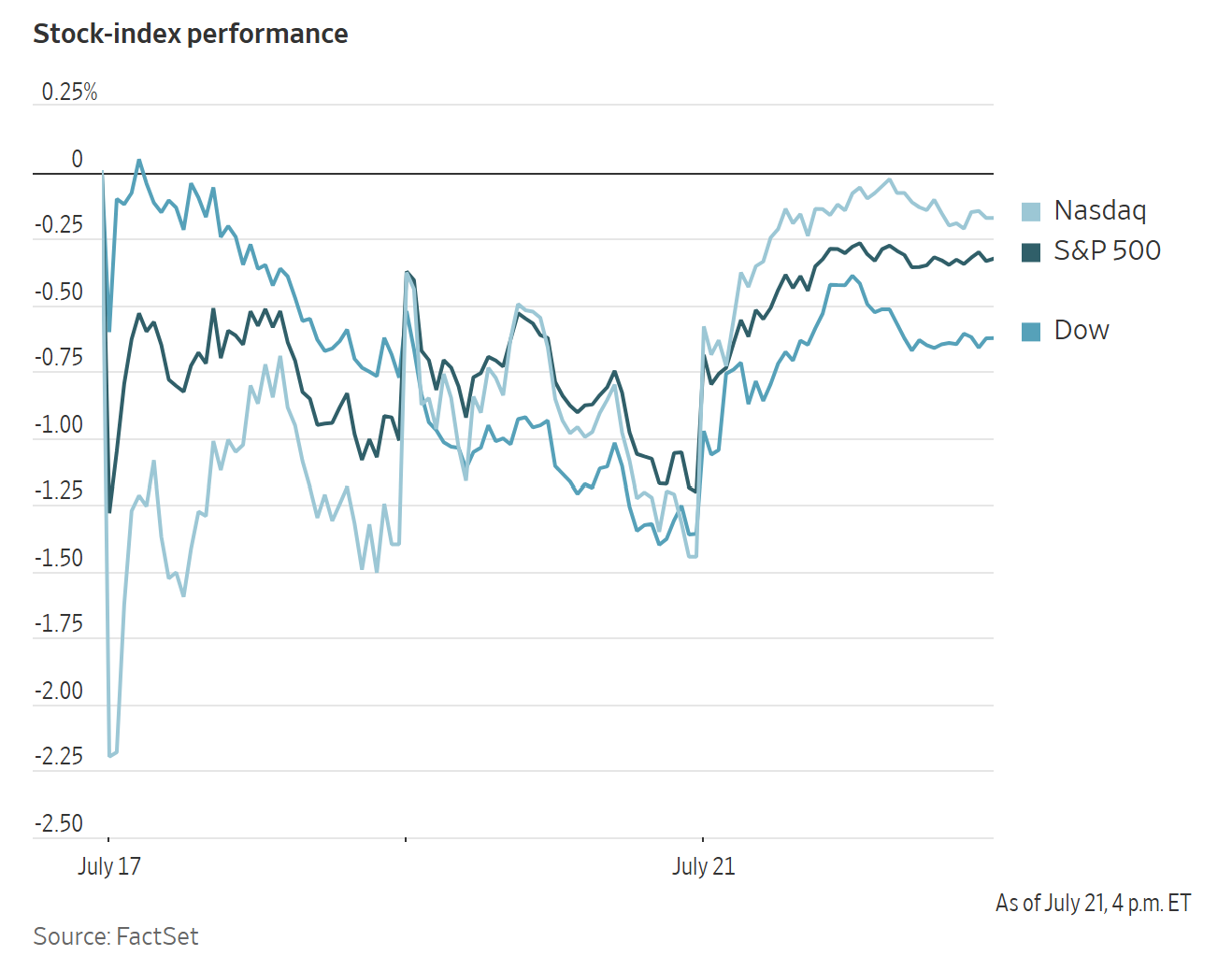
US equities snapped a three-day losing streak on Tuesday, supported by a rebound in semiconductor shares and optimism ahead of earnings from several of the country’s largest technology companies.
The Nasdaq Composite led gains among major US benchmarks, rising +1.29%, while the S&P 500 advanced +0.89%. The Dow Jones Industrial Average gained +0.74%, or 385.38 points.
In corporate news, Apple is preparing to launch Apple Upgrade, a leasing programme expected to cover most iPhone, Mac, iPad and Apple Watch models. The service would operate similarly to a subscription, allowing users to pay off devices early, upgrade before the end of the term or keep the device once the leasing period ends. Apple plans to position the programme as a lower-payment alternative to its current financing options and will discontinue new enrollments in its existing iPhone payment programmes to support the rollout.
Ozempic maker Novo Nordisk filed a lawsuit against Eli Lilly, alleging that the company used deceptive advertising to mislead consumers. The complaint claims Eli Lilly relied on outdated studies to promote its branded GLP-1 drugs, Mounjaro and Zepbound, as delivering significantly greater average weight loss than Novo Nordisk’s Ozempic and Wegovy.
Corporate Earnings Reports
Posted on Tuesday, 21 July from The Pulse, our real-time AI-driven news tool. Available exclusively on the EXANTE Web Platform
Halliburton reported Q2 earnings before the open. EPS came in at $0.64 vs $0.55 y/y. Adjusted operating income was $683mn vs the $688.7mn consensus estimate. Drilling & Evaluation revenue beat at $2.51bn vs $2.35bn expected, while Completion & Production revenue also beat at $3.20bn vs $3.16bn expected. However, Completion & Production segment operating income missed at $474mn vs $486.4mn. Drilling & Evaluation operating income exceeded expectations at $338mn vs $320.8mn.
D.R. Horton reported Q3 fiscal 2026 earnings: EPS of $3.20, beating the $2.99 estimate but down -5% y/y from $3.36. Revenue was $9.2bn, slightly above the $9.17bn consensus. The company guided FY revenue to $32.5bn-$33.0bn, down from a prior view of $33.5bn-$34.5bn, and homes closed to 83,800-84,300, down from 86,000-87,500. It affirmed dividend payments of ~$500mn and share repurchases of ~$2.5bn. CEO Paul J. Romanowski said, "The D.R. Horton team delivered a solid third quarter, highlighted by earnings per diluted share of $3.20, consolidated pre-tax income of $1.2 billion, revenues of $9.2 billion and a pre-tax profit margin of 13.3%." A separate note indicated Morgan Stanley sees AI potentially transforming the US mortgage market, which could benefit homebuilders like D.R. Horton.
Danaher reported Q2 revenue of $6.3bn vs $6.27bn expected and adjusted EPS of $1.94 vs $1.84 expected. Revenue rose +5.5% y/y. The Biotechnology segment grew +4.0% y/y, Life Sciences +5.5% y/y, and Diagnostics +7.0% y/y. Following the early close of the Masimo acquisition, management raised full-year adjusted EPS guidance to $8.45-$8.60 from $8.35-$8.55, with core revenue growth forecast of +3.0% to +4.0%. Danaher repurchased $900mn in shares and announced its Leica Biosystems unit will acquire StatLab. Management noted that better-than-expected Q2 results and improved core growth driven by disciplined execution supported the upgraded outlook.
Charles Schwab reported Q2 2026 earnings that beat consensus estimates. Adjusted EPS came in at $1.62 vs $1.55 expected, while revenue was $7.07bn vs $6.92bn expected, representing a y/y increase of +21%. Net income rose +32% y/y to $2.80bn. Total client assets reached $13.08trn, up +22% y/y, and core net new assets were $119.8bn vs $111bn estimated, up +49% y/y. Net interest revenue was $3.36bn vs $3.3bn expected, and net interest margin stood at 3.0%. The company guided for FY revenue growth of 17.5% to 18.5% compared to the prior year. CEO Rick Wurster noted that the retail investor is 'buying dips' and 'wealthier than ever.' The bank also launched direct Bitcoin and Ethereum trading through Schwab Crypto, and introduced a generative AI tool, Portfolio Insights.
General Motors reported Q2 results before the open. Adj. EPS was $3.57 vs $3.19 expected, revenue was $48.03bn vs $46.61bn expected, and adj. EBIT was $3.94bn vs $3.79bn expected. North American adj. EBIT hit $3.45bn, International Operations $190mn. Vehicle sales were 990,000 units, up +1.6% y/y. GM raised FY26 guidance for the second time, now seeing adj. EPS of $12.00-$14.00, adj. EBIT of $14bn-$16bn, and adj. auto FCF of $9.5bn-$11.5bn. The quarter included $2.3bn in EV realignment charges. CEO Mary Barra said customer demand in North America remains strong, driven by pickups and SUVs, and that the company delivered its best quarter and first half ever for Super Cruise-equipped vehicles. Separately, Canada agreed to intensify trade negotiations following new US tariffs on Canadian autos, dairy, and alcohol.
3M reported Q2 2026 earnings before the open. Adjusted EPS was $2.40 (est. $2.25, up +11% y/y) on revenue of $6.5bn (est. $6.4bn, up +2.4% y/y), with adjusted operating margin of 24.9% (est. 24.7%, up +40bps y/y). The company raised full-year guidance, seeing adjusted EPS of $8.80-$8.95 (est. $8.74), total sales growth above +4.5%, organic sales growth above +3.5%, and adjusted operating cash flow of $5.8bn-$6.0bn. 3M also announced a strategic AI partnership with Microsoft for Azure data centres. CEO William Brown stated the company delivered a strong quarter with double-digit EPS growth and is raising guidance due to continued momentum.
European Stock Indices
CAC 40 +0.28%
DAX +0.66%
FTSE 100 +0.58%
Commodities
Gold spot +1.74% to $4,075.24 an ounce
Silver spot +4.01% to $58.82 an ounce
West Texas Intermediate +2.11% to $84.71 a barrel
Brent crude +2.81% to $91.44 a barrel
Gold advanced on Tuesday with spot gold rising +1.74% to $4,075.24 per ounce due to hopes of a de-escalation in Middle East tensions following the circulation of a proposal for a 10-day ceasefire in the US - Iran conflict.
Spot silver gained +4.01% to $58.82 per ounce.
Crude benchmarks settled at their highest levels in more than five weeks, supported by the ongoing war in Iran and rising Houthi-related risks to Red Sea traffic. The WTI August contract expired, while the September contract settled at $84.71 per barrel.
Brent crude futures settled $2.50, or +2.81%, higher at $91.44 per barrel, while US WTI futures rose $1.75, or +2.11%, to $84.71 per barrel.
An Iranian official began meetings on Tuesday with mediators in Pakistan, two officials told the AP, as diplomats attempted to revive the collapsed ceasefire agreement between Iran and the US. Despite those reported discussions, the US continued to strike targets in Iran, while Iran continued to target several neighbouring countries.
Although Iranian officials have repeatedly said they are targeting only US military assets in the region, Kuwait has intercepted missiles or drones targeting power and water desalination facilities for four consecutive days.
At least two Saudi oil tankers reversed course in the Red Sea and are now avoiding the Bab el-Mandeb strait after Yemen’s Houthis threatened ships calling at Saudi ports. Reuters reported that Asian refiners are seeking to ship crude oil from Saudi Arabia’s Red Sea port through the Suez Canal.
CPC terminal exports remain offline after loadings were suspended on Monday, and the terminal has stopped accepting Kazakhstan inflows.
JODI data showed Saudi crude exports fell by 552,000 bpd m/o/m in May to a record low of 3.434 million bpd, while production rebounded by 244,000 bpd m/o/m from April’s record lows to 6.560 million bpd.
Tropical Storm Bertha, with maximum sustained winds of 60 mph, continued moving slowly toward the Louisiana coast, modestly affecting Gulf of America production and regional shipping. The US Bureau of Safety and Environmental Enforcement did not provide an afternoon update on shut-in production.
Note: As of 4 pm EDT 21 July 2026
Currencies
EUR -0.09% to $1.1400
GBP -0.37% to $1.3375
Bitcoin +1.68% to $66,358.54
Ethereum +1.15% to $1,923.17
The dollar index increased by +0.19% to 101.19 on Tuesday, while the yen remained under pressure near an almost four-decade low.
The yen touched ¥163.24 per US dollar earlier in the session, its weakest level since late 1986, and ended the day -0.40% lower at ¥163.14.
The euro was -0.09% lower on the day to $1.1400 after touching just below that level earlier in the session.
Sterling also tested support, falling through its 200-day moving average to $1.3375, or -0.37% lower on the day, as traders assessed how new UK finance minister John Healey plans to fund spending.
Fixed Income
US 10-year Treasury +3.2 basis points to 4.629%
German 10-year Bund +1.2 basis points to 3.189%
UK 10-year Gilt -1.0 basis points to 5.035%
US 10-year Treasury yields reached a two-month high on Tuesday.
The 2-year note yield, which typically tracks Fed rate expectations, rose +6.3 bps to 4.278%.
The US 10-year note yield rose +3.2 bps to 4.629%, after reaching 4.640% earlier in the session, its highest level since 20 May. The 2s10s curve flattened to 35.1 bps.
The Fed is expected to hold rates steady when it concludes its two-day meeting next week on 29 July. Fed funds futures currently imply a 23.1% probability of a rate increase by next week and 38.5 bps of rate hikes by year-end.
The US Treasury Department is scheduled to sell $13 billion of 20-year bonds today and $21 billion of 10-year Treasury Inflation-Protected Securities tomorrow.
Eurozone government bond yields edged slightly higher on Tuesday.
At the ECB’s policy announcement on Thursday, markets expect the central bank to keep its deposit rate unchanged at 2.25%, following a 0.25 bps rate increase in June.
Further ahead, markets are pricing in +45 bps of ECB tightening by year-end, equivalent to one quarter-point rate hike and an 80% probability of a second hike.
Germany’s 2-year Schatz yield, which is sensitive to changes in ECB deposit-rate expectations, rose +1.7 bps to 2.810% after touching a two-year high of 2.817% in Monday’s session. Germany’s 10-year bond yield rose +1.2 bps to 3.189%, its highest level in more than eight weeks.
Britain’s 10-year gilt yield declined -1.0 bps to 5.035%. Investors are closely watching the UK gilt market after new Prime Minister Andy Burnham appointed former defence minister John Healey, who served as a junior Treasury minister from 2002 to 2007, as finance minister.
Note: As of 4 pm EDT 21 July 2026
While every effort has been made to verify the accuracy of this information, EXT Ltd. (hereafter known as “EXANTE”) cannot accept any responsibility or liability for reliance by any person on this publication or any of the information, opinions, or conclusions contained in this publication. The findings and views expressed in this publication do not necessarily reflect the views of EXANTE. Any action taken upon the information contained in this publication is strictly at your own risk. EXANTE will not be liable for any loss or damage in connection with this publication.
本文提供給您僅供資訊參考之用,不應被視為認購或銷售此處提及任何投資或相關服務的優惠招攬或遊說。金融商品交易涉及重大損失風險,可能不適合所有投資者。過往績效不代表未來表現。




由專業人士建立。為專業人士打造。
