

Do investors risk getting lost with no Fed guidance?

 S&P 500 -0.69% to 7,691.76 US 10-year yield -1.6 basis points to 4.710% Spot gold -1.89% to $4,333.48 an ounce DXY +0.08% at 99.65.
What to look out for today
Companies reporting on Wednesday, 19 August: Analog Devices, Lowe’s, Nordson, Raymond James Financial, Target, Progressive, TJX
Key data to move markets today
EU: Eurozone Harmonised Index of Consumer Prices and Core Harmonised Index of Consumer Prices and a speech by ECB Chief Economist Philip Lane
UK: CPI, Core CPI, PPI, PPI Core Output and Retail Price Index
USA: FOMC Minutes
JAPAN: Merchandise Trade Balance Total, Adjusted Merchandise Trade Balance and Imports and Exports
Global Macro Updates
Preview: July FOMC meeting minutes. The minutes of the July FOMC meeting will be released today at 14:00 EDT. At that meeting, the Fed left rates unchanged, as expected, although the decision included three dissents from Cleveland Fed President Beth Hammack, Minneapolis Fed President Neel Kashkari and Dallas Fed President Lorie Logan, each favouring a 25 bps hike.
The minutes may carry greater significance given the relatively limited communication approach under Chair Kevin Warsh. The July policy statement was concise and Warsh avoided offering explicit forward guidance or further detail on the Fed’s reaction function. However, he did make several dovish-leaning remarks, including that financial markets had already delivered a meaningful degree of tightening without a change in the Fed’s policy stance.
Market participants will look to the minutes for broader context on the economic outlook and the balance of risks, particularly because Warsh’s post-meeting comments provided limited new information. Investors will also assess the extent to which officials were sympathetic to the arguments behind the three dissents, especially after several non-voting officials subsequently expressed support for more hawkish views.
That said, the minutes may already appear somewhat dated, given the softer labour-market data and more favourable inflation readings released since the meeting. They will also precede the Fed’s Jackson Hole symposium on 27 - 29 August, which will provide Warsh with his next major opportunity to clarify both the policy outlook and the Fed’s communications strategy.
ECB’s Lane expects eurozone Inflation to remain near 3% in 2026. ECB Chief Economist Philip Lane told Irish RTE Radio 1 that inflation is likely to remain near three percent through 2026, citing risks linked to the Iran war. He also identified food prices as a key inflation driver next year and warned of additional upward pressure in summer 2027 from weather events, including El Niño, according to RTE. Lane emphasised that the ECB will act to prevent inflation from remaining too high for too long, prioritising price stability even if higher rates place pressure on mortgage holders.
Lane described the eurozone economy as reasonably resilient, pointing to recent quarterly growth of 0.3% to 0.4%. However, he warned that an open-ended conflict in the Middle East could alter what has so far been a relatively benign global backdrop. He declined to discuss the likely rate path, noting only that policy decisions will remain data-dependent and focussed on returning inflation to target. His 2026 inflation view is broadly consistent with the ECB’s June projections, which are due to be updated in September.
US Stock Indices
Dow Jones Industrial Average -0.22%
Nasdaq 100 -1.68%
S&P 500 -0.69%, with 7 of the 11 sectors of the S&P 500 down
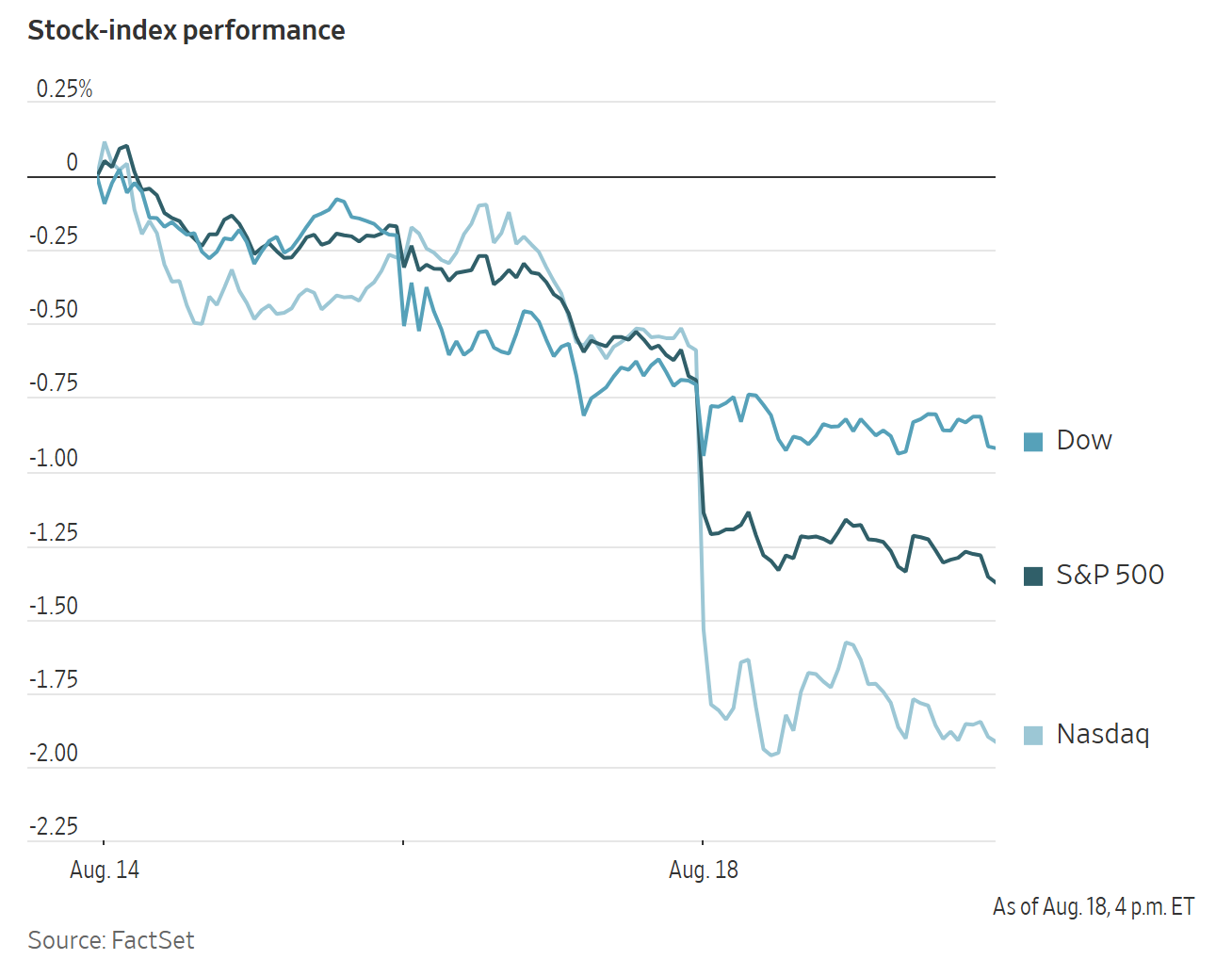
US equities fell on Tuesday for the third consecutive session. The S&P 500 declined -0.69%, or down 53.30 points, to 7,691.76. The Nasdaq Composite was -1.33%, or down 355.20 points to 26,289.71. The Dow Jones Industrial Average fell -0.22%, or down 116.38 points, to 53,343.40.
In corporate news, Anthropic PBC’s revolving credit facility is expected to exceed its roughly USD 10 billion target, Bloomberg reported, citing people familiar with the matter, as the AI company prepares for a closely watched initial public offering.
Amylyx Pharmaceuticals shares rose sharply Tuesday after the company said its experimental treatment for post-bariatric hypoglycemia, or PBH, reduced significant blood-sugar crashes by 55% versus placebo in a late-stage trial.
Corporate Earnings Reports
Posted on Tuesday, 18 August from The Pulse, our real-time AI-driven news tool. Available exclusively on the EXANTE Web Platform
Home Depot reported Q2 earnings that exceeded expectations. Revenue was $47.9bn vs $47.3bn expected, and adjusted EPS was $4.92 vs $4.73 expected. Comparable sales rose +1.7%, while customer trips fell -1% and the average ticket rose +2.8%. Tariff refunds reduced cost of goods sold by $685mn. The company reaffirmed its full-year guidance. CFO Richard McPhail described a ‘frozen housing market’ where consumers have yet to return to large projects. CEO Ted Decker is on temporary medical leave; Ann-Marie Campbell will oversee day-to-day operations and Richard McPhail will manage financial matters.
Baidu reported Q2 2026 earnings. Revenue was RMB31.3bn (vs RMB31.96bn expected). Non-GAAP EPS/ADS was RMB7.22 (vs RMB9.92 expected) while adjusted EBITDA of RMB6.2bn beat the RMB5.79bn consensus. AI Cloud infrastructure revenue rose +50% y/y. Separately, on 13 Aug, Fitch downgraded Baidu’s credit rating to ‘A-’ with a stable outlook.
Amer Sports reported Q2 revenue of $1.63bn (up +32% y/y), beating estimates of $1.54bn, and adjusted EPS of $0.22 vs $0.11 expected. Adjusted EBITDA was $311.9mn vs $198mn expected. The company raised its FY26 guidance for adjusted EPS to $1.27-$1.30, revenue growth of ~24%, and an operating margin of 14.2%-14.5%. However, its Q3 adjusted EPS guidance of $0.31-$0.33 fell short of the $0.38 consensus. Segment revenue grew across all divisions, led by Outdoor Performance at +37% y/y. CEO management commented that strong brand positioning and execution gave the firm confidence to raise full-year guidance.
European Stock Indices
CAC 40 -0.82%
DAX -0.80%
FTSE 100 +0.07%
Commodities
Gold spot -1.89% to $4,333.48 an ounce
Silver spot -3.94% to $63.30 an ounce
West Texas Intermediate +0.38% to $85.27 a barrel
Brent crude +0.24% to $91.30 a barrel
Gold prices declined on Tuesday, pressured by broader market dynamics and a firmer tone across parts of the rates complex.
Spot gold fell -1.89% to $4,333.48 per ounce, while spot silver dropped -3.94% to $63.30 per ounce.
Oil prices settled at their highest level in more than three weeks on Tuesday, supported by renewed geopolitical risk after Iran signalled a more offensive stance and said the Strait of Hormuz would remain closed, while the US ruled out extending a ceasefire.
Gains were contained, however. Brent crude futures finished up 22 cents, or +0.24%, at $91.30 per barrel, while US WTI crude futures closed up 32 cents, or +0.38%, at $85.27 per barrel. Both contracts ended at their highest levels since 24 July. The WTI September contract expires Thursday, while the October contract closed at $84.06 per barrel.
Supply concerns eased somewhat after Saudi Aramco resumed oil loadings from inside the Strait and began offering cargoes through ship-to-ship transfers off Fujairah in the UAE, according to shipping data and trade sources.
Two Chinese shipping companies also began collecting oil cargoes outside the Gulf, according to industry executives, tanker trackers and brokers. Even so, vessel traffic through the strategic waterway remained in the single digits, excluding ships transiting with transponders turned off.
Top Iranian negotiator Mohammad Baqer Qalibaf said Iran would keep the Strait closed until the US meets the conditions of the interim deal signed in June, according to comments published by state media on Tuesday.
The US President, who previously said the deal was over, stated on Tuesday that talks between the US and Iran were neither taking place nor scheduled, and maintained that the Strait was open. White House sources said Trump instructed his team not to engage with Iran until Tehran is ready to sign an agreement. The market reaction was muted.
Shortly before 11:00 am EDT, crude benchmarks briefly moved higher after Dubai issued a missile-threat alert.
Reuters reported that Aramco resumed loadings from inside the Strait of Hormuz last week and had additional tankers waiting to load, after sales had been halted for three weeks, according to ship-tracking data.
Security risks also remained elevated. Yemen’s Houthis said they launched missiles at vessels they described as a Saudi military ship and four escorts in the Red Sea. Separately, the UK Maritime Trade Operations said it received a report that a vessel was struck by an unknown projectile while transiting out of the strait, causing engine-room damage and one crew casualty. This marked the 16th consecutive day of attacks on ships in or around the Strait.
Four sources told Reuters that Russia is rerouting Kazakhstan’s crude oil exports from the Baltic port of Ust-Luga to the Black Sea port of Novorossiysk, freeing capacity for additional Russian oil exports from the Baltic amid heightened Black Sea security risks.
The shift would allow Russia to replace Kazakh barrels at Ust-Luga with its own crude exports, while Ukrainian drone attacks continue to complicate tanker availability for Russian Black Sea loadings.
In refined products, the US diesel crack reached an all-time high of $102.20 per barrel on Monday.
Note: As of 4 pm EDT 18 August 2026
Currencies
EUR +0.01% to $1.1575
GBP -0.04% to $1.3532
Bitcoin +0.37% to $64,583.65
Ethereum +0.37% to $1,912.32
The US dollar traded in a narrow range against major peers on Tuesday, as investors assessed softer US data and the implications for the Fed’s policy outlook. The dollar index rose +0.08% to 99.65.
The euro eased from Monday’s two-month high of $1.1610, but remained +0.01% higher on Tuesday at $1.1575.
Recent data have pointed to a softer US economy, including unexpected job losses last month and mild inflation readings, prompting investors to scale back expectations for a Fed rate hike.
Sterling was -0.04% lower against the dollar at $1.3532, just below the three-month peak reached in the previous session.
The Japanese yen was -0.11% weaker at ¥159.58 per dollar. Nearly half of the gains generated by the joint US and Japanese intervention at the end of July have now been erased.
Traders remained focussed on the risk of further intervention and on next month’s BoJ meeting, where the central bank is expected to raise interest rates.
Fixed Income
US 10-year Treasury -1.6 basis points to 4.710%
German 10-year Bund +3.6 basis points to 3.276%
UK 10-year Gilt +1.9 basis points to 5.085%
US yields moved off earlier highs on Tuesday, reversing after two consecutive upward sessions even as a global bond selloff pushed long-term borrowing costs in major economies toward multi-decade highs.
The shift in sentiment came during a week with limited economic data and few catalysts, leaving trading conditions thin and direction less firmly established.
Markets will focus on the Fed’s minutes from the latest FOMC meeting for insight into policymakers’ views on the rate path. The US Treasury is also scheduled to auction 20-year bonds.
The yield on the US 10-year Treasury note fell -1.6 bps to 4.710%, while the 30-year bond yield declined -2.2 bps to 5.284%.The two-year US Treasury yield, which typically tracks Fed funds expectations, traded +0.4 bps higher at 4.186%.
The 2s10s yield curve stood at 52.4 bps.
Across the Atlantic, longer-dated eurozone bond yields rose to multi-year highs on Tuesday, extending the global fixed-income selloff, with larger increases in more heavily indebted countries such as France, Spain and Italy.
Germany’s 10-year yield rose +3.6 bps to 3.276%, its highest level since May 2011.
France’s 10-year OAT yield rose +5.2 bps to 4.120%, its highest level since November 2008. This widened the spread over Germany’s 10-year yield to 84.4 bps, the largest gap since October 2025. Italy’s 10-year BTP yield rose +6.2 bps to 4.077%.
A deteriorating geopolitical backdrop is expected to support higher military spending, while volatile weather in Europe is adding pressure to public finances. These concerns tend to weigh most heavily on longer-dated bonds, whose prices are more sensitive to borrowing needs and debt-sustainability expectations.
Future financing needs, and therefore government bond supply, remain substantial, reflecting ageing populations, rearmament and a greater need for supply security in a world marked by rising geopolitical conflict and unrest.
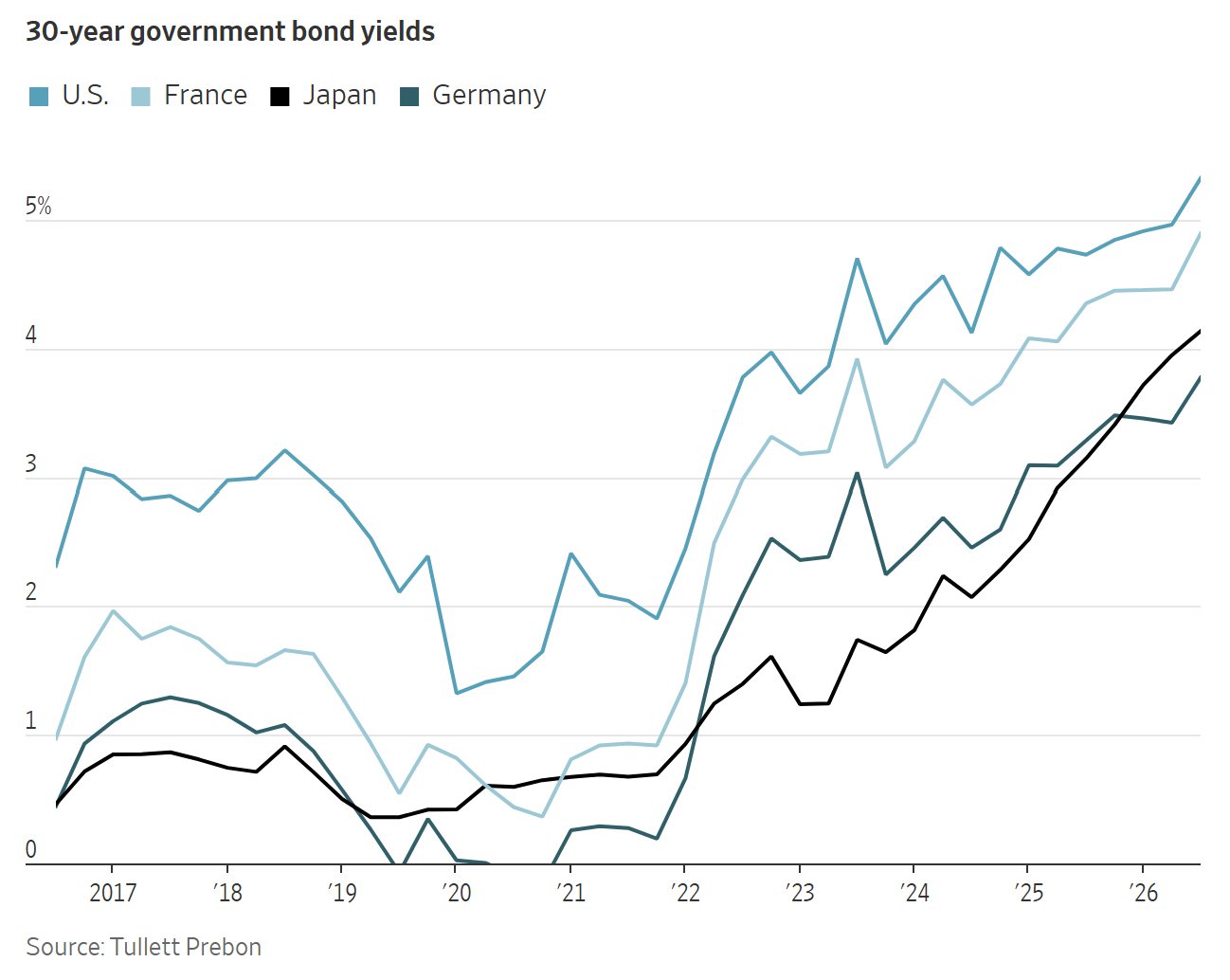
Germany’s 30-year yield rose to 3.772%, its highest level since July 2011.
Futures markets are almost fully pricing in a 25 bps rate hike at next month’s ECB policy meeting, with roughly 43 bps of tightening priced by year-end, implying a greater than 70% probability of an additional increase.
Germany’s two-year yield, which is sensitive to shifts in monetary policy expectations, rose +4.2 bps to 2.860%, its highest level since 24 July.
Note: As of 4 pm EDT 18 August 2026
While every effort has been made to verify the accuracy of this information, EXT Ltd. (hereafter known as “EXANTE”) cannot accept any responsibility or liability for reliance by any person on this publication or any of the information, opinions, or conclusions contained in this publication. The findings and views expressed in this publication do not necessarily reflect the views of EXANTE. Any action taken upon the information contained in this publication is strictly at your own risk. EXANTE will not be liable for any loss or damage in connection with this publication.
本文提供给您仅供信息参考之用,不应被视为认购或销售此处提及任何投资或相关服务的优惠招揽或游说。金融工具交易存在重大亏损风险,未必适合所有投资者。过往表现并非未来业绩的可靠指标。








由专业人士创建。 为专业人士。
