

Which hyperscaler is winning the ROI race?


 S&P 500 -1.52% to 7,316.15 US 10-year yield +7.3 basis points to 4.684% Spot gold +0.92% to $4,064.30 an ounce DXY -0.56% to 100.85
What to look out for today
Companies reporting on Thursday, 30 July: Alliant Energy, Amazon, Apple, Bristol Myers, Camden Property Trust, Coinbase Global, Corteva, Edison International, First Solar, GoDaddy, KKR, Live Nation Entertainment, Martin Marietta Materials, Norwegian Cruise Line, Regeneron Pharmaceuticals, Hershey, The Southern, Valero Energy, Xcel Energy, Yum! Brands
Key data to move markets today
EU: German GDP, CPI and Harmonised Index of Consumer Prices, Italian GDP, Spanish GDP and Harmonised Index of Consumer Prices, Eurozone GDP, Unemployment Rate, Economic Sentiment Indicator, Consumer Confidence and Business Climate
UK: BoE’s Interest Rate Decision, Minutes, Monetary Policy Report, MPC Vote and a speech by BoE Governor Andrew Bailey
USA: GDP, Personal Consumption Expenditures Index (PCE), Core PCE, Personal Income and Spending, Initial and Continuing Jobless Claims
JAPAN: Tokyo Consumer Price Index, Tokyo Core CPI, Unemployment Rate and Retail Trade
Global Macro Updates
Fed leaves rates unchanged. As expected, the Fed held rates steady at 3.50% – 3.75% at the July FOMC meeting. Dallas Fed President Lorie Logan, Cleveland Fed President Beth Hammack and Minneapolis Fed chief Neel Kashkari dissented, voting in favour of a 25 bps rate hike. While many had expected Hammack and Logan to dissent, Kashkari’s vote represented a somewhat hawkish surprise.
The statement contained no meaningful changes. The FOMC reiterated that inflation ‘remains elevated,’ that ‘job gains have kept pace with the workforce’ and that unemployment has ‘changed little.’
Sell-side previews had broadly anticipated a hold, with debate focussed on balancing inflation credibility against Warsh’s preference to look through supply-driven price shocks. Despite heightened uncertainty from renewed Iran hostilities during the Fed blackout period, some analysts argued that a rate hike would have limited impact on supply-driven inflation while expectations remain anchored. However, others suggested that an increasingly hawkish FOMC composition, reflected in today’s three dissents, could place greater pressure on Warsh at upcoming meetings.
As expected, Fed Chair Kevin Warsh offered limited new guidance during the press conference. He reiterated his commitment to the 2% inflation target and noted that, if inflation remains high, rates could be part of the solution. He also praised the economy’s ‘impressive’ resilience despite multiple shocks, while downplaying labour market concerns and noting that unemployment remains steady.
US Stock Indices
Dow Jones Industrial Average -2.19%
Nasdaq 100 -2.06%
S&P 500 -1.52%, with 8 of the 11 sectors of the S&P 500 down
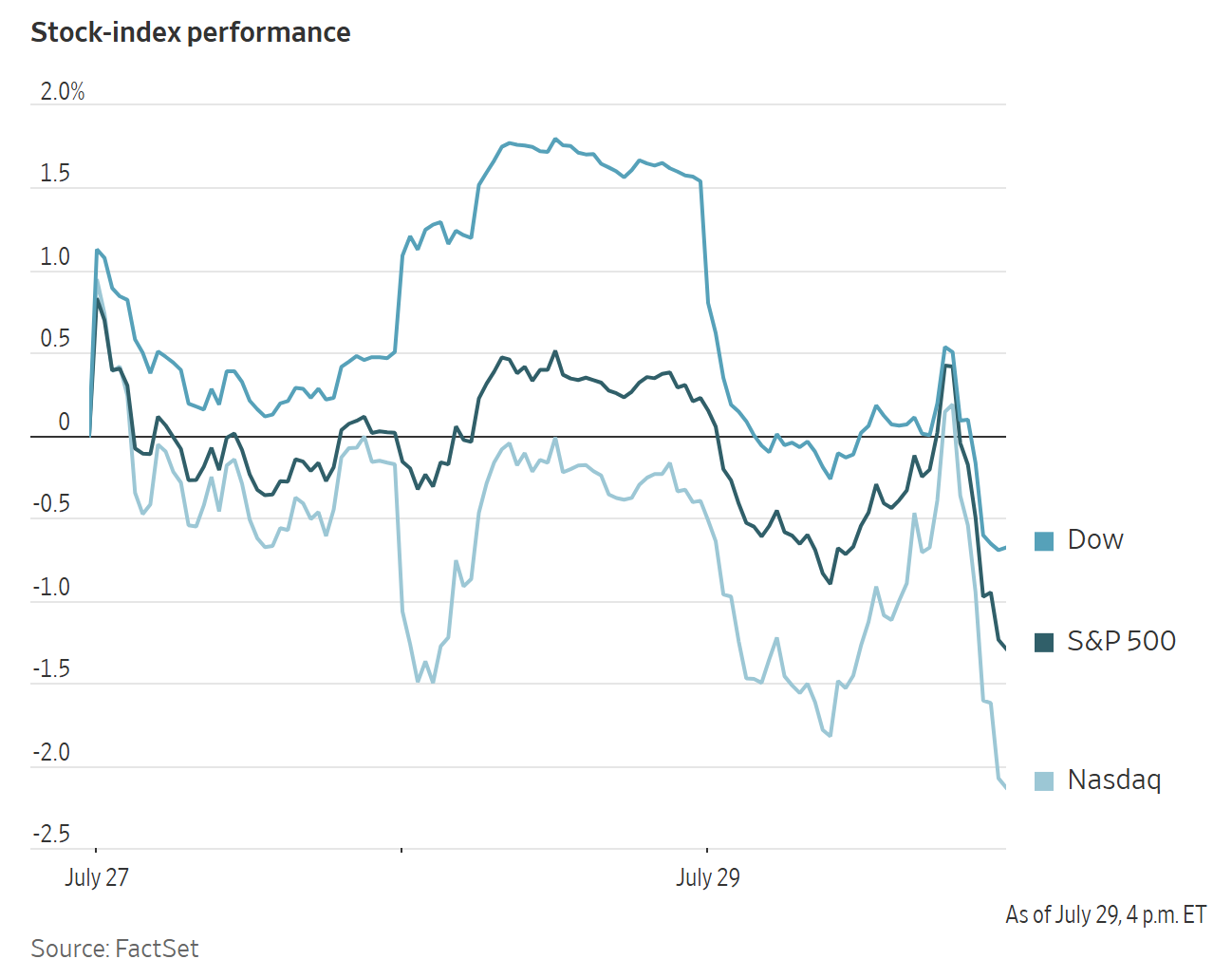
On Wednesday, the Dow Jones Industrial Average lost -2.19%, or 1,153.18 points, while the S&P 500 fell -1.52%. The Nasdaq Composite fell -1.74%.
Meta Platforms Q2 earnings. Meta's Wednesday print was a study in contrasts: a clean top-line beat overshadowed by an earnings miss and a CapEx bill that's starting to spook even patient investors.
Revenue reached $60.801 billion, up 28.0% y/o/y and topping the $60.224 billion consensus. Advertising from the Family of Apps contributed $59.363 billion, powered by a 13.2% increase in ad impressions and a 12.0% rise in average price per ad. EPS landed at $6.18, badly missing the $7.19 consensus and down 13.5% y/o/y. Net income fell 13.6% y/o/y to $15.848 billion, dragged by $2.4 billion in legal charges and $1.18 billion in severance costs tied to May layoffs, alongside a jump in the effective tax rate to 16% from 11%.
CapEx increased 82.1% y/o/y to $30.116 billion for the quarter, up from $16.538 billion a year ago, pushing FCF down to just $784 million from $8.549 billion in Q2 2025. Operating margin compressed to 31.3% from 43.4% a year ago. Management raised the low end of full-year 2026 CapEx guidance to $130 to $145 billion.
Shares fell in after-hours trading, marking a ninth straight losing session heading into the print. Bloomberg framed it alongside Microsoft's stronger Azure print the same night as a ‘study in contrasts’ for AI monetisation.
The narrative forming on the Street is one of patience wearing thin. On the earnings call, analysts pressed CEO Mark Zuckerberg on which product lines would show ‘quantifiable, material ROIC’ by 2026–27, as well as Meta's plan to simultaneously lease out and purchase compute capacity. Meta is increasingly viewed as still searching for that ‘undeniable’ payoff, even as Zuckerberg insists AI is already accelerating the core business.
Microsoft Q2 earnings. Microsoft’s results delivered a clear, broad-based beat that drew praise from the Street rather than skepticism.
Microsoft revenue reached $90.007 billion, ahead of the $87.620 billion consensus and the company’s guidance of $87.800 billion. Q2 EPS of $4.74 came in higher than the $4.24 Street estimate. Intelligent Cloud segment’s revenue $39.306 billion, up 31.6% y/o/y. The key metric investors were watching, Azure growth, came in at 39.4%, in line with the 39% to 40% guidance range.
Shares jumped in extended trading, a sharp contrast to the muted-to-negative reactions that have greeted Alphabet and Meta’s AI-capex-heavy prints this earnings season.
CapEx discipline became the core narrative. Microsoft delivered the Azure beat without materially lifting its CapEx outlook, keeping guidance broadly in line rather than raising it sharply as markets had feared after Alphabet’s recent increase.
Microsoft also reported that Copilot, its AI offering embedded across Office applications, reached 30 million paid users, up from 20 million in the prior quarter, though the company continues to face challenges converting its large user base into paying AI customers.
Microsoft cut its calendar 2026 CapEx forecast to roughly $175 billion from about $190 billion after extending the estimated useful life of its data centres and office buildings to 25 years from 15. The accounting change will shift more future data centre leases into operating leases, which are excluded from CapEx, while leaving the company’s underlying investment plans unchanged.
The Street’s emerging view is that Microsoft is meeting the standard investors have set for hyperscalers this earnings season. It is converting AI-led cloud demand into revenue quickly enough to justify infrastructure spending, rather than relying on faith in a future payoff. With 2027 CapEx guidance also in focus, the quarter was read as evidence that Microsoft’s spending is generating revenue within the same fiscal year, easing the credit-quality and ROIC concerns weighing on other AI-infrastructure names.
Corporate Earnings Reports
Posted on Wednesday, 29 July from The Pulse, our real-time AI-driven news tool. Available exclusively on the EXANTE Web Platform
Meta reported Q2 revenue of $60.8bn, beating the $60.24bn estimate, up +28% y/y. EPS of $6.18 missed the $7.22 consensus and fell -13% y/y. Free cash flow dropped to $784mn. FY26 capex guidance was narrowed to $130bn-$145bn. Ad revenue rose +27% y/y to $59.4bn, with impressions up +14% and average price per ad up +12%. Reality Labs revenue was $431mn, missing the $441.5mn estimate, and its operating loss was $4.62bn (vs ~$5bn expected). Guidance for Q3 revenue was $61bn-$64bn. Evercore ISI reiterated its Outperform rating and $930 price target. CEO Mark Zuckerberg said AI is accelerating the core business and opening the door to new enterprise opportunities. Meta and BlackRock also formed a $14bn joint venture to build a 1GW data centre campus in Texas; Meta will lease the entire campus.
Procter & Gamble reported Q4 FY2026 revenue of $21.2bn, missing the $21.34bn estimate, while core EPS of $1.43 beat the $1.41 consensus. Organic sales were flat year-over-year, versus expectations of +1.9%. Gross margin came in at 48.5%, down -60bps y/y. For FY2027, the company guided core EPS growth of 0% to +3% ($6.89-$7.11 vs $7.04 estimate) and organic sales growth of +1% to +3% (vs +2.44% estimate). Segment highlights included Beauty net revenue of $3.98bn, up +6% y/y. P&G returned $10.2bn in dividends and $5bn in share repurchases during FY2026, marking its 70th consecutive year of dividend increases. CEO Jon Moeller commented that fiscal 2026 was a year of foundation building while continuing to grow sales and profit despite a challenging geopolitical and economic environment.
BIIB reported revenue was $2.74bn (vs $2.47bn expected), up +3% y/y. Adjusted EPS was $3.60 (vs $2.89 expected), down -34% y/y. Product revenue reached $1.92bn (vs $1.77bn expected). Growth portfolio revenue rose +24% y/y to $1.06bn, exceeding the legacy MS portfolio. FY26 adjusted EPS guidance was lowered to $12-$13 from $14.25-$15.25, while revenue is expected to increase by a mid-single-digit percentage. Key segment performances included SPINRAZA +2% y/y, LEQEMBI +15% y/y, and SKYCLARYS +29% y/y. CEO Chris Viehbacher said the quarter reflects significant progress in repositioning the company for long-term growth, with growth portfolio revenue surpassing legacy MS and commercial momentum from SPINRAZA HD and LEQEMBI IQLIK approvals.
Boston Scientific reported Q2 2026 earnings with adjusted EPS of $0.86 vs $0.83 expected and net sales of $5.44bn vs $5.36bn expected, up +7.5% y/y. The company guided Q3 adjusted EPS to $0.80-$0.82 vs $0.84 expected and reduced its full-year adjusted EPS forecast to $3.28-$3.32 from $3.34-$3.41, against the $3.36 consensus. Cardiovascular segment revenue reached $3.62bn, up +8.3% reported, while MedSurg revenue was $1.82bn, up +5.9%. The company completed a $2bn accelerated share repurchase programme. CEO commented that the firm remains focussed on disciplined execution and prioritising investments in its highest-impact opportunities.
Humana reported Q2 2026 results before the open. Revenue was $40.9bn vs $40.61bn expected, up +26% y/y. Adjusted EPS came in at $7.61 vs $7.22 expected, up +21% y/y. The insurance benefit ratio was 91.2%, in line with guidance. For FY26, the company affirmed adjusted EPS of at least $9.00 (est $8.94) but guided revenue at least $160bn (est $162.19bn). Q3 insurance benefit ratio is expected slightly above 94%. The CEO said the first half went well and the firm is on track with Investor Day targets. Separately, the Trump administration reportedly plans to end Medicare drug plan subsidies, a potential industry headwind.
Microsoft reported Q4 FY26 earnings. Revenue was $90.01bn (up +18% y/y, vs $87.72bn expected) and adjusted EPS was $4.74 (vs $4.25 expected). Azure and other cloud services revenue grew +43% y/y, and Azure annual revenue surpassed $100bn for the first time. Microsoft Cloud revenue was $59.3bn (up +27% y/y). Commercial remaining performance obligation rose +84% to $678bn. Capex including leases was $41bn (vs $42.05bn estimated). Microsoft 365 Copilot exceeded 30mn paid seats. CEO Satya Nadella said the company is advancing the frontier on the cost-to-outcome curve, ensuring every customer can turn tokens into business results.
Qualcomm reported Q3 adjusted EPS of $2.21 (in line) and revenue of $9.95bn (vs $9.62bn consensus). China OEM handset revenue reached a bottom in Q3. For Q4, it guided adjusted EPS of $2.05 to $2.25 (vs $2.35 expected) and revenue of $9.7bn to $10.5bn (vs $9.95bn). Separately, BMW selected Qualcomm as primary chip supplier for its digital cockpit. Qualcomm informed customers of a double-digit percentage price increase due to rising costs.
Starbucks reported Q3 fiscal 2026 earnings after the market close. Adjusted EPS was $0.85 vs $0.65 expected, with revenue of $9.30bn vs $9.16bn expected. Global comparable sales rose +7.9% vs +5.73% expected, driven by US comparable sales of +7.9% and international +5.7%. The adjusted operating margin was 14.4% vs 11.9% expected. The company guided for Q4 US comparable sales of at least +6.5% and raised its full-year global comparable sales growth forecast to near 6.0%.
European Stock Indices
CAC 40 -0.60%
DAX -0.01%
FTSE 100 +0.34%
Commodities
Gold spot +0.92% to $4,064.30 an ounce
Silver spot +1.08% to $57.73 an ounce
West Texas Intermediate +6.91% to $84.60 a barrel
Brent crude +8.11% to $90.55 a barrel
Gold prices traded less than one percent higher on Wednesday. Spot gold increased +0.92% to $4,064.30 per ounce.
Spot silver prices also rose, settling +1.08% higher to $57.73 per ounce
On Wednesday, oil prices surged, reflecting intensifying Middle East tensions and a bullish update from the DOE Weekly Petroleum Status Report.
Brent futures settled at $90.55 per barrel, up $6.79, or +8.11%. WTI futures ended at $84.60 per barrel, up $6.91, or +6.91%.
Late Tuesday afternoon, US Central Command reported that IRGC forces launched multiple ballistic missiles from Iran in an attempted surprise attack on US forces based in the Middle East. On Wednesday, US and Saudi forces carried out strikes against Iranian-backed groups in Iraq, marking the first time Saudi Arabia has participated in attacks on Iranian proxies inside the country since the war began.
Both crude benchmarks were already up roughly four percentage points, but extended gains from 8:15 am EDT after the US President said, ‘We will hit Iran hard,’ a message he reiterated after the oil close.
The DOE Weekly Petroleum Status Report reported a crude draw of more than 7 million barrels, while Cushing inventories fell firmly into operationally critical territory below 19 million barrels, their lowest level since July 2014. Distillate stockpiles increased by 1.060 million barrels, while gasoline inventories were broadly unchanged. Commercial crude inventories declined to their lowest level since September 2018, the SPR reached a new low of more than 40 years, refinery utilisation rose to 97.2%, an eight-year high, and jet fuel production remained above 2.0 million bpd for a 13th consecutive week.
Kpler now expects a full recovery in Middle East crude supplies to 27 million bpd to be delayed until early 2027, compared with an estimated July average of 19.4 million bpd and an August average of 16.6 million bpd.
Additional Russian refineries were hit overnight. Reuters sources said Moscow is preparing to extend its diesel export ban by another month, while overnight reports indicated that Ukrainian drones struck three refining facilities in Ryazan, Taganrog and Perm.
Note: As of 4 pm EDT 29 July 2026
Currencies
EUR +0.61% to $1.1459
GBP +0.50% to $1.3354
Bitcoin -0.20% to $63,783.88
Ethereum -1.35% to $1,896.33
The US dollar declined on Wednesday after the Fed left its policy rate unchanged and Fed Chair Kevin Warsh kept markets uncertain about how divisions within the FOMC would be resolved.
The dollar index declined -0.56% to 100.85.
The British pound was +0.50% higher at $1.3354 ahead of today’s BoE interest rate decision, with market participants expecting no change. The euro rose +0.61% to $1.1459.
The yen strengthened against the US dollar, trading +0.22% higher at ¥163.41, after the FOMC left the Fed funds rate unchanged and ahead of the BoJ interest rate decision on Friday.
Fixed Income
US 10-year Treasury +7.3 basis points to 4.684%
German 10-year Bund +4.6 basis points to 3.183%
UK 10-year Gilt +10.3 basis points to 5.049%
Yields on the US long bond climbed to 19-year highs on Wednesday as doubts over the Fed’s resolve to curb inflation led investors to demand greater compensation for inflation risk.
Investors pushed 30-year bond yields up +11.2 bps to 5.204%, near levels last seen in mid-2007, after the yield cleared its May peak of 5.201%.
The abrupt sell-off followed the Fed’s decision to leave rates unchanged at Wednesday’s policy meeting, even as three FOMC members voted for an immediate hike.
The 10-year yield rose +7.3 bps to 4.684%, while the 2-year yield edged down -1.0 bps to 4.281%, resulting in a markedly steeper curve. The 2s10s spread widened by 8.3 bps to 40.3 bps.
Eurozone government bonds snapped a three-day rally on Wednesday.
Germany’s 10-year Bund yield rose +4.6 bps to 3.183%, its largest daily increase in nearly two weeks. The yield had declined over the previous three sessions after reaching a 15-year high of 3.212% on 23 July.
Other eurozone bonds underperformed German Bunds. Italy’s 10-year yield rose +6.9 bps to 3.983%, while France’s 10-year yield advanced +7.1 bps to 3.962%.
Shorter-dated yields also moved higher, with Germany’s 2-year yield up +3.4 bps at 2.819%.
Note: As of 4 pm EDT 29 July 2026
While every effort has been made to verify the accuracy of this information, EXT Ltd. (hereafter known as “EXANTE”) cannot accept any responsibility or liability for reliance by any person on this publication or any of the information, opinions, or conclusions contained in this publication. The findings and views expressed in this publication do not necessarily reflect the views of EXANTE. Any action taken upon the information contained in this publication is strictly at your own risk. EXANTE will not be liable for any loss or damage in connection with this publication.
本文提供给您仅供信息参考之用,不应被视为认购或销售此处提及任何投资或相关服务的优惠招揽或游说。金融工具交易存在重大亏损风险,未必适合所有投资者。过往表现并非未来业绩的可靠指标。








由专业人士创建。 为专业人士。
