

Paying for access: section 301 edition


 S&P 500 -0.61% last week to 7,411.98 US 10-year yield +13.7 basis points last week to 4.687% Spot gold +0.14% last week to $4,052.56 an ounce DXY +0.70% last week to 101.47
What to look out for today
Companies reporting on Monday, 27 July: Brown & Brown, Cincinnati Financial, F5, Nucor, Principal Financial Group and Universal Health Services
Key data to move markets today
EU: EcoFin Meeting and German IFO Business Climate, Current Assessment and Climate
USA: Durable Goods Orders and Nondefence Capital Goods Orders
Global Macro Updates
Section 301 replaces emergency-powers tariffs. Washington has revived its tariffs obsession. The Trump administration has imposed new import duties of 10% to 12.5% on imports from roughly 60 economies, citing their failure to prevent forced labour in supply chains at the expense of American workers.
These duties are authorised under Section 301 of the Trade Act of 1974, allowing the administration to sidestep the emergency powers previously invoked. They replace the temporary global 10% tariff, valid for only 150 days, that the US President imposed after the Supreme Court invalidated the prior Liberation Day reciprocal tariffs in February 2026. Exemptions cover oil, gas, fertiliser, goods the US does not produce and certain products under USMCA. The move follows a broader escalation in recent weeks, including a 50% tariff on select Canadian goods last week and a 25% levy on many Brazilian imports the prior week.
A second, parallel Section 301 investigation is underway into claims of industrial overcapacity among trading partners including China, Japan, Mexico and the EU, though rates for that track remain unset.
Economists note the impact may be relatively contained, since these rates sit below the prior IEEPA-based reciprocal tariffs. Still, the prospect of further action, particularly the pending overcapacity probe, injects fresh uncertainty and raises the risk of higher-than-anticipated tariffs heading into 2027.
This framework may rest on more solid legal ground than the invalidated IEEPA tariffs. The Supreme Court's February 2026 ruling found that IEEPA never explicitly authorised tariffs, noting the statute contains no reference to duties, taxes or surcharges, unlike traditional trade statutes. Section 301, by contrast, is a purpose-built tariff authority: it explicitly empowers the USTR to impose duties following formal investigations, comment periods and public hearings once specific statutory findings (such as unfair, unreasonable or discriminatory foreign practices burdening US commerce) are established. That structured, procedural basis, paired with decades of prior use under Section 301 without successful legal challenge, gives these new duties a considerably stronger constitutional footing than the emergency-powers approach the Court rejected.
Beyond the tariff mechanics, as noted by the Financial Times, some observers frame this shift as part of a broader recalibration of how the US extracts value from its position as a global economic hub — leveraging access to its markets, technology and financial infrastructure to discourage trading partners from building parallel systems, rather than simply raising the cost of goods.
S&P Global PMIs. US flash PMIs were mixed in July, with manufacturing slightly below expectations and services materially stronger. The manufacturing PMI eased to 53.8, below consensus of 54.3 and June’s 53.9, marking a four-month low. By contrast, the services PMI rose to 53.6 from 51.2, well above the 51.3 expected and its strongest level in eight months. The report pointed to renewed momentum from FIFA World Cup-related spending, firmer 4 July demand and increased business investment, although exports remained under pressure. Supplier delays worsened to their most severe level in nearly four years amid the Middle East conflict, while input-cost inflation reached a 14-month high and selling-price inflation approached a four-year peak. Employment recovered after two months of declines. Business output expectations improved to an eight-month high, albeit with diverging sector trends.
Eurozone activity rebounded more strongly than expected. The S&P Global flash composite PMI rose to 51.9 from 50.0, above consensus of 50.3, marking the first expansion in four months and the strongest reading since before the US war with Iran began. Manufacturing output accelerated to a 52-month high of 53.0, while the headline manufacturing PMI rose to 52.0. Services returned to expansion at 51.6. New orders increased for the first time in five months and at the fastest pace since April 2023, supported by only a marginal decline in export orders. Employment also rose for the first time in 2026. Germany returned to growth, France’s contraction moderated and the rest of the region recorded its strongest expansion in eight months. Softer input-cost inflation and easing supply disruptions allowed manufacturers to rebuild stocks, although S&P Global warned that higher oil prices and shipping risks could revive inflation pressures and challenge the recovery.
UK activity also improved, with the composite PMI rising to a three-month high of 52.1 from 49.3, above the 49.8 expected. Services recovered to 51.8, while manufacturing strengthened to 52.8. The rebound was supported by a modest increase in new work, stronger consumer services demand and more upbeat business expectations. However, hiring appetite remained limited, particularly in services, as firms continued to manage cost pressures and uncertainty linked to renewed geopolitical tensions.
US Stock Indices
Dow Jones Industrial Average +0.46%
Nasdaq 100 -1.15%
S&P 500 +0.05%, with 10 of the 11 sectors of the S&P 500 up down
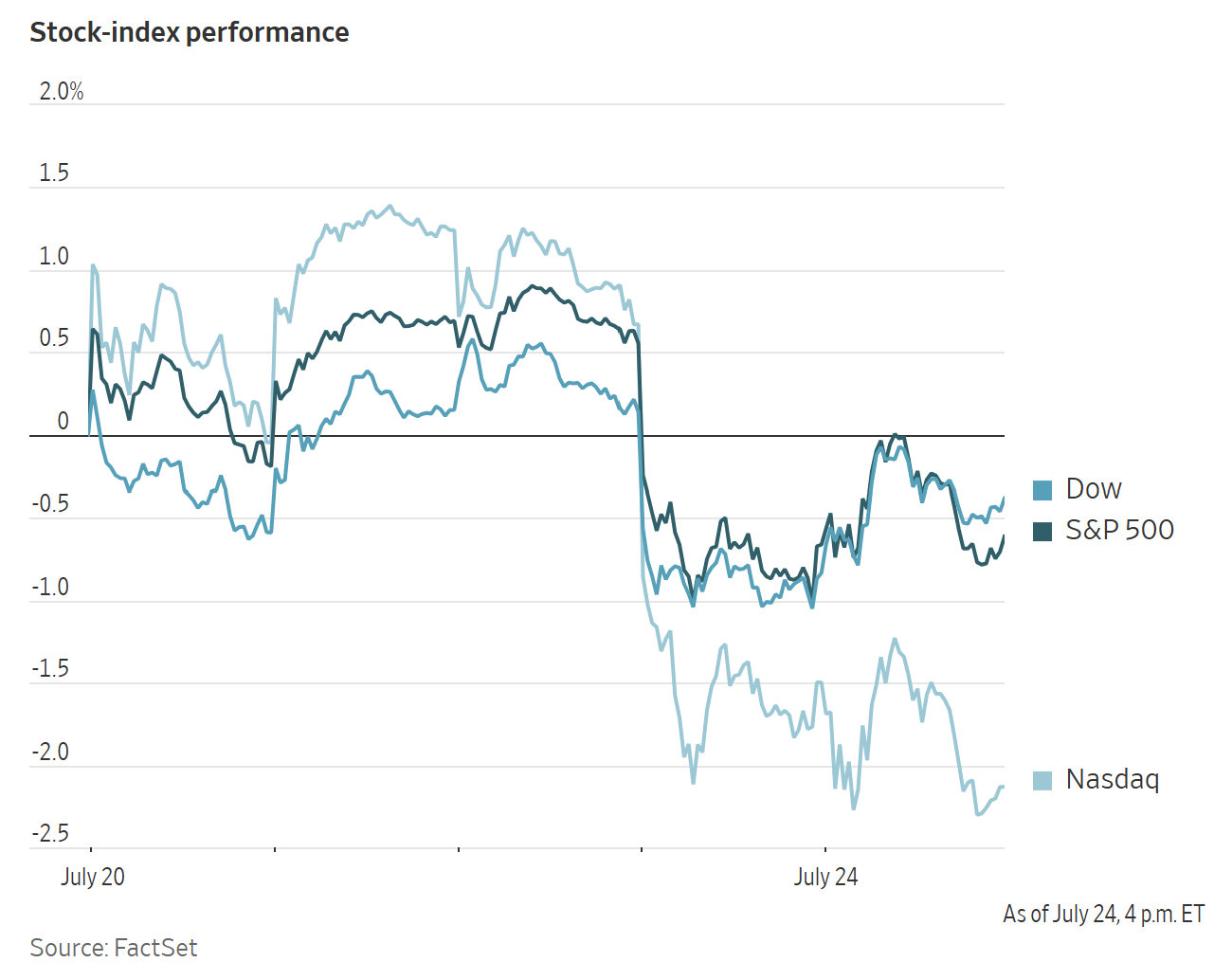
On Friday the S&P 500 edged up +0.05%, while the Dow Jones Industrial Average rose +0.46%, or 235.60 points. The Nasdaq Composite declined -0.64%.
The weekly performance was weaker. Over the past five sessions, the Nasdaq Composite lost -2.13%, while the S&P 500 and Dow Jones Industrial Average fell -0.61% and -0.38%, respectively. The S&P 500 and Nasdaq also posted their first consecutive weekly declines since March.
In corporate news, Wise shares fell Friday after the Office of the Comptroller of the Currency rejected its application for a US banking licence, citing shortcomings in its anti-money laundering and counter-terrorist financing controls.
Alphabet’s Waymo is considering ending its robotaxi partnership with Uber Technologies. The company has notified Uber that it intends to launch service through its own app in Austin and Atlanta in January 2028, ending exclusivity in those markets. Existing Waymo vehicles will remain available on Uber’s platform at least through May 2028, when the current contract expires. Uber Technologies shares dropped -4.31% on Friday.
Paramount Skydance and Warner Bros. Discovery agreed not to close their merger until June unless the related litigation is resolved earlier. Paramount said Friday it will not proceed until legal challenges are settled or 1 June 2027, whichever comes first. A trial on whether the transaction should be permanently blocked is expected, with both sides due to submit proposed trial plans by the end of July.
Any delay could be costly for Paramount: the merger agreement includes a ticking fee requiring payments to Warner shareholders of about $650 million per quarter starting in October until closing. Paramount’s deadline to complete the deal is 4 March 2027, with an automatic extension to 4 June 2027 if only regulatory approvals or government orders, including an antitrust injunction, remain unresolved.
Corporate Earnings Reports
Posted on Friday, 24 July from The Pulse, our real-time AI-driven news tool. Available exclusively on the EXANTE Web Platform
Verizon reported Q2 results ahead of the open. Adjusted EPS was $1.30 vs $1.27 expected, while operating revenue of $34.3bn missed the $35.17bn estimate. The company reported 184,000 postpaid phone net additions, a five-year Q2 high. It raised full-year adjusted EPS guidance to $4.99-$5.04 from $4.95-$4.99 and increased its share buyback target to $4.5bn. Verizon also announced a $1bn deal with Google to provide dark-fiber connectivity for its data centers, with additional AI infrastructure deals expected by year-end that could generate billions in revenue. The company ruled out giving Starlink MVNO access to its network. CEO Dan Schulman said the transformation is driving a structural inflection point across the business.
Charter Communications reported Q2 earnings. Revenue came in at $13.5bn, slightly below the $13.52bn estimate, down -1.7% y/y. Adjusted EBITDA was $5.4bn, missing the $5.58bn consensus and falling -4.3% y/y. EPS of $10.66 exceeded the $9.96 estimate. Free cash flow was $969mn. The company guided full-year capital expenditures to approximately $11.4bn. Segment revenue showed mobile service rising +18.9% y/y to $1.1bn, while internet revenue fell -3.2% y/y to $5.8bn and video declined -9.7% y/y to $3.1bn. Total mobile lines reached 12.5mn, up +1.7mn y/y. Internet customers totalled 29.4mn, down -1.7% y/y. CEO commented that the company looks forward to delivering the benefits of its strategy to Cox’s customers after the transaction closes.
American Express reported Q2 earnings with EPS of $4.53, beating the $4.41 estimate, while revenue of $19.64bn narrowly missed the $19.69bn consensus but grew +10% y/y. Billed business reached $455.8bn, above forecasts. The provision for credit losses fell to $1.1bn, well below the $1.38bn estimate. Full-year revenue guidance was raised to ~10% from 9%-10%, while EPS guidance of $17.30-$17.90 was maintained. CEO Stephen Squeri noted 'another excellent quarter' with card member spending up +9% y/y, the highest in three years, and strong momentum among Millennial and Gen Z customers. CFO Christophe Le Marchand highlighted global Amex travel bookings up +22% y/y and US consumer spending growth of +11%, the strongest since Q1 2018. Some impact on Middle East travel was seen, but no broader slowdown.
SLB reported Q2 earnings with revenue of $8.97bn (vs $8.67bn expected), up +5% y/y. Adjusted EPS was $0.55 (vs $0.51 expected), down -26% y/y. Net income was $786mn, down -22% y/y. The company affirmed FY26 capital investment guidance of ~$2.5bn. Data Center Solutions revenue rose +80% y/y to $186mn, and management noted the business is on track to exceed a $1bn annualised revenue run rate by year-end, with a target of surpassing $2bn by end of 2027. CEO Olivier Le Peuch commented that solid results were driven by broad-based international growth offsetting Middle East disruptions.
European Stock Indices
CAC 40 +0.88%
DAX +1.36%
FTSE 100 +0.91%
Commodities
Gold spot +0.14% to $4,052.56 an ounce
Silver spot +1.07% to $58.17 an ounce
West Texas Intermediate -2.05% to $90.47 a barrel
Brent crude -2.12% to $98.40 a barrel
Gold prices edged higher on Friday. Spot gold rose +0.14% to $4,052.56 per ounce after declining -2.00% in the previous session. For the week, prices gained +0.89%, supported by earlier dip-buying despite sustained US dollar strength.
Spot silver advanced +1.07% to $58.17 per ounce, bringing its weekly gain to +4.05%.
Crude oil futures fell on Friday for the first time in six sessions. Benchmarks extended intraday losses shortly after 11:00 EDT following reports that Pakistan and Iran were exploring a path toward renewed talks with the US under a China-initiated effort.
Brent and US West Texas Intermediate crude had rallied earlier in the week as the US and Iran exchanged missile strikes, traffic through the Strait of Hormuz slowed sharply and Yemen’s Houthis attacked shipping in the Red Sea.
Brent futures settled at $98.40 per barrel, down $2.13, or -2.12%, after closing above $100 in the previous session for the first time since May. WTI futures ended at $90.47 per barrel, down $1.89, or -2.05%. On a weekly basis, Brent rose +11.68% and WTI gained +9.70%.
Tanker traffic through the Strait of Hormuz and crude loadings have nearly halted, while estimates suggest more than 11.0 million bpd of Gulf production has been shut in. Shipping data showed only one tanker passing through the Strait of Hormuz on Thursday.
While several vessels in the Red Sea have reversed course and are now heading north toward the Suez Canal, others have passed safely through the Bab el-Mandeb strait. In a statement Friday, the Houthis said they were targeting only the ‘Saudi side.’
Kazakhstan’s oil production is estimated to be down by 500,000 bpd after Ukraine’s attacks last week forced the closure of the CPC export terminal. These supply disruptions have strengthened spot premiums for Russian and Middle Eastern crude grades.
Traders said Friday that demand for US crude cargoes had increased sharply amid disruptions in the Strait of Hormuz and the Bab el-Mandeb strait.
China was said to have purchased some crude on the spot market, while other reports indicated that Chinese buyers were flipping cargoes. Month-to-date Chinese crude imports are tracking roughly fifty percent below pre-war levels.
Ukraine continued attacks on Russian tankers in the Azov and Black Seas. Russian officials said the domestic fuel situation had improved, while reports indicated that Moscow was considering extending diesel and gasoline export bans.
The DOE Weekly Petroleum Status Report showed crude, gasoline and distillate inventories all building for the first time since January.
Note: As of 4 pm EDT 24 July 2026
Currencies
EUR -0.07% to $1.1367
GBP +0.04% to $1.3319
Bitcoin -1.66% to $64,089.39
Ethereum -1.36% to $1,855.82
The US dollar posted its largest weekly gain since mid-June on Friday. The dollar index edged up +0.02% to 101.47 and gained +0.70% for the week, its largest weekly increase in five weeks.
The euro slipped -0.07% to $1.1367 and fell -0.63% for the week, one day after the ECB left interest rates unchanged while keeping the possibility of a September hike open.
ECB Chief Economist Philip Lane said the central bank still viewed the current inflation shock as medium-sized, requiring some policy action but not aggressive moves, and expected price growth to return to 2% over the next year or so.
The British pound snapped a three-week winning streak on Friday, as softer inflation data and the worsening Middle East conflict led investors to reassess positioning ahead of this week’s BoE meeting.
Sterling traded marginally higher on the day at $1.3319 against the dollar, but recorded a weekly loss of -1.00%. Sterling also ticked -0.10% lower against the euro to 1.1692 euros, marking its fourth consecutive session of losses.
The yen recorded its steepest weekly percentage decline in more than two months, despite Japan’s Finance Minister Satsuki Katayama again reiterating on Friday that the government was prepared to act in the foreign exchange market if needed.
Some analysts expect any further intervention by Japanese officials to have only a short-lived effect unless it is accompanied by coordinated measures such as a more aggressive path of BoJ rate hikes.
The US Treasury Department on Thursday joined calls for BoJ rate hikes, warning that excessive currency volatility was undesirable. Markets have fully priced out the possibility of a BoJ rate hike at this week’s policy meeting.
The rise in dollar-yen is consistent with current conditions: the yen remains a low-yielding currency facing a terms-of-trade shock from higher oil prices.
Against the Japanese yen, the dollar strengthened +0.02% to ¥163.80 and rose +0.87% for the week, its strongest weekly performance against the currency since 15 May. Last Thursday, the dollar reached ¥163.98, its highest level against the yen since November 1986.
Fixed Income
US 10-year Treasury -1.3 basis points to 4.687%
German 10-year Bund -2.6 basis points to 3.204%
UK 10-year Gilt -7.0 basis points to 5.033%
US 10-year Treasury yields eased from 18-month highs on Friday as investors remained cautious ahead of this week’s FOMC policy meeting.
Fed funds futures traders are now pricing in a 34.2% probability of a hike at the conclusion of the Fed’s two-day meeting on Wednesday, up from 12.8% one week earlier, according to CME Group’s FedWatch Tool.
The 2-year note yield, which moves closely with Fed funds rate expectations, fell -0.3 bps to 4.352% but recorded its largest one-week increase since 11 May, rising +16.9 bps.
The US 10-year note yield fell -1.3 bps to 4.687%. For the week, it rose +13.7 bps, its largest weekly increase since 11 May. The 2s10s curve flattened by 3.2 bps over the week to 33.5 bps.
Eurozone bond yields declined on Friday after reaching multi-year highs a day earlier. Germany’s 10-year bond yield traded -2.6 bps lower at 3.204% after touching a 15-year high in the previous session. Germany’s 2-year bond yield, which is more sensitive to ECB deposit-rate expectations, was -5.4 bps lower at 2.835% after touching its highest level since July 2024 in the previous session.
However, eurozone bonds were under pressure throughout the week given the European economy’s vulnerability to imported energy, with Brent prices rising above $100 per barrel for the first time since May. For the week, 10-year Bund yields rose +5.3 bps, while 2-year Schatz yields advanced +3.2 bps.
The ECB left interest rates unchanged on Thursday, as expected, but kept the option of a September increase on the table. Markets are pricing in a strong probability of a September ECB rate hike, with the possibility of another increase later in the year.
Note: As of 4 pm EDT 24 July 2026
While every effort has been made to verify the accuracy of this information, EXT Ltd. (hereafter known as “EXANTE”) cannot accept any responsibility or liability for reliance by any person on this publication or any of the information, opinions, or conclusions contained in this publication. The findings and views expressed in this publication do not necessarily reflect the views of EXANTE. Any action taken upon the information contained in this publication is strictly at your own risk. EXANTE will not be liable for any loss or damage in connection with this publication.
本文提供给您仅供信息参考之用,不应被视为认购或销售此处提及任何投资或相关服务的优惠招揽或游说。金融工具交易存在重大亏损风险,未必适合所有投资者。过往表现并非未来业绩的可靠指标。








由专业人士创建。 为专业人士。
