

Fixed Income Briefing September 2026



Renée Friedman, Global Head of Research
US Economic and US Treasury Market Review
• The dollar has strengthened through September due to a more hawkish Federal Reserve policy outlook and robust economic indicators. The dollar index is +1.80% MTD in September.
• On the labour market front, data released in September suggests that the US economy is experiencing more weakness than previously indicated. The US Bureau for Labor Statistics showed that non-farm payroll jobs increased by 162,000 in August. The change in total nonfarm payroll employment for June was revised up by 11,000, from +20,000 to +31,000, and the change for July was revised up by 44,000, from -23,000 to +21,000. The labour force participation rate edged up to 61.6 percent in August but is down by 0.5 percentage point since January. The national unemployment rate was unchanged at 4.1% in August, and the number of unemployed people changed little at 7.0 million. Average hourly earnings were up 0.3% month-over-month and up 3.1% year-over-year in August 2026.
• On the economic growth front, business activity growth accelerated for a fourth successive month in September to reach the fastest rate for over five years in September, The S&P Global Flash US PMIs surprised markets with new orders reaching the highest since March 2022 in the service sector and the highest since April 2022 in manufacturing. Employment also rose sharply, with new jobs growing at the fastest pace in over four years. The Flash Composite PMI came in at 58.4, up from August’s 56.0 reading and a 62-month high. Manufacturing came in slightly below expectations and services were materially stronger. The Flash Manufacturing PMI jumped to 57.0 from August’s 53.9 and was a 52-month high. The Flash Services PMI rose to 58.7 from August’s 56.5 and a 59-month high.
• On the consumer side, US consumer sentiment was down in September. The University of Michigan Consumer Sentiment Index fell again in September, by 7.5%, to 47.8, down from August’s 51.0. The Current Economic Situation survey also showed a decline, falling to 50.9 from August’s 51.9, while the index of consumer expectations fell to 45.8 from August’s 51.5. Overall, sentiment is now 16% below February, prior to the start of the Iran conflict, and 13% lower than a year ago. Year-ahead inflation expectations jumped from 4.0% last month to 4.6% this month, the highest reading since June.
• On the inflation front, headline CPI in August rose to a seasonally adjusted 0.4% on a seasonally adjusted basis in August after rising 0.1 percent in July. The annual inflation rate was 3.4%% according to the Bureau for Labor Statistics. Core inflation came in at +0.3% m/o/m after rising 0.2% in July, while annualised core CPI was 2.4%, down from July's 2.5%. The energy index increased 2.1% in August, after falling 1.5% in July. The index for gasoline rose 3.9% in August, accounting for over one third of the monthly all items increase. Services costs, which are closely watched by Fed policymakers as an indicator of longer-run inflation trends, saw a slight increase, with services inflation, less energy, rising by 0.23% from the previous month and 3.0% over the 12-month period ending in August.
Yield swings
September has been another difficult month for fixed income markets with definite bear flattening taking place, driven largely by the Fed’s hawkish tone. Concerns around the pace of growth in the US, further inflation upside risks coming from an expected surge in food prices following the summer drought in Europe and the lack of fertiliser due to the hostilities in the Gulf, the still unsettled war in the Middle East causing oil to remain over the $100 mark, growing political uncertainty in the run up to the US midterms, surprising election results in Germany and next year’s election in France, the need for continuing intervention by the BoJ to steady the Japanese yen and a growing sense of trepidation over the UK government’s autumn budget are some of the factors weighing on bonds.
The US 10-year yield is +37 basis points (bps) from a month ago. The 10-year German Bund is +27.7 bps. The spread between the two has risen to 156 bps since the end of August from 142 bps. On the long-end of the curve, the US 30-year yield is +12 bps from a month ago, while the German 30-year yield is +8.8 bps from a month ago. The faster rise in US rates may also reflect the impact of AI -related bond issuance out of the US as well as a higher amount of debt issuance over the period.
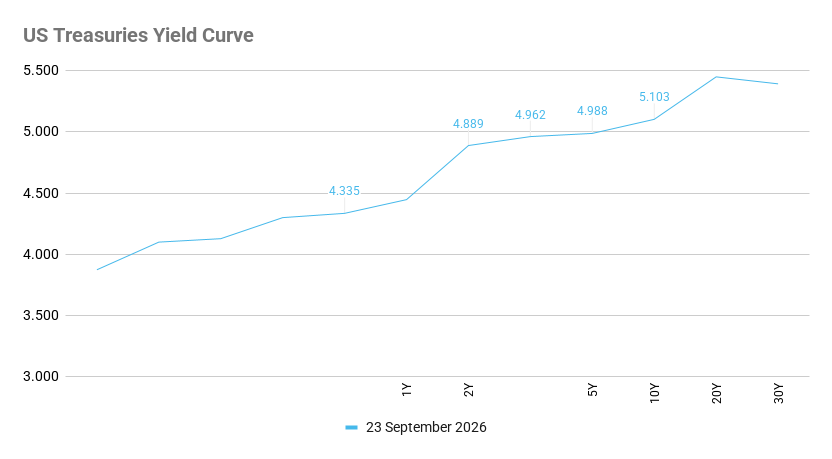
Source: FactSet
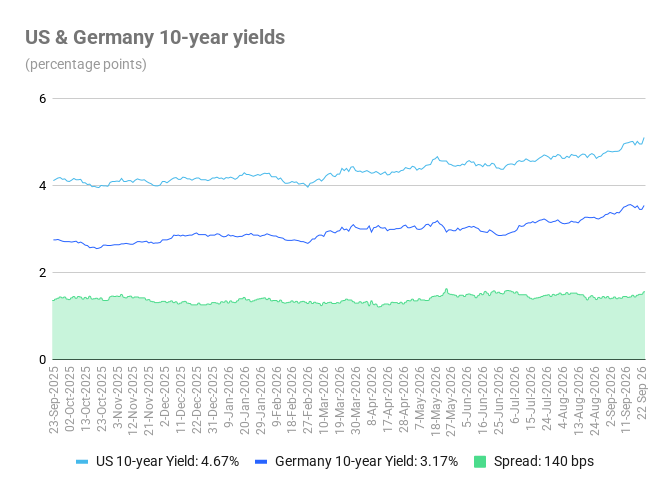
Source: FactSet
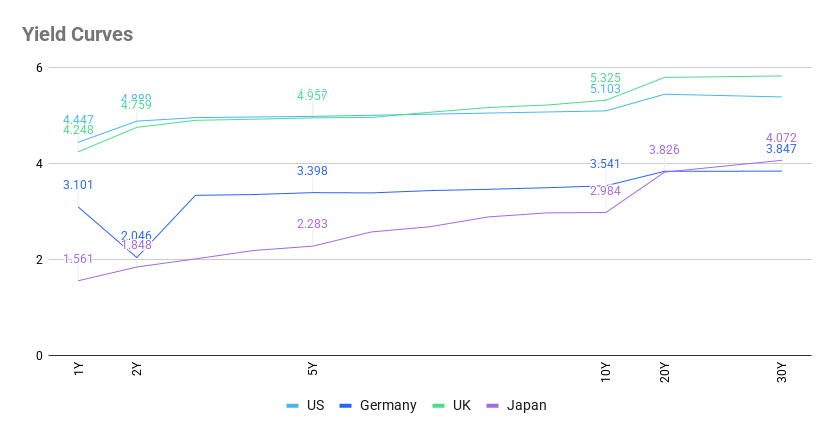
Source: FactSet
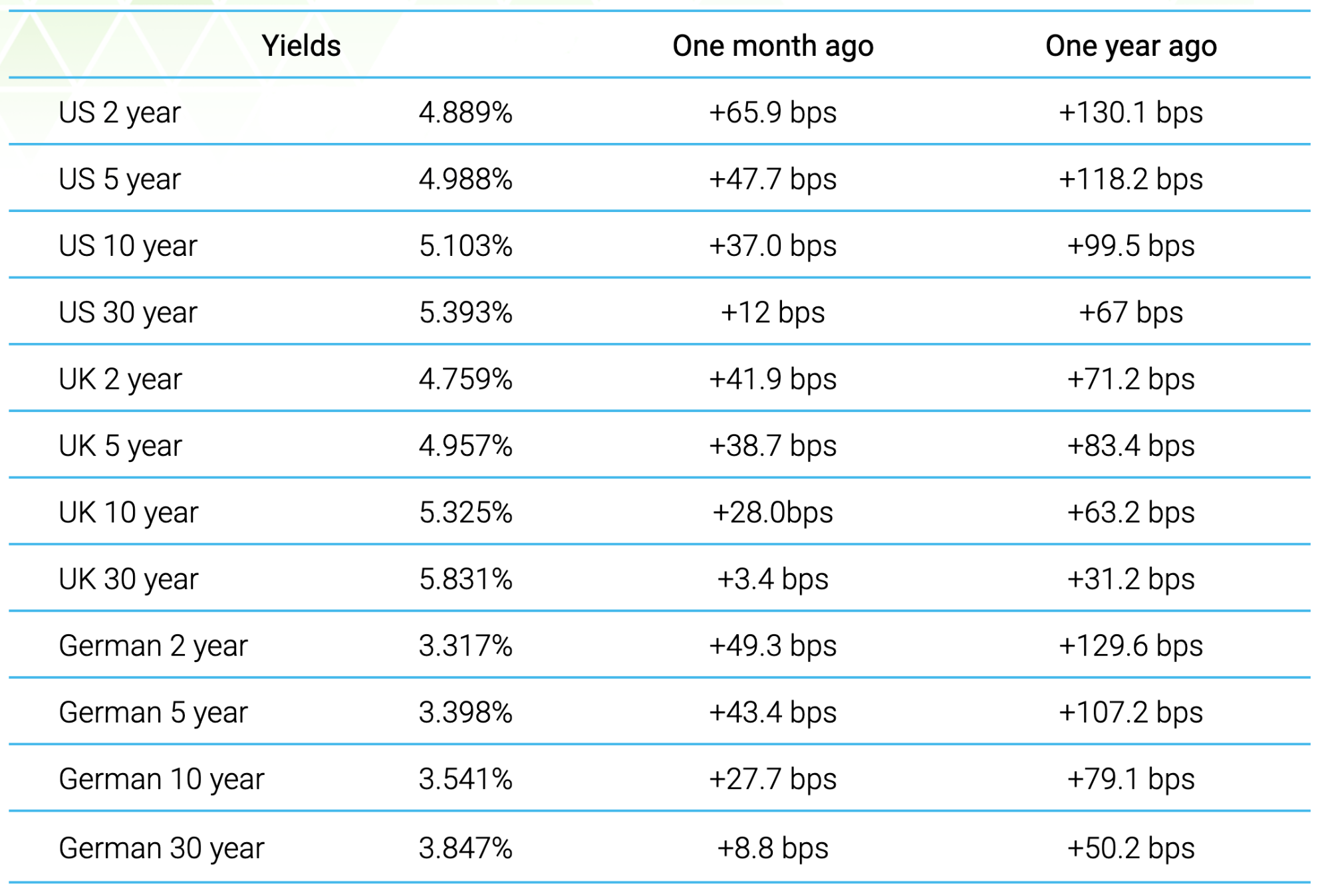
Source: FactSet 5:00 pm EST 26 August 2026
Global Economic and Market Review
The eurozone economy is faring better than expected, but still showing signs of stress from the war with Iran and the surge in energy prices. Eurozone headline inflation rose to 3.2 % in August 2026, up from 2.9 % in July. It was 2 % a year ago. However, the ECB stated that in the latest consumer inflation expectations survey, consumer prices were seen rising 3.0 % over the next year, up from 2.9 % in July. The three-year gauge, considered more important for setting monetary policy, fell to 2.7 % from 2.8 % the previous month.
Eurozone activity was surprisingly resilient in September, despite the increase in energy prices emanating from the ongoing conflict in the Middle East. The S&P Global Eurozone Flash Composite PMI unexpectedly rose to 53.1, the highest level in more than three years, as services rebounded and both Germany and France returned to expansion. Eurozone Services PMI rose to 53.0 from August’s 51.6, a 10-month high. The Flash Eurozone Manufacturing PMI: was unchanged from August’s 52.7. However, new orders strengthened, backlogs accumulated and demand related to AI and defence supported manufacturing. At the same time, higher fuel and energy costs pushed price pressures to their steepest level since May, signalling stronger growth alongside persistent inflation. S&P Global’s estimate of approximately 0.4 % quarterly GDP growth in Q3 and improving order books point to continued momentum in Q4, although weakening business confidence in France leaves some scope for a downward revision in the final reading.
European consumers are also losing confidence. According to the European Commission, the flash estimate of the consumer confidence indicator fell by 1.0 pps in the euro area, it was down to -16.5 points, veering away from its long-term average again, after four months of recovery.
Bundesbank President Joachim Nagel has noted that oil prices were becoming an increasingly important consideration for ECB policymakers when setting interest rates. He also left open the possibility of further rate increases, noting that core inflation remained too high, although he had not yet observed significant second-round inflation effects. Markets are pricing in about 35 bps of tightening this year by the ECB with 60 % of traders expecting a 25 bps rate hike in the October meeting to 2.75 % and 55.2 % expecting an additional hike to 3.00 % at the December meeting according to ECB Watch.
The UK is facing a harder situation than in Europe. The UK is diverging on growth, but not on inflation. The S&P Global Flash Composite PMI eased to 51.7 in September, down from August’s 52.5, a 3-month low, as services moderated. The Flash Services PMI came in at 51.7 3-month low. However, manufacturing improved to 52.0 from 51.7, its highest level in three months. Consumer demand and hiring remained weak despite support from technology, AI and defence spending. At the same time, input costs accelerated for a second consecutive month, reflecting higher energy, fuel and raw material expenses. Prices charged also rose at a faster pace, suggesting renewed upward pressure on consumer inflation.
Headline inflation in the UK came in at a five-month high, hitting 3.1 % in the 12 months to August 2026, up from 2.9 % in the 12 months to July according to the Office for National Statistics data. On a monthly basis, CPI rose by 0.5 % in August 2026, compared with a rise of 0.3 % in August 2025. The jump in inflation is largely due to higher prices at the pump as a result of the ongoing war in Iran, as well as air fares during the summer holidays. Core inflation rose by 2.6 % in the 12 months to August 2026, unchanged from the 12 months to July. The CPI goods annual rate rose from 2.7 % from July’s 2.2 %, while the CPI services annual rate remained at 3.6 %.
According to the Office for National Statistics (ONS) September 2026 release, the unemployment rate is 4.9 % in May to July 2026. This is up by 0.2 percentage points on the year but largely unchanged on the latest quarter. The economic inactivity rate was estimated at estimated at 20.9 % in May to July 2026. This is down by 0.1 percentage points on both the year and the latest quarter. Annual growth in total earnings (including bonuses) was 3.9 % in May to July 2026, down from 4.2 % in the previous three-month period. The estimated number of vacancies in the UK decreased in the latest quarter. Early estimates for June to August 2026 suggest a decrease of 8,000 (1.1 %) to 702,000, compared with March to May 2026.
Things to think about
Markets are pricing in interest rates rises in Europe this year with expectations of a rise in the UK as investors consider ongoing and future geopolitical disruptions, expected food price inflation, and a rising global rate environment. According to the OECD in its latest report, central banks need to ensure underlying inflation pressures are durably contained given renewed energy price shocks and stronger-than-expected demand pressures at a time when inflation is already above target in many economies. The increasing issuance of corporate bonds by hyperscalers to help fund the AI build out is continuing to affect both duration and term premia. The competition for capital is expected to remain strong as governments in the US, UK, Europe and Japan need to issue debt to finance persistent deficits and cover growing fiscal expenditures..
In the US, the Fed’s unanimous decision to raise rates 25 bps to 3.75%-4.00% surprised some investors and reinforced a hawkish tone. Treasuries are likely to remain high as oil prices remain above the $100 mark. With increasing expectations of rate rises, more bear flattening may occur as the front end sells off while longer term rates hold slightly firmer ground. However, there will still be concerns about rising debt levels and debt sustainability, especially in the run up to the November mid-terms. Yet, beyond the uncertainty around oil prices, upside inflation risks still include tariffs, technology spending and future fiscal policy, especially any changes towards fiscal consolidation, will continue to affect the market.
Global yields are expected to remain at multi-decade highs unless a durable resolution to the Middle East conflict is achieved. The Bank of England will remain data-dependent, but with energy bills continuing to rise, piling further cost of living pressures on households and businesses, there will be increasing pressure on the MPC to act. Bank of England Deputy Governor Clare Lombardelli has said that firms have, so far, absorbed higher energy prices but their ability to keep doing so is limited. Although the FOMC, in a 6-3 decision, decided to hold interest rates on 17 September, markets are pricing in 3 rate rises by next year, with the first in November. The decision to raise will still be difficult given the slight drop in the growth outlook. The OECD estimates a 1 % growth rate, down from its earlier 1.1 % forecast. The IMF has warned of rising debt service costs and that this needed to be dealt with. This is in addition to the continuing uncertainty around the autumn budget statement, which may have a negative impact on consumer confidence and economic growth in the quarters ahead.
Geopolitical uncertainty is still high; there is still a chance that there could be an escalation in the war with Iran, causing the market to price in an even more aggressive Fed next year. Investors may wish to focus on selective yield-spread targeting, continuing to diversify across geographies to reduce country-specific risks. This may look a particularly attractive choice as EM bonds have continued to show structural resilience and outperform developed market bonds. However, with central banks generally adopting a more hawkish tone, short-duration paper remains attractive as the global bond sell-off may continue. Investors may also wish to use inflation-protected securities (e.g., TIPS) to hedge inflation risk. High volatility and expanding national budget deficits make long-duration bonds vulnerable
Key risks
• Inflation risks continue to rise, further undermining consumer and business confidence. The ongoing inability of the US and Iran to agree to either a permanent ceasefire or terms on the safe passage of ships through the Strait of Hormuz means that oil prices could jump even higher if energy infrastructure continues to be attacked both in the Gulf region and in Russia. The potential overheating of the US economy due to the increased consumer demand and in the AI buildout, which may help with increasing tax revenues that have slowed under President Trump’s cuts, also puts further pressure on the FOMC to raise rates. Importantly, although long-term rate expectations have not changed, the narrative of “higher for longer” has become embedded in the market’s psyche, creating a more volatile dynamic.
• Policy uncertainty. The central banks may get the timing of rate hikes wrong or we may see a faster divergence in policy due to fragile geopolitical energy dynamics. In Europe, we are likely to see growing national and wider regional friction following on from Germany’s regional elections and the upcoming French election, both of which may influence fiscal policies. In addition, the Fed may ultimately deliver less tightening than the ECB or the Bank of Japan, creating potentially important divergence across rates and FX. Fiscal stimulus changes amid domestic political pressures may create additional volatility in gilt markets.
• Geopolitical tensions, re-alignments and events. Geopolitical risk stemming from the Iran war, increasing uncertainty around the US midterm elections, the threat to Taiwan from mainland China, the increasingly aggressive behaviour by the Chinese navy in the South China Seas, the potential continuation of US military and political activities in Latin America and in Cuba, and the ongoing war in Ukraine, all have the potential to hit supply chains further, with the consequent effects on inflation, bond yields and currency valuations.
本文提供给您仅供信息参考之用,不应被视为认购或销售此处提及任何投资或相关服务的优惠招揽或游说。金融工具交易存在重大亏损风险,未必适合所有投资者。过往表现并非未来业绩的可靠指标。







由专业人士创建。 为专业人士。
