

Has Europe’s tail risk flipped?

 S&P 500 -0.02% to 7,704.13 US 10-year yield +8.9 basis points to 5.205% Spot gold -0.15% to $4,279.73 an ounce DXY +0.11% at 101.24
Key data to move markets today
EU: German GfK Consumer Confidence, Spanish GDP and a speech by ECB Vice President Boris Vujčić
USA: Michigan Consumer Sentiment and Expectations Indices, UoM 1-year and 5-year Consumer Inflation Expectations, Durable Goods Orders, Nondefence Capital Goods Orders ex Aircraft and speeches by New York Fed President John Williams and Cleveland Fed President Beth Hammack
Global Macro Updates
Germany finds a pulse. Germany’s Ifo business-climate index rose to 89.9 in September, beating the 89.0 consensus and climbing from 88.8. Both components improved, as current conditions reached 89.5, while expectations advanced to 90.4.
The headline index is now at its highest since May 2023 after five consecutive monthly gains. The results align with recent German surveys, including September’s PMI, which reached an 11-month high of 51.8 thanks to a services-led jump.
The details, inevitably, remain more revival-adjacent than revival. Manufacturing sentiment improved largely because expectations brightened, particularly among electrical-equipment producers. Current business remained constrained by thin order books, while the automotive industry continued to navigate what economists politely call a difficult environment.
Trade also strengthened as companies reported better current conditions, although retailers were more cautious as inflation returned to the conversation. Construction was broadly unchanged, with civil engineering continuing to outperform the commercial and residential segments. While Germany may be turning a corner, it still needs to find the accelerator.
Lombardelli’s energy hedge. BoE Deputy Governor Clare Lombardelli has put a conditional rate hike on the table. Her argument is straightforward: the longer elevated energy costs persist, the greater the probability that they migrate from utility bills into corporate pricing and wage demands.
There are caveats. Direct effects have evolved broadly as expected, indirect effects have so far been smaller and Lombardelli sees little evidence of significant second-round pressures. She also maintains that monetary policy remains restrictive.
Wage growth remains too high. The crucial variable is not energy prices themselves, but how they interact with an economy displaying more underlying resilience. Stronger demand gives companies greater scope to pass through costs; persistent inflation gives workers more reason to seek compensation.
That is the hawkish tail risk. Some sell-side estimates suggest headline inflation above 4% could force the BoE’s hand. Markets are already close to fully pricing a November hike and more than 100 bps of tightening over the following year. The focus is shifting from the temporary nature of the energy shock to the duration policymakers can tolerate before the BoE responds.
US Stock Indices
Dow Jones Industrial Average -0.31%
Nasdaq 100 +0.03%
S&P 500 -0.02%, with 7 of the 11 sectors of the S&P 500 down
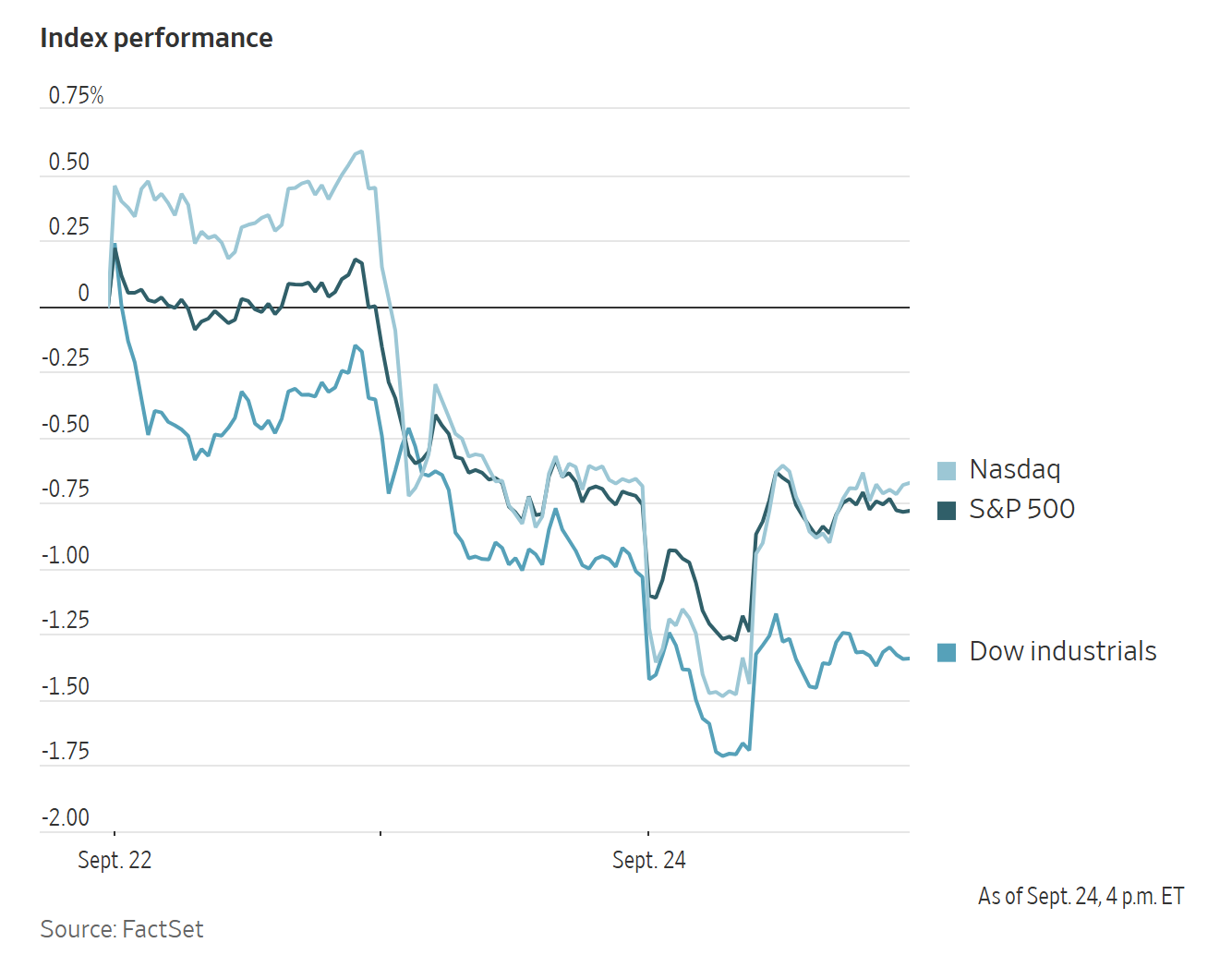
On Thursday, the Dow Jones Industrial Average declined -0.31%, or 161.61 points. The other major indexes finished little changed, with the S&P 500 down -0.02% and the Nasdaq Composite edging +0.01% higher.
In corporate news, Oracle invoked force majeure on the Project Jupiter data centre in New Mexico to limit its financial exposure following significant regulatory and permitting setbacks, according to a Bloomberg news report. The company is seeking to defer payments if the project is derailed or does not become operational in 2028 as planned and has notified developer Blue Owl.
A key natural-gas pipeline serving the project has been delayed until 1 February 2027, constraining the power supply required for the facility’s Bloom Energy fuel cells. The delay to the 2.45-GW facility, part of the $400 billion OpenAI-Oracle-SoftBank infrastructure initiative, comes as debt linked to the development trades below 90 cents on the dollar. The development reinforces concerns over financing and execution risks in the AI infrastructure buildout, as rising costs and political opposition to data centres weigh against strong AI-driven demand.
Barry Diller said on Wednesday that he was withdrawing his bid for MGM Resorts after several months of discussions with the company.
Anthropic will pay Akamai Technologies at least $11.6 billion to use its cloud infrastructure and software over seven years. The agreement includes a potential $9 billion expansion, which would increase the total possible commitment to approximately $20 billion. Akamai also issued Anthropic a warrant to purchase approximately 7.7 million shares of its non-voting, convertible Series B preferred stock on an as-converted basis.
European Stock Indices
CAC 40 -0.52%
DAX -0.57%
FTSE 100 -0.24%
Commodities
Gold spot -0.15% to $4,279.73 an ounce
Silver spot -1.35% to $63.91 an ounce
West Texas Intermediate +2.21% to $94.76 a barrel
Brent crude +3.47% to $107.03 a barrel
Gold prices declined on Thursday, reaching a one-week low.
Spot gold fell -0.15% to $4,279.73 per ounce after touching its lowest level since 16 September earlier in the session.
Spot silver declined -1.35% to $63.91 per ounce.
Oil prices rose to a one-week high on Thursday after a Houthi missile attack on Saudi Arabia renewed concerns over potential supply disruptions. Trading remained volatile, however, and prices retreated from session highs following reports that the US and Iran had discussed reopening the Strait of Hormuz.
Brent futures gained $3.59, or +3.47%, to settle at $107.03 per barrel. WTI crude rose $2.05, or +2.21%, to settle at $94.76 per barrel. At their session highs, both contracts were up by more than four percent.
Saudi Arabia intercepted six ballistic missiles launched by Yemen’s Iran-backed Houthis on the southern province of Taif and the Red Sea area of Yanbu, according to the Saudi-led coalition in Yemen.
With the US - Israeli-led war against Iran largely at a months-long battlefield stalemate, Washington announced an expansion of financial sanctions targeting third-country companies that conduct business with Iranian firms, a practice known as secondary sanctions.
In response to new US sanctions, neighboring countries, including the UAE and Oman, barred Iranian airlines. This marked the first significant effect of a shift in US policy toward companies in third countries that conduct business with Iran.
On Wednesday, Iran threatened retaliation against neighboring countries that comply with the US flight ban, warning that it would render their airports ‘unusable’.
Separately, Saudi Arabia is increasing crude flows through its East - West Pipeline to the Red Sea export hub of Yanbu, although tanker loadings have not yet resumed, according to industry sources, satellite imagery and shipping data.
US and Iranian negotiators in New York are exploring a phased path toward ending the conflict under which Tehran would reopen the Strait of Hormuz and Washington would lift its economic blockade of Iran.
Note: As of 4 pm EDT 24 September 2026
Currencies
EUR -0.06% to $1.1376
GBP -0.22% to $1.3209
Bitcoin -0.05% to $84,334.48
Ethereum +0.44% to $2,686.26
The dollar reached a fresh two-month high on Thursday as Treasury yields rose and expectations for further Fed tightening strengthened following hawkish commentary from Fed officials.
Treasury yields extended the previous session’s sharp rise. The 30-year US bond yield reached its highest level since June 2004. The benchmark 10-year note yield climbed to its highest in nearly two decades after data showed stronger business activity alongside mounting price pressures.
The dollar index advanced for a fourth consecutive session, rising +0.11% to 101.24 after reaching 101.39 earlier in the day, its highest level since 29 July.
The euro declined -0.06% to $1.1376 after falling to $1.1358, its lowest level since 28 July. ECB Executive Board member Isabel Schnabel resigned on Thursday to assume a senior role at the International Monetary Fund, initiating a prolonged reshuffle at Europe’s most influential financial institution.
The Japanese yen weakened -0.30% against the dollar to 158.79 per dollar. Japanese Finance Minister Satsuki Katayama said the principles underpinning the coordinated Japan - US currency intervention in July remained intact. However, sentiment remained fragile after the previous week’s BoJ rate increase failed to convince investors that a faster tightening cycle was likely.
The British pound declined -0.22% to $1.3209.
Fixed Income
US 10-year Treasury +8.9 basis points to 5.205%
German 10-year Bund +3.9 basis points to 3.601%
UK 10-year Gilt +3.5 basis points to 5.385%
Long-dated US Treasury yields rose to their highest levels in more than 20 years on Thursday, extending a global bond selloff.
Investor concern has intensified as the selloff in the US Treasury market, the world’s deepest and most influential government bond market, has accelerated. The 30-year Treasury yield rose +7.8 bps to 5.480%, its highest level since 2004. The 10-year yield reached 5.205% after advancing +8.9 bps on Thursday.
The two-year US Treasury yield rose +3.2 bps to 4.935%, following a +15.2 bps increase on Wednesday.
The US 2s10s yield curve stood at 27.0 bps, 5.7 bps wider than on Wednesday.
Money markets assigned a 67.5% probability to a 25-bps increase at the Fed’s 28 October meeting, compared with 69.7% on Wednesday and 55.4% one week earlier, according to CME FedWatch.
The ICE BofA US Bond Market Option Volatility Estimate Index, or MOVE Index, surged from 78 to 95, its highest close since early April. It subsequently retraced only modestly to approximately 93 on Thursday, according to Intercontinental Exchange data.
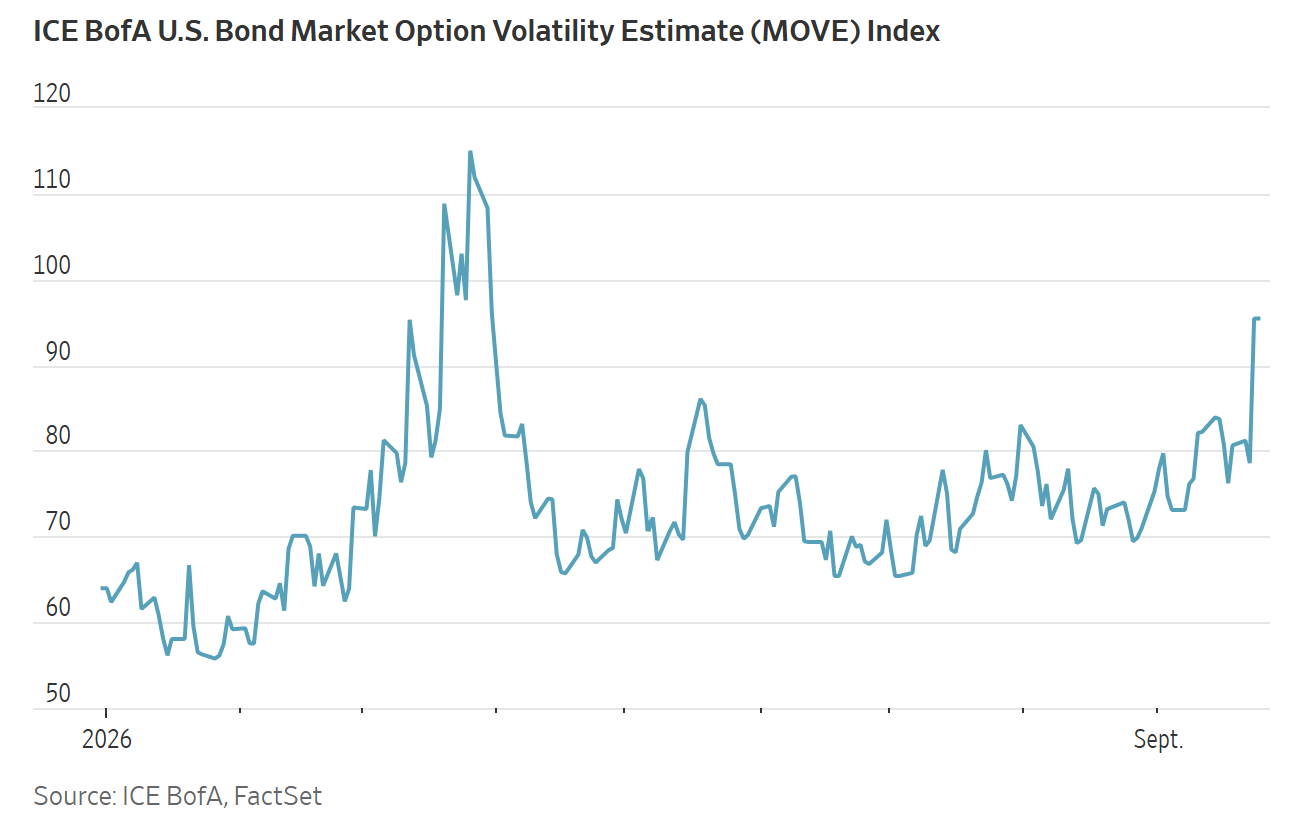
Although the index remains below levels commonly observed between 2022 and 2025, the increase is concerning because the rise in Treasury yields had previously occurred amid subdued volatility. The move may indicate a transition toward a less orderly trading environment.
For passive index investors, the shift may also signal wider spreads. If bond-market volatility remains elevated, corporate and mortgage bond investors could experience greater losses than holders of Treasurys.
Across the Atlantic, the selloff in euro-area government bonds continued on Thursday, pushing yields once more to multi-year highs.
Germany’s 10-year government bond yield rose +3.9 bps to 3.601%, its highest level in more than 17 years.
Strong economic data also contributed to the bond selloff. German business sentiment improved more than expected in September, providing further evidence that the recovery was gaining traction in the euro area’s largest economy.
Data released on Wednesday showed that business activity was accelerating in both the euro area and the US.
Money-market futures priced in 35 bps of ECB tightening by year-end, implying one 25-bps increase and an approximately 40% probability of a second. Futures also implied four 25-bps rate increases over the next 12 months.
Germany’s two-year yield, which is sensitive to changes in expectations for the ECB deposit rate, fell -1.2 bps to 3.329%. At the long end of the curve, the 30-year yield rose +1.5 bps to 3.866%.
The bond selloff has been most pronounced in highly indebted euro-area countries, including France and Italy. France remains in focus as it approaches the 2027 election year with a substantial primary deficit and budget risks arising from a fragmented parliament.
France’s 10-year OAT yield rose +8.0 bps to 4.724%, its highest level in more than 18 years.
The spread between 10-year OAT and Bund yields widened to 1.123 bps, its highest level since mid-2012. Similarly, Italy’s 10-year BTP yield rose +8.0 bps to 4.572%, leaving its spread over Bunds at 97.1 bps.
Note: As of 4 pm EDT 24 September 2026
While every effort has been made to verify the accuracy of this information, EXT Ltd. (hereafter known as “EXANTE”) cannot accept any responsibility or liability for reliance by any person on this publication or any of the information, opinions, or conclusions contained in this publication. The findings and views expressed in this publication do not necessarily reflect the views of EXANTE. Any action taken upon the information contained in this publication is strictly at your own risk. EXANTE will not be liable for any loss or damage in connection with this publication.
本文提供给您仅供信息参考之用,不应被视为认购或销售此处提及任何投资或相关服务的优惠招揽或游说。金融工具交易存在重大亏损风险,未必适合所有投资者。过往表现并非未来业绩的可靠指标。






由专业人士创建。 为专业人士。
