

What is the cost of a hot summer?


 S&P 500 +0.24% to 7,746.47 US 10-year yield -0.3 basis points to 4.693% Spot gold +0.89% to $4,406.91 an ounce DXY +0.16% to 100.01
What to look out for today
Companies reporting on Thursday, 13 August: Applied Materials, JD.Com, Tapestry
Key data to move markets today
EU: Spanish CPI and Harmonised Index of Consumer Prices and Eurozone Industrial Production
UK: GDP, Industrial Production and Manufacturing Production
USA: Initial and Continuing Jobless Claims, PPI and speeches by Cleveland Fed President Beth Hammack and Richmond Fed President Tom Barkin
Global Macro Updates
Heatwaves deepen Europe’s growth and inflation risks. Europe’s summer heatwaves are increasingly translating into tangible economic disruption, adding to downside risks for growth and renewing upward pressure on food prices. The effects are emerging across industrial supply chains, labour-intensive sectors and agricultural markets and underscoring how acute weather events are becoming a more material macroeconomic consideration.
In Germany, low water levels on the Rhine are already disrupting a critical freight artery. Reuters reported that chemical producers, utilities, steelmakers and agricultural traders are facing higher transportation costs, logistical bottlenecks and constraints on production. While widespread shutdowns have so far been avoided, cargo capacity is becoming increasingly difficult to secure and companies are reporting a rising number of operational challenges.
The UK is also seeing a meaningful economic toll. Research cited by The Guardian estimates that recurring heatwaves may have cost the economy more than £4 billion in lost output by the end of July, including an estimated £2.36 billion impact from June alone. The analysis warns that, should heatwaves continue to intensify at the pace seen over the past decade, their annual cost to the UK economy could exceed £25 billion by 2030.
These developments follow a recent Triodos Bank assessment suggesting that extreme heat could reduce EU-wide GDP by around 1% in 2026. The largest effects are expected to stem from weaker labour productivity, particularly in heat-exposed industries and in countries with limited adaptation capacity or low air-conditioning penetration. France is expected to face the largest economic impact, followed by Italy and Spain.
The broader evidence points to a growing structural risk. ING previously estimated that the 2025 European heatwave reduced output by around 0.3%, while Allianz Trade has warned that the most exposed economies, led by France, Italy, Germany and Spain, could face cumulative GDP losses of 5% to 7% by 2030. The drag would reflect weaker productivity, softer investment and rising cooling-related energy demand.
The effects are also moving through the food supply chain. The UK Food and Drink Federation has warned that elevated temperatures across the UK and Europe are likely to raise food prices by constraining supplies of fruit, vegetables and grains. These pressures are particularly significant given the already elevated cost base faced by producers.
According to the Federation, manufacturers’ input costs rose by 39% between January 2020 and June 2026, excluding labour, regulatory and financing costs. Retail food prices increased at a similar pace over the period, suggesting that producers have already absorbed a substantial share of the pressure. However, the scope for further absorption may be narrowing.
The British Retail Consortium noted that retailers and suppliers have become more experienced in managing supply disruptions, helping to limit the immediate impact on consumers. Even so, economists at the Food and Drink Federation expect renewed input-cost pressure to lift food inflation into 2027.
Other forecasts reinforce the risk. Oxford Economics has estimated that severe heatwaves, combined with an El Niño weather pattern, could add around 1 percentage point to food-price inflation next year.
This sits uneasily with the BoE’s more benign July outlook. Its Monetary Policy Report noted that supermarkets expected food inflation to peak at 4% to 5% this year, down from earlier expectations of 6% to 7% formed shortly after the outbreak of the US - Iran conflict. Persistent heat and drought conditions, however, risk challenging that moderation and could keep food-price dynamics and the broader inflation outlook under close scrutiny.
July CPI. The Consumer Price Index released by the US Bureau of Labor Statistics was in line with expectations for both headline and core measures. Core inflation rose 0.2% m/o/m after a flat prior reading, while annual core inflation eased to 2.5% from 2.6%. Headline CPI increased 0.1% after a 0.4% decline, with annual inflation slowing to 3.4% from 3.5%. Shelter accounted for roughly two-thirds of the monthly headline increase, rising 0.1%, while a 1.5% drop in energy prices, following June’s 5.7% decline, partly offset the gain.
Core services details were generally seen as benign despite firmer shelter and medical services readings. Rent and owners’ equivalent rent both rose 0.3% m/o/m, though some economists expect softer market rents and home prices to support further moderation. Airfares also strengthened, but Citi expects moderation later this year, potentially as soon as August, while BofA noted a subdued ex-housing supercore reading.
Core goods rose 0.2% m/o/m, although analysts broadly viewed the increase as contained rather than evidence of a wider reacceleration. Overall, the Fed read-through was generally dovish, with the debate focussed on whether the July CPI simply supports a September hold or changes the broader policy outlook.
US Stock Indices
Dow Jones Industrial Average -0.04%
Nasdaq 100 +0.74%
S&P 500 +0.24%, with 8 of the 11 sectors of the S&P 500 up
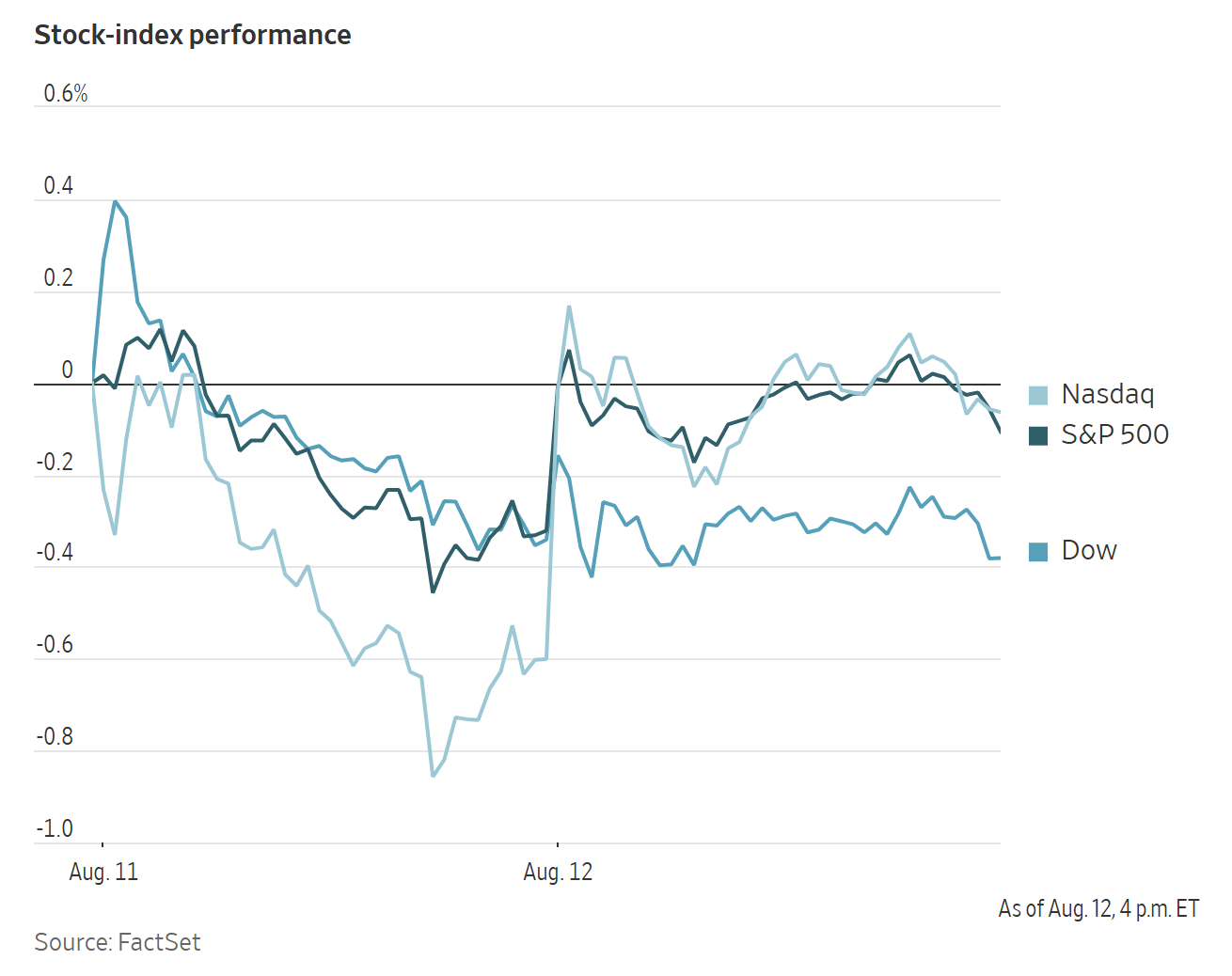
US stocks ended mixed, while government bond yields slipped after July inflation eased modestly. The Dow Jones Industrial Average was -0.04%, or down 21.58 points, to 53,770.27. The Nasdaq Composite rose +0.54%, or 143.04 points, to 26,588.49, while the S&P 500 advanced +0.24%, or 18.27 points, to 7,746.47.
In corporate news, Wendy’s shares gained after the Financial Times reported that Nelson Peltz’s Trian Fund Management is preparing a bid to take the struggling fast-food chain private.
Egan-Jones Ratings, a credit-ratings firm accused by former employees of grade inflation, will not be allowed to add asset-backed securities to its ratings portfolio after the Securities and Exchange Commission rejected its application Wednesday. The firm still has SEC approval to rate other debt types, including private credit, and remains a major provider of confidential “private letter ratings” to life and annuity insurers. Analysis by The Wall Street Journal recently found that about $40 billion in insurer investments carry Egan-Jones ratings.
Corporate Earnings Reports
Posted on Wednesday, 12 August from The Pulse, our real-time AI-driven news tool. Available exclusively on the EXANTE Web Platform
Cisco reported Q4 fiscal 2026 earnings.. Revenue was $17.3bn (up +18% y/y, vs $16.82bn consensus) and non-GAAP EPS was $1.22 (up +23% y/y, vs $1.17 consensus). The company guided for fiscal Q1 2027 revenue of $18.0bn-$18.2bn (vs $16.8bn) and adjusted EPS of $1.32-$1.34 (vs $1.16 consensus). Full fiscal 2027 revenue guidance was $72.2bn-$73.4bn (vs $68.69bn) with adjusted EPS of $5.05-$5.11 (vs $4.80). AI infrastructure orders were $4bn in Q4 and $9.3bn for fiscal 2026, with management also outlining a $7.5bn AI revenue target for fiscal 2027. CEO Chuck Robbins said: "We delivered a very strong close to fiscal 2026, marking another record year for Cisco."
Nebius Group reported Q2 results. Revenue was $582.3mn, up +454% y/y, beating the $573.9mn consensus. Adjusted EBITDA was $236.2mn vs a -$21mn loss a year ago and the $175mn estimate. Diluted EPS was -$0.68 vs the -$0.62 consensus. AI cloud revenue reached $575mn, up +514% y/y. The company reaffirmed full-year 2026 guidance, raised its year-end contracted power forecast to 5 GW from more than 4 GW, and expects more than $9bn in customer prepayments this year. CEO Arkady Volozh said the company 'could sell our entire 2027 capacity on these terms today' but is deliberately holding some back for immediate customer needs. Separately, DA Davidson maintained Neutral but cut its price target to $175 from $250, citing Vineland facility delays. Goldman Sachs maintained Buy with a $286 price target. Michael Burry disclosed a short position in the stock, citing concerns about off-balance-sheet liabilities.
Coherent Corp reported Q4 revenue of $2.1bn vs $1.99bn expected, up +34% y/y. Adjusted EPS was $1.74 vs $1.61, net income $351mn vs $323mn, and operating income $446mn vs $427mn. For Q1, the company guided revenue of $2.2bn-$2.4bn vs $2.14bn consensus and EPS of $1.85-$2.05 vs $1.77. Jefferies raised its price target to $420 from $375 and maintained a Buy rating. Management commented that it is “prioritizing investments to expand manufacturing capacity” amid strong customer demand.
European Stock Indices
CAC 40 -0.46%
DAX -0.23%
FTSE 100 -0.10%
Commodities
Gold spot +0.89% to $4,406.91 an ounce
Silver spot +1.08% to $65.25 an ounce
West Texas Intermediate -1.05% to $82.88 a barrel
Brent crude -0.39% to $88.62 a barrel
Gold advanced to its highest level in more than two months on Wednesday.
Spot gold rose +0.89% to $4,406.91 per ounce and traded above its 100-day moving average of $4,387.22.
Spot silver gained +1.08% to $65.25 per ounce after earlier reaching its highest level since 22 June.
WTI and Brent settled slightly lower as markets assessed the IEA’s August Oil Market Report, the US Department of Energy Weekly Petroleum Status Report and Iran’s denial of an official start date of a ceasefire agreement to extend.
Brent futures settled down 35 cents, or -0.39% lower, at $88.62 per barrel, while WTI crude declined 88 cents, or -1.05%, to $82.88 per barrel.
A Reuters report published around 7:00 am EDT cited senior Iranian officials as saying there were no talks to extend a US - Iran ceasefire and that, from Tehran’s perspective, no official ceasefire agreement had begun.
The US Department of Energy Weekly Petroleum Status Report was led by a 17.4 million-barrel crude build, the largest weekly increase in more than three years. It was driven primarily by a 1.768 million bpd rise in net crude imports and a 14.6 million-barrel increase in PADD 3 inventories. Gasoline stocks drew just under 1.0 million barrels, while distillate inventories were unchanged.
Distillate exports reached record highs for a second consecutive week, jet fuel production remained above 2.0 million bpd for a record 15th consecutive week and Venezuelan crude imports rose to 743,000 bpd, a nine-year high. Distillate inventories and gasoline stockpiles are at their lowest seasonal levels in at least 25 years and more than 10 years, respectively.
The IEA and OPEC monthly reports incorporated the impact of the short-lived memorandum of understanding between the US and Iran, which enabled higher production from Saudi Arabia, Kuwait and Iraq.
Russia is reportedly importing gasoline from India, adding to the list of countries the Kremlin has approached for fuel as Ukrainian attacks continue to pressure domestic refining capacity.
IEA Monthly Oil Market Report. In its Monthly Oil Market Report, the IEA expects global demand to decline by 1.6 million bpd in 2026, a 510,000 bpd downward revision m/o/m, as the continued closure of the Strait of Hormuz and elevated fuel prices weigh on consumption. Demand is expected to expand by 2.4 million bpd in 2027.
Global supply is projected to decline by 4.3 million bpd in 2026 before rebounding by 8.3 million bpd next year.
Refinery crude throughputs improved in July from June, but remained 5.0 million bpd below year-earlier levels. Throughputs are expected to decline by 2.5 million bpd in 2026 before rising by 3.5 million bpd in 2027.
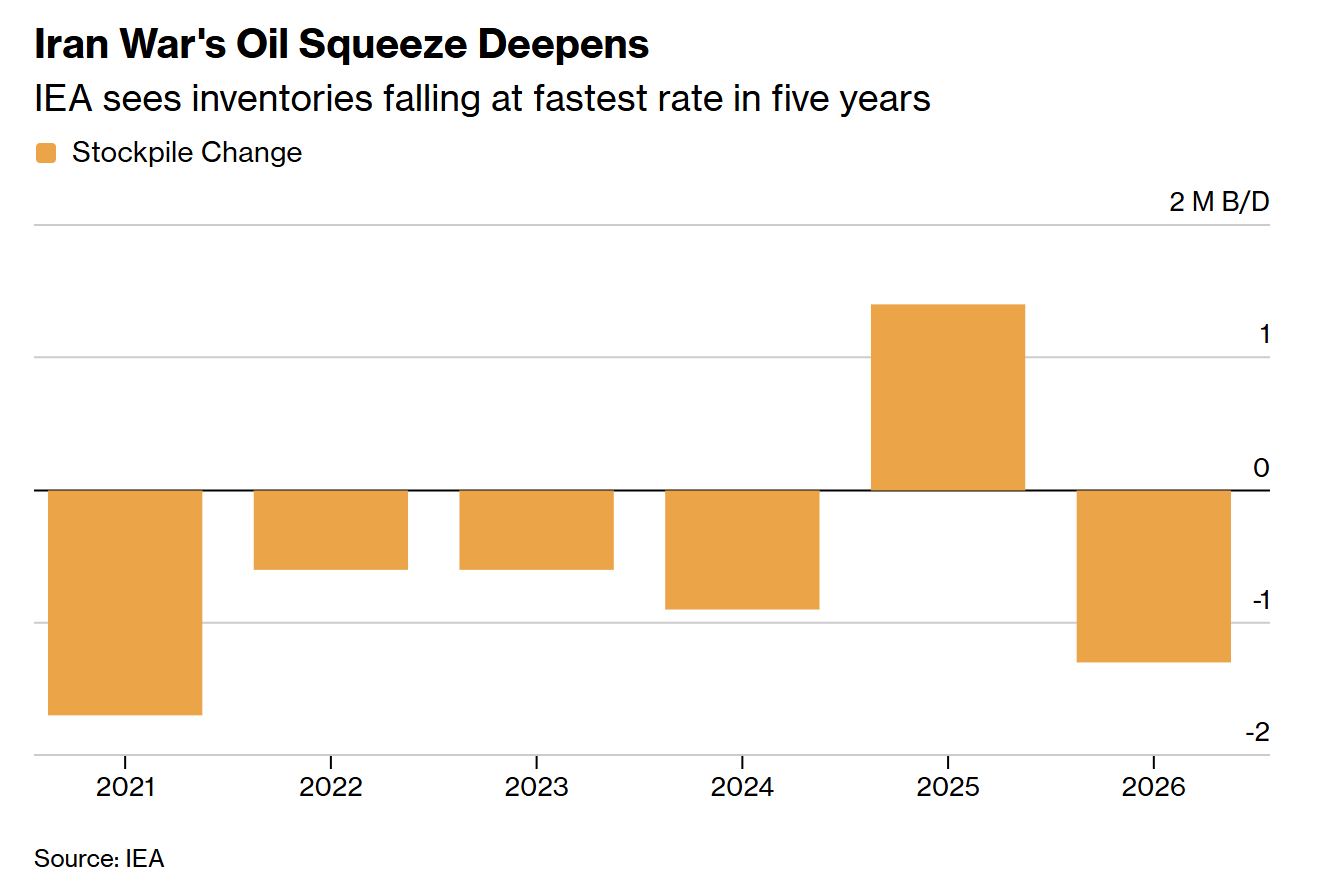
Global observed oil inventories fell by 69 million barrels in July. The global oil balance is now expected to show a 1.8 million bpd deficit in Q3, more than double the roughly 800,000 bpd deficit estimated in the prior report.
Seaborne product trade declined by 3.8 million bpd y/o/y in July, despite a 700,000 bpd increase in US exports.
Note: As of 4 pm EDT 12 August 2026
Currencies
EUR -0.13% to $1.1522
GBP -0.14% to $1.3488
Bitcoin -0.30% to $63,455.04
Ethereum -0.07% to $1,882.31
The dollar strengthened on Wednesday, with the dollar index rising +0.16% to 100.01, while the euro slipped -0.13% to $1.1522.
The British pound fell -0.14% to $1.3488.
The Japanese yen weakened -0.10% to ¥159.43 per dollar, giving back gains from the late July joint intervention by US and Japanese authorities to support the currency.
The latest Commodity Futures Trading Commission report, released late last week, showed the intervention triggered a sharp squeeze in speculative short yen positions. Without a shift in fundamentals, stable financial markets may encourage speculators to rebuild those positions as carry trades remain attractive.
Fixed Income
US 10-year Treasury -0.3 basis points to 4.693%
German 10-year Bund +0.4 basis points to 3.174%
UK 10-year Gilt +1.0 basis points to 4.976%
US Treasuries were little changed on Wednesday after a muted July inflation report, while the government’s 10-year note auction cleared at the highest yield in 19 years.
US two-year yields, which are sensitive to rate expectations, fell -1.4 bps to 4.212%. The 10-year yield edged down -0.3 bps to 4.693%, while the US 30-year yield rose +1.0 bps to 5.255%.
The Consumer Price Index rose 0.1% in July after falling 0.4% in June, its first monthly decline in six years. Annual inflation eased to 3.4% from 3.5%.
After the report, according to the CME FedWatch tool, US rate futures reduced the probability of a September Fed rate increase to 40.1% from 48.4% late Tuesday.
The US Treasury auctioned $42 billion in 10-year notes on Wednesday, clearing at a high yield of 4.683%, marking the highest auction yield since the 2007 global financial crisis. The auction, however, was well received, with the bid-to-cover ratio rising to 2.53x, above the 2.44x average for refunding auctions.
Eurozone government bond yields were broadly unchanged on Wednesday.
Germany’s 10-year bund yield rose +0.4 bps to 3.174%.
Germany’s two-year Schatz yield fell -0.5 bps to 2.791%.
Traders modestly reduced expectations for additional ECB tightening this year, with money markets pricing in 39 bps of further hikes for the remainder of the year.
French yields remained above Italy’s, as political uncertainty in France outweighed the potential energy-driven inflation impulse in Italy.
Note: As of 4 pm EDT 12 August 2026
While every effort has been made to verify the accuracy of this information, EXT Ltd. (hereafter known as “EXANTE”) cannot accept any responsibility or liability for reliance by any person on this publication or any of the information, opinions, or conclusions contained in this publication. The findings and views expressed in this publication do not necessarily reflect the views of EXANTE. Any action taken upon the information contained in this publication is strictly at your own risk. EXANTE will not be liable for any loss or damage in connection with this publication.
本文提供給您僅供資訊參考之用,不應被視為認購或銷售此處提及任何投資或相關服務的優惠招攬或遊說。金融商品交易涉及重大損失風險,可能不適合所有投資者。過往績效不代表未來表現。








由專業人士建立。為專業人士打造。
