

Is the Red Sea the new inflation beta?


 S&P 500 -0.19% to 7,443.28 US 10-year yield +4.7 basis points to 4.597% Spot gold -0.27% to $4,005.71 an ounce DXY +0.24% to 100.99
Key data to move markets today
EU: ECB Bank Lending Survey, German ZEW Current Situation and Economic Sentiment surveys, Eurozone ZEW Economic Sentiment survey and a speech by Bundesbank President Joachim Nagel
UK: Employment Change, ILO Unemployment Rate, Claimant Count Rate and Change and Average Earnings
USA: ADP Employment Change 4-week Average
JAPAN: Imports, Exports and Merchandise Trade Balance
Global Macro Updates
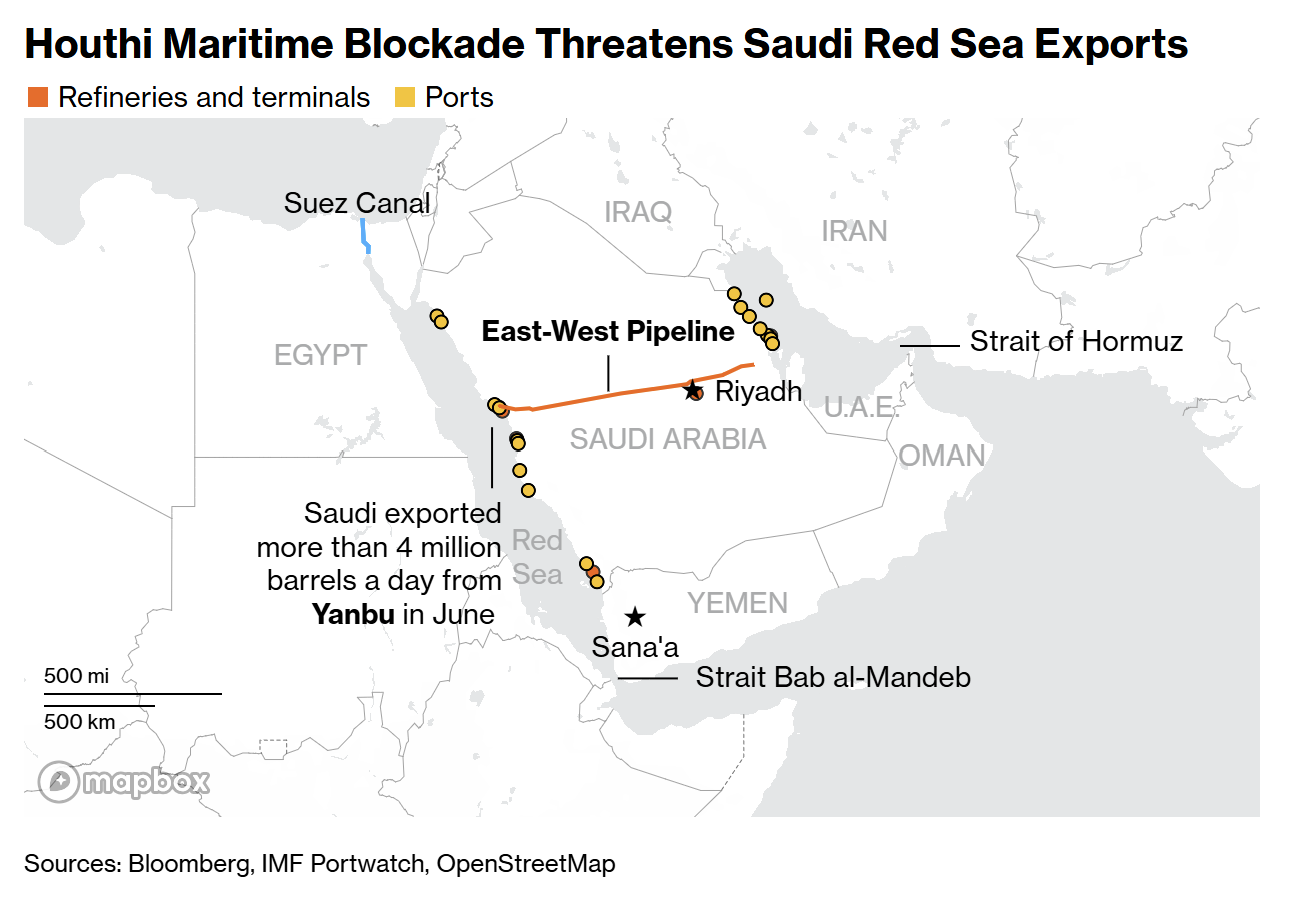
Red Sea Risk. As reported by Bloomberg news, Yemen’s Houthi movement’s vow to impose a maritime blockade on Saudi Arabia at Bab el-Mandeb injects a fresh layer of supply‑side risk into an already fragmented global energy map. While the operational feasibility of a full shutdown remains uncertain, even partial disruption of flows through the Red Sea corridor would tighten prompt crude and product availability into Europe and Asia.
For energy producers, higher flat prices and steeper backwardation would bolster cash flow, but complicate upstream planning. Supply rerouting via longer Cape routes raises freight costs and erodes realised differentials for Middle Eastern grades. Refiners, particularly in Europe, face margin volatility, as stronger cracks on constrained diesel supply may be offset by higher feedstock and shipping costs, forcing runs optimisation and opportunistic crude slate adjustments.
Container and dry bulk operators confront immediate operational headwinds as insurance premia, war‑risk surcharges and transit times increase, with schedules re‑sequenced around choke points and some tonnage diverted from the Red Sea entirely. This feeds into global manufacturing and retail via longer lead times and higher landed costs, reinforcing the ‘just‑in‑case’ inventory bias that has been building since the pandemic.
Across asset classes, the shock strengthens the bid for energy, shipping and defence equities, while pressuring fuel‑intensive sectors such as airlines and logistics. It supports a renewed safety premium in USD and front‑end volatility. For macro investors, it reopens the energy‑geopolitics channel as a central driver of inflation expectations and policy‑rate path debates.
US Stock Indices
Dow Jones Industrial Average -0.59%
Nasdaq 100 +0.04%
S&P 500 -0.19%, with 8 of the 11 sectors of the S&P 500 down
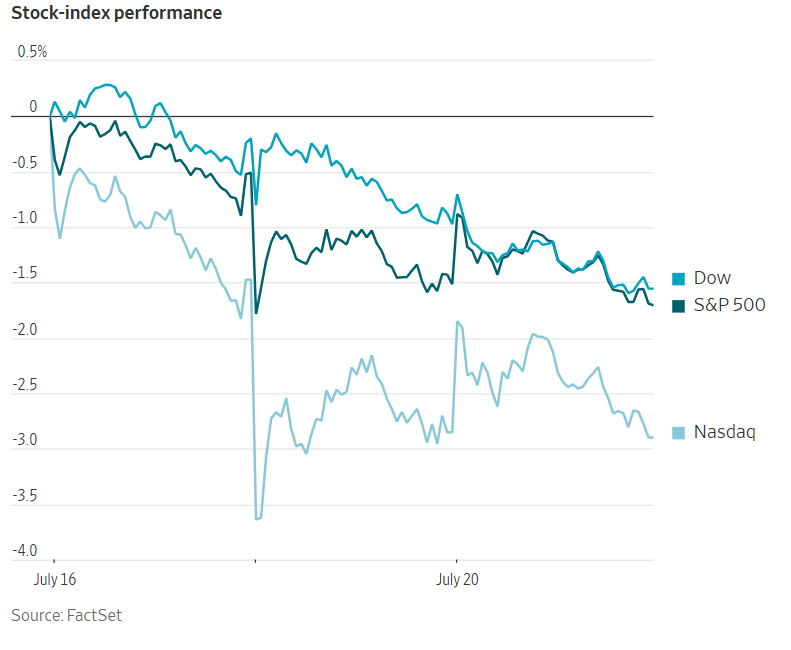
Stocks fell on Monday due to rising oil prices amid concerns about an escalation in Middle East hostilities. The Nasdaq Composite edged down -0.05%, or 12.17 points, to 25,508.07, the Dow industrials fell -0.59%, or down 307.16 points, to 51,839.26, and the S&P 500 dropped -0.19%, or down 14.41 points, to 7,443.28. The Philadelphia SE Semiconductor Index closed Monday with modest 0.6% gain.
In corporate news, Paramount Skydance was forced by US District Judge Araceli Martinez-Olguin to pause its $110 billion acquisition of Warner Bros. Discovery through 3 August after a coalition of 11 states including New York, Colorado, California and Massachusetts, argued the merger would harm competition.
Alphabet shares rose +1.52% on Monday after it was reported that its Google unit is developing a Gemini-integrated server chip aimed at improving AI efficiency and easing computing-capacity constraints.
As noted by Bloomberg news, Domino’s Pizza posted its slowest US comparable sales growth in five quarters as budget-conscious diners continue to pull back on dining out and new higher-priced offerings failed to drive growth.
European Stock Indices
CAC 40 +0.02%
DAX +0.06%
FTSE 100 -0.71%
Commodities
Gold spot -0.27% to $4,005.71 an ounce
Silver spot +1.16% to $56.55 an ounce
West Texas Intermediate +0.59% to $82.96 a barrel
Brent crude +0.94% to $88.94 a barrel
Gold fell on Monday due to a stronger dollar. Spot gold fell -0.27% to $4,005.71 an ounce. Spot silver rose +1.16% to $56.55 per ounce.
WTI and Brent began the week higher as the conflict in Iran continued to dominate market sentiment. The WTI August contract expires tomorrow afternoon, while the September contract settled at $82.48 per barrel.
Brent crude futures settled 83 cents, or +0.94%, higher at $88.94 per barrel, while US WTI futures rose 49 cents, or +0.59%, to $82.96 per barrel.
Although reports pointed to a possible 10-day ceasefire, the US continued to strike targets in Iran. Iran launched missiles at several neighbouring countries, including Kuwait, Jordan and Bahrain, while also targeting additional vessels in the Strait of Hormuz. Shortly after 14:00 EDT, explosions were heard at US bases in Jordan. Axios cited US officials as saying talks are ongoing, but that the US President remains focussed on holding Iran accountable for MOU violations, continued attacks in the Strait of Hormuz and the recent deaths of US soldiers.
Yemen’s Houthis announced a sea-navigation ban against Saudi Arabia. In a radio message to vessels in the Bab el-Mandeb area, the group warned ships linked to Saudi Arabia against proceeding through the Red Sea and Gulf of Aden, stating that non-compliant vessels would be targeted.
In supply developments, Iraq producer Gulf Keystone shut in production at the Shaikan oilfield in Kurdistan, citing the developing regional security environment. Air France suspended flights to Riyadh and Dubai through this week due to worsening Middle East security conditions.
CPC said it again suspended crude loadings following a new Ukrainian drone attack on a tanker.
Chevron shut in production at its Petronius facility in the Gulf of Mexico and moved associated personnel onshore ahead of Tropical Depression #2, which is becoming better organised. BSEE did not provide an afternoon update on shut-in Gulf of Mexico production.
Europe has continued to absorb a larger share of Guyana’s supply. So far this year, 49% of Guyana’s total oil exports have gone to Europe, up from 16% in 2021. Shipments to Europe averaged 110,000 bpd from January through early September, according to Refinitiv Eikon tanker-tracking data, exceeding the total daily volume shipped to all destinations in 2021.
Note: As of 4 pm EDT 20 July 2026
Currencies
EUR -0.25% to $1.1410
GBP -0.22% to $1.3424
Bitcoin +1.85% to $65,261.18
Ethereum +3.26% to $1,901.27
The US dollar hovered near a one-week high on Monday.
The US dollar index was +0.24% higher at 100.99, close to its highest level since 15 July.
The euro was -0.25% lower at $1.1410, while sterling declined -0.22% to $1.3424 after UK Prime Minister Andy Burnham said his government would adhere to existing fiscal rules, but use any flexibility within them.
Against the yen, the dollar was +0.06% higher at ¥162.49.
Fixed Income
US 10-year Treasury +4.7 basis points to 4.597%
German 10-year Bund +2.6 basis points to 3.177%
UK 10-year Gilt +7.8 basis points to 5.045%
US Treasury yields rose across the curve on Monday as traders weighed escalating oil prices, driven by the escalating war with Iran, and the impact on inflation. It is a quiet week for US economic data with Fed policymakers in a blackout period ahead of next week’s interest-rate decision.
The two-year note, which typically tracks Fed funds rate expectations, increased +3.2 bps to 4.215%.
The US 10-year yield rose +4.7 bps to 4.597%.
The 2s10s curve steepened to 38.2 bps.
Data released last week showed that US consumer inflation slowed more than expected in June as energy prices retreated.
The Treasury Department is scheduled to sell $13 billion of 20-year bonds on Wednesday and $21 billion of 10-year Treasury Inflation-Protected Securities on Thursday.
Eurozone yields were mixed after a volatile session on Monday, while inflation-sensitive markets fully priced in two additional ECB rate hikes by early 2027.
German two-year Schatz yields, which are sensitive to policy-rate expectations, reversed earlier gains and fell -1.0 bps to 2.793% after touching 2.817%, their highest level since July 2024.
Investors broadly expect the ECB to keep rates unchanged while avoiding firm guidance on the future path of policy.
Money markets implied an ECB deposit rate of 2.66% in December and 2.73% in February 2027, compared with the current 2.25%. Markets also fully priced in a September rate hike.
Germany’s 10-year government bond yield rose +2.6 bps to 3.177%.
Italy’s 10-year government bond yield increased +2.1 bps to 3.969%.
Note: As of 4 pm EDT 20 July 2026
While every effort has been made to verify the accuracy of this information, EXT Ltd. (hereafter known as “EXANTE”) cannot accept any responsibility or liability for reliance by any person on this publication or any of the information, opinions, or conclusions contained in this publication. The findings and views expressed in this publication do not necessarily reflect the views of EXANTE. Any action taken upon the information contained in this publication is strictly at your own risk. EXANTE will not be liable for any loss or damage in connection with this publication.
本文提供给您仅供信息参考之用,不应被视为认购或销售此处提及任何投资或相关服务的优惠招揽或游说。金融工具交易存在重大亏损风险,未必适合所有投资者。过往表现并非未来业绩的可靠指标。








由专业人士创建。 为专业人士。
