

Who owns the long end?


 S&P 500 +0.49% to 7,711.76 US 10-year yield -1.9 basis points last week to 4.717% Spot gold -3.26% last week to $4,452.67 an ounce DXY +1.31% last week to 99.68
Key data to move markets today
EU: German CPI and Harmonized Index of Consumer Prices
CHINA: RatingDog Manufacturing PMI
Global Macro Updates
The Fed’s new twist meets the Treasury's old one. Fed Chair Kevin Warsh went to Jackson Hole rejecting forward guidance yet delivered a clear guide to the Fed’s bias. Inflation remains too high, the 2 per cent target is ‘firm’ and recent benign prints have not improved the underlying trend. With PCE inflation at 3.7% and labour markets near full employment, the hierarchy for the FOMC is now unambiguous, as price stability comes first. ‘Committed to a discipline, not to a decision’ may be careful central-bank prose, but investors heard optionality for a hike.
The curve duly translated rhetoric into positioning. Two-year yields jumped 11.4 bps to 4.352%, while the long end moved much less. September hike odds rose to 57.0% from 35.0%. It argues against reaching for front-end duration and favours flatteners if Warsh’s credibility contains inflation compensation. Long duration now looks cleaner as relative value than an outright rally, and still needs protection against fiscal unrestraint.
That protection is needed because the economic picture hardly resembles one demanding rescue. Warsh described solid output, healthy consumption, nearly 3% growth in private domestic final purchases and capital expenditure rising around 9%, more than half related to AI. Stronger productivity could raise potential growth later, yet today’s investment boom, easy credit and elevated margins leave financial conditions insufficiently restrictive. A Fed less willing to pre-commit also removes the suppression mechanism that guidance once provided to rate volatility.
Enter Treasury’s quasi-Twist. From 9 September, buybacks of 10- to 30-year bonds will at least double to $4 billion per operation. That improves liquidity and removes duration from the street, cushioning the long end and reinforcing curve flattening. But it does not erase fiscal supply. If investors read the programme as yield management rather than market plumbing, the benefit may migrate from bonds to the currency adjustment, as the dollar becomes the pressure-release valve for capped term premia without deficit repair.
Warsh’s hawkishness complicates that bearish-dollar verdict. Higher front-end yields and restored anti-inflation credibility supported the greenback on Friday. The near-term configuration is therefore dollar-positive and curve-flattening; the medium-term risk is less comfortable. In the end, the US Treasury can buy bonds, not credibility.
The larger issue is that lowering long-term yields works directly against monetary restraint. Mortgage rates, corporate borrowing costs, equity valuations and other interest-sensitive spending decisions depend more on longer-term rates than on small changes in bill yields. The Fed itself describes policy transmission as running through long-term rates, asset prices, credit availability and the exchange rate - not merely through overnight money-market conditions.
The irony is that Treasury’s attempt to contain the long end may eventually reinforce Warsh’s hand at the short end. Additional bill supply can tighten money-market conditions, but lower term premia also loosen the financing conditions that matter most for housing, corporate credit and risk assets. Treasury suppresses term premium at the long end while the Fed raises the expected path of short rates at the front.
US Stock Indices
Dow Jones Industrial Average -0.02%
Nasdaq 100 -0.70%
S&P 500 -0.25%, with 6 of the 11 sectors of the S&P 500 down
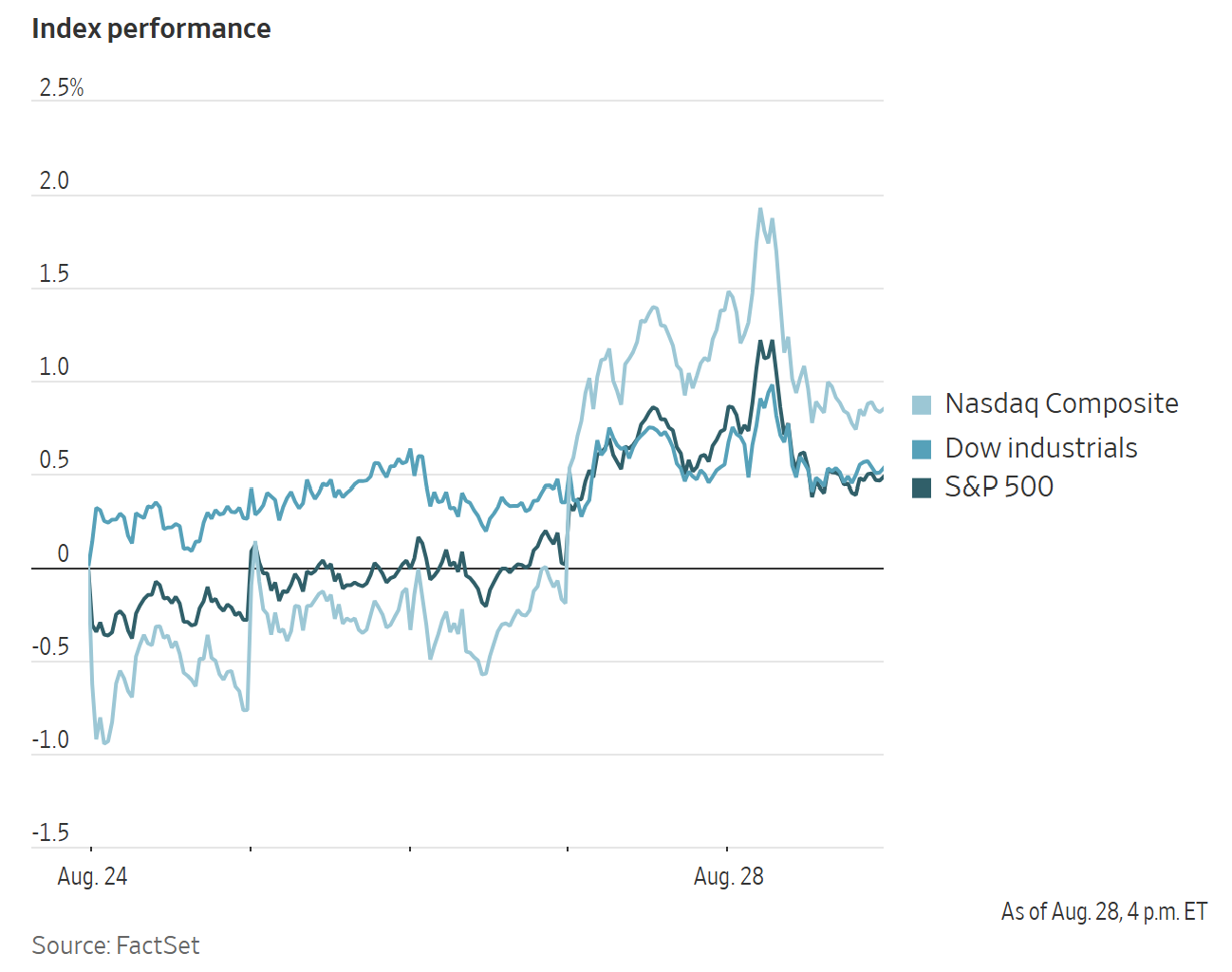
Fed Chair Kevin Warsh signaled that the FOMC may not yet be finished with its effort to contain inflation, a message that lifted bond yields and weighed on equities.
The S&P 500 initially advanced following Warsh’s remarks but later reversed course, ending the session down -0.25%. The Nasdaq Composite fell -0.52%, while the Dow industrials edged -0.02% lower, equivalent to a decline of 9.45 points.
For the week, all US indices traded higher. The S&P 500 advanced +0.49%, the Dow Jones rose +0.53% and the Nasdaq Composite increased +0.85%.
Equity investors have so far shown limited reaction to the recent volatility in bond markets, focusing instead on the conclusion of another strong earnings season and, potentially, the summer holiday period.
Daily trading volumes during the past week ranked among the lowest of 2026. Stocks received an additional boost on Thursday after Nvidia reported another strong quarter, easing concerns about slowing demand for AI chips. Even after Friday’s pullback, the S&P 500 remained roughly ~1% below its all-time high.
The market now enters September, a month that has historically been more volatile for US equities.
In corporate news, Walmart agreed to pay $50 million to settle a DoJ lawsuit alleging violations of the Controlled Substances Act.
Airbus is considering the sale of its US space unit as it shifts its strategic focus toward satellite production in Europe.
GM reached a tentative union agreement to move pickup truck assembly to a plant in Ontario.
European Stock Indices
CAC 40 +0.98%
DAX +0.77%
FTSE 100 +0.29%
Commodities
Gold spot -3.22% to $4,452.67 an ounce
Silver spot -4.29% to $66.35 an ounce
West Texas Intermediate -0.12% to $83.44 a barrel
Brent crude -0.22% to $89.37 a barrel
Gold prices reversed course on Friday, falling by more than -3.00% as a stronger US dollar weighed on demand for bullion.
Spot gold declined -3.22% to $4,452.67 per ounce, reaching its lowest level since 20 August.
Bullion ended the week -3.26% after Friday’s decline, retreating from the more than three-month high of $4,696.18 reached on Tuesday.
The dollar rose to a more than one-week high, making US dollar-denominated bullion more expensive for holders of other currencies.
In India, gold discounts narrowed sharply as demand weakened amid market speculation that the government could consider reversing a recent increase in import duties.
Silver also came under pressure, with spot prices falling -4.29% to $66.35 per ounce on Friday and closing the week -3.79%.
Oil prices settled lower on Friday and ended the week in negative territory, as markets continued to assess geopolitical risks and supply disruptions.
Brent crude futures settled at $89.37 per barrel, down 20 cents, or -0.22%, while West Texas Intermediate crude futures finished at $83.44 per barrel, down 10 cents, or -0.12%.
For the week, Brent declined -4.82% and WTI fell -3.69%.
The US-Israeli war with Iran reached its sixth month on Friday. During the week, the US announced what it described as the “toughest sanctions in history” against Iran, while Tehran characterized the measures as an “inhumane and hostile act” that had lost effectiveness.
Mediators are intensifying efforts to reopen the Strait of Hormuz. Tehran agreed to prepare a list of conditions for restoring normal traffic after a Qatari emissary urged Iranian officials to respect freedom of navigation.
Preliminary shipping data released on Friday showed that seven commodity vessels transited the route on Thursday, down from 17 the previous day and below the 10-day average of 15. The Bab el-Mandeb, another key maritime chokepoint, recorded 17 commodity vessel transits, with six entering and 11 exiting.
Goldman Sachs estimated on Thursday that recent total Gulf exports stood at 15 million to 16 million bpd, around 7 million to 8 million bpd below pre-war levels but 5 million to 6 million bpd above the March trough.
Officials in President Donald Trump’s administration are working on an agreement to secure long-term access to a portion of Venezuela’s crude reserves, according to sources familiar with the negotiations. Such a move could ultimately reduce the cost of US oil imports.
Venezuela is also considering leaving the OPEC oil production group, Bloomberg reported.
Separately, geopolitical tensions escalated after Moscow warned that it could strike British military targets inside and outside Ukraine in response to Kyiv’s attacks on Russian territory using British-supplied long-range cruise missiles.
Ukraine’s military also struck a Russian oil refinery in the Yaroslavl region overnight, according to the Ukrainian General Staff.
Note: As of 4 pm EDT 28 August 2026
Currencies
EUR -0.57% to $1.1584
GBP -0.34% to $1.3534
Bitcoin -3.54% to $77,349.81
Ethereum -3.16% to $2,425.10
The US dollar strengthened sharply on Friday, putting it on course for its largest daily advance in two and a half months after Fed Chair Kevin Warsh indicated that additional interest rate increases may be required if policymakers lack confidence that inflation is returning to target.
The dollar index rose +0.55%, its largest gain since 17 June, to 99.68 after touching 99.73, the highest level since 17 August. The euro declined -0.57% to $1.1584 after falling to $1.1577, its weakest level since 19 August.
For the week, the greenback advanced +1.31%, its strongest weekly performance in 10 weeks, while the euro fell -0.81%, marking its first weekly decline after four consecutive weeks of gains.
Against the Japanese yen, the dollar strengthened +0.41% on Friday to ¥160.04, contributing to a weekly gain of +0.70% and marking its third weekly advance in four weeks. Data showed that annual core inflation in Tokyo accelerated in August for a third consecutive month, signaling broader price pressures and reinforcing the case for an interest rate increase as soon as next month.
Sterling weakened -0.34% to $1.3534 and ended the week -0.78%, snapping a four-week streak of gains.
Fixed Income
US 10-year Treasury +4.3 basis points to 4.717%
German 10-year Bund +2.8 basis points to 3.296%
UK 10-year Gilt +4.9 basis points to 5.070%
US Treasury yields rose sharply on Friday, with rate-sensitive two-year yields reaching a more than one-month high following Fed Chair Kevin Warsh’s remarks at Jackson Hole.
Speaking at the Fed’s annual Jackson Hole symposium, Warsh noted that financial conditions do not appear restrictive and offered his clearest indication yet that further rate increases may be necessary to curb inflation.
Expectations for a Fed rate increase of at least 25 bps at the September meeting rose to 57.0% after Warsh’s comments, according to CME FedWatch tool, up from 35.0% before the speech and 39.9% the previous week.
Warsh has established five task forces to review the Fed’s operational and monetary frameworks, including one focused on the data used in policy decision-making. He has also indicated a preference for alternative inflation measures that may show more moderate price pressures than the PCE data traditionally emphasized by the Fed.
The two-year note yield, which typically tracks Fed funds rate expectations, rose +11.4 bps to 4.352%, its highest level since 24 July and its largest one-day increase since March. Over the week, the two-year yield traded +11.2 bps higher.
The yield on US 10-year notes rose +4.3 bps to 4.717% on Friday, although it declined -1.9 bps over the week.
The 2s10s yield curve bear-flattened by 13.1 bps over the week to 36.5 bps.
At the long end of the curve, the 30-year yield traded +1.1 bps higher on Friday but recorded a weekly decline of -6.8 bps.
Across the Atlantic, Germany’s 10-year government bond yield rose to a 15-year high on Friday as European sovereign bonds remained under pressure.
German two-year bond yields, which are sensitive to changes in ECB deposit-rate expectations, rose +4.4 bps to 2.905% and advanced +4.9 bps over the week.
Traders priced the ECB deposit rate at 2.80% by March next year, compared with the current 2.25%. By late 2027, market pricing implied an approximately 60% probability of an ECB rate increase to 3.00%.
Germany’s 10-year bond yield rose +2.8 bps to 3.296% after earlier touching a 15-year high of 3.286%, as concerns over fiscal sustainability continued to pressure bonds. For the week, the yield increased +2.0 bps.
The French OAT-Bund spread stood at 82.1 bps after reaching 86.6 bps on Monday, its widest level since November 2024, as France faces a particularly challenging annual budget process in the coming months.
France’s economy stagnated in the second quarter, according to the national statistics agency, which revised down its preliminary reading and raised doubts about the outlook for the remainder of the year.
Italy’s 10-year BTP yield traded +2.4 bps higher on Friday, contributing to a weekly increase of +0.9 bps and leaving its spread over Bunds at 80.0 bps.
Note: As of 4 pm EDT 28 August 2026
While every effort has been made to verify the accuracy of this information, EXT Ltd. (hereafter known as “EXANTE”) cannot accept any responsibility or liability for reliance by any person on this publication or any of the information, opinions, or conclusions contained in this publication. The findings and views expressed in this publication do not necessarily reflect the views of EXANTE. Any action taken upon the information contained in this publication is strictly at your own risk. EXANTE will not be liable for any loss or damage in connection with this publication.
Tento článek je poskytován pouze pro informační účely a neměl by být považován za nabídku nebo výzvu k nákupu nebo prodeji jakýchkoli investic nebo souvisejících služeb, jejichž odkazy se v něm můžou vyskytovat. Obchodování s finančními nástroji je spojeno se značným rizikem ztráty a nemusí být vhodné pro všechny investory. Dřívější produktivita není spolehlivým ukazatelem budoucí produktivity.




Přihlásit se k odběru přehledů trhu
Přihlásit se k odběru
přehledů
trhu
Předplaťte si nyní Předplaťte si nyní


Založeno profesionály. Pro profesionály.
