

Is Europe repricing winter?


 S&P 500 +2.62% last month to 7,686.14 US 10-year yield +1.6 basis points last month to 4.756% Spot gold +10.10% last month to $4,448.29 an ounce DXY -0.40% last month to 99.41
Key data to move markets today
EU: German Retail Sales, Italian, Spanish, German and French HCOB Manufacturing PMIs, Italian GDP and CPI, Eurozone Harmonised Index of Consumer Prices, Core Harmonised Index of Consumer Prices and Unemployment Rate and speeches by Bundesbank President Joachim Nagel and ECB Vice President Boris Vujčić
USA: ISM Manufacturing PMI, Prices Paid, Employment and New Orders Indices, JOLTS Jobs Openings and a speech by Fed Governor Michael Barr
Global Macro Updates
Lower than feared German inflation and European LNG storage. German inflation rose less than feared in August, offering modest reassurance ahead of the eurozone HICP release. Headline inflation edged up to 2.9% y/o/y from 2.8% in July, below the 3.1% consensus. Energy inflation accelerated to 10.5% from 8.3% as the conflict with Iran lifted commodity costs, but core inflation held at 2.4%, suggesting that broader pass-through remains limited.
The eurozone picture is likely to prove less benign. Headline HICP (to be published today) is expected to rise to 3.3% y/o/y from 2.9%, with some analysts seeing upside risk to 3.4%, which would be the highest rate in three years. Core inflation should remain near 2.5%, but the energy component could climb to 14% to 15% from 10.3%, reflecting sharper increases in refined products and TTF gas outside Germany. National releases reinforce that divergence. Spanish inflation reached 4.5%, its highest since 2023, while French inflation accelerated to a stronger-than-expected 2.7%.
That combination should keep the ECB on course to raise rates in September, although policymakers appear reluctant to pre-commit to further tightening. For now, stable core inflation and anchored longer-term expectations support the argument that the shock remains predominantly external. However, shorter-dated expectations are more exposed. Higher TTF prices feed mechanically into household gas and electricity tariffs, initially lifting headline inflation and near-term inflation compensation before filtering, albeit with a lag, into firms’ production and distribution costs. The ECB has similarly noted that energy shocks raise near-term inflation while purchasing-power losses weigh on consumption and GDP growth.
Gas prices have eased marginally, but remain near three-year highs around €69/MWh. Renewed Gulf hostilities threaten LNG flows and complicate Europe’s winter restocking. EU storage was only around 63% full in late August, compared with a five-year norm near 80%. It was the weakest seasonal level in more than a decade. Germany is particularly exposed at roughly 51%, while the Netherlands and Belgium stand near 45% and 51%, respectively.
Without a reopening of Hormuz, TTF could breach €100/MWh, according to some analysts. Such a move would deepen Europe’s adverse terms-of-trade shock: real household incomes would weaken, corporate margins and industrial output would come under pressure and investment would slow. The result would be an uncomfortable mix of higher near-term inflation expectations and weaker growth prospects, leaving the ECB to confront an energy-driven inflation shock with increasingly stagflationary consequences.
US Stock Indices
Dow Jones Industrial Average -0.70%
Nasdaq 100 +0.08%
S&P 500 -0.33%, with 9 of the 11 sectors of the S&P 500 down
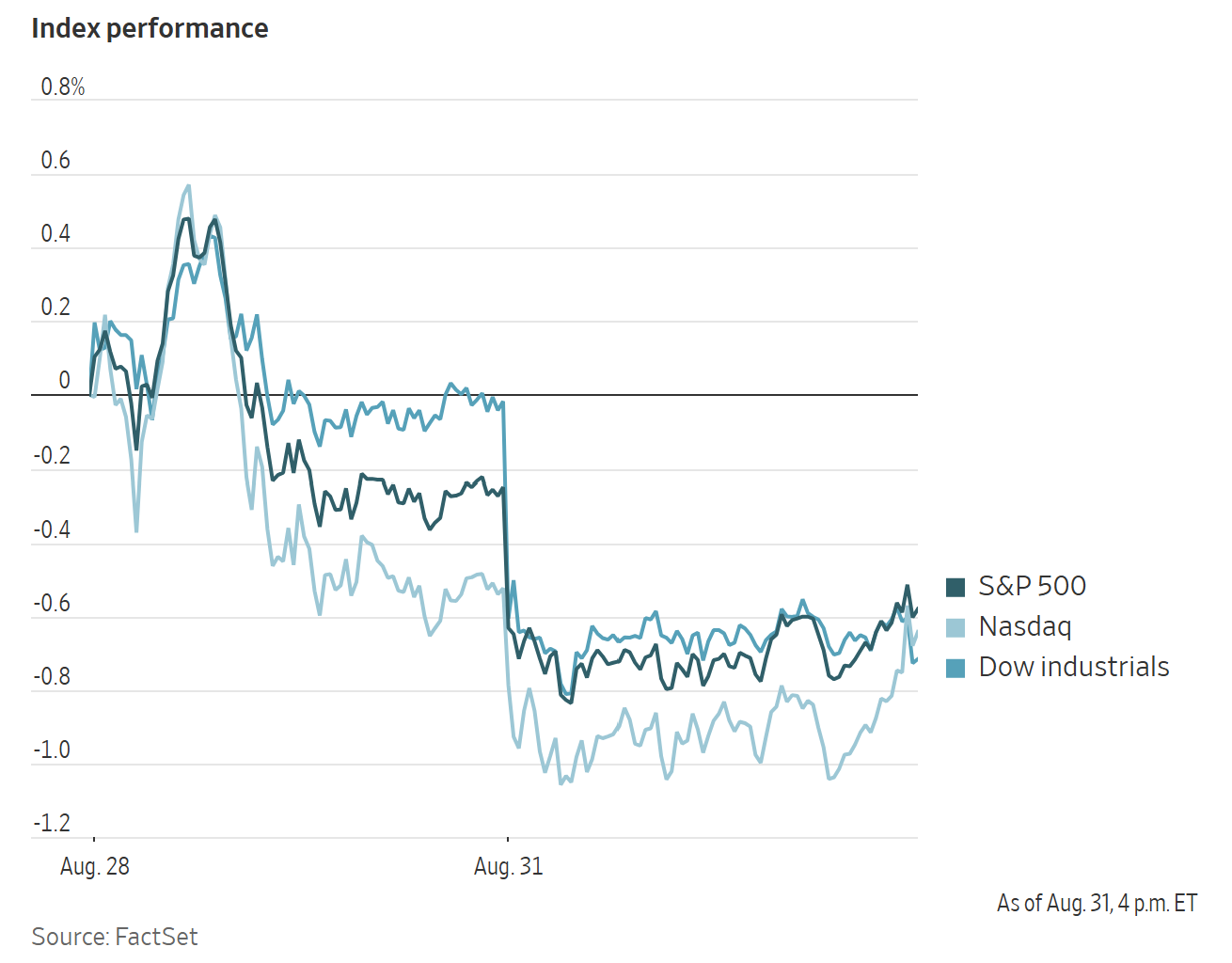
US equities finished lower on Monday, although sector performance was mixed. Within the S&P 500, Energy and Information Technology were the only sectors to close higher, gaining +2.10% and +0.30%, respectively. The broader S&P 500 declined -0.33%, the Dow Jones Industrial Average fell -0.70% and the Nasdaq Composite retreated -0.12% to 26,307.89.
Despite Monday’s softer session, August was constructive for US equity investors.
All three major US indices finished the month in positive territory for the first time since May. The technology-heavy Nasdaq led the gains, rising +3.93% in August, while the S&P 500 advanced +2.62% and the Dow Jones Industrial Average ended the month +1.34% higher.
Software stocks, rather than the more prominent AI-linked names, were among the strongest monthly performers. They were supported by a series of better-than-expected earnings reports that helped ease the negative sentiment that had weighed on the sector earlier in the year.
Moderna was the S&P 500’s standout performer. It gained +156.00% in August after an experimental mRNA vaccine co-developed with Merck succeeded in preventing cancer recurrence or spread in a study of high-risk melanoma patients.
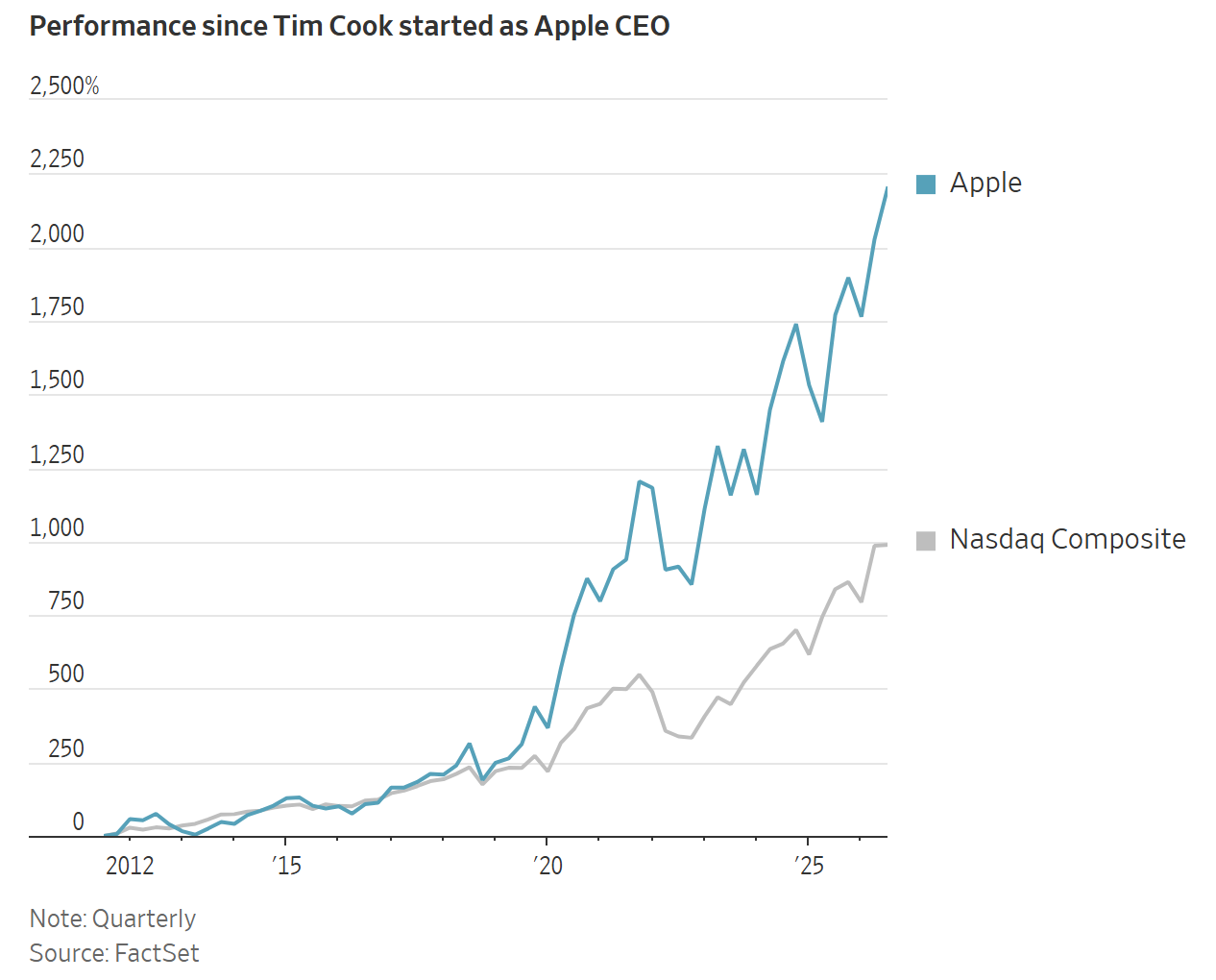
Apple shares fell -0.89% on Monday, which marked Tim Cook’s final day as chief executive. Since Cook became CEO in 2011, the iPhone maker’s stock has risen more than +2,200%, equivalent to an annualised price gain of roughly 23.5%. That performance is more than double the annual gain of the Dow Jones Industrial Average and has also outpaced the gains of the S&P 500 and Nasdaq Composite.
In corporate news, Aon agreed to acquire insurance brokerage USI Insurance from private-equity firm KKR for roughly $17 billion, including debt. The companies announced the transaction on Monday, after The Wall Street Journal reported on Sunday that a deal was imminent.
Publicly traded utilities came under pressure on Monday after California lawmakers rejected Governor Gavin Newsom’s proposal to shield the sector from wildfire-related lawsuits. Shares of California utility PG&E fell more than twenty percent, their steepest decline since the Covid-19 selloff in March 2020.
Other California-based utilities, including Edison International, also declined sharply. Newsom and state lawmakers have disagreed this month over proposed changes to California’s wildfire response framework. The administration had initially sought to prevent insurance companies from suing utilities over wildfire claims, a measure supporters said was needed to limit electricity bill increases for residents and reduce bankruptcy risk for utilities.
Nvidia is investing $3.5 billion in MediaTek to deepen its collaboration with the Taiwanese chipmaker. Under the investment, MediaTek will use Nvidia’s NVLink Fusion and NVHBM technologies to improve communication among data centre components.
SLB agreed to acquire Kelvion from investors including Apollo Global Management for $3.4 billion in cash, expanding its push into data centre services. The acquisition is expected to more than double SLB’s exposure to the AI-driven data centre buildout and broaden its data centre solutions business. SLB expects the unit to exceed a $2 billion annualised revenue run rate by the end of 2027 and aims to position itself as a key technology provider for data centre customers. As part of the transaction, the Houston-based company will assume $700 million in debt, with closing expected in H1 2027.
Separately, the US Federal Trade Commission and 22 US states sued Amazon, alleging that the e-commerce company systematically overcharged advertisers for several years.
European Stock Indices
Commodities
Gold spot -0.10% to $4,448.29 an ounce
Silver spot +0.25% to $66.52 an ounce
West Texas Intermediate +3.44% to $86.31 a barrel
Brent crude +1.56% to $90.76 a barrel
Gold traded lower on Monday, hovering near a two-week low as momentum softened after a strong August performance.
Spot gold slipped -0.10% to $4,448.29 per ounce, after earlier touching its lowest level since 19 August. Even so, the metal posted its strongest monthly performance since January, rising +10.10% in August.
Spot silver rose +0.25% to $66.52 per ounce, bringing its August gain to +15.42%.
Oil prices advanced on Monday as renewed fighting between the US and Iran revived concerns over potential supply disruptions from one of the world’s key crude-producing regions.
Brent crude rose $1.39, or +1.56%, to $90.76 per barrel. WTI crude gained $2.87, or +3.44%, to $86.31 per barrel.
For August, WTI declined -0.61%, while Brent increased +0.74%.
Middle East tensions escalated further after the US President threatened additional strikes against Iran following the first direct exchange of attacks between the two countries in a month on Sunday. The renewed confrontation marked a shift from a recent economic standoff back toward military risk.
Shipping flows also showed signs of strain. Over the weekend, the number of visible commodity vessels transiting the Strait of Hormuz fell to five per day, according to shipping data from Kpler.
Mediation efforts led by Qatar, Oman and other parties to reopen the Strait of Hormuz have so far failed to gain traction. Before the war erupted in late February, the waterway carried about one-fifth of global oil supplies.
The risks to shipping and oil supply remained evident after the United Kingdom Maritime Trade Operations agency said on Tuesday that a tanker reported being struck by three projectiles while sailing out of the Strait of Hormuz. No casualties or environmental impact were reported.
Separately, on Friday, the US President announced a deal with Venezuela to control oil reserves in the country, later stating that the agreement would help replenish the US Strategic Petroleum Reserve, which remains near a 44-year low.
Reuters reported on Monday, citing five sources close to the preparations, that US companies Chevron and GE Vernova, India’s ONGC, Italy’s Eni and Colombia’s GeoPark are on track to sign final agreements in Venezuela after months of negotiations to advance energy projects in the OPEC country.
Note: As of 4 pm EDT 31 August 2026
Currencies
EUR +0.24% to $1.1612
GBP +0.12% to $1.3550
Bitcoin +2.10% to $78,977.76
Ethereum +2.21% to $2,478.73
The yen stabilised near the 160-per-dollar level on Monday after weakening beyond that threshold in the previous two sessions. On Monday, the yen traded +0.19% higher at ¥159.73 per US dollar.
Markets are pricing a 73% probability of a BoJ rate hike later this month, although analysts noted that the central bank would need to deliver stronger follow-through to sustain the move.
The US dollar was subdued, retreating from Friday’s gains. The euro advanced +0.24% to $1.1612, resulting in a monthly gain of +0.59% in August.
Sterling traded at $1.3550 after rising +0.12% on Monday and finished August up +0.52%.
The dollar index eased -0.27% to 99.41 and declined -0.40% over the month.
Fixed Income
US 10-year Treasury +3.9 basis points to 4.756%
German 10-year Bund +4.3 basis points to 3.339%
UK 10-year Gilt unchanged at 5.070%
US Treasury yields moved higher on Monday as rate expectations firmed ahead of the Fed’s upcoming meeting.
The yield on the US 10-year Treasury note rose +3.9 bps to 4.756%, after earlier touching 4.768%, its highest level since 15 January 2025. For August, the yield increased +1.6 bps, marking its second consecutive monthly advance and its fifth gain in the past six months.
Expectations for a Fed rate hike of at least 25 bps at the upcoming meeting stood at 66.4%, according to CME FedWatch tool, up from 57.0% in the prior session and 41.4% a week earlier, but slightly below 67.0% a month earlier.
The yield on the US 30-year bond rose +3.7 bps to 5.244%, after touching 5.267% earlier in the session, its highest level since 21 August. For August, however, the yield declined -3.1 bps.
The US 2s10s yield curve stood at 40.2 bps, after narrowing by 3.7 bps over August.
The US two-year Treasury yield, which typically moves in line with Fed funds rate expectations, edged up +0.2 bps to 4.354%. For August, the yield rose +11.4 bps, its sixth consecutive monthly increase.
German and French long-dated government bond yields climbed to their highest levels in more than 15 years on Monday, as investors focused on rising bond supply, fiscal pressures, and geopolitical risks.
Markets are closely monitoring bond supply in both countries as Germany increases spending on infrastructure and defence, while France faces a difficult budget debate amid investor scrutiny over its ability to contain public finances. Investors are also concerned that geopolitical tensions could drive additional defence expenditure.
Germany’s 10-year bond yield rose +4.3 bps to 3.339%, its highest level since May 2011. Over August, the yield advanced +11.0 bps.
German two-year bond yields rose +3.4 bps on Monday to 2.939%, their highest level since July 2024, bringing the monthly increase to +10.8 bps. French short-dated yields also reached their highest levels since summer 2024, rising +3.5 bps on the day to 3.126% and +12.4 bps over August.
Traders are pricing the ECB deposit rate at about 2.70% by December, implying an 80% probability of a second rate hike after one widely expected in September, compared with the current 2.25% rate.
Investors are also positioning for rates to move closer to 3.00% by late 2027, with the deposit rate priced at 2.98% by September 2027.
France’s 10-year bond yield rose +6.1 bps to 4.178%, its highest level since November 2008. For August, the yield increased +17.7 bps.
Italian 10-year BTP yields reached their highest level since June 2024 at 4.156%, after rising +6.0 bps on Monday and +13.6 bps over August.
UK markets were closed for the Summer Bank Holiday national holiday.
Note: As of 4 pm EDT 31 August 2026
While every effort has been made to verify the accuracy of this information, EXT Ltd. (hereafter known as “EXANTE”) cannot accept any responsibility or liability for reliance by any person on this publication or any of the information, opinions, or conclusions contained in this publication. The findings and views expressed in this publication do not necessarily reflect the views of EXANTE. Any action taken upon the information contained in this publication is strictly at your own risk. EXANTE will not be liable for any loss or damage in connection with this publication.
Tento článek je poskytován pouze pro informační účely a neměl by být považován za nabídku nebo výzvu k nákupu nebo prodeji jakýchkoli investic nebo souvisejících služeb, jejichž odkazy se v něm můžou vyskytovat. Obchodování s finančními nástroji je spojeno se značným rizikem ztráty a nemusí být vhodné pro všechny investory. Dřívější produktivita není spolehlivým ukazatelem budoucí produktivity.




Přihlásit se k odběru přehledů trhu
Přihlásit se k odběru
přehledů
trhu
Předplaťte si nyní Předplaťte si nyní

Založeno profesionály. Pro profesionály.
