

The pause that keeps tightening


 S&P 500 -0.47% to 7,765.36 US 10-year yield -6.0 basis points to 5.235% Spot gold +0.61% to $4,133.93 an ounce DXY -0.17% to 102.10
Key data to move markets today
EU: EcoFin Meeting and speeches by ECB Executive Board members Isabel Schnabel and Piero Cipollone
USA: Michigan Consumer Sentiment and Expectations Indices, UoM 1- and 5-year Consumer Inflation Expectations and USDA WASDE Report
Global Macro Updates
Fedspeak turns hawkish as Europe feels the squeeze. The latest Fedspeak has acquired a hawkish accent. At a Bloomberg event in New York, St Louis Fed president Alberto Musalem said further policy firming would be required to return inflation to 2%, suggesting rates may need to rise over the next six to nine months, although he kept an open mind in October. Fed Governor Christopher Waller echoed that view, saying inflation remains too high and further increases are likely, although they do not need to occur at consecutive meetings. The destination is firmer policy; the route can still include lay-bys.
Waller noted that futures implied an 85% probability of at least one further hike by December, while traders broadly expect a pause in October. A slower cadence may contain near-term volatility, but it does not remove pressure on term premia, duration-sensitive equities or borrowers confronting refinancing cliffs. ‘Not every meeting’ should not be mistaken for ‘nearly done’.
Across the Atlantic, the ECB’s September account was hawkish on paper. All members supported a 25 bps rate increase after the inflation outlook worsened. Core inflation was expected to remain above 2% throughout the forecast period, risks were tilted upwards and the economy was considered resilient enough to withstand higher rates. Since then, ECB Chief Economist Philip Lane has said that higher energy prices, declining fiscal support and increased long term borrowing costs will curb demand, which could reduce the need for further ECB tightening.
So, are higher yields already tightening European financial conditions? Yes, but the impact is uneven and carries an uncomfortable complication. Higher market rates increase corporate, mortgage and sovereign refinancing costs, while wider spreads intensify the strain on fiscally vulnerable economies. France’s bond selloff has pushed borrowing costs towards levels last seen in the early 2000s and weighed on European bank shares. The bond market is doing part of the ECB’s work while simultaneously reviving fragmentation risk.
For investors, this is less a straightforward ‘buy duration’ signal than a reason to respect transmission lags. A pause by either central bank would not necessarily cap long yields while inflation risk, sovereign supply and term premia remain elevated. Strong balance sheets, limited refinancing needs and prudent sovereign exposure should attract a premium. Highly leveraged equities, long duration growth stocks and weaker credits remain vulnerable. Europe’s tightening is already visible, albeit not evenly distributed.
US Stock Indices
Dow Jones Industrial Average +0.10%
Nasdaq 100 -1.39%
S&P 500 -0.47%, with 5 of the 11 sectors of the S&P 500 down
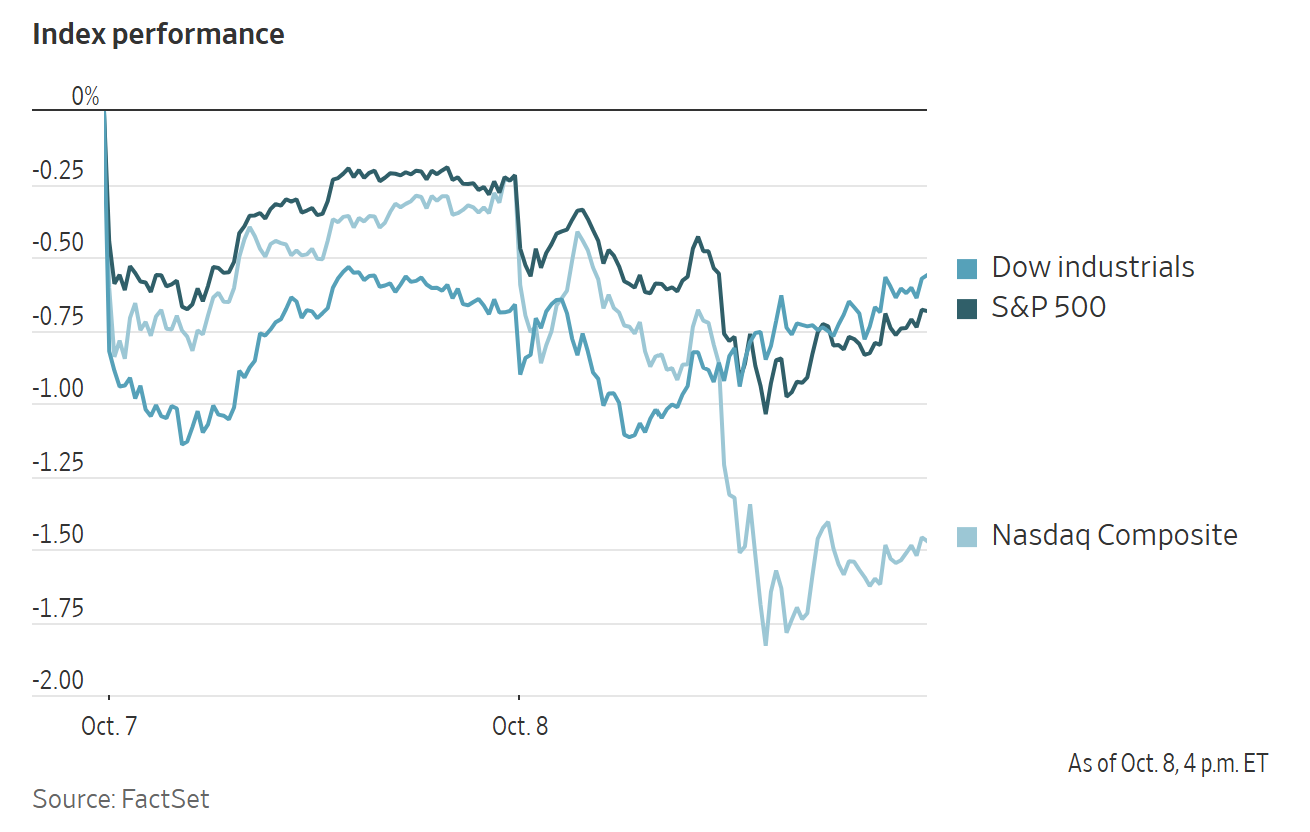
Higher energy prices weighed on the S&P 500, which declined for a second consecutive session.
The Nasdaq Composite led the losses, falling -1.25%.
The S&P 500 declined -0.47%, while the Dow industrials edged up +0.10%.
Chipmakers Nvidia, Broadcom, Intel and Micron fell more than two percent after the Financial Times reported that OpenAI had told investors its annualised revenue was approaching $50 billion at the end of September, $20 billion below the widely reported $70 billion figure.
A person familiar with the matter said the discrepancy reflected efforts by OpenAI investors to compare its annualised revenue directly with Anthropic’s. The companies calculate the metric differently. Anthropic includes sales through cloud partners such as Amazon’s AWS and Google Cloud, while OpenAI does not.
In corporate news, Chipotle shares jumped +6.21% on Thursday after the Financial Times reported that Starbucks had explored a potential takeover of Chipotle. Starbucks said it remained ‘laser-focussed’ on executing its Back to Starbucks strategy. A tie-up would rank among the largest restaurant deals on record and would task Starbucks CEO Brian Niccol, Chipotle’s former chief, with reviving two of the country’s best-known chains simultaneously.
CME Group said Thursday that it plans to launch futures contracts linked to CME FutureSports performance indices. The indices will initially track statistics for the 30 professional baseball teams, beginning with the Major League Baseball postseason and the four teams remaining in the playoffs next week. Subject to regulatory review, the contracts will launch Monday and trade around the clock. The initiative follows a similar move by CME and FutureSports involving National Hockey League indices announced in August.
SpaceX acquired low-band spectrum to expand Starlink into a “major mobile carrier” in the US. The spectrum, supported by most current mobile devices, would allow signals to penetrate walls and reach users indoors. Subject to Federal Communications Commission approval, SpaceX plans to combine its satellite-to-cell service with a terrestrial network to provide broader connectivity. SpaceX acquired the 800 MHz-band licences from investment firm Grain Management after Grain completed a spectrum swap with T-Mobile in August. Neither company disclosed the transaction price.
The Trump administration accused Microsoft, Adobe and several other companies of abusing a US worker visa programme and indefinitely suspended them from a longstanding immigration initiative that has been a key talent pipeline for Silicon Valley and Wall Street.
European Stock Indices
CAC 40 -0.51%
DAX -1.18%
FTSE 100 -0.16%
Commodities
Gold spot +0.61% to $4,133.93 an ounce
Silver spot -1.70% to $59.10 an ounce
West Texas Intermediate +2.52% to $91.18 a barrel
Brent crude +2.94% to $103.92 a barrel
Gold strengthened on Thursday as a softer US dollar and lower Treasury yields increased bullion’s appeal.
Spot gold rose +0.61% to $4,133.93 per ounce after touching a two-month low on Wednesday.
Spot silver fell -1.70% to $59.10 per ounce.
Oil prices settled higher on Thursday as concerns over the ongoing war in the Middle East resurfaced and an approaching hurricane threatened supply disruptions along the US Gulf Coast.
Brent crude futures settled $2.97, or +2.94%, at $103.92 per barrel, while WTI crude gained $2.24, or +2.52%, to $91.18 per barrel. Both contracts rose by more than $5 per barrel at one point, with Brent reaching its highest level since 29 September amid concerns over potential US strikes on Iran and Hurricane Isaias expected landfall on Friday.
Prices retreated from their highs after the US President said Washington was holding productive discussions with Iran and pledged not to attack the country before the US midterm elections on 3 November.
Iran’s Tasnim news agency reported that Foreign Minister Abbas Araqchi said Tehran was reviewing the US response to its proposal to reopen the Strait of Hormuz within seven days and would reply within days.
However, the US Treasury imposed fresh sanctions on Iran on Thursday, targeting individuals, networks and 17 vessels involved in transporting Iranian crude, oil products and petrochemicals. The Treasury Department said the measures were intended to increase economic pressure on Tehran.
France and Saudi Arabia are assessing several options involving French military assets to help protect the Yanbu oil terminal, French Armed Forces Chief of Staff General Fabien Mandon said on Thursday.
Syria was also considering military support for its key ally Saudi Arabia in its conflict with the Iran-backed Houthis in Yemen, according to a US official and a Syrian military official briefed on the matter. The options under review include defensive assistance and the deployment of forces in an offensive role to support Saudi-backed Yemeni troops.
Hurricane Isaias moved toward US offshore production areas, prompting companies to shut platforms. With maximum sustained winds of 85 mph, the hurricane is expected to make landfall on Friday night near the Alabama-Mississippi border. The BSEE said operators had reported 1,282,879 bpd of shut-in Gulf of America production as of 11:00 CDT on Thursday. Although the storm’s expected path has shifted away from the heart of the Gulf Coast refining region, some capacity remains at risk of disruption.
On Wednesday, Shell and Chevron said they were curtailing Gulf offshore operations, while BP said it had removed all personnel and halted production at its Na Kika and Thunder Horse platforms.
Ukrainian drones struck Russia’s largest refinery in Omsk on Thursday, which has capacity exceeding 440,000 bpd, as well as a 200,000 bpd refinery in Salavat.
Note: As of 4 pm EDT 8 October 2026
Currencies
EUR +0.13% to $1.1210
GBP +0.13% to $1.3228
Bitcoin -1.84% to $81,624.48
Ethereum -3.47% to $2,477.24
The euro was on track for a fifth consecutive weekly decline on Thursday, although the selloff appeared to be losing momentum as France’s debt market stabilised and lower US yields reduced support for the dollar’s rally.
The common currency had fallen to a 17-month low of $1.1161 on Monday, but subsequently recovered to $1.1210 after gaining +0.13% on Thursday.
The euro-sterling cross fell -0.04% on the day to trade near a 16-month low of 84.74 pence.
The British pound also advanced +0.13% on the day against the greenback to $1.3228.
The yen appreciated +0.15% against the US dollar to ¥157.80.
Fixed Income
US 10-year Treasury -6.0 basis points to 5.235%
German 10-year Bund +1.8 basis points to 3.507%
UK 10-year Gilt +2.7 basis points to 5.481%
US Treasuries advanced on Thursday, with yields declining across the curve for only the second time this week. A 30-year bond auction drew solid demand, indicating that investors remain willing to purchase long-dated government debt despite the broader market selloff.
In afternoon trading, the 10-year yield fell -6.0 bps to 5.235% after reaching a 24-year high on Wednesday. The 30-year yield also declined, falling -6.4 bps to 5.609%.
At the front end of the curve, the US 2-year yield, which reflects interest-rate expectations, edged down -0.8 bps to 4.760%.
The $22 billion auction of 30-year government bonds cleared at a yield of 5.618%, below the expected rate at the bidding deadline, indicating that investors accepted the bonds without demanding additional compensation.
The bid-to-cover ratio stood at 2.54x, above the 2.41x average over the previous six auctions. Indirect bidders, including foreign investors, purchased 72.3% of the supply, compared with an average of 69.1% over the same period.
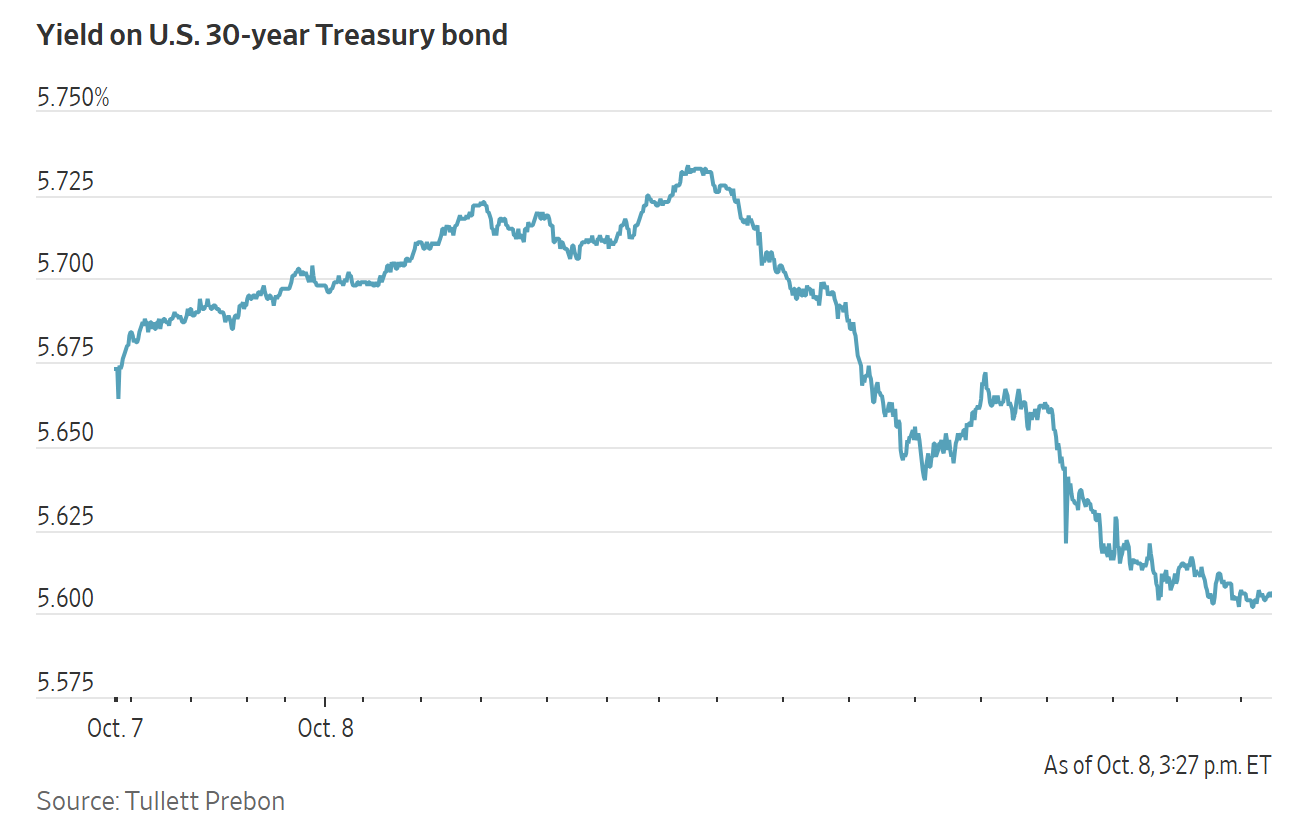
The yield curve flattened on Thursday, with the 2s10s spread narrowing to 47.5 bps from 52.7 bps. Earlier in the session, the spread reached 54.2 bps, its widest level since mid-August.
According to CME Group's FedWatch Tool, traders assigned a 82.8% probability to the Fed leaving rates unchanged at its 27 - 28 October meeting and also a 82.8% probability to a rate increase in December.
Eurozone borrowing costs diverged across markets on Thursday.
France’s 10-year OAT yield fell -0.7 bps to 4.885% after rising as much as 9.0 bps earlier in the session. Italy’s 10-year yield declined -2.2 bps to 4.609%, leaving the spread over Bunds at 110.2 bps.
The spread between French and German 10-year yields contracted 2.5 bps to 137.8 bps, while the 10-year Bund yield rose +1.8 bps to 3.507%.
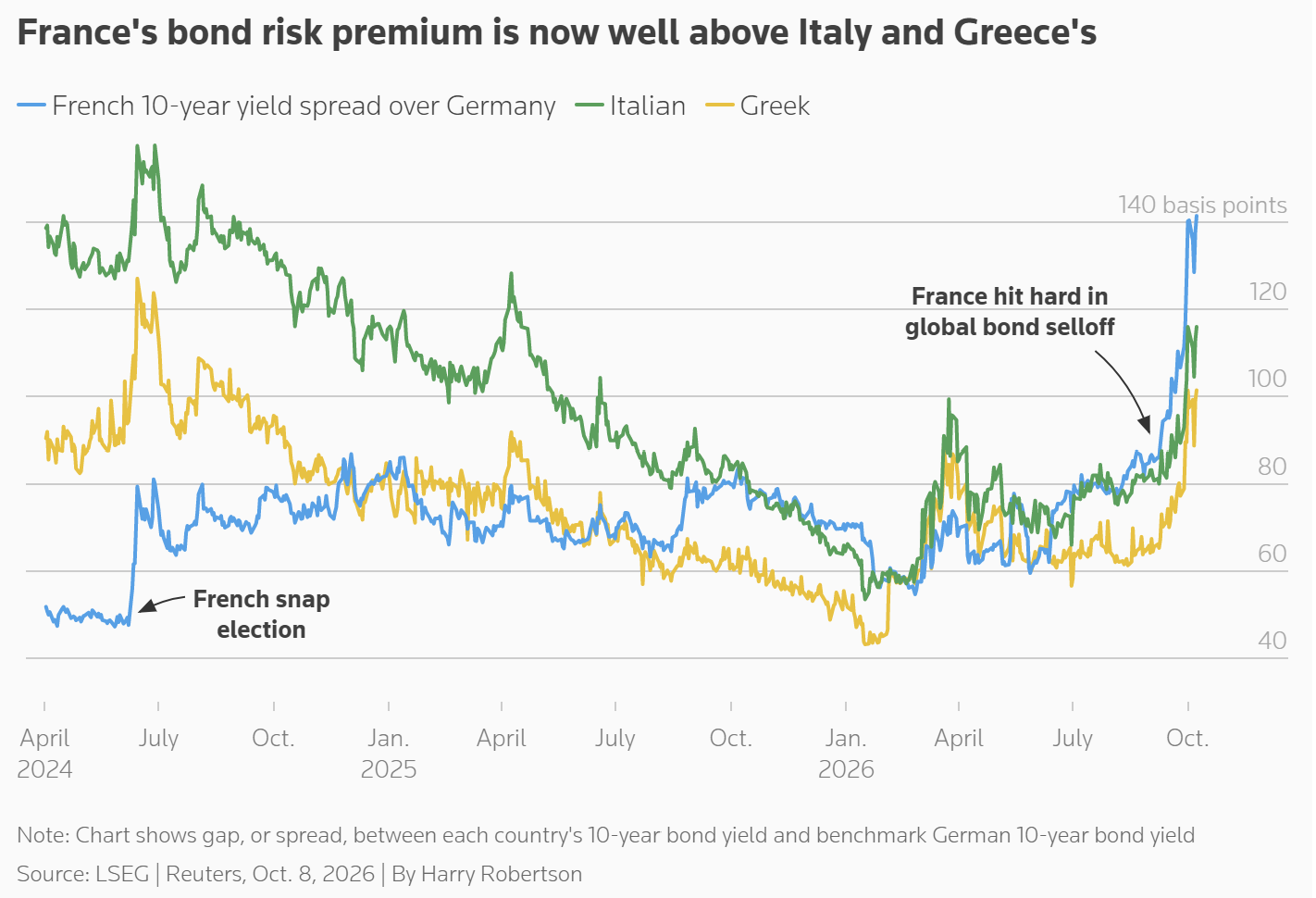
German debt benefited from its safe-haven status during the week’s market turbulence.
German yields fell last week as borrowing costs in other eurozone markets increased. Although German yields have risen this week, the increase has been smaller than in many neighbouring markets.
Shorter-dated yields, which are sensitive to ECB rate expectations, also rose. Germany’s 2-year Schatz yield increased +6.0 bps to 3.100%, while the 30-year yield advanced +0.7 bps at the long end.
Note: As of 4 pm EDT 8 October 2026
While every effort has been made to verify the accuracy of this information, EXT Ltd. (hereafter known as “EXANTE”) cannot accept any responsibility or liability for reliance by any person on this publication or any of the information, opinions, or conclusions contained in this publication. The findings and views expressed in this publication do not necessarily reflect the views of EXANTE. Any action taken upon the information contained in this publication is strictly at your own risk. EXANTE will not be liable for any loss or damage in connection with this publication.
Tento článek je poskytován pouze pro informační účely a neměl by být považován za nabídku nebo výzvu k nákupu nebo prodeji jakýchkoli investic nebo souvisejících služeb, jejichž odkazy se v něm můžou vyskytovat. Obchodování s finančními nástroji je spojeno se značným rizikem ztráty a nemusí být vhodné pro všechny investory. Dřívější produktivita není spolehlivým ukazatelem budoucí produktivity.
 Zpět na všechny přehledy



Přihlásit se k odběru přehledů trhu
Přihlásit se k odběru
přehledů
trhu
Předplaťte si nyní Předplaťte si nyní


Založeno profesionály. Pro profesionály.
