

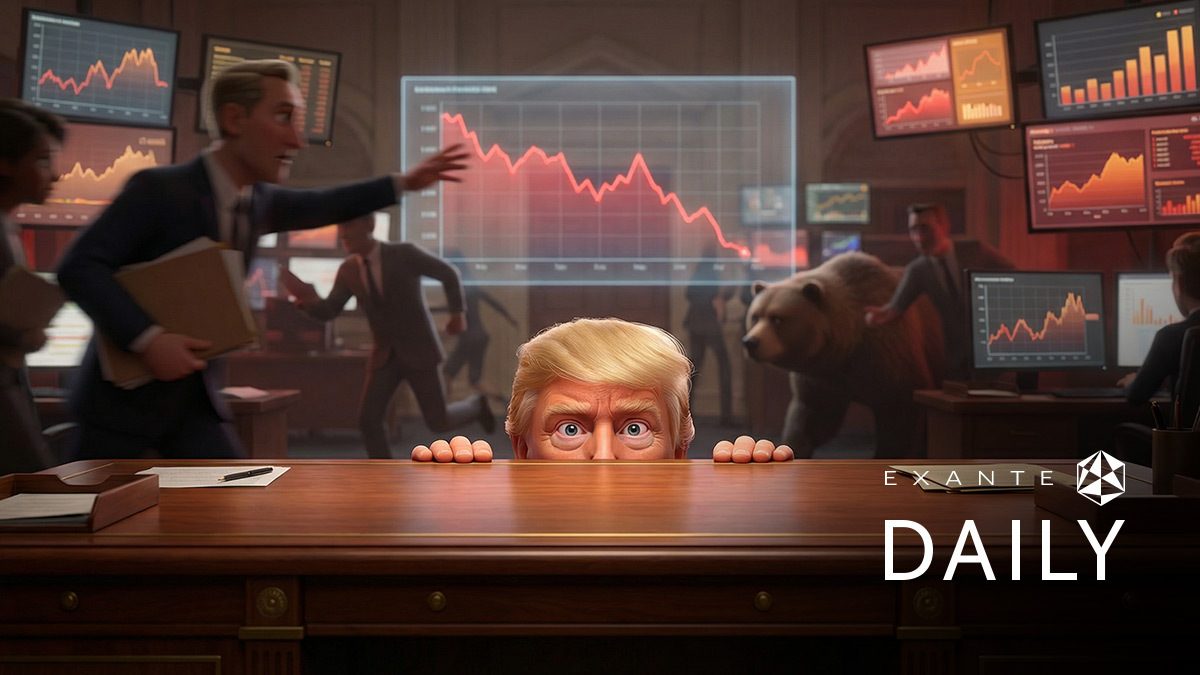
Is it an April fool’s joke?


 S&P 500 +2.91% to 6,528.52 US 10-year yield -3.8 basis points to 4.318%Spot gold +4.20% to $4,699.60 an ounceDXY -0.62% to 99.87
Key data to move markets today
EU: Spanish, Italian German and Eurozone Manufacturing PMIs, Eurozone Unemployment Rate and a speech by ECB Executive Board Member Piero Cipollone
US: ADP Employment Change, Retail Sales, Retail Sales Control Group, ISM Manufacturing PMI, ISM Manufacturing Employment Index, ISM Manufacturing New Orders Index, ISM Manufacturing Prices Paid and speeches by St Louis Fed President Alberto Musalem and Fed Governor Michael Barr
Global Macro Updates
Momentum and growth lead as Iran tensions appear to ease. Market sentiment shifted toward risk-on, with momentum and growth factors emerging as notable outperformers. Optimism surrounding a possible resolution to the Iran conflict served as a primary catalyst for this move. On Tuesday, President Trump appeared to corroborate an overnight report from The Wall Street Journal via Truth Social, indicating his willingness to end the military campaign against Iran, even if the Strait of Hormuz remains largely closed. In subsequent comments to the New York Post, he stated that the US would not remain engaged in Iran for much longer and expressed confidence that the Strait of Hormuz would ‘automatically open,’ though he also suggested that countries reliant on the Strait should take responsibility for ensuring its accessibility. He further noted that those controlling oil supplies ‘will be very happy’.
Despite recent progress toward de-escalation, the geopolitical environment is expected to remain complex and volatile. On Tuesday, the IRGC issued a warning that US companies operating in the region could be targeted in retaliation for actions taken by the US and Israel. Favourable positioning and sentiment dynamics, coupled with substantial month- and quarter-end buying activity, have also been cited as supportive factors for at least a tactical market rebound. The recent stabilisation in interest rates is also a bright spot.
Additionally, a significant week for M&A activity contributes to the resilient corporate narrative, which has gained momentum ahead of the upcoming Q1 earnings season. According to FactSet, analysts anticipate S&P 500 earnings growth of 13.0% for Q1, marking the sixth consecutive quarter of double-digit earnings expansion.
US consumer confidence unexpectedly rises as jobs decline. Consumer confidence rose in March, but households remained worried about the labour market, inflation and interest rates. On Tuesday, the Conference Board said its Consumer Confidence index edged up by 0.8 points in March to 91.8 (from 91.0 in February). The present situation index — based on consumers’ assessment of current business and labour market conditions — increased by 4.6 points to 123.3. The expectations index — based on consumers’ short-term outlook for income, business and labour market conditions — declined by 1.7 points to 70.9. The labour-market differential, which reflects the net difference between survey respondents who believe jobs are "plentiful" and those who believe jobs are "hard to get", ticked up by 0.1 percentage point to 5.8%. Worries over higher inflation over the next 12 months as gasoline prices surge and tariff passthrough continues were at the highest level since last August. In addition, the percentage of consumers stating that interest rates over the next 12 months will be higher on net skyrocketed from 34.9% to 42.4%.
Meanwhile, JOLTS data from the US Bureau of Labor Statistics indicated that US job openings fell in February and hiring slowed to its weakest level since April 2020. The February JOLTS job openings came in at 6,88 million vs a consensus 6,92 million, while January's figure was revised higher to 7.24 million. The pullback in openings was driven by declines in accommodation and food services, mining and logging. The drop in openings means that there was already cooling demand for workers before the war in Iran started. The surge in oil prices in March, which risks pushing up operating costs for companies, has threatened further slowdowns in hiring. The so-called quits rate, which measures the percentage of people voluntarily leaving their jobs each month, dropped to 1.9%, the lowest level since 2020. This suggests people are less confident in their ability to find a new position.
US Stock Indices
Dow Jones Industrial Average +2.49%
Nasdaq 100 +3.43%
S&P 500 +2.91%, with 9 of the 11 sectors of the S&P 500 up
Equity markets rallied on Tuesday, lifted by speculation about a potential de-escalation in the Middle East war. US President Donald Trump told aides he was willing to end the military campaign against Iran, even if the Strait of Hormuz remained largely closed. Defence Secretary Pete Hegseth said the next few days in the Iran war would be decisive and warned Tehran that the conflict would intensify if it did not make a deal. However, later on Tuesday, President Trump said a deal with Iran was not necessary for the US to end its campaign in the Middle East.
The S&P 500 ended the day +2.91% or 184.80 points, its biggest one-day gain since May last year. The Nasdaq Composite was +3.83% or 795.99 points and the Dow Jones Industrial Average rose +2.49%, gaining 1,125.37 points.
In corporate news, Nvidia is taking a $2 billion stake in Marvell Technology and is opening up its system to allow Marvell to integrate custom AI chips and networking equipment on the platform.
Unilever announced that it will merge its food business with spice maker McCormick, creating a company worth around $65 billion in the second-largest food transaction in history. Unilever is to receive $15.7 billion in cash from the deal while Unilever shareholders will retain 65% stake in the merged entity, equivalent to $29.1 billion.
CoreWeave announced that it raised $8.5 billion to help finance an expansion of its cloud computing capacity.
Eli Lilly & Co.. agreed to buy sleep drugmaker Centessa Pharmaceuticals in a deal worth up to $7.8 billion.
S&P 500 Best performing sector
Communication Services +4.42%, with Meta Platforms +6.67%, Alphabet +5.02% and Netflix +3.42%
S&P 500 Worst performing sector
Energy -1.12%, with EOG Resources -3.55%, APA -2.97% and ONEAK -2.76%
Mega Caps
Alphabet +5.02%, Amazon +3.64%, Apple +2.90%, Meta Platforms +6.67%, Microsoft +3.12%, Nvidia +5.59% and Tesla +4.64%
Information Technology
Best performer: ON Semiconductor +11.25%
Worst performer: EPAM Systems -0.57%
Materials and Mining
Best performer: Freeport McMoRan +7.56%
Worst performer: CF Industries -5.64%
European Stock Indices
CAC 40 +0.57%
DAX +0.52%
FTSE 100 +0.48%
Commodities
Gold spot +4.20% to $4,699.60 an ounce
Silver spot +7.19% to $75.11 an ounce
West Texas Intermediate -3.84% to $101.56 a barrel
Brent crude +3.31% to $118.31 a barrel
Gold surged by more than four percent on Tuesday, yet it experienced its sharpest monthly decline since October 2008.
Spot gold advanced +4.20% to $4,699.60 per ounce, marking its highest value since 20 March. In March, spot gold declined by -11.27%.
Spot silver increased by +7.19% to $75.11; however, it fell -20.43% over the month.
Oil prices edged higher in early Wednesday trading, with Brent front-month futures extending a record March rally as heightened volatility in the Middle East kept markets unsettled.
Early market sentiment on Tuesday was influenced by reports of a fully loaded crude tanker being hit near Dubai and news that President Trump had indicated a willingness to end the military campaign against Iran, even if the Strait of Hormuz remains largely closed. Crude benchmarks turned negative later in the session following comments from Iranian President Pezeshkian, who expressed readiness to end hostilities if sufficient guarantees were provided. Iranian Foreign Minister Araghchi emphasised that Iran sought a complete end to the war rather than a temporary ceasefire. However, Iran reiterated warnings that the UAE's Fujairah port and the Hormuz oil pipeline could be targeted if hostilities toward Iran persist. The IRGC specified that it would begin targeting US companies in the region, including major firms such as Microsoft, Apple and Intel, from 1 April onward.
The front-month Brent contract for June delivery rose by $3.79, or +3.31%, to $118.31 per barrel. According to LSEG data, Brent futures achieved a record monthly increase of +61.60% in March.
Conversely, US WTI crude futures declined by $4.06, or -3.84%, to $101.56 per barrel, despite posting a +50.93% gain for March.
Russian crude exports declined following attacks on export terminals. Oil flows from Russia for the week ending 29 March fell by 1.75 million barrels per day (bpd) w/o/w to 2.32 million bpd. The four-week average saw a more moderate decrease, with exports down by 280,000 bpd to 3.31 million bpd, marking a two-month low.
Ukrainian drone strikes targeted Russia’s oil export terminal at Ust-Luga for the fifth time in ten days, with reports indicating that Transneft facilities were also attacked on Tuesday.
Note: As of 4 pm EDT 31 March 2026
Currencies
EUR +0.82% to $1.1555
GBP +0.31% to $1.3221
Bitcoin +2.18% to $68,219.56
Ethereum +3.22% to $2,100.87
On Tuesday, the dollar fell amid optimism that the US-Israel-led conflict with Iran may be heading towards a resolution. Nevertheless, the currency remained poised to deliver its strongest quarterly performance since Q3 2024.
The dollar index declined -0.62% to 99.87. However, it still saw a monthly increase of +2.27% in March, its highest since July, and posted a +1.62% return for Q1.
Since the onset of the conflict on 28 February, the US dollar has benefitted from its safe-haven status. Furthermore, as a net energy exporter, the US is better positioned to manage disruptions in oil supply relative to other countries.
Investor activity on Tuesday was likely influenced by portfolio adjustments associated with the end of the month and quarter.
The primary focus for US economic data this week is Friday’s employment report for March, which is anticipated to reveal a net gain of 60,000 jobs, following an unexpected reduction of 92,000 positions in February.
The euro appreciated +0.82% to $1.1555, though it registered a -2.21% decline in March, the steepest since July, and a quarterly loss of -1.62%, its worst since Q3 of 2024.
The British pound strengthened by +0.31% to $1.3221. Nonetheless, it sustained a monthly loss of -1.96%, its largest since October, and a -1.87% decline for Q1.
The Japanese yen advanced by +0.67% against the dollar, reaching ¥158.68 per dollar. The yen rebounded for a second consecutive day following increased intervention threats by Japanese officials seeking to counter recent currency weakness. On Tuesday, Finance Minister Satsuki Katayama reaffirmed Tokyo's preparedness to take comprehensive action against volatile market movements.
Katayama characterised the latest yen depreciation as speculative for the first time since the outbreak of the Middle East conflict, thereby refocusing attention on currency short-sellers as policymakers prepared for a potential triple market selloff prompted by renewed inflation concerns.
The dollar was +1.68% for the month against the yen and +1.30% for Q1 against the yen.
Fixed Income
US 10-year Bond -3.8 basis points to 4.318%
German 10-year Bund -2.9 basis points to 3.006%
UK 10-year gilt -2.2 basis points to 4.856%
US Treasuries ended Q1 on a positive note, slightly recovering after experiencing substantial selling pressure throughout the month.
Bond market participants redirected their attention toward the likelihood of subdued economic growth, rather than persistent inflation, should the conflict in Iran persist. As a result, investors began to factor in the possibility of interest rate reductions.
During afternoon trading, the yield on the 10-year Treasury note decreased -3.8 bps to 4.318%, marking its second consecutive session of decline. Nevertheless, in March, 10-year yields rose +36.6 bps, representing the largest monthly increase since December 2024.
At the shorter end of the yield curve, the two-year Treasury yield, which closely reflects prevailing interest rate expectations, fell -3.9 bps to 3.805%. Despite this decline, two-year yields climbed +41.8 bps over the month, marking their most significant monthly increase since October 2024.
The 30-year Treasury yield edged down -0.3 bps to 4.914%. However, on a monthly basis, the yield advanced +29.6 bps, its largest increase since December 2024.
The yield curve remained largely stable on Tuesday compared to late Monday, with the spread between two-year and 10-year yields widening by 0.1 bps to 51.3 bps, up from 51.2 bps at the previous close. This marks the widest spread since 17 March.
According to CME Group's FedWatch Tool, Fed funds futures traders are pricing in 8.5 bps of rate cuts in 2026, in contrast with the 9.1 bps of rate hikes priced in a week ago. Fed funds futures traders are now pricing in a 1.6% probability of a 25 bps rate hike at the 29 April FOMC meeting, compared to last week’s 8.3% probability.
Eurozone government bond yields fell for a second consecutive session on Tuesday.
This decline followed Monday’s retreat from multi-year highs, as investors shifted their focus toward the risk of slower economic growth resulting from ongoing energy shocks.
Germany’s 10-year yield fell -2.9 bps to 3.006%. Over March, the yield climbed +35.0 bps, marking the largest monthly gain since late 2022. Notably, it reached its highest level since 2011 at 3.130% last Friday.
The yield on Germany’s two-year Schatz, closely linked to ECB interest rate expectations, edged up +0.1 bps to 2.623%. It rose +60.7 bps in March, its largest monthly increase since mid-2022. On the long end of the curve, the 30-year yield declined -4.6 bps on Tuesday but recorded a +13.6 bps rise for the month.
Italian 10-year BTP yields declined -7.1 bps on Tuesday, but recorded a rise of +56.2 bps in March. The spread over Bunds stood at 90.6 bps on Tuesday, after widening by 21.2 bps throughout March.
On Tuesday, traders priced in 69.2 bps of ECB rate hikes for the year and implied a 50.0% probability that interest rates would remain at 2.00% at the upcoming ECB meeting scheduled for 29 April.
Note: As of 4 pm EDT 31 March 2026
DISCLAIMER: This article is provided to you for informational purposes only and should not be regarded as an offer or solicitation of an offer to buy or sell any investments or related services that may be referenced here. Trading financial instruments involves significant risk of loss and may not be suitable for all investors. Past performance is not a reliable indicator of future performance.
While every effort has been made to verify the accuracy of this information, EXT Ltd. (hereafter known as “EXANTE”) cannot accept any responsibility or liability for reliance by any person on this publication or any of the information, opinions, or conclusions contained in this publication. The findings and views expressed in this publication do not necessarily reflect the views of EXANTE. Any action taken upon the information contained in this publication is strictly at your own risk. EXANTE will not be liable for any loss or damage in connection with this publication.
本文提供给您仅供信息参考之用,不应被视为认购或销售此处提及任何投资或相关服务的优惠招揽或游说。金融工具交易存在重大亏损风险,未必适合所有投资者。过往表现并非未来业绩的可靠指标。






由专业人士创建。 为专业人士。
