

Will the BoE continue to cut?


 S&P 500 -1.07% to 6,827.41 US 10-year yield +4.8 basis points to 4.190%Spot gold +0.42% to $4,299.10 an ounceDXY +0.1% to 98.44
Key data to move markets today
EU: Eurozone Industrial Production
USA: NY State Empire Manufacturing Index and speeches by Fed Governor Stephen Miran and New York Fed President John Williams
CHINA: Industrial Production and Retail Sales
US Stock Indices
Dow Jones Industrial Average -0.51%
Nasdaq 100 -1.91%
S&P 500 -1.07%, with 5 of the 11 sectors of the S&P 500 up
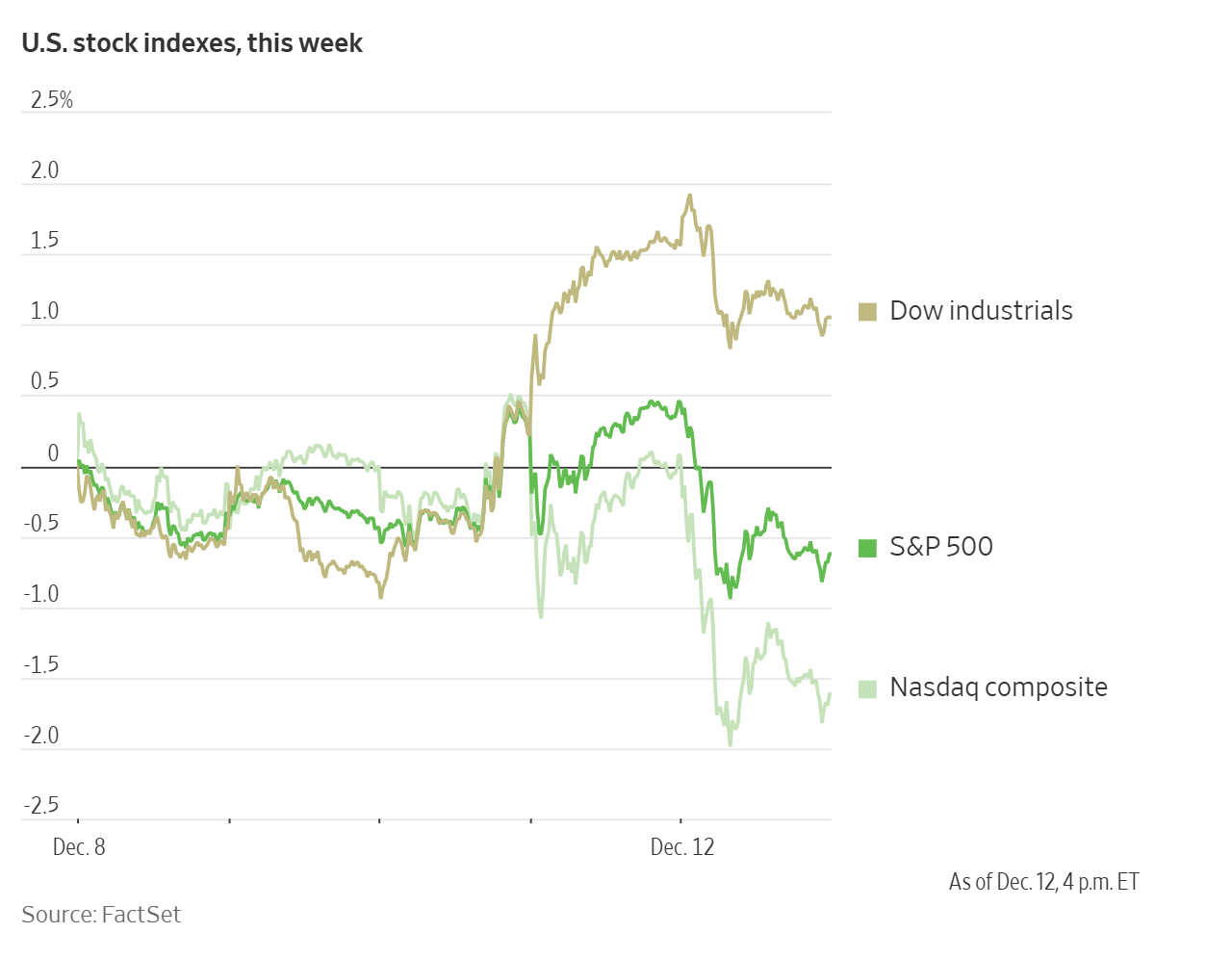
Renewed concerns about the artificial-intelligence boom continued to weigh on technology stocks on Friday with Broadcom’s earnings reigniting fears about high valuations as investors raised questions about its sales forecasts, contract backlog and anticipated future margins. Broadcom shares fell -11.4%, with the company losing about $220 bn from its market value.
The tech-heavy Nasdaq Composite ended the day down 398.69 points, or -1.69%, to 23,195.17. The S&P 500 was down 73.59 points, or -1.07% to 6,827.41 and the Dow Jones Industrial Average was down 245.96 points, or -0.51%, to 48.458.05.
In corporate news, yoga-wear maker Lululemon Athletica shares rallied after it raised its full-year outlook and announced that its chief executive officer would step down after a period of sluggish growth.
According to LSEG I/B/E/S data, Q3 2025 y/o/y earnings are expected to be 15.0%. Excluding the Energy sector, the y/o/y earnings estimate is 15.8%. Of the 498 companies in the S&P 500 that have reported earnings to date for Q3 2025, 83.3% reported above analyst expectations. This compares to a long-term average of 67%. The Q3 2025 y/o/y blended revenue growth estimate is 8.3%. If the Energy sector is excluded, the growth rate for the index is 8.9%.
For Q4 2025, there have been 52 negative EPS preannouncements issued by S&P 500 corporations compared to 47 positive EPS preannouncements. The forward four-quarter (Q4 2025– Q3 202) P/E ratio for the S&P 500 is 22.7.
During the week of 15 December, no S&P 500 companies are expected to report quarterly earnings.
S&P 500 Best performing sector
Consumer staples +0.93%, with Monster Beverage +2.04%, Coca Cola +2.04%, and Philip Morris International +1.79 %
S&P 500 Worst performing sector
Information Technology -2.87%, with Sandisk -14.6%, Broadcom -11.43%, and Corning -7.97%
Mega Caps
Alphabet -1.01%, Amazon -1.78%, Apple +0.09 %, Meta Platforms -1.30%, Microsoft -1.02%, Nvidia -3.27%, and Tesla +2.70%
Information Technology
Best performer: Adobe +1.71%
Worst performer: Sandisk -14.66%
Materials and Mining
Best performer: Mosaic +4.05%
Worst performer: Dow -2.48%
European Stock Indices
CAC 40 -0.21%
DAX -0.45%
FTSE 100 -0.56%
Commodities
Gold spot +0.42% to $4,299.10 an ounce
Silver spot -3.05% to $61.85 an ounce
West Texas Intermediate -0.28% to $57.44 a barrel
Brent crude -0.26% to $61.12 a barrel
Gold rose to a seven-week peak on Friday with spot gold +0.42% to $4,299.10 an ounce.
Spot silver fell on Friday due to profit-taking after hitting an all-time high earlier in the session of $64.64. Spot silver ended the trading session -3.05% to $61.85 per ounce. Silver prices were up nearly 5% for the week. They have gained 112% this year due to tightening inventories, sustained industrial demand and its inclusion on the US critical minerals list.
Oil prices fell on Friday in choppy trading, with US WTI falling to its lowest since May, due to a bearish sentiment about oversupply. Brent slumped to the weakest in about two months. Brent crude futures were down 16 cents, or -0.26%, to $61.12 per barrel. US WTI crude also settled down 16 cents, or -0.28% to $57.44 per barrel, Both benchmarks lost about 4% last week due to concerns over a supply glut and a potential Russia-Ukraine peace deal despite the US seizing a sanctioned oil tanker off the coast of Venezuela.
International Energy Agency forecasts released Thursday indicated that global oil supply will exceed demand by 3.84 million barrels per day next year. In contrast, OPEC’s monthly report, also issued on Thursday, indicated that world oil supply will match demand closely in 2026. According to Friday’s report from energy services firm Baker Hughes, US energy firms cut the number of oil and natural gas rigs operating for a second time in three weeks. The oil and gas rig count, an early indicator of future output, fell by one to 548 in the week to 12 December.
Baker Hughes said this week's decline puts the total rig count down 41 rigs, or 6.9% below this time last year. Baker Hughes said oil rigs rose by one to 414 this week, their highest since 21 November, while gas rigs fell by two to 127.
The oil and gas rig count declined by about 5% in 2024 and 20% in 2023 as lower US oil and gas prices prompted energy firms to focus more on boosting shareholder returns and paying down debt rather than increasing output.
Note: As of 4 pm EST 12 December 2025
Currencies
EUR -0.01%to $1.1744
GBP –0.16% to $1.3372
Bitcoin -2.9% to $90,213,64
Ethereum -5.2% to $3,082.14
On Friday, the US dollar rose against major currencies, with the dollar index +0.1% to 98.44. Nevertheless, it was -6% for the week, marking its third consecutive weekly drop. This was due to market expectations of Federal Reserve rate cuts next year.
The euro was very slightly down, -0.01%, to $1.1744 after hitting a more than two-month high on Thursday.
The British pound fell -0.16% to $1.3372 after data showed GDP contracted by 0.1% in the August-to-October period, the fourth month of no growth. This lack of growth may strengthen the case for the BoE to cut rates at its meeting this week.
The US dollar was +0.24% against the Japanese yen to ¥155.83 per dollar, ahead of the BoJ’s meeting later this week where it is expected to enact a rate hike. Markets are likely to remain focussed on comments from policymakers on the rate path development in 2026.
Fixed Income
US 10-year Treasury +4.8 basis points to 4.190%
German 10-year bund +2.1 basis points to 2.864%
UK 10-year gilt +5.1 basis points to 4.518%
The US 10-year Treasury yield rose on Friday after two straight sessions of declines, as investors assessed commentary from Fed speakers.
The yield on the US 10-year Treasury note rose +4.8 bps to 4.190%. It was +5.2 bps over the past seven days, and marked its second straight weekly climb.
The yield on the 30-year bond jumped +6.2 bps to 4.854%. It was +6.3 basis points on the week, its second straight weekly advance.
On the short-end of the curve, the two-year US Treasury yield, which typically moves in line with Fed rate expectations, was +0.11 bps to 3.528% and was down -3.5 bps for the week.
A closely watched part of the Treasury yield curve measuring the gap between two- and 10-year Treasury notes, seen as an indicator of economic expectations, was at a positive 66.2 basis points.
According to CME Group's FedWatch Tool, Fed funds futures traders are now pricing in a 24.4% probability of a 25 bps rate cut at January’s FOMC meeting, down from 24.8% a week ago.
German government bond yields rose Friday after hitting their highest level since March last week. Germany’s 30-year yield, more sensitive to long-term fiscal concerns, climbed to a fresh 14-year high of 3.489%, up +3.7 basis points, as long-dated bonds sold off on fears of rising fiscal spending and heavier issuance after the government pledged massive spending on infrastructure and defence. It was +6.5 bps on the week. The yield on the German 10-year Bunds +2.1 bps to 2.864% on Friday. It was +7.8 bps over the week. On the shorter end of the curve, the German 2-year Schatz -0.2 bps to 2.162%. It was +7.4 bps for the week. The spread between US and German 10 year yields was 132.6 bps.
The Italian I0-year yield increased +2.3 bps to 3.558%, resulting in the spread between BTPs and Bunds edging up +0.2 bps to 69.4 bps.
Money markets have priced out an ECB rate cut in 2026, while assigning around a 25% probability to a tightening move by December 2026.
Note: As of 4 pm EST 12 December 2025
Global Macro Updates
Fed officials say the Fed should have waited until delayed data came through. FOMC policymakers who voted against the Fed’s interest rate cut last week said on Friday they are worried that inflation remains too high to justify lower borrowing costs, particularly given the delay in recent official data about the pace of inflation.
Chicago Fed President Austan Goolsbee said in a statement he opposed the 25 bps rate cut because he felt it was better to wait for more data about inflation and the state of the job market before lowering borrowing costs. In his statement he said, “Given that inflation has been above our target for four and a half years, further progress on it has been stalled for several months, and almost all the businesspeople and consumers we have spoken to in the district lately identify prices as a main concern, I felt the more prudent course would have been to wait for more information.”
Goolsbee, along with Kansas City Fed President Jefffrey Schmid dissented in the FOMC rate cut vote in favour of holding the policy rate steady. "We should have waited to get more data, especially about inflation," said Goolsbee." He added, “Waiting to take this matter up in the new year would not have entailed much additional risk and would have come with the added benefit of updated economic data which have been absent lately.”
In a separate statement Schmid said he dissented because inflation is "too hot" and he feels monetary policy should remain modestly restrictive to keep it in check. He also said he thought the labour market was "largely in balance."
The most recent official data on unemployment and inflation is for September, and showed the unemployment rate rising to 4.4% from 4.3%, while the Fed's preferred measure of inflation also increased slightly to 2.8% from 2.7%. The Bureau of Labor Statistics is expected to issue key employment and inflation reports for November this week that have been delayed by the government shutdown.
Goolsbee and Schmid will rotate out of their voting roles on the rate-setting Federal Open Market Committee next year. One of their incoming replacements on the FOMC, Philadelphia Fed President Anna Paulson, made a more dovish statement on Friday at an event hosted by the Delaware State Chamber of Commerce, saying she was “still a little more concerned about labor market weakness than about upside risks to inflation." She said it was partly because she sees a decent chance of inflation coming down in 2026 as tariff impacts wane.
UK economy contracts again. According to data from the Office for National Statistics (ONS) released Friday, the UK economy performed worse than expected in October 2025, falling 0.1% in October. This decline was the same as in September, meaning the economy has not grown for four months and is likely to show a contraction in Q4. The biggest drag came from the services sector, which slipped 0.3%. The construction sector dropped 0.6% due to a decline in new private house building (down 2.4%). This fall was offset in part by a 1.1% rebound in industrial production.This growth was seen across various industries, including manufacturing (up 0.5%, boosted by a significant 9.5% rise in the motor vehicle and trailer manufacturing) and mining (up 4.3%). Wholesale and retail trade was also down 4.3% and probably reflects concerns prior to November’s budget that Chancellor of the Exchequer, Rachel Reeves, would raise taxes
On a more positive note, according to a Bank of England survey, households’ inflation expectations are slightly down from their highest in two years. Households anticipate prices rising 3.5% over the next 12 months, down from a two-year high of 3.6% in August. Households expect prices to climb 3.7% annually in five years’ time. This is also down 0.1 percentage point from the last time the survey was done.
The GDP figures will play an important role in the BoE’s final meeting of the year on 18 December. Although the economy is cooling and the labour market is weakening, the still elevated inflation expectations means that, once again, the vote is expected to be tight, with Governor Andrew Bailey having the swing vote. The money markets indicate there is a 90% chance that the Bank will cut rates by a quarter of a percentage point to 3.75%.
While every effort has been made to verify the accuracy of this information, EXT Ltd. (hereafter known as “EXANTE”) cannot accept any responsibility or liability for reliance by any person on this publication or any of the information, opinions, or conclusions contained in this publication. The findings and views expressed in this publication do not necessarily reflect the views of EXANTE. Any action taken upon the information contained in this publication is strictly at your own risk. EXANTE will not be liable for any loss or damage in connection with this publication.
本文提供给您仅供信息参考之用,不应被视为认购或销售此处提及任何投资或相关服务的优惠招揽或游说。金融工具交易存在重大亏损风险,未必适合所有投资者。过往表现并非未来业绩的可靠指标。







由专业人士创建。 为专业人士。
