

Did August borrow September’s jobs?


 S&P 500 -0.27% last week to 7,722.72 US 10-year yield +4.1 basis points last week to 5.283% Spot gold -5.36% last week to $4,142.34 an ounce DXY +0.88% last week to 101.92
Key data to move markets today
EU: Eurozone, Spanish, French, German and Italian HCOB Services and Composite PMIs, Eurozone Sentix Investor Confidence and PPI and speeches by ECB’s Chief Economist Philip Lane and Executive Board member Isabel Schnabel
USA: S&P Global Services and Composite PMIs, ISM Services’ PMI, Prices Paid, New Orders and Employment Indices
Global Macro Updates
Payrolls lose momentum, not altitude. September’s payrolls report looked alarming at first glance. Nonfarm employment rose by just 29,000, against consensus expectations of 90,000, while revisions removed another 60,000 jobs from July and August. That lowered the three-month average to 51,000, near estimates of the pace required to stabilise unemployment. September also tends to disappoint when Labor Day falls relatively late, as it did this year, suggesting some of August’s apparent strength was merely borrowed from the following month.
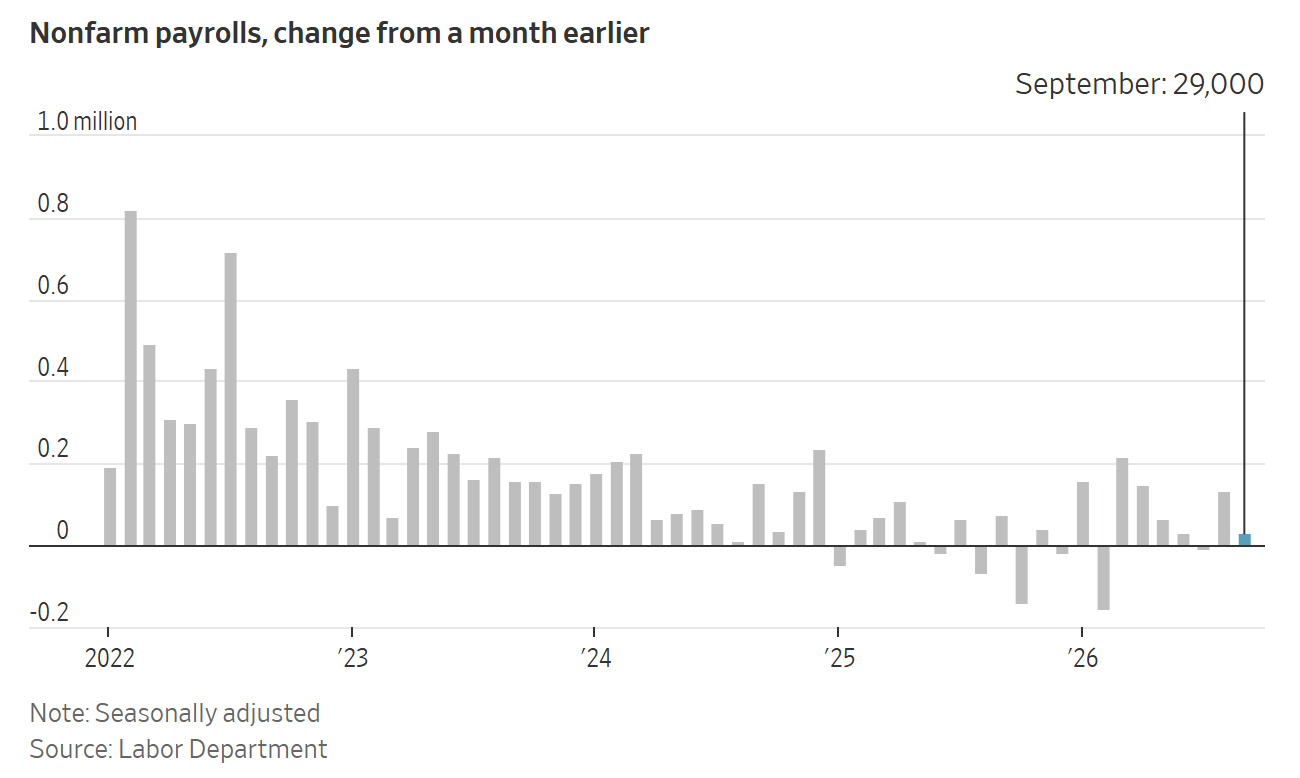
Healthcare remained the principal job growth engine, while construction and manufacturing also added workers. Goldman Sachs linked part of the latter two sectors’ resilience to AI and data-centre investment, a useful reminder that the AI CapEx cycle is supporting parts of the old economy. Therefore, narrow hiring breadth leaves labour demand more vulnerable should investment momentum decelerate.
The unemployment rate edged up to 4.18%, but the deterioration coincided with a 20 bps increase in labour-force participation. Household employment actually rose, making this something short of an unambiguous recession signal. More consequential was the 0.1% monthly increase in average hourly earnings. This might be welcome evidence that wages are not reigniting inflation, but less comforting for consumption if price growth continues to outpace pay.
For markets, this is a ‘bad news is good news’ event, with an asterisk. The report substantially strengthens the case for an October Fed pause and should offer near-term support to Treasuries and rate-sensitive equities. Yet, it does not settle the FOMC December meeting, as implied odds of a 25 bps hike increased following the report. Focus now turns to the CPI release on 14 October.
US Stock Indices
Dow Jones Industrial Average +0.49%
Nasdaq 100 +1.00%
S&P 500 +0.73%, with 10 of the 11 sectors of the S&P 500 up
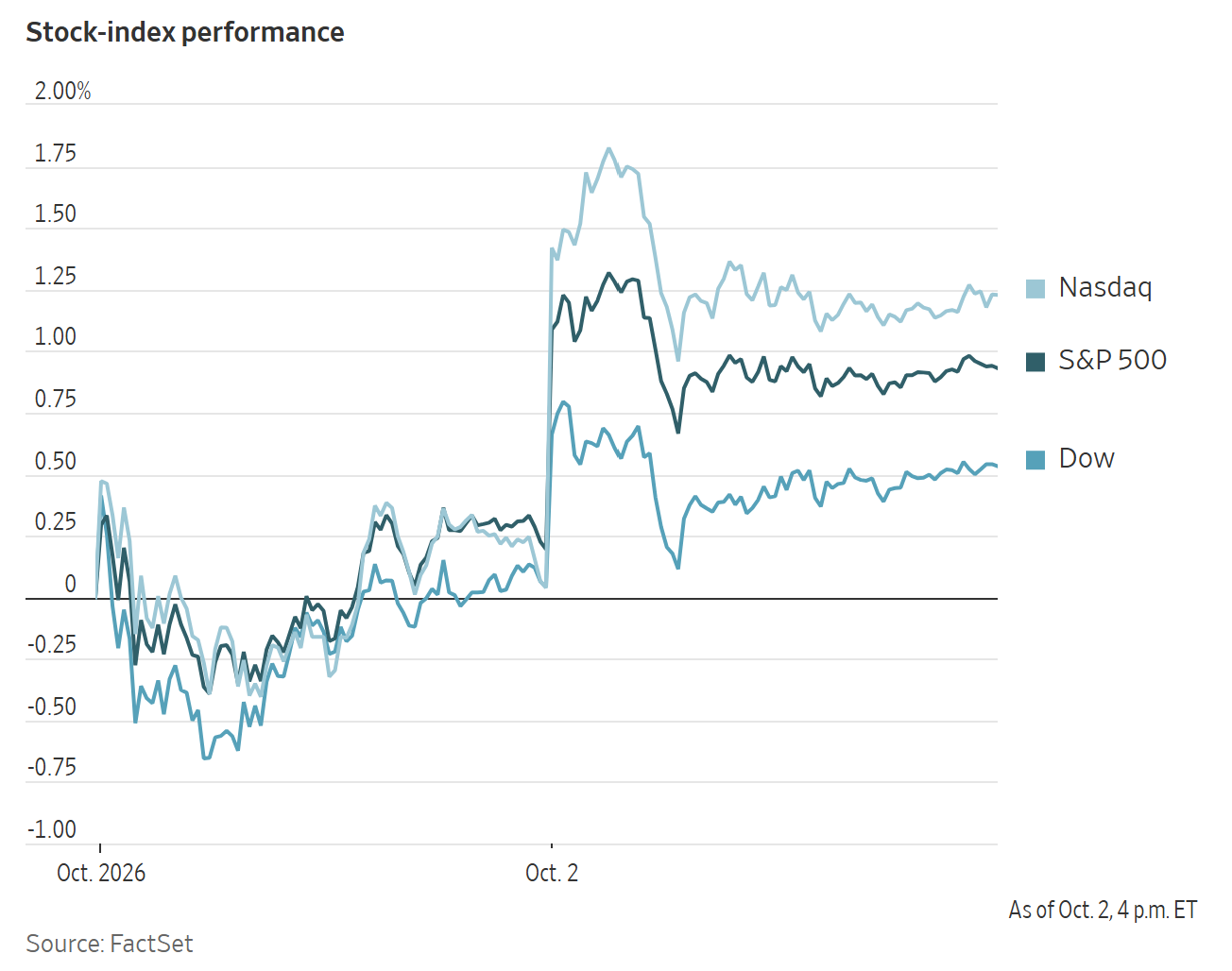
The US added just 29,000 jobs in September, according to Friday’s monthly employment report. The increase was well below economists’ forecasts and the previous month’s total, suggesting the economy was expanding more slowly than widely expected.
US equities rallied in response. Major indices advanced on Friday, bringing the Nasdaq Composite and S&P 500 close to record highs. Investors viewed the weaker labour data as a sign that the Fed could delay further rate hikes.
The Nasdaq Composite rose +1.19%, the S&P 500 gained +0.73% and the Dow Jones Industrial Average advanced +0.49%, or 250.36 points.
Despite Friday’s advance, all three major indices were mixed for the week: the S&P 500 declined -0.27% and the Dow Jones fell -1.26%. However, the Nasdaq Composite climbed +0.45%.
In corporate news, shares of Volvo declined after it withdrew its full-year guidance, citing a weaker Chinese auto market and a slow US recovery that weighed on sales.
Bayer plans to invest $2.2 billion in a new pharmaceutical manufacturing facility in New Albany, Ohio. The German company expects the site to create about 600 jobs, with the first manufacturing module scheduled to open in 2031.
Broadcom’s Wall Street banking syndicate is seeking $60 billion in new AI chip financing for Anthropic and other companies. Bank of America, Citigroup and Morgan Stanley are preparing syndication letters for a $42 billion Class A senior secured tranche. Blackstone is leading an $18 billion Class B junior debt tranche and committing $9 billion through various funds.
A Federal Aviation Administration panel concluded that a software glitch affecting Boeing 737 Max aircraft does not pose a safety risk because pilots retain full control and cockpit alerts are clear. The FAA will consider further action if needed. Boeing will issue guidance to airlines on handling the malfunction. Boeing will also work with carriers on a procedure for pilots to restore the automated navigation system and will follow the FAA’s direction as engineers develop the next software update.
European Stock Indices
CAC 40 +0.79%
DAX +1.17%
FTSE 100 +0.32%
Commodities
Gold spot -0.85% to $4,142.34 an ounce
Silver spot -0.77% to $60.39 an ounce
West Texas Intermediate -1.79% to $91.25 a barrel
Brent crude +0.47% to $102.73 a barrel
Gold prices fell on Friday, reversing earlier gains, weighed down by a stronger dollar.
Spot gold fell -0.85% to $4,142.34 per ounce, bringing its weekly decline to -5.36%.
Spot silver fell -0.77% to $60.39 per ounce, bringing its weekly decline to -8.82%.
Crude oil and refined products ended the week lower. Stalled US - Iran talks, reports of additional US military deployments to the Middle East and continued tanker attacks in the Strait of Hormuz were more than offset by several bearish factors.
These factors included shipping data showing Strait of Hormuz crude exports, led by Saudi Arabia and the UAE, near prewar levels. Crude loadings also resumed at the Red Sea port of Yanbu, East-West pipeline flows climbed to 6.0 million bpd, Libyan output returned to recent peaks and G7 nations announced an additional 50 million barrels of crude stockpile releases on Friday.
On Friday, Brent settled 48 cents higher, or +0.47%, at $102.73 per barrel. WTI finished $1.66 lower, or -1.79%, at $91.25 per barrel.
For the week, Brent fell -1.61%, while WTI declined -1.29%.
EU governments acted after discussing a French proposal for European countries to release 50 million barrels of diesel and for International Energy Agency members to release 50 million barrels of crude oil. Under the proposal, Europe would release part of the diesel volumes over a 20-day period, two of the sources said.
The development underscores that the energy market’s primary strain has shifted from crude availability, as Middle East flows recover, to refined product supply, which remains constrained by reduced refinery capacity and output across the Middle East and Russia.
Prices also drew support from reports that the US was sending a third aircraft carrier and up to 10,000 additional troops to the Middle East as the US President considered resuming strikes on Iran after the midterm elections.
Refined products, particularly diesel, were a key focus for energy markets last week. By threatening a US diesel export ban, the US president persuaded G7 nations to release up to 50 million barrels of diesel from stockpiles over the next four months.
Although Gulf crude exports are approaching prewar levels, refined product exports remain weak.
Earlier last week, China announced a ban on refined product exports to all destinations except Macau and Hong Kong, effective after the Golden Week holiday. Russia extended its diesel export ban through October.
Ukrainian attacks on Russian refineries continued, with four facilities targeted from Thursday night into Friday. Ukraine struck at least seven refineries or sites containing refining assets.
The OPEC+ capacity assessment, initially expected to be completed by September, has been delayed until mid-November because some countries have yet to submit their data.
Note: As of 4 pm EDT 2 October 2026
Currencies
EUR +0.12% to $1.1253
GBP +0.38% to $1.3241
Bitcoin -0.02% to $84,519.76
Ethereum -1.05% to $2,664.60
The greenback pared some of its recent gains after data showed that US job growth in September fell short of economists’ expectations and the unemployment rate edged up to 4.2%. The dollar index fell -0.12% to 101.92 on Friday but advanced +0.88% for the week.
Nevertheless, the dollar remained supported by US yields near multi-decade highs and mounting concerns about the fiscal outlook in parts of Europe.
The euro posted a fourth consecutive weekly loss against the dollar, its longest losing streak since mid-May 2025.
The euro traded +0.12% higher at $1.1253 on Friday, but fell -1.21% for the week.
The British pound rose +0.38% to $1.3241 on Friday, limiting its weekly decline to -0.08%.
The dollar weakened -0.15% to ¥157.83 against the Japanese yen on Friday but still posted a third consecutive weekly gain, rising +0.36%.
Fixed Income
US 10-year Treasury +4.1 basis points to 5.283%
German 10-year Bund -5.1 basis points to 3.475%
UK 10-year Gilt -3.2 basis points to 5.369%
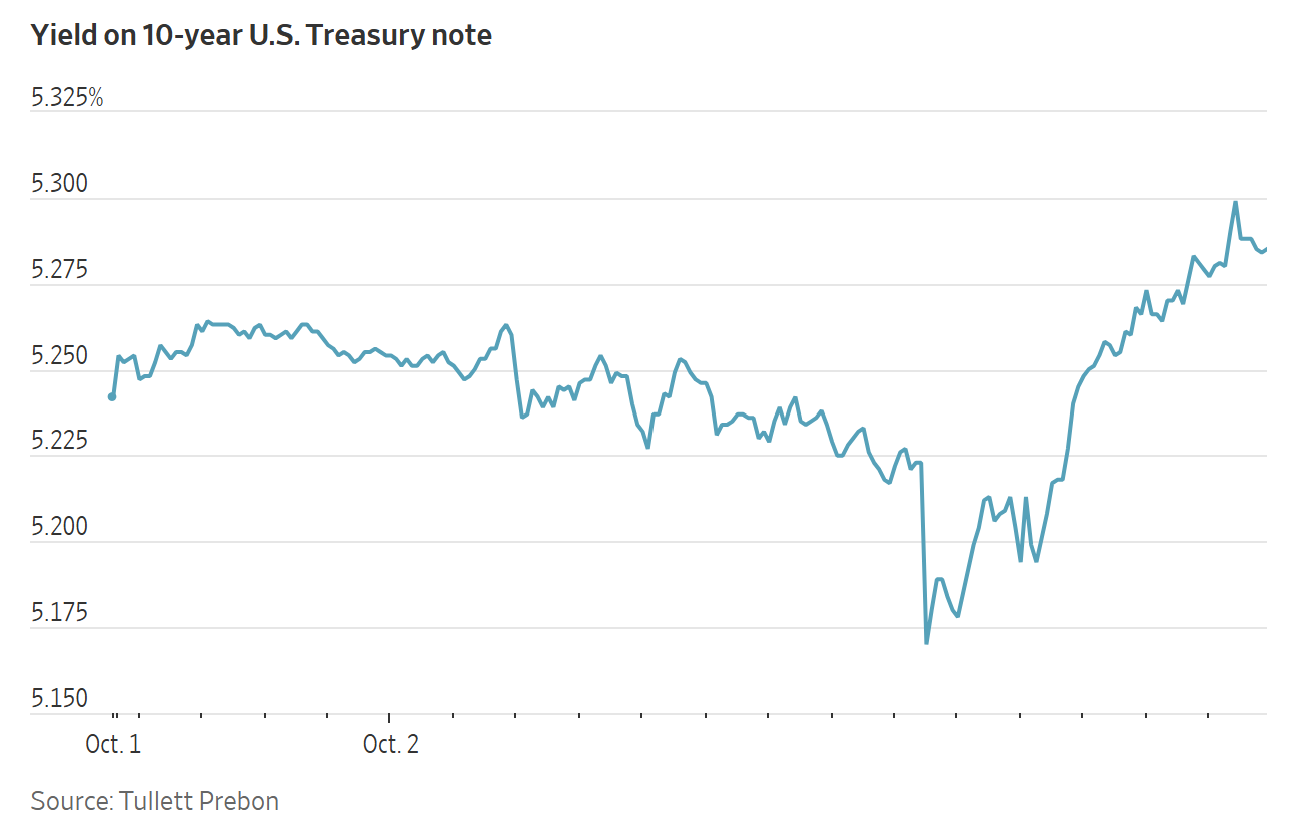
US Treasury yields reversed earlier declines on Friday as investors assessed September’s weaker-than-expected jobs report.
Investors initially responded by buying Treasuries across the curve, but selling resumed later. The reversal highlighted the multiple pressures weighing on the market, including resilient economic growth, heavy debt issuance and inflation concerns.
According to CME FedWatch, traders assigned a 77.9% probability to the Fed leaving rates unchanged at this month’s FOMC meeting, up from 35.8% a week earlier. The probability of a December rate increase rose to 68.0% from 41.6%.
The US 10-year Treasury yield rose +4.1 bps to 5.283% after earlier falling to 5.157%, its lowest level in a week. It advanced +11.8 bps over the week.
The 30-year Treasury yield edged -0.7 bps lower to 5.614% after falling to 5.552% following the jobs report. It also advanced +11.8 bps over the week.
The 2-year Treasury yield, which typically tracks expectations for the Fed funds rate, rose +3.7 bps to 4.839%. It had fallen to 4.693% after the report, its lowest level in two weeks, and declined -2.9 bps over the week.
The US 2s10s yield curve stood at 44.4 bps, 14.7 bps wider than the previous week’s 29.7 bps.
Across the Atlantic, European government bond markets declined on Friday. Last week concerns about widening fiscal imbalances and elevated inflation drove demand for safe-haven German and Dutch debt while pushing French borrowing costs to their highest level in 14 years.
The 10-year Bund yield fell as much as 13.7 bps during Friday’s session before closing -5.1 bps lower at 3.475%. It declined -12.5 bps over the week.
Data released on Friday showed that eurozone inflation rose more than expected. However, the increase in bond yields, which effectively tightened credit conditions, prompted traders to scale back expectations for ECB rate hikes. Markets no longer fully price another ECB increase until early 2027.
The 2-year Schatz yield fell -1.2 bps to 3.076% after reaching a session low of 2.943%. It declined -20.1 bps over the week. At the long end of the German curve, the 30-year yield fell -7.3 bps on Friday to 3.820%, bringing its weekly decline to -7.9 bps.
The French 10-year OAT yield fell -3.6 bps on Friday to 4.866% after nearly reaching 5% for the first time in almost 25 years. It rose +14.0 bps over the week, leaving the 10-year OAT spread over Bunds at 139.1 bps, 26.5 bps wider than a week earlier.
Italy’s 10-year BTP yield fell -9.5 bps on Friday to 4.604%, but remained +6.3 bps higher over the week.
Note: As of 4 pm EDT 2 October 2026
While every effort has been made to verify the accuracy of this information, EXT Ltd. (hereafter known as “EXANTE”) cannot accept any responsibility or liability for reliance by any person on this publication or any of the information, opinions, or conclusions contained in this publication. The findings and views expressed in this publication do not necessarily reflect the views of EXANTE. Any action taken upon the information contained in this publication is strictly at your own risk. EXANTE will not be liable for any loss or damage in connection with this publication.
Tento článek je poskytován pouze pro informační účely a neměl by být považován za nabídku nebo výzvu k nákupu nebo prodeji jakýchkoli investic nebo souvisejících služeb, jejichž odkazy se v něm můžou vyskytovat. Obchodování s finančními nástroji je spojeno se značným rizikem ztráty a nemusí být vhodné pro všechny investory. Dřívější produktivita není spolehlivým ukazatelem budoucí produktivity.
 Zpět na všechny přehledy




Přihlásit se k odběru přehledů trhu
Přihlásit se k odběru
přehledů
trhu
Předplaťte si nyní Předplaťte si nyní


Založeno profesionály. Pro profesionály.
