

Can bonds ignore the growth upgrade?


 S&P 500 +2.03% in Q3 to 7,651.54 US 10-year yield +82.1 basis points in Q3 to 5.291% Spot gold +3.71% in Q3 to $4,155.99 an ounce DXY +0.29% in Q3 to 101.47
Key data to move markets today
EU: Spanish, Italian, German and Eurozone HCOB Manufacturing PMIs, Italian Unemployment and speeches by ECB President Christine Lagarde and Executive Board members Isabel Schnabel and Piero Cipollone, Banque de France Governor François Villeroy de Galhau, Bundesbank President Joachim Nagel and De Nederlandsche Bank President Olaf Sleijpen
UK: GDP and a speech by BoE external MPC member Catherine Mann
USA: Continuing and Initial Jobless Claims, Challenger Job Cuts, ISM Manufacturing, PMI, Prices Paid and New Orders and Employment Indices, and speeches by Fed Governors Lisa Cook, Michelle Bowman and Christopher Waller, Fed Vice Chair Philip Jefferson and New York Fed President John Williams
JAPAN: Tokyo CPI and Core CPI, and Unemployment Rate
Global Macro Updates
Strong demand and convenient disinflation. Wednesday’s US data offered a favourable market mix of softer underlying inflation and considerably stronger growth. Core PCE rose 0.2% m/o/m in August, below expectations, while July’s increase was revised down to 0.1%. The annual core rate held at 3.0% and didn’t accelerate as forecast. Headline prices advanced 0.3% on the month and 3.4% annualised, unchanged from July. This is still well above the Fed’s target.
The relatively benign inflation signal comes with an important statistical caveat. The Bureau of Economic Analysis revised its treatment of portfolio-management services, legal services and computer software, applying the changes retrospectively to 2021. The methodological overhaul produced a one-off downward adjustment to recent inflation readings, meaning August’s numbers flatter the disinflation narrative without necessarily revealing an equivalent improvement in the underlying trend.
The growth side of the ledger was anything but subdued. Q2 GDP was revised sharply higher to an annualised 2.2%, from 1.5%, reflecting stronger consumer spending and investment. More tellingly, real final sales to private domestic purchasers, a clearer measure of underlying demand that excludes trade, inventories and government spending, grew at a robust 4.6% pace, up from the previously reported 4.2%.
The consumer entered Q3 with similar enthusiasm. Nominal spending increased 0.9% m/o/m in August, partly because higher petrol prices increased outlays at service stations. Inflation-adjusted consumption still climbed a healthy 0.6%. Yet income rose only 0.2% and the saving rate stood at 4.1%. Households cannot indefinitely maintain this spending pace without stronger wage growth, increased borrowing or a further drawdown in savings.
For investors, this combination initially supports risk assets because resilient domestic demand strengthens earnings expectations and cooler core inflation reduces immediate policy risk. However, the outlook is less favourable for longer duration assets. Growth exceeding earlier estimates, together with consumption rising faster than income, could sustain services inflation and support the case for further rate rises.
US Stock Indices
Dow Jones Industrial Average -0.86%
Nasdaq 100 +0.23%
S&P 500 -0.25%, with 9 of the 11 sectors of the S&P 500 down
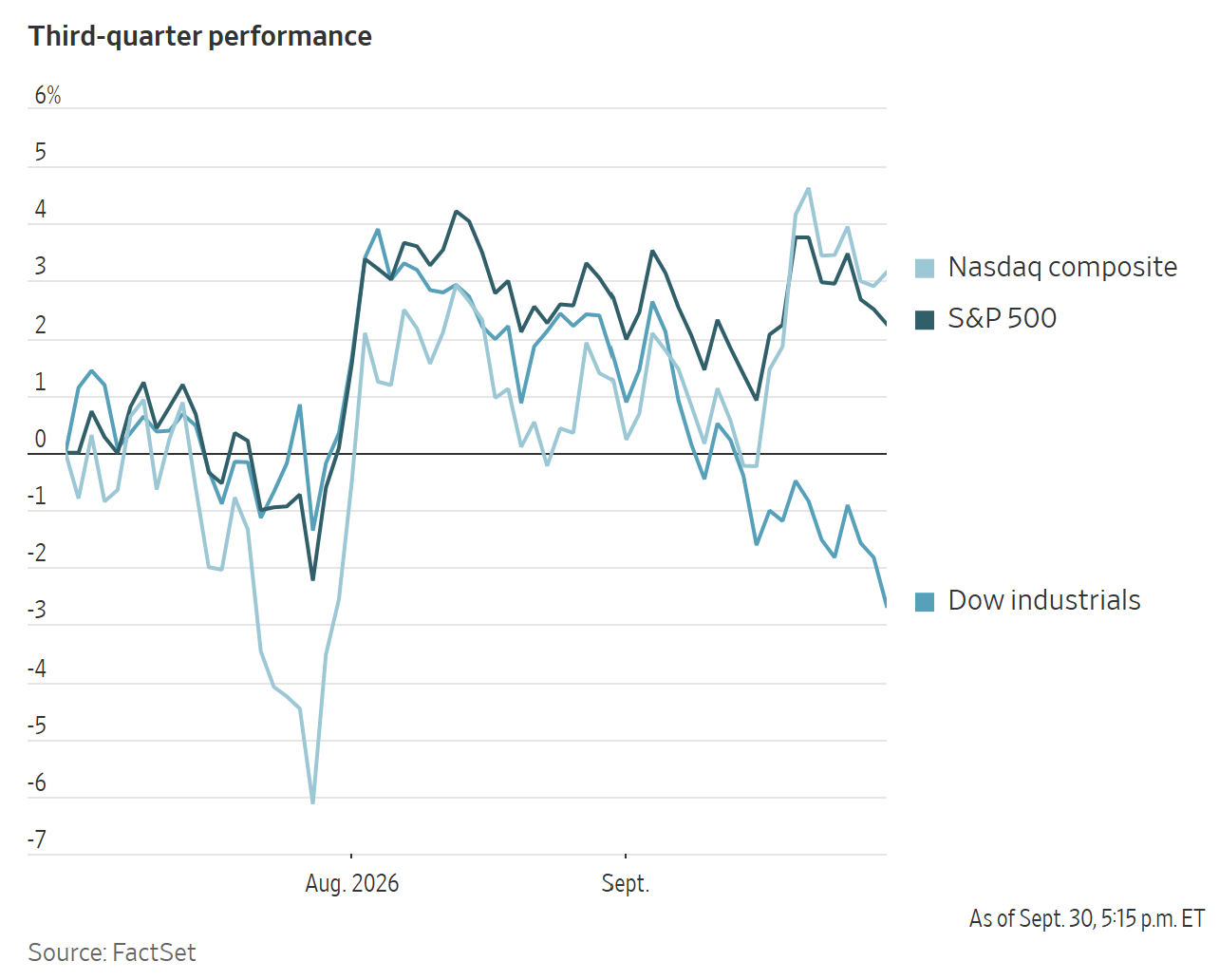
After a strong first half of the year, equities posted more modest gains in Q3. With rates likely to rise further toward year-end, the market’s resilience and its bid for a fourth consecutive year of double-digit gains, will be tested.
For now, big tech remains resilient despite surging oil prices and interest rates. Microsoft, Meta, Nvidia and Apple each gained more than ten percent in Q3, helping the Nasdaq Composite rise +2.23% and close at a record high on 22 September. The S&P 500 advanced +2.03% in Q3 despite a persistent bond selloff.
Higher interest rates and energy prices pressured other sectors, weighing on consumer spending and pushing the Dow Jones Industrial Average down -1.85% for Q3.
In September, the Nasdaq Composite gained +1.62%, while the S&P 500 fell -0.45% and the Dow Jones Industrial Average declined -3.45%.
In corporate news, Boeing won a US Navy contract worth more than $20 billion to build its next-generation fighter jet.
Condé Nast CEO Roger Lynch will step down after more than seven years to become Mattel’s CEO.
Ford CEO Jim Farley said a component shortage halted F-150 production at a Michigan plant for about a week and is affecting Q3 wholesale deliveries. Ford plans to produce 150,000 more trucks this year than in 2025, when output was constrained by an aluminium shortage, to recover lost sales.
Conagra raised its inflation forecast for the current fiscal year to the upper end of its 5% - 6% range, citing higher logistics and fuel costs, a driver shortage and other expenses. To offset these pressures, the company is increasing prices across its refrigerated and frozen food portfolio, following earlier price hikes in canned foods, to mitigate higher costs from steel tariffs.
European Stock Indices
CAC 40 -0.89%
DAX -0.79%
FTSE 100 -0.29%
Commodities
Gold spot -0.59% to $4,155.99 an ounce
Silver spot +1.65% to $60.41 an ounce
West Texas Intermediate +1.57% to $90.34 a barrel
Brent crude +0.92% to $103.50 a barrel
Gold relinquished earlier gains and edged lower on Wednesday, ending September with a monthly decline of -6.57%.
Spot gold fell -0.59% on Wednesday to $4,155.99 per ounce.
Spot silver declined -1.70% to $60.41 per ounce, bringing its September loss to -9.19%.
In Q3, gold prices advanced +3.71%, while spot silver rose +3.12%.
Oil prices rose on Wednesday and posted monthly gains for September, supported by stalled US - Iran peace talks and tightening US fuel markets.
The Brent November futures contract, which expired on Tuesday, settled $0.94, or +0.92% higher, at $103.50 per barrel. The more actively traded December contract gained $1.87, or +1.94%, to $98.03 per barrel. WTI settled up $1.40, or +1.57%, at $90.34 per barrel.
The spread between the two crude benchmarks also widened to a four-month high as traders assessed potential US restrictions on diesel exports. Such measures could create a domestic oversupply and prompt US refiners to process less crude.
The White House is considering permitting sales of red-dyed diesel, rather than imposing an export ban, to provide consumers with some price relief ahead of the November midterm elections.
In September, Brent was +14.04%, its strongest monthly increase since July. WTI rose +4.67% in September. In Q3, WTI advanced +28.29% and Brent surged +42.17%.
Qatar said on Tuesday that it hoped shuttle diplomacy between Tehran and Washington would produce a breakthrough.
However, the US President denied press reports, citing US officials, that he was prepared to ease sanctions and release frozen Iranian funds in exchange for concrete steps by Tehran on its nuclear programme.
On Tuesday, Saudi Arabia resumed oil tanker loadings from its Red Sea port of Yanbu after restoring operations on the East - West Pipeline. Over the past five days, the 10-day average for total oil exports held at 20.5 million bpd, equivalent to 89% of 2025 levels, according to JPMorgan.
Kpler’s seven-day average for crude transits through the Strait of Hormuz stood at 14.19 million bpd, compared with a pre-war baseline of 17.13 million bpd.
OPEC+ producers are expected to keep their November production targets unchanged when they meet on Sunday, according to two people familiar with the matter who spoke to Reuters.
The DOE Weekly Petroleum Status Report reported a crude inventory build of 922,000 barrels, alongside draws of 1.680 million barrels in gasoline, 2.250 million barrels in distillates and 1.900 million barrels in jet fuel.
The crude build appears somewhat more bearish when accounting for the West Coast, which is generally considered less relevant to the supply-and-demand balance, where inventories fell by 2.4 million barrels.
The four-week average of implied jet fuel demand increased +6.5% y/o/y. Refinery crude inputs declined by a further 554,000 bpd and have fallen by a cumulative 1.073 million bpd over the past two weeks.
The EIA updated its estimate of US oil production for July. US crude output averaged 13.948 million bpd, up 104,000 bpd from an upwardly revised June estimate. The record high remains 13.995 million bpd, set in October.
Note: As of 4 pm EDT 30 September 2026
Currencies
EUR -0.12% to $1.1329
GBP +0.27% to $1.3260
Bitcoin +0.28% to $83,714.80
Ethereum +0.14% to $2,682.71
The US dollar edged higher against major currencies on Wednesday after US inflation rose less than expected. The US Dollar Index rose +0.07% to 101.47 and gained +2.07% in September.
The greenback recorded monthly gains against both the euro and sterling.
The euro traded -0.12% lower at $1.1329. The single currency fell -2.44% against the US dollar in September, following two consecutive monthly gains in July and August.
Sterling advanced +0.27% to $1.3260; however, it recorded a monthly loss of -2.14% against the US dollar in September, ending two consecutive months of gains.
The US dollar traded +0.04% higher against the yen at ¥157.35. Over September, the yen appreciated +1.46% against the US dollar.
For Q3, the euro declined -0.81% against the US dollar, while the British pound advanced slightly, +0.05%. The yen appreciated +3.18% through Q3 against the greenback.
Fixed Income
US 10-year Treasury +4.2 basis points to 5.291%
German 10-year Bund -3.2 basis points to 3.600%
UK 10-year Gilt +1.3 basis points to 5.427%
US Treasury yields rose on Wednesday after data showed that inflation increased more slowly than expected in August. However, the latest ADP data showed that US private payrolls increased by 90,000 jobs in September, exceeding the consensus forecast of 70,000.
In September, Treasury yields registered their fastest monthly increase in years, while the 10-year note posted its largest quarterly rise since 2009.
Yields on two- and 10-year Treasuries initially extended their declines after the Commerce Department reported that the Personal Consumption Expenditures Price Index rose 0.3% in August, following a downwardly revised 0.1% increase in July.
Core PCE inflation increased 3.0% y/o/y in August, matching a downwardly revised 3.0% rise in July. The initial estimate had indicated a 3.3% increase in the 12 months through July.
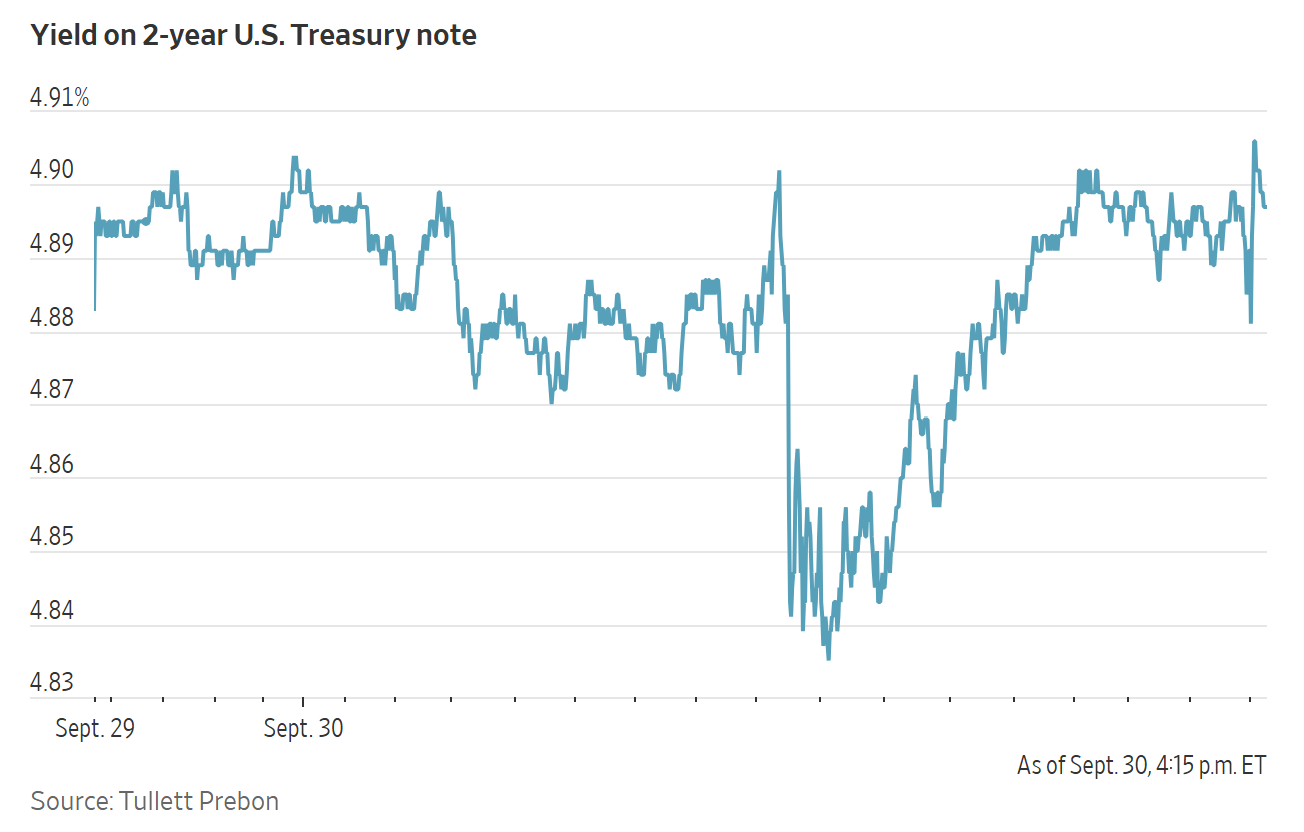
Markets assigned a 61.8% probability that the Fed will leave rates unchanged next month, up from 49.1% on Tuesday, according to the CME’s FedWatch tool.
The 10-year US Treasury yield rose +4.2 bps to 5.291%, after reaching 5.306% earlier in the session, its highest level since June 2007. In September, the yield increased +53.5 bps, its largest monthly rise since September 2022. In Q3, it climbed +82.1 bps, the strongest quarterly increase since Q2 2009.
The 30-year US Treasury yield rose +6.3 bps to 5.634%, after reaching 5.651% earlier in the session, its highest level since June 2002. The yield advanced +39.0 bps in September, its largest monthly increase since December 2024, and rose +66.9 bps in Q3, its strongest quarterly gain since Q3 2023.
The two-year US Treasury yield, which is sensitive to Fed funds rate expectations, rose +2.5 bps to 4.908%, after falling to 4.827% earlier in the session. It increased +55.4 bps in September, its largest monthly rise since February 2023, and advanced +71.3 bps in Q3, its strongest quarterly gain since Q2 2023.
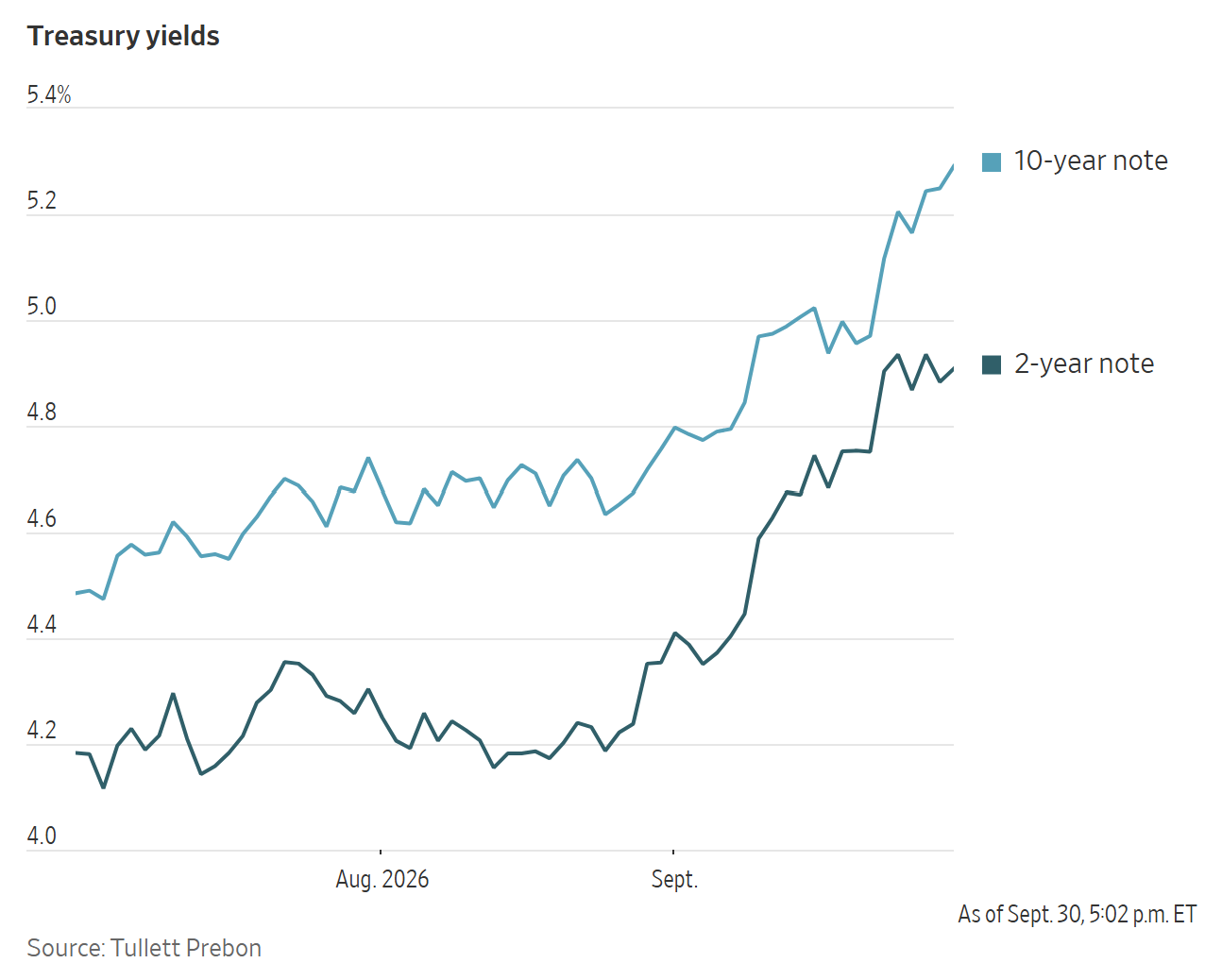
The US 2s10s yield curve stood at 38.3 bps, 1.9 bps narrower than its 40.2 bps level on 31 August.
Investors are now awaiting September’s nonfarm payrolls report, due on Friday.
Euro-area yields eased from the week’s highs on Wednesday as markets became more cautious about further rate increases by the ECB. However, the decline was limited by hotter-than-expected inflation data from France, Germany and Italy.
The 10-year French OAT yield settled +3.4 bps higher at 4.845%, after reaching an 18-year high of 4.849% earlier in the session. It rose +66.7 bps in September, its largest monthly increase since late 2022. It underperformed comparable bonds from every other major euro-area economy.
Since 30 June, the yield has risen +129.8 bps, its largest quarterly increase since 1987, placing additional pressure on France’s fiscal capacity. Late on Tuesday, the government said it would issue a record €340 billion of bonds next year. Interest expenditure is now projected to be €5 billion higher in 2026 and €7 billion higher in 2027 than forecast a year ago.
Higher interest rates are increasingly contributing to fiscal deterioration, making it more difficult to stabilise public debt. The spread between 10-year OATs and Bunds stood at 124.5 bps on Wednesday, its widest since June 2012. The spread widened 40.6 bps in September.
Germany’s 10-year Bund yield fell -3.2 bps to 3.600% on Wednesday, moving away from Monday’s 3.650% peak, its highest level since 2009. The yield rose +26.1 bps in September. It advanced +73.6 bps in Q3.
Germany’s two-year yield fell -10.1 bps to 3.204%, although it advanced +26.5 bps in September. Consequently, the German 2s10s yield curve stood at 39.6 bps, just 0.4 bps narrower than at the end of August.
The long end of the curve was likewise affected by the global shift in sovereign yields. Germany’s 30-year Bund yield rose +12.3 bps in September to 3.939%.
In Italy, the 10-year BTP yield edged +0.2 bps higher on Wednesday to 4.604%, bringing its September increase to +44.8 bps. It advanced +101.7 bps in Q3.
Note: As of 4 pm EDT 30 September 2026
While every effort has been made to verify the accuracy of this information, EXT Ltd. (hereafter known as “EXANTE”) cannot accept any responsibility or liability for reliance by any person on this publication or any of the information, opinions, or conclusions contained in this publication. The findings and views expressed in this publication do not necessarily reflect the views of EXANTE. Any action taken upon the information contained in this publication is strictly at your own risk. EXANTE will not be liable for any loss or damage in connection with this publication.
Tento článek je poskytován pouze pro informační účely a neměl by být považován za nabídku nebo výzvu k nákupu nebo prodeji jakýchkoli investic nebo souvisejících služeb, jejichž odkazy se v něm můžou vyskytovat. Obchodování s finančními nástroji je spojeno se značným rizikem ztráty a nemusí být vhodné pro všechny investory. Dřívější produktivita není spolehlivým ukazatelem budoucí produktivity.




Přihlásit se k odběru přehledů trhu
Přihlásit se k odběru
přehledů
trhu
Předplaťte si nyní Předplaťte si nyní


Založeno profesionály. Pro profesionály.
