

Will bonds recover?


 S&P 500 -0.71% to 7,631.47 US 10-year yield +3.4 basis points to 4.792% Spot gold -2.69% to $4,328.60 an ounce DXY +0.27% to 99.68
Key data to move markets today
USA: ADP Employment Change, Factory Orders and Fed’s Beige Book
Global Macro Updates
US labour market remains in low hire, low fire mode as manufacturing appears to slow. The number of job openings rose by 89,000 to 7.271 million by the last day of July, the Labor Department's Bureau of Labor Statistics said in its Job Openings and Labor Turnover Survey, or JOLTS report. This was up from a downwardly revised 7.182 million in June. There were 1.05 job openings for every unemployed person in July, up from 1.01 in June. The most unfilled jobs were in the manufacturing sector, with an additional 79,000 vacancies, nearly all of them in the durable goods industries. There were 65,000 fewer job openings in the professional and business services sector. The overall job openings rate rose to 4.4% from 4.3% in June.
Hiring dropped by 278,000 to 5.054 million in July. The worst sector was professional and business services, which saw a decline of 188,000 jobs. The hires rate fell to 3.2% from 3.4% in June. Layoffs and discharges fell by 119,000 to 1.666 million, with the rate edging down to 1.0% from June’s 1.1%.
The ISM Manufacturing PMI data suggested factory activity is slowing. It fell to a still-elevated 54.6 last month from 55.6 in July, which was the highest reading since May 2022. The Institute for Supply Management on Tuesday also noted price pressures. Manufacturing, which accounts for about 9.4% of the economy, remains supported by the AI spending boom. The ISM survey's new orders measure slipped to 53.7 last month from 56.7 in July. The pullback in orders did not ease the pressure on supply chains. The survey's supplier deliveries index increased to 59.3 from 58.9 in July. A reading above 50 indicates slower deliveries. The supply constraints meant inflation at the factory gate remained high last month. The survey's gauge of prices paid for inputs was unchanged at 71.1. This suggests that inflation will not be anywhere near the Fed’s target for the foreseeable future. These higher prices and continuing supply constraints may be attributed to tariff uncertainty and continuing geopolitical risks.
US Stock Indices
Dow Jones Industrial Average -0.79%
Nasdaq 100 -1.29%
S&P 500 -0.71%, with 7 of the 11 sectors of the S&P 500 down
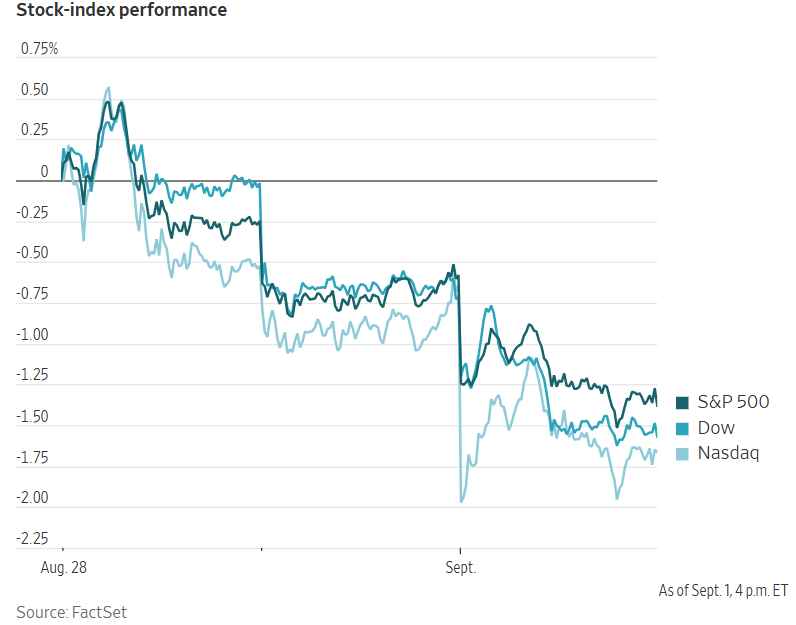
US equity indices ended lower on Tuesday due to upward pressure on oil prices, inflationary risks and AI trade weakness. The Nasdaq Composite was -1.03%, or down 271.11 points to 26,099.77. The S&P 500 fell -0.71%, or 54.67 points, to 7,631.47, while the Dow Jones Industrial Average was -0.79%, or down 419.02 points to 52,766.88.
In corporate news, Chevron is reported to be finalising a deal that will significantly expand its operations in Venezuela by adding two giant oil fields in the Orinoco Belt.
As noted by Bloomberg news, new Apple CEO John Ternus touted the company’s strong product pipeline and teased a “phenomenal” iPhone launch next week in his first remarks to employees as their new leader. Apple disclosed in a filing on Tuesday that Ternus' annual salary was increased to $3 million. There will also be an annual equity award with a $55 million target value, starting 2027, a majority of which will be tied to the company's stock performance. Cook will earn $2 million annually and restricted stock units in 2027 with a target value of $45 million.
Corporate Earnings Reports
Posted on Tuesday, 1 September from The Pulse, our real-time AI-driven news tool. Available exclusively on the EXANTE Web Platform
Medtronic reported Q1 FY27 results with revenue of $9.76bn (up +13.7% y/y, vs estimate of $9.54bn) and adj EPS of $1.45 (up +15.1% y/y, vs estimate of $1.39). The company raised its FY27 guidance: adj EPS to $5.94-$6.00 and organic revenue growth to 7.25%-7.75%. Cardiac Ablation Solutions revenue rose +88% y/y. Medtronic announced a $700mn partnership with Cornerstone Robotics for rights to the Sentire surgical robot outside the US. The company closed acquisitions of Scientia Vascular and SPR Therapeutics and made a strategic investment in Pi-Cardia. CEO Geoff Martha stated that strong operating performance and disciplined financial management drove the beat, adding that confidence comes from the breadth of performance and increasing contributions from newer growth platforms.
Credo reported Q1 fiscal 2027 earnings. Revenue was $479mn vs $472mn expected, up +114.7% y/y. Adjusted EPS was $1.20 vs $1.17 expected. Non-GAAP net income was $236.3mn vs $230mn expected, up +140% y/y. Non-GAAP operating income of $230.6mn missed the $246mn estimate. Gross margin was 68%, in line with expectations. Q2 revenue guidance midpoint of $530mn exceeded the $517mn consensus, with gross margin guided at 68% at the midpoint. CEO stated that as AI infrastructure scales, the company will continue to provide innovative, energy-efficient connectivity solutions for the data centre.
MongoDB reported fiscal Q2 2027 results. Revenue was $772mn vs $734mn estimated, up +30% y/y. Adjusted EPS came in at $1.90 vs $1.61 expected, up +90% y/y. Remaining performance obligations (RPO) reached $1.52bn, up +91% y/y.
Atlas revenue was $566mn, up +29% y/y. The company raised its full-year FY27 guidance: revenue to $3.01bn (vs $2.96bn consensus) and EPS to $6.49 (vs $6.13). Q3 guidance sees revenue of $756-761mn and EPS of $1.57-1.61. CEO Dev Ittycheria commented: 'We delivered strong second quarter results, highlighted by 30% year-over-year revenue growth... and continued strong profitability. This gives us the confidence to raise our full year fiscal 2027 guidance.'
Dell Technologies reported record Q2 FY27 revenue of $47bn, up +58% y/y and beating the $44.5bn consensus, with adjusted EPS of $7.04 vs $4.90 expected, a +203% y/y rise. AI-optimised server revenue reached $16.4bn, up +100% y/y, as the company booked a record $60.9bn in AI orders and exited the quarter with a $95bn backlog. Traditional servers and networking revenue grew +122% y/y. Dell raised its full-year FY27 revenue guidance to $192bn (from $167bn), AI server revenue to $74bn, and adjusted EPS to $25.50, all above consensus estimates. The company also reported its lowest operating expense rate at 8% of revenue. COO Jeff Clarke noted that demand for AI servers continues to outstrip supply, constrained by DRAM and NAND shortages.
GitLab reported Q2 FY27 earnings. Revenue was $286.3mn (up +21% y/y) vs $273mn estimated, and adjusted EPS was $0.24 vs $0.18 expected. Non-GAAP operating income came in at $42.6mn vs $31.2mn. Dollar-based net retention was 117%. For FY27, the company guided revenue of $1.129bn–$1.133bn (above $1.12bn consensus) and non-GAAP operating income of $148mn–$152mn (above $138mn). Q3 revenue guidance of $281mn–$283mn was in line with estimates. Management cited “record gross bookings and net ARR growth exceeding 40% year over year” and highlighted “sequential acceleration in dollar-based net retention and meaningful operating leverage”.
Palo Alto Networks reported Q4 FY26 earnings. Revenue was $3.41bn (up +34% y/y) vs $3.35bn expected, and adjusted EPS was $1.02 vs $0.98 expected. Next-Gen Security ARR reached $9.1bn, up +63% y/y. FY27 guidance was issued: revenue of $14.2bn vs $13.8bn expected, EPS of $4.18 vs $4.11 expected, and NGS ARR of $11.1bn vs $10.9bn expected. The company acquired Console, an AI-native platform for agentic workflows. Scotiabank maintained an Outperform rating and raised its price target to $430 from $320. CEO Nikesh Arora stated that AI is elevating cybersecurity as a top CIO priority, serving as a durable tailwind toward the $20bn FY30 NGS ARR target.
European Stock Indices
CAC 40 -0.39%
DAX -1.10%
FTSE 100 -0.32%
Commodities
Gold spot -2.69% to $4,328.60 an ounce
Silver spot -2.90% to $64.59 an ounce
West Texas Intermediate +5.2% to $90.22 a barrel
Brent crude +4.6% to $94.65 a barrel
Gold prices fell on Tuesday to a two-week low, weighed down by a stronger US dollar and rising Treasury yields. Gold’s break below its 200-day moving average triggered additional technical selling.
Spot gold was down -2.69% to $4,328.60 an ounce.
Spot silver fell -2.90% to $64.59 per ounce.
Crude benchmarks closed higher on Tuesday after the US launched new air strikes on Iranian targets after Iran attempted attacks on commercial ships and fired missiles at American bases. Iran warned that it would prevent oil being exported from the Gulf, despite a threat by President Trump to hit Iran "hard" in response to Iranian strikes, and a warning from US Treasury Secretary Scott Bessent that Washington was about to impose new sanctions.
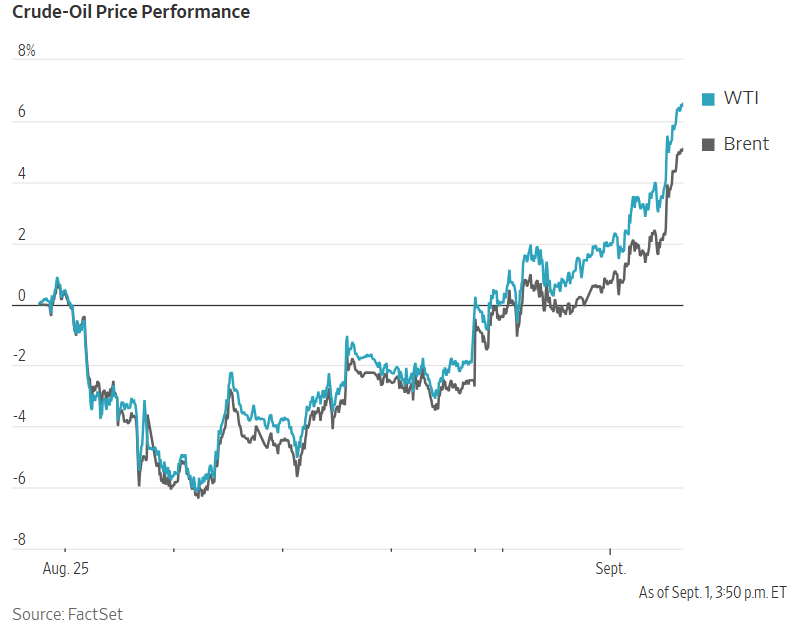
Oil prices jumped more than $4 a barrel on Tuesday, settling at a five-week high.
Brent futures rose $4.16, or +4.6%, to settle at $94.65 a barrel. WTI crude rose $4.46, or +5.2%, to settle at $90.22. This was the highest close for Brent since 24 July and for WTI since 23 July.
In the US, diesel futures surged to a 52-month high after rising 51% over the past 10 weeks, boosting the diesel crack spread, which measures refining profit margins, to a record high of around $107 a barrel, according to LSEG data.
Note: As of 4 pm EDT 1 September 2026
Currencies
EUR -0.23% to $1.1589
GBP -0.26% to $1.3511
Bitcoin -1.81% to $77,186.54
Ethereum -2.30% to $2,414.68
The dollar was up on Tuesday due to renewed US attacks on Iran following Iran’s targeting of US troops in the region and commercial ships in the Strait of Hormuz. This pushed oil prices higher, fuelling inflation concerns and increasing the likelihood of interest rate rises by global central banks. This resulted in a global bond selloff on Tuesday.
The dollar index rose +0.27% to 99.68, with the euro down -0.23% at $1.1589. Sterling fell -0.26% to $1.3511.
The Japanese yen fell -0.30% against the dollar to ¥160.19 per dollar. According to the Treasury department, US Treasury Secretary Scott Bessent urged Bank of Japan Governor Kazuo Ueda to use monetary policy to anchor inflation expectations and avoid excessive yen volatility.
Fixed Income
US 10-year Treasury +3.4 basis points to 4.792%
German 10-year Bund +2.1 basis points to 3.360%
UK 10-year Gilt +8.1 basis points to 5.151%
There was a sell-off in global bond markets on Tuesday as investors continue to worry about inflation and sovereign debt levels. US, eurozone and UK yields all rose. Japan's 10-year yield hit 3% on Tuesday for the first time in 30 years.
US Treasury yields rose as the rally in oil prices pressured bonds. Investors remain worried that the surge in oil prices will keep inflation high and force central banks to raise rates. These inflationary concerns, along with rising fiscal deficits, increasing competition from corporate borrowers, primarily for AI-infrastracture building, and the lack of forward guidance from the Fed are all feeding into investor uncertainty around the policy path. However, Fed Governor Michael Barr said on Tuesday that if inflation does not cool quickly, it will be time for the Fed to increase rates.
Rates have returned to levels last seen before US Treasury Secretary Scott Bessent said the Treasury would engage in buybacks. However, the expanded buybacks aren’t set to start until 9 September. It is still not clear how many bonds the Treasury will ultimately purchase.
According to the CME FedWatch tool, traders are pricing a 66.9% probability of a 25 bps rate hike at the Fed’s 16 September meeting, up from last week’s 39.6% probability. Expectations for a Fed hike have jumped since Fed Chair Kevin Warsh’s hawkish comments at Jackson Hole last Friday.
Both the 2-year and the benchmark 10-year hit their highest since January 2025 and up for five consecutive sessions on Tuesday.
The 2-year note yield, which typically tracks Fed funds rate expectations, rose +3.8 bps to 4.392% after hitting 4.392% earlier in the session. The yield on the US benchmark 10-year notes was +3.4 basis points to 4.792% after at one point touching 4.798%, its highest level since 14 January 2025. The yield on the 30-year bond was +1.4 bps to 5.263% after rising to 5.288%, its highest since 19 August.
The spread between yields on two- and 10-year Treasury notes, an indicator of economic expectations, was at a positive 40.1 basis points.
The breakeven rate on five-year US Treasury Inflation-Protected Securities (TIPS) was 2.371% after closing at 2.33% on Monday. The 10-year TIPS breakeven rate was 2.35%. This suggests that the market sees inflation averaging about 2.3% a year for the next decade.
Eurozone bond yields also rose on Tuesday.
Germany’s 10-year bond yield was +2.1 bps to 3.360%, its highest since 2011. This came after eurozone inflation rose above 3% in August. The 2-year yield rose +2 bps to 2.94%.
Traders in money markets have almost fully priced in a 25 bps rate rise at this month’s ECB meeting. A further 25 bps hike is priced by February next year.
French 10-year yields rose +2 bps to 4.19%, while the Italian 10-year BTP touched 4.22%, its highest since 2023 before ending +1.8 bps to 4.174%.
In the UK, borrowing costs reached their highest levels since 1998. The benchmark 10-year gilt was +8.1 bps to 5.151% after rising +10 bps earlier in the session to about 5.25%, the highest level since the 2008 global financial crisis, while the 30-year gilt jumped +9 basis points to 5.88%.
Note: As of 4 pm EDT 1 September 2026
While every effort has been made to verify the accuracy of this information, EXT Ltd. (hereafter known as “EXANTE”) cannot accept any responsibility or liability for reliance by any person on this publication or any of the information, opinions, or conclusions contained in this publication. The findings and views expressed in this publication do not necessarily reflect the views of EXANTE. Any action taken upon the information contained in this publication is strictly at your own risk. EXANTE will not be liable for any loss or damage in connection with this publication.
Tento článek je poskytován pouze pro informační účely a neměl by být považován za nabídku nebo výzvu k nákupu nebo prodeji jakýchkoli investic nebo souvisejících služeb, jejichž odkazy se v něm můžou vyskytovat. Obchodování s finančními nástroji je spojeno se značným rizikem ztráty a nemusí být vhodné pro všechny investory. Dřívější produktivita není spolehlivým ukazatelem budoucí produktivity.




Přihlásit se k odběru přehledů trhu
Přihlásit se k odběru
přehledů
trhu
Předplaťte si nyní Předplaťte si nyní


Založeno profesionály. Pro profesionály.
