

Will rising yields hit AI momentum?

 S&P 500 -0.52% to 7,745.06 US 10-year yield +2.79 basis points to 4.724% Spot gold +1.02% to $4,420.41 an ounce DXY -0.06% at 99.6
What to look out for today
Companies reporting on Tuesday, 18 August: Baidu, Home Depot, Keysight Technologies, Xiaomi, Toll Brothers
Key data to move markets today
EU: German ZEW Economic Sentiment and Current Situation surveys and a speech by ECB Chief Economist Philip Lane
UK: Average Earnings, Claimant Count Rate, Claimant Count Change, Employment Change and ILO Unemployment Rate
USA: ADP Employment Change 4-week Average, Building Permits, Housing Starts, Industrial Production and Pending Home Sales
Global Macro Updates
The long end sends a message. US bond yields have re-emerged as the market's central preoccupation this week, even as the disinflation narrative found modest support in the July CPI and PPI prints. The dissonance is notable: softer inflation data failed to arrest the upward drift in borrowing costs. The current selloff is less about near-term price pressures and more about the structural forces reshaping the Treasury market.
The clearest signal came from Thursday's 30-year auction, which cleared at 5.216%, the highest yield for that tenor since 2001. Real rates now sit at decade-plus highs, a development that reflects mounting scrutiny of US fiscal sustainability. The Treasury Department confirmed this week that the fiscal year-to-date deficit has reached $1.8 trillion through July, already surpassing the entirety of fiscal 2025 with two months still remaining.
Compounding the supply-side strain is the AI-related corporate bond wave. Goldman Sachs estimates AI-linked issuance has already reached $489 billion this year, eclipsing the full-year 2025 total of $322 billion. This corporate borrowing surge is competing directly with sovereign issuance for investor capital, adding another layer of upward pressure on long-end yields.
Demand-side dynamics are shifting in parallel. Treasury data released this week showed foreign holdings of US government debt fell to $9.299 trillion in June, down from $9.371 trillion in May, led by declines from Japan, the UK and China. Japan, still the largest non-US holder, trimmed its stake by 2.3% to $1.116 trillion, well below its November 2021 peak. China's holdings fell 4% to $633.4 billion, the lowest level since September 2008 and down more than 13% year-on-year. The UK, often viewed as a proxy for hedge fund positioning through its custody role, reduced holdings by 1% to $939.9 billion.
Notably, weaker foreign appetite has not derailed overall capital inflows, which rose to $133.5 billion in June, buoyed by strong equity inflows of $181.4 billion. This suggests private and institutional demand is partially offsetting official-sector retrenchment, even as the burden of absorbing record issuance increasingly falls on domestic and non-official buyers.
US Stock Indices
Dow Jones Industrial Average -0.51%
Nasdaq 100 -0.17%
S&P 500 -0.52%, with 10 of the 11 sectors of the S&P 500 down
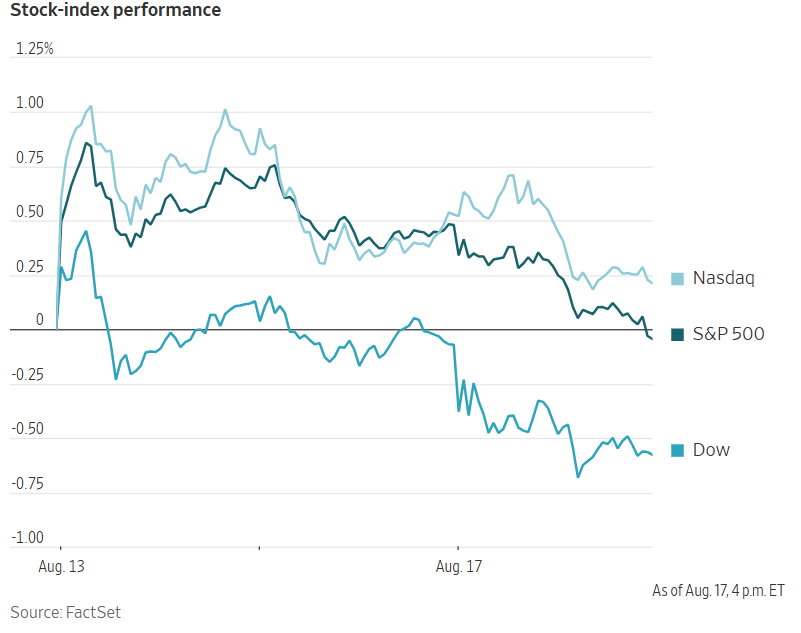
US equities fell on Monday for the second consecutive session as concerns grew that peace prospects for the US-led war with Iran were over as President Trump said that he’s not interested in extending the expiring agreement with Iran. Investors are waiting for quarterly reports from large retailers including Home Depot, due to report today, and retail bellwether Walmart on Thursday, to provide insights into the strength of the US consumer.
The S&P 500 declined -0.52%, or down 40.70 points, to 7,745.06 with Microsoft and Meta Platforms providing the biggest drags, with both declining more than 3%. However, chip sector stocks provided the biggest index point boosts to the benchmark index with Micron Technology adding 4% and Applied Materials climbing 5.5%.
The Nasdaq Composite was -0.32%, or down 84.25 points to 26,644.91. The Nasdaq 100 erased an earlier advance to end the day down. The Dow Jones Industrial Average fell -0.51%, or down 272.63 points, to 53,459.78. The breadth was solidly negative with the equal-weight S&P lagging the cap-weighted index after outperforming last week.
In corporate news, Nvidia has agreed to provide a guarantee of up to $105 billion to help OpenAI lease a sprawling data centre in Ohio being developed by SoftBank-owned SB Energy. Nvidia will also invest $1.5 billion in SB Energy. This comes months after a $1 billion investment from OpenAI and SoftBank to expand data centre infrastructure.
L3Harris Technologies replaced CEO Christopher Kubasik following a conduct review.
RTX won a $23 billion contract from the US Navy to accelerate production of more than 7,000 Tomahawk cruise missiles.
Centene said on Monday that Chris Neczypor would succeed Drew Asher
as chief financial officer in January. Asher will step down in December and retire at the end of 2027. Neczypor will join in September to ensure a smooth transition.
European Stock Indices
CAC 40 -0.66%
DAX -0.38%
FTSE 100 -0.28%
Commodities
Gold spot +1.02% to $4,420.41 an ounce
Silver spot +1.69% to $65.78 an ounce
West Texas Intermediate +2.55% to $84.50 a barrel
Brent crude +2.65% to $90.87 a barrel
Gold was up again on Monday, supported by a weaker dollar and falling expectations of a Fed rate hike due to softer US jobs and retail data.
Spot gold rose +1.02% to $4,420.41 an ounce.
Spot silver rose +1.69% to $65.78 an ounce.
Crude oil futures rose again on Monday due to growing concerns about an escalation of the war between the US and Iran. Fox News reported that President Trump threatened to bomb Oman if the Gulf state “gets in the way” of Washington’s efforts to strike a deal with Iran to reopen the Strait of Hormuz. Additionally, Iranian media said an oil tanker had been seized in the Strait of Hormuz. The Iranian-state-linked Fars News Agency reported on X that a tanker had been detained, saying that Iran requires shipowners transiting the waterway to pay transit fees.
A senior Iranian official told Reuters Tehran would escalate tensions in the Strait of Hormuz and beyond, and launch an attack if the US fails to implement an interim peace deal fully in a matter of weeks.
Brent crude futures settled up $2.35, or +2.65%, at $90.87 a barrel. WTI crude futures settled up $2.10, or +2.55%, to $84.50 a barrel.
Shipping through the Strait of Hormuz slowed over the weekend. Five vessels transited the strait on Saturday, with none registered for Sunday, shiptracking data from Kpler showed, versus 31 for the prior weekend.
Note: As of 4 pm EDT 17 August 2026
Currencies
EUR +0.08% to $1.1578
GBP +0.06% to $1.3543
Bitcoin +2% to $64,246.01
Ethereum +1.4% to $1,905.78
The US dollar fell on Monday to its lowest level since June, with the dollar index down -0.06% at 99.6 as traders reacted to softer US data. The euro ended the day +0.08% to $1.1578 after reaching $1.1614, the highest since 17 June. Sterling was +0.06% to $1.3543.
The yen pared early gains and was down -0.11% to ¥159.49 per dollar
Fixed Income
US 10-year Treasury +2.79 basis points to 4.724%
German 10-year Bund +1 basis points to 3.21%
UK 10-year Gilt +4.0 basis points to 5.08%
US Treasuries fell on Monday as global benchmark Brent crude prices jumped above $90 a barrel, amid growing concerns about an escalation in the war between the US and Iran, contributing to inflation worries.
The 30-year Treasury yield finished the day at a new 19-year high. It gained +4.43 bps to 5.310% on growing worries over the US fiscal position and heavy AI-related corporate debt issuance continued to push yields up.
The 10-year yield rose +2.79 bps to 4.724%, up from 4.695% on Friday. The US 2-year yield, which is sensitive to expectations for Fed policy, gained +0.9 bps to 4.18%.
The 2s10s spread rose to 54.7 bps from 51.5bps on Friday.
US rate futures are now pricing in a probability of a Fed rate hike at next month’s policy meeting at 34.6% according to CME FedWatch tool. Although this is lower than last week’s 52.2% probability, it is still higher than Friday’s 33.1% probability.
Investors will also be watching for the release on Wednesday of the FOMC minutes as well as an auction of 20-year US bonds.
The breakeven rate on five-year US Treasury Inflation-Protected Securities (TIPS) was at 2.255% after closing at 2.249% on Friday. The 10-year TIPS breakeven rate was 2.284%, indicating the market sees inflation averaging about 2.3% a year for the next decade.
Eurozone bond yields rose on Monday with long-dated government bond yields hitting multi-year highs. Market participants worried about the prospect of a prolonged conflict in the Middle East increasing inflationary pressures.
Germany's 10-year Bund yield was +1 basis point to 3.21% after reaching 3.2158%, the highest since May 2011. The 2-year bond yield, which is more sensitive to interest rate expectations, was unchanged at 2.79%.
France's 10-year OATS yield was +1.5 bps at 4.05%, after hitting 4.0581%, the highest level since June 2009. The yield on the 30-year was +2 bps to reach 4.8617%, the highest since September 2008.
The yield gap between 10-year OATs and Bunds was at 84 bps, almost the highest level since October 2025.
Money markets priced in an ECB deposit rate of 2.76% in March 2027, up from the current 2.25%. They also implied a more than 90% chance of a September rate hike.
Italy's 10-year government bond yield rose +1.5 bps to 4.0%, while its 30-year yield hit 4.8254%, the highest since November 2023.
Note: As of 4 pm EDT 17 August 2026
While every effort has been made to verify the accuracy of this information, EXT Ltd. (hereafter known as “EXANTE”) cannot accept any responsibility or liability for reliance by any person on this publication or any of the information, opinions, or conclusions contained in this publication. The findings and views expressed in this publication do not necessarily reflect the views of EXANTE. Any action taken upon the information contained in this publication is strictly at your own risk. EXANTE will not be liable for any loss or damage in connection with this publication.
Tento článek je poskytován pouze pro informační účely a neměl by být považován za nabídku nebo výzvu k nákupu nebo prodeji jakýchkoli investic nebo souvisejících služeb, jejichž odkazy se v něm můžou vyskytovat. Obchodování s finančními nástroji je spojeno se značným rizikem ztráty a nemusí být vhodné pro všechny investory. Dřívější produktivita není spolehlivým ukazatelem budoucí produktivity.



Přihlásit se k odběru přehledů trhu
Přihlásit se k odběru
přehledů
trhu
Předplaťte si nyní Předplaťte si nyní


Založeno profesionály. Pro profesionály.
