

When bad news is good news

 S&P 500 +3.58% last week to 7,757.64 US 10-year yield -8.9 basis points last week to 4.651% Spot gold +7.46% last week to $4,341.71 an ounce DXY -0.20% last week to 99.60
What to look out for today
Companies reporting on Monday, 10 August: Ferguson Enterprises, Simon Property Group
Key data to move markets today
EU: Eurozone Sentix Investor Confidence
UK: BRC Like-For-Like Retail Sales
Global Macro Updates
July NFP report. July nonfarm payrolls declined by 23,000 m/o/m, compared with consensus expectations for an 80,000 increase. This marked the softest reading since February 2026, when payrolls fell by 156,000. It extended the steady deceleration in job growth for a fourth consecutive month. Revisions to May and June reduced payrolls by a combined 103,000, lowering the three-month average gain to just 20,000.
The unemployment rate edged down to 4.1%, its lowest levels since June 2025, compared with expectations for an unchanged 4.2% reading. The decline was driven largely by a drop in labour force participation, which slipped to 61.4%. The participation rate has fallen by around 70 bps since January, largely among prime-age workers. It is now at its lowest level in more than five years.
Wage growth was softer than expected, with average hourly earnings rising 0.1% m/o/m, below consensus of 0.3% and June’s 0.3% increase. On an annualised basis, average hourly earnings rose 3.2%, compared with consensus expectation of 3.5% and below June’s 3.4% pace.
Job losses were led by government employment, which fell by 53,000, followed by leisure and hospitality, down 40,000, and retail, down 19,000. Private payrolls, however, rose by 30,000. Analysts noted that the decline in government employment was driven almost entirely by a 50,000 drop in local government education, which was viewed as largely seasonal and noisy. Job gains were led by health care and social assistance, up 23,000, construction, up 22,000, and professional and business services, up 18,000.
The increase in health care and social assistance was broadly in line with expectations, although some analysts had also anticipated a rebound in leisure and hospitality following June’s decline. Weaker summer hiring, particularly among new graduates, and a potential pullback in government hiring, had been flagged as downside risks.
Analyst reactions highlighted the report’s dovish implications for the Fed. Weaker payroll growth, negative revisions and softer household employment make additional rate hikes harder to justify, particularly if inflation continues to moderate. However, the risk of sticky inflation remains a complicating factor for the Fed’s policy path.
According to CME FedWatch, the implied probability of a September rate hike fell to 44.4% from 54.5% before the release.
US Stock Indices
Dow Jones Industrial Average +0.28%
Nasdaq 100 +1.19%
S&P 500 +0.62%, with 8 of the 11 sectors of the S&P 500 up
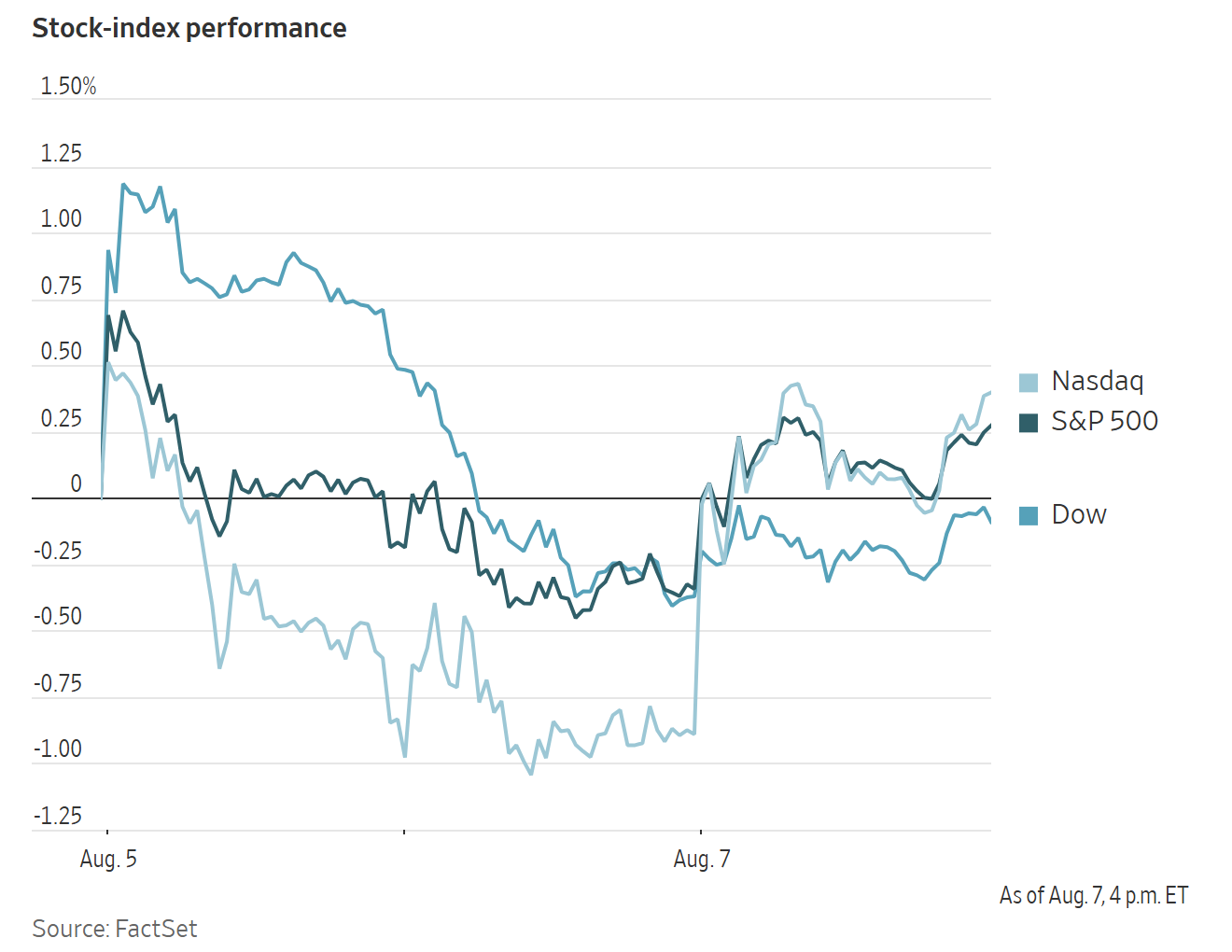
The S&P 500 closed at a record high on Friday after the weaker NFP report eased investor concerns about a potential Fed rate hike in September.
The S&P 500 gained +0.62%, securing its 26th all-time high of the year. The Dow Jones Industrial Average added +0.28%, or 151.83 points, while the Nasdaq Composite advanced +1.30%.
For the week, the S&P 500 rose +3.58%, the Nasdaq Composite advanced +5.19% and the Dow increased +2.96%. All three major indices recorded their largest weekly gains since 17 April.
In corporate news, AeroVironment shares rose after Bloomberg news reported that the US Army plans to purchase at least $400 million of counter-drone lasers from the company.
Corporate Earnings Reports
Posted on Friday, 7 August from The Pulse, our real-time AI-driven news tool. Available exclusively on the EXANTE Web Platform
Take-Two Interactive reported Q1 results for fiscal 2027. Revenue was $1.53bn vs $1.41bn expected, up +2% y/y. Net bookings reached $1.39bn, beating $1.37bn estimates. EBITDA was $167mn vs $155mn expected. The company reiterated full-year net bookings guidance of $8.0bn to $8.2bn, while revenue guidance of $7.9bn-$8.1bn fell short of the $8.51bn consensus. CEO Strauss Zelnick defended the $80 price tag for Grand Theft Auto VI, stating Rockstar aims to deliver far more value than players pay. He also noted that pre-orders for the game, launching on 19 Nov, are exceptional and unprecedented for the company or industry. Backpack added TTWO to its tokenized stock lineup on Solana.
European Stock Indices
CAC 40 +0.17%
DAX +0.69%
FTSE 100 +0.31%
Commodities
Gold spot +2.42% to $4,341.71 an ounce
Silver spot +3.30% to $63.55 an ounce
West Texas Intermediate -1.47% to $77.08 a barrel
Brent crude -1.59% to $82.25 a barrel
Gold rose sharply on Friday, advancing to its highest level in seven weeks and delivering bullion’s strongest weekly performance in seven months.
Spot gold increased +2.42% to $4,341.71 per ounce, after earlier climbing more than three percent to its highest level since 17 June.
For the week, spot gold gained +7.46%, its largest weekly advance since 19 January.
Spot silver rose +3.30% to $63.55 per ounce, taking its weekly gain to +10.27%.
Oil prices fell on Friday as uncertainty persisted over negotiations aimed at determining control of, and reopening, the Strait of Hormuz.
Brent crude futures settled at $82.25 per barrel, down $1.33, or -1.59%, while West Texas Intermediate futures closed at $77.08 per barrel, down $1.15, or -1.47%. For the week, WTI fell -11.24% and Brent declined -8.70%.
Although signals around a possible agreement have driven volatile swings in sentiment, the market remains uncertain about what conditions must be met for a deal to be finalised.
Iran and Oman are said to have agreed on the shipping route through the strait, which lies between the two countries, although it remains unclear whether the US will accept those terms.
Crude benchmarks weakened last Monday after President Trump paused a large-scale attack on Iran’s energy infrastructure. Prices then bottomed last Tuesday after Qatar said efforts toward a US - Iran resolution were ongoing and that draft language for a possible deal had been prepared.
On the same day, Secretary Bessant said a deal to reopen the Strait of Hormuz could come as soon as Wednesday. WTI and Brent subsequently rallied on Thursday and Friday amid reports that the IRGC was pressuring Iranian negotiators to seek broader financial concessions, including transit fees through the Strait of Hormuz, sanctions relief and the unfreezing of assets. Additional reports indicated that some Iranian hardliners want US and Israeli vessels barred from passing through the strait.
Other factors supporting prices in the second half of the week included continued attacks on vessels in the region by the IRGC and Yemen’s Houthis, who expanded their threats against the Kingdom of Saudi Arabia to all parts of the Red Sea. ADNOC said that three of its tankers were attacked this week alone. Iran also threatened on Thursday to target Gulf neighbours’ energy infrastructure if the US resumes strikes.
Ukraine continued its assault on Russian refining capacity, striking at least four additional facilities while Moscow continued to scramble for fuel supplies. Ukrainian officials said their goal is to end the war through refinery attacks. Bloomberg news reported that Russian refinery throughputs averaged 3.6 million bpd in July, a 24-year low and well below the seasonal historical average of 5.4 million bpd.
Libyan production and exports have risen to multi-year highs, Venezuelan production remains near multi-year highs, US imports of Venezuelan crude increased to 600,000 bpd, Kuwaiti output was said to be at its strongest level since the start of the war and Brazilian production set another record in June.
In other news, China further loosened restrictions on oil product exports. Asian crude imports in July reached their highest level since the war began, while China’s July crude imports rebounded from more than 10-year lows.
Note: As of 4 pm EDT 7 August 2026
Currencies
EUR +0.33% to $1.1558
GBP +0.27% to $1.3488
Bitcoin +0.80% to $64,919.34
Ethereum +0.56% to $1,915.90
The dollar declined against major currencies on Friday after US employment unexpectedly contracted in July, raising concerns about the economy’s underlying strength and weakening the case for further Fed tightening. The dollar index fell -0.34% to 99.60 and recorded a weekly decline of -0.20%, its second consecutive weekly loss.
The dollar weakened against the yen, reversing part of its recent gains following the prior week’s historic intervention by Japanese and US authorities, which had pushed the currency pair to a 13-week low.
The US dollar fell -0.43% to ¥157.78 on Friday, although it still posted a weekly gain of +0.18%.
The euro rose +0.33% against the dollar to $1.1558, bringing its weekly gain to +0.12%.
The British pound advanced +0.27% on Friday to $1.3488 and gained +0.06% for the week.
Fixed Income
US 10-year Treasury -3.0 basis points to 4.651%
German 10-year Bund -1.2 bps to 3.148%
UK 10-year Gilt -1.5 basis points to 4.927%
US Treasury yields declined on Friday after data showed that employers unexpectedly shed 23,000 jobs in July, prompting traders to reduce their expectations of a Fed rate hike in September.
Yields pared part of their earlier decline ahead of this week’s long-dated supply and the release of July consumer price inflation data.
The 2-year note yield, which typically tracks Fed funds rate expectations, fell -5.2 bps to 4.206%, after reaching 4.154% earlier in the session, its lowest level since 17 July.
The US 10-year note yield declined -3.0 bps to 4.651%. On a weekly basis, the 10-year yield fell -8.9 bps, while the 2-year yield declined -9.5 bps.
The 2s10s yield curve steepened by 0.6 bps over the week to 44.5 bps.
According to the CME Fedwatch tool, Fed funds futures traders are now pricing in a 44.4% probability of a rate hike at the Fed’s September meeting, down from 55.6% before the data. They are also pricing in +28.7 bps of rate hikes for the remainder of the year, down from +36.2 bps a week earlier.
The Treasury Department will test demand for longer-dated debt this week, when it sells $125 billion in coupon-bearing securities, including $58 billion in 3-year notes, $42 billion in 10-year notes and $25 billion in 30-year bonds.
Across the Atlantic, eurozone government bond yields edged lower on Friday.
Germany’s 2-year bond yield, which is sensitive to ECB deposit-rate expectations, fell -1.3 bps to 2.756%, contributing to a weekly decline of -7.5 bps.
Germany’s 10-year bond yield declined -1.2 bps to 3.148%. It fell -8.1 bps over the week, its largest weekly decline since late June. The spread between 10-year Bunds and US notes narrowed by 0.8 bps over the week to 150.3 bps.
Italy’s 10-year BTPs outperformed eurozone peers last week, with the yield declining -12.3 bps to 3.897%, its largest weekly fall since May. Over the same period, France’s 10-year OAT yield fell -8.3 bps to 3.918%.
On Friday, money markets priced in 36 bps of additional ECB monetary tightening this year, down from 37 bps a day earlier.
Note: As of 4 pm EDT 7 August 2026
While every effort has been made to verify the accuracy of this information, EXT Ltd. (hereafter known as “EXANTE”) cannot accept any responsibility or liability for reliance by any person on this publication or any of the information, opinions, or conclusions contained in this publication. The findings and views expressed in this publication do not necessarily reflect the views of EXANTE. Any action taken upon the information contained in this publication is strictly at your own risk. EXANTE will not be liable for any loss or damage in connection with this publication.
Tento článek je poskytován pouze pro informační účely a neměl by být považován za nabídku nebo výzvu k nákupu nebo prodeji jakýchkoli investic nebo souvisejících služeb, jejichž odkazy se v něm můžou vyskytovat. Obchodování s finančními nástroji je spojeno se značným rizikem ztráty a nemusí být vhodné pro všechny investory. Dřívější produktivita není spolehlivým ukazatelem budoucí produktivity.




Přihlásit se k odběru přehledů trhu
Přihlásit se k odběru
přehledů
trhu
Předplaťte si nyní Předplaťte si nyní


Založeno profesionály. Pro profesionály.
