

Will European risk be repriced?


 S&P 500 -1.55% last week to 7,457.69 US 10-year yield -1.2 basis points last week to 4.550% Spot gold -2.51% last week to $4,016.69 an ounce DXY -0.21% last week to 100.76
Key data to move markets today
EU: ECB Bank Lending Survey, German ZEW Survey Current Situation and Economic Sentiment, Eurozone ZEW Survey Economic Sentiment and a speech by Bundesbank President Joachim Nagel
USA: ADP Employment Change
UK: Employment Change, ILO Unemployment Rate, Claimant Count Rate and Change and Average Earnings
JAPAN: Merchandise Trade Balance, Imports and Exports
Global Macro Updates
Eurozone June inflation print confirms inflation cooling. Eurozone final CPI eased to 2.8% in June from 3.2% in May, matching the flash estimate, which had already come in below expectations of 3.0%. The decline was driven by slower increases in energy, services and food prices. Energy inflation fell to 8.5% from 10.8%. Services inflation eased to 3.2% from 3.5%, reversing much of May’s tourism-driven increase. Core inflation slowed to 2.1%, while the measure excluding only energy stood at 2.4%. Headline inflation averaged 3.0% in the second quarter, below the ECB’s forecast of 3.2%.
Analysts attributed part of the decline to lower fuel prices and continued moderation in food inflation. Airlines appear to have absorbed much of the recent increase in jet fuel costs linked to Middle East tensions, which limited the pass-through to consumers.The softer reading, particularly the cooling in services inflation and the limited second-round effects from higher energy prices, may reduce pressure on the ECB to deliver another rate hike next week. Although recent geopolitical tensions have pushed oil prices higher again, the June data gives policymakers more scope to wait and assess conditions before the September meeting.
Andy Burnham elected Labour leader and set to become PM today. Andy Burnham was elected Labour leader Friday in an uncontested race and is set to become Britain’s next Prime Minister today. The former Greater Manchester mayor will take office with a pledge to rebalance the UK away from London-centric politics and address the rise of Reform UK. According to the Financial Times, Burnham’s team is preparing a rapid policy push for his first days in office.
Key plans include signalling support for new North Sea oil and gas drilling at the Jackdaw and Rosebank fields, placing Thames Water into special administration or mutual ownership and accelerating social care reform through a potential national care service, according to Bloomberg news. He is also expected to advance devolution through a new ‘No. 10 North’ unit and introduce early cost-of-living measures, including possible rent controls.
In his victory speech, Burnham pledged to be pro-business, while emphasising support for small local businesses rather than large corporations. He also criticised the privatisation of key services under Margaret Thatcher, arguing that it left households more exposed to higher costs in housing, water, energy and transport.
Although the proposed energy measures may ease supply concerns, they could conflict with net-zero objectives. Fiscal pressures remain significant, and the likely appointment of Shabana Mahmood from her role of home secretary to Chancellor of the Exchequer is already drawing internal criticism. With a general election due by 2029, Burnham will need to deliver visible results quickly. Markets are likely to focus on whether his ambitious regional and interventionist agenda can be implemented within tight fiscal constraints.
US Stock Indices
Dow Jones Industrial Average -0.77%
Nasdaq 100 -1.49%
S&P 500 -1.01%, with 8 of the 11 sectors of the S&P 500 down
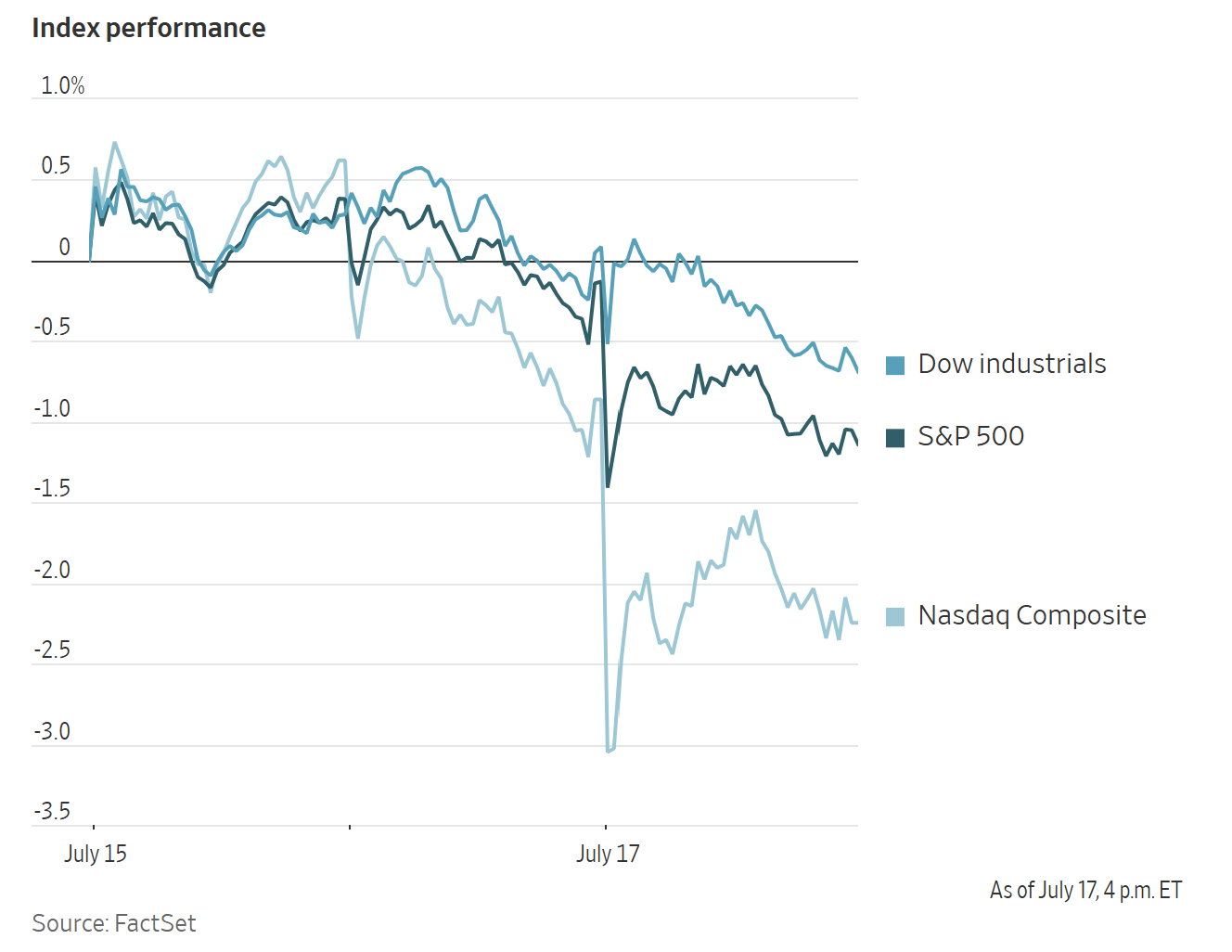
On Friday, the Nasdaq Composite lost -1.40%, the Dow industrials declined by -0.77%, or 406.55 points, and the S&P 500 decreased -1.01%.
For the week, the S&P 500 lost -1.55% and the Nasdaq Composite declined -2.90%, while the Dow fell -0.93%, accumulating a second consecutive week of losses.
A selloff in chipmakers accelerated, pushing the PHLX Semiconductor Sector index into bear-market territory amid growing concerns that the AI spending hyper-cycle is becoming increasingly difficult to justify.
The PHLX Semiconductor Sector index posted its worst week since April 2025, falling -20.23% to 11,763.89 on Friday from its 22 June record of 14,634.72. The index declined -9.97% for the week.
In corporate news, The Wall Street Journal reported that SpaceX is discussing a multibillion-dollar agreement with the Defence department to provide data centre capacity for AI model operations. The potential deal would further strengthen the Pentagon’s relationship with SpaceX, which already supports rocket launches and satellite management.
Meta Platforms is in early talks to lease computing capacity from its data centres to Anthropic PBC, potentially creating a new business line from its substantial AI infrastructure investment. The arrangement could be worth up to $10 billion over two years, according to The New York Times, which first reported the discussions.
Apple and the US Justice Department are in early settlement talks over a 2024 lawsuit alleging that the iPhone maker violated antitrust laws. The discussions remain active, with both sides exchanging draft settlement materials, though an agreement is not assured. The DOJ accused Apple of monopolising the high-end smartphone market, citing restrictions on super apps, outside messaging options and other practices.
European Stock Indices
CAC 40 -0.47%
DAX -0.34%
FTSE 100 +0.27%
Commodities
Gold spot +1.11% to $4,016.69 an ounce
Silver spot +0.73% to $55.90 an ounce
West Texas Intermediate +3.63% to $82.47 a barrel
Brent crude +3.78% to $88.11 a barrel
Gold rose on Friday, but still posted its largest weekly decline in six weeks.
Spot gold gained +1.11% to $4,016.69 per ounce, after touching its lowest level since 30 June earlier in the session. For the week, prices declined -2.51%.
The US dollar advanced for a second consecutive session, making bullion more expensive for overseas buyers.
Spot silver rose +0.73% to US$55.90 per ounce, although it fell -6.58% over the week.
Oil prices rose on Friday to their highest level in over a month, as escalating attacks between the US and Iran raised concerns over Gulf shipping flows. The risk of a potential Red Sea closure added to already restricted traffic through the Strait of Hormuz.
Brent crude futures settled US$3.21, or +3.78%, higher at US$88.11 per barrel, while US WTI futures rose US$2.89, or +3.63%, to US$82.47 per barrel.
Brent had its third consecutive weekly gain, while WTI its second. On a weekly basis, Brent and WTI traded +15.96% and +15.33% higher over the week, respectively.
The collapse of the US-Iran truce has led to a sharp decline in oil flows through the strait, as Iran targets vessels transiting the area.The US launched multiple waves of attacks against positions in Iran during last week, while Iran carried out attacks on Jordan, Bahrain, Kuwait, the UAE and other locations.
Friday’s prices were also supported in part by reports that the US was sending dozens of additional refuelling aircraft to Israel ahead of a possible escalation in attacks on Iran. Tensions between Iran-backed Houthis in Yemen and Saudi Arabia also increased after both sides launched strikes against one another.
Reports last Thursday indicated that Iran had asked Yemen’s Houthis to be prepared to close the Red Sea oil route if the US strikes Iranian power infrastructure. Houthi leaders also threatened to target Saudi oil facilities if Riyadh becomes involved in the military escalation.
Qatar’s defence ministry said its armed forces had thwarted an Iranian missile attack early on Friday, while the interior ministry reported that a child was wounded by shrapnel from interception operations.
Ukraine maintained pressure on Russian energy infrastructure, striking additional refineries and tankers in both the Azov and Black Seas. Russian refinery throughputs are estimated at 21-year lows of 3.8 million bpd. Concerns over low global product inventories also resurfaced, while the WTI 3-2-1 crack spread rose to record levels above $70 per barrel.
Note: As of 4 pm EDT 17 July 2026
Currencies
EUR -0.03% to $1.1439
GBP -0.15% to $1.3453
Bitcoin -0.04% to $64,075.76
Ethereum -1.86% to $1,841.19
The dollar index stood at 100.76, up +0.03% on the day, but recorded a weekly decline of -0.21% after softer US inflation data prompted traders to reduce bets on imminent Fed rate hikes.
The euro declined -0.03% on Friday to $1.1439, although it finished the week +0.23% higher.
Sterling fell -0.15% to $1.3453. It posted its third consecutive weekly gain following UK economic growth figures and expectations of greater political certainty, with incoming Prime Minister Andy Burnham reportedly set to appoint a centrist finance minister. The pound advanced +0.36% last week.
The Japanese yen was -0.01% lower at ¥162.39 per US dollar on Friday, remaining close to the 40-year low of ¥162.84 reached at the start of the month. For the week, the yen declined -0.43%.
Traders remained alert to the risk of official intervention from Tokyo after Japanese Finance Minister Satsuki Katayama reiterated the government’s readiness to take decisive action.
Fixed Income
US 10-year Treasury -0.9 basis points to 4.550%
German 10-year Bund -1.2 basis points to 3.151%
UK 10-year Gilt -0.5 basis points to 4.967%
Longer-dated US Treasury yields declined on Friday following the latest economic data and ended the week lower, as markets largely priced out the likelihood of a Fed rate hike at its policy meeting later this month.
Money markets are now pricing in only a 14.4% probability of a July rate hike, according to CME FedWatch, down from slightly above 40% last Monday. However, expectations for a hike at the Fed’s September meeting stand at 57.1%.
The yield on the US 10-year Treasury note fell -0.9 bps to 4.550%. The yield declined -1.2 bps over the week, marking its first weekly drop after two consecutive weekly increases.
The yield on the 30-year bond fell -1.4 bps to 5.072%, but was slightly higher on the week, up +1.1 bps. This is its fourth consecutive weekly increase. The yield is +10.7 bps higher MTD.
The US Treasury yield curve, measured by the spread between two-year and 10-year Treasury yields, stood at 36.7 bps, 2.1 bps higher than the prior week.
The two-year US Treasury yield, which typically moves in line with Fed funds rate expectations, traded +2.5 bps higher at 4.183% on Friday, but declined -3.3 bps over the week.
Eurozone government bond yields rose this week, as investors positioned for the ECB to deliver more than one additional rate hike this year.
Investors now expect the ECB to raise rates at least once more in September and assign a roughly 72% probability to a second hike before year-end.
The 2-year German Schatz yield rose +14.1 bps last week to 2.803%, up +3.8 bps on Friday.
The 10-year German Bund yield also performed poorly, rising +8.4 bps last week to 3.151% after declining -1.2 bps on Friday. Italy’s 10-year BTP yield advanced +13.5 bps last week to 3.948%, while the French 10-year OAT yield traded +21.3 bps higher over the week to 3.934%.
Note: As of 4 pm EDT 17 July 2026
While every effort has been made to verify the accuracy of this information, EXT Ltd. (hereafter known as “EXANTE”) cannot accept any responsibility or liability for reliance by any person on this publication or any of the information, opinions, or conclusions contained in this publication. The findings and views expressed in this publication do not necessarily reflect the views of EXANTE. Any action taken upon the information contained in this publication is strictly at your own risk. EXANTE will not be liable for any loss or damage in connection with this publication.
Tento článek je poskytován pouze pro informační účely a neměl by být považován za nabídku nebo výzvu k nákupu nebo prodeji jakýchkoli investic nebo souvisejících služeb, jejichž odkazy se v něm můžou vyskytovat. Obchodování s finančními nástroji je spojeno se značným rizikem ztráty a nemusí být vhodné pro všechny investory. Dřívější produktivita není spolehlivým ukazatelem budoucí produktivity.




Přihlásit se k odběru přehledů trhu
Přihlásit se k odběru
přehledů
trhu
Předplaťte si nyní Předplaťte si nyní

Založeno profesionály. Pro profesionály.
