

Can Paris afford its politics?


 S&P 500 +0.58% to 7,818.93, a record high US 10-year yield -2.3 basis points to 5.289% Spot gold +0.58% to $4,163.73 an ounce DXY -0.27% to 101.84
Key data to move markets today
EU: German Industrial Production and a speech by ECB Vice President Boris Vujčić
USA: FOMC Minutes
JAPAN: Current Account
Global Macro Updates
France’s fiscal spread bet. French bonds rallied on Tuesday, with the 10-year OAT - Bund spread at 125.8 bps after approaching 159 bps last week. Yet this is not catharsis. France still combines a deficit of 5.4% of GDP, debt near 120% and planned issuance of €340 billion for 2027, while pandemic era borrowing is refinanced at less forgiving rates.
Of course, politics is only now catching up with the unforgiving math. Marine Le Pen’s programme promises €140 billion of net savings by 2032, primary balance within 18 months and a deficit below 3% by 2030, more ambitious than the government’s 5% objective for 2027. Yet fuel tax relief, earlier retirement and projected savings from immigration, EU transfers and administrative streamlining leave investors ample reason to apply a credibility discount.
The FT’s useful framing is that bond vigilantes, parliamentary gridlock and street unrest are no longer separate stories; together, they are making fiscal capacity the organising issue of the 2027 election. The uncomfortable inversion is that France, formerly a core creditor during Europe’s sovereign debt crisis, now trades with a larger risk premium than several former peripheral borrowers.
Still, this is not 2011 - 12 redux. Then, markets questioned solvency and euro membership across the periphery; today’s stress remains principally French, euro-area safeguards are stronger and the ECB has its Transmission Protection Instrument (TPI). France is larger and deeply embedded in European portfolios, so genuine contagion could prove harder to quarantine.
That distinction matters when testing for overreaction. Investors should seek sustained compression between French and German yields alongside stable Italian, Spanish and Greek spreads, lower French sovereign credit default swaps, resilient bank shares and subordinated debt, orderly auctions and a euro no longer weakening on French headlines. An OAT only rally would resemble short covering. Broader normalisation would signal overshoot. ECB intervention remains distant because France is subject to the EU excessive deficit procedure, while the TPI targets disorderly tightening rather than weak fiscal arithmetic.
The calendar supplies the catalysts that investors should be mindful of. Assembly scrutiny begins on 13 October, the revenue section faces a crucial vote on 20 October and the full bill is scheduled for 17 November. Amendments, opposition concessions, ratings actions and any resort to Article 49.3 could move spreads. If no budget clears by year-end, a special law could roll forward the 2026 framework, leaving a final pre-election window through February and little prospect of sleepy year-end trading.
US Stock Indices
Dow Jones Industrial Average +0.49%
Nasdaq 100 +0.48%
S&P 500 +0.58%, with 10 of the 11 sectors of the S&P 500 up
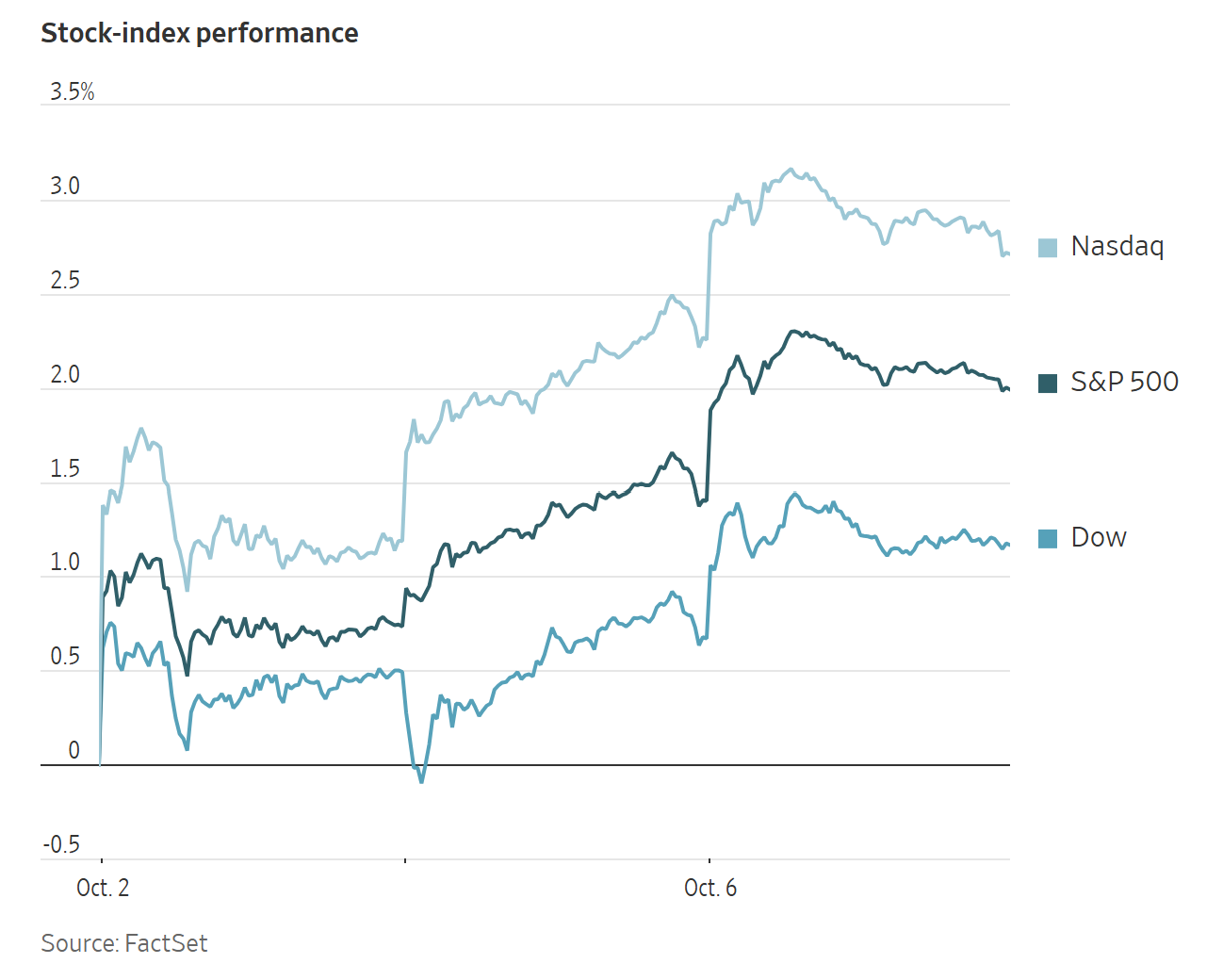
US stocks reached new records on Tuesday as bond yields eased slightly, extending a week in which equities advanced despite shifting rate expectations. The S&P 500 and Nasdaq Composite both posted record closing highs. The S&P 500 gained +0.58%, the Nasdaq Composite rose +0.45% and the Dow Jones Industrial Average advanced 253.38 points, or +0.49%.
Against that backdrop, the S&P 500 set a new intraday high above 7,830 and recorded its 28th record close of 2026.
Despite the broad index gains, the market is increasingly being driven by a narrow group of technology companies investing in and benefitting from the AI hyper-CapEx cycle. Most other segments are under pressure, including healthcare companies, banks, consumer staples, small-cap stocks and blue-chip shares such as those in the Dow Jones Industrial Average.
This concentration has widened the gap between the market's largest winners and the broader equity market. Fewer than half of the stocks in the S&P 500 closed above their 200-day moving average on Tuesday, according to Dow Jones Market Data, with the share declining steadily since August.
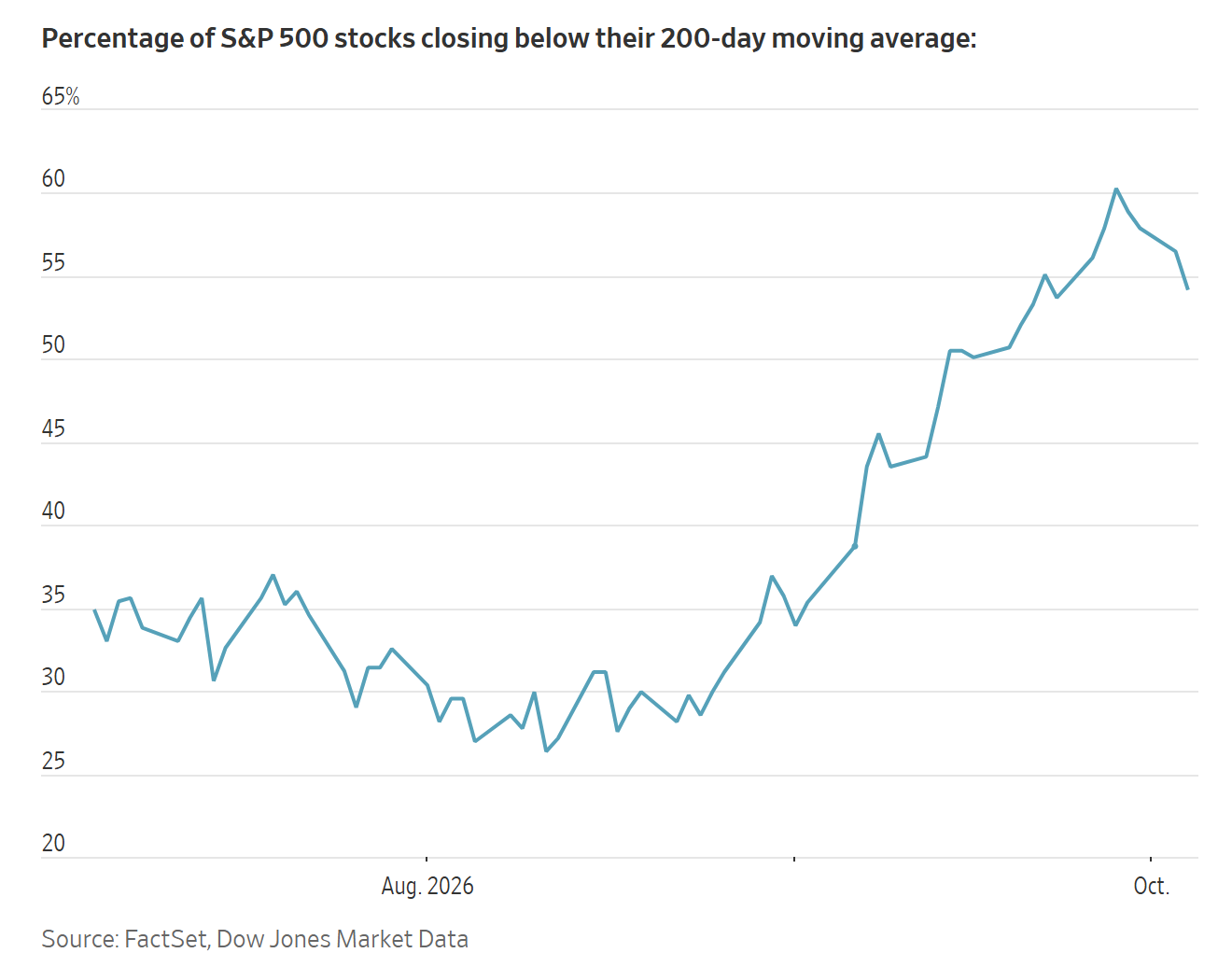
As a result, investors are increasingly assessing which areas of the market can withstand these conditions, with technology stocks increasingly viewed as relatively defensive.
By contrast, the prospect of higher interest rates and rising costs is weighing on companies across the broader market. Since the end of August, the Russell 2000 has underperformed the S&P 500. The Dow Jones Industrial Average and the equal-weighted S&P 500 have also lagged.
In corporate news, Uber agreed to acquire workplace catering and meals platform ezCater in a transaction valued at $2.3 billion.
Becton Dickinson reached an agreement with the Trump administration to expand domestic manufacturing in exchange for relief from future tariffs. The medical technology company said it would invest $19 billion in the US over several years, including $3 billion in manufacturing. The US President said medical-device tariffs would be introduced by year-end.
The Wall Street Journal reported that Nvidia-backed cloud computing company Lambda is raising up to $4 billion in a final funding round ahead of a planned initial public offering. The pre-IPO round, led by Blackstone and Coatue Management, values Lambda at $14.5 billion before the new capital. The company is targeting a 2027 IPO, while its backlog increased from $15 billion in June to $50 billion in September.
The growing intersection of technology and energy was underscored on Tuesday by a broad 20-year nuclear power agreement between Google and Constellation Energy aimed at increasing output from 11 existing reactors to meet rising data-centre power demand. The 890-megawatt power purchase agreement announced on Tuesday covers upgrades to Constellation-owned reactors in Illinois, Pennsylvania and New Jersey. Constellation plans to invest more than $4.3 billion in the facilities, with the first uprate project scheduled for 2028 and work on the remaining projects continuing through 2032 or 2033. The companies also signed a 15-year supply agreement for an additional 2,700 megawatts of electricity in the PJM power market across the Mid-Atlantic and Midwest.
European Stock Indices
CAC 40 +0.40%
DAX +0.77%
FTSE 100 +0.42%
Commodities
Gold spot +0.58% to $4,163.73 an ounce
Silver spot +0.46% to $61.23 an ounce
West Texas Intermediate +0.68% to $89.91 a barrel
Brent crude +0.81% to $101.15 a barrel
Gold prices rose on Tuesday, supported by a pause in the US Treasury yield rally and a weaker dollar.
Spot gold rose +0.58% to $4,163.73 per ounce.
Silver gained +0.46% to $61.23 per ounce.
Oil prices edged higher on Tuesday after recovering earlier losses, as markets weighed rising Middle Eastern crude exports and a planned G7 release of emergency diesel and crude stockpiles against supply concerns linked to attacks by Yemen's Iran-backed Houthis.
Brent futures rose 81 cents, or +0.81%, to settle at $101.15 per barrel, while US WTI crude gained 61 cents, or +0.68%, to close at $89.91 per barrel.
Around 12 million bpd of crude oil and 2 million bpd of refined products, volumes needed to ease price pressures, have left the Middle East on tankers over the past seven to 10 days, Vitol's CEO said on Tuesday.
Saudi Energy Minister Prince Abdulaziz bin Salman said oil flows through the East-West Pipeline to the Red Sea export hub of Yanbu had reached 5.8 million barrels by Tuesday morning.
However, the risk of further supply disruptions in the Middle East limited the decline in oil prices.
Saudi Arabia's airports in Jazan and Najran were targeted in two attacks on Monday evening, injuring three people and causing limited damage, according to the Saudi aviation authority, as hostilities with Yemen's Iran-backed Houthis escalated.
The attacks came as Saudi-backed Yemeni government forces launched a major offensive to retake territory from the Houthis after weeks of rebel advances, with Riyadh intensifying airstrikes in support of the campaign.
Separately, Ukrainian President Volodymyr Zelenskiy said on Tuesday that the latest intelligence indicated Russia was preparing a ‘massive attack.’
According to US energy data, Russia was the world's third-largest crude oil producer in 2025, behind the US and Saudi Arabia. Sanctions aimed at restricting Russian energy from global markets have supported oil prices since Russia invaded Ukraine in 2022.
In the US, the National Hurricane Center said there was a 100% chance that a cyclone could form in the Gulf of Mexico over the next seven days. A Gulf storm could support oil prices by disrupting oil and natural gas production and damaging energy infrastructure.
The International Energy Agency will meet next week to finalise the details of a diesel stock release, as uncertainty grows over how many barrels Europe and the US plan to make available to address shortages and record-high prices, sources said.
The surge in diesel prices has made the fuel, which underpins trucking, agriculture and industry, a global political and economic concern. The wars in Iran and Ukraine have curtailed exports and damaged refineries, contributing to the rise in prices.
Under pressure from the US President, the G7 agreed on Friday to release 100 million barrels of diesel and crude oil from emergency reserves and pledged not to impose energy export restrictions.
With the war in Iran disrupting Middle Eastern oil flows, the US Energy Information Administration projected on Tuesday that global petroleum production would fall from a record 106.3 million bpd in 2025 to 101.1 million bpd in 2026. Global oil demand was also forecast to decline from a record 104.4 million bpd to 102.4 million bpd.
For 2027, however, the EIA projected that global oil supply and demand would rebound to record highs of 109.6 million bpd and 104.6 million bpd, respectively.
Note: As of 4 pm EDT 6 October 2026
Currencies
EUR +0.37% to $1.1259
GBP +0.39% to $1.3268
Bitcoin -0.36% to $85,626.74
Ethereum -0.71% to $2,698.18
The euro rebounded on Tuesday and was on track for its strongest advance in seven weeks after touching a 17-month low the previous day, as a pullback in French government bond yields eased concerns over stress in eurozone debt markets.
The euro jumped +0.37% to $1.1259, its largest daily gain since 19 August. On Monday, it had fallen to $1.1160, its lowest level since May 2025, after declining 1.21% in the previous week for a fourth consecutive weekly loss.
The dollar index fell -0.27% to 101.84, its sharpest daily decline since 3 September.
The dollar's decline supported other currencies, with sterling rising +0.39% to $1.3268, its strongest daily gain since 19 August, after reaching a one-week high of $1.3283.
The yen was the exception, with the dollar rising +0.13% to ¥158.09 against the Japanese currency.
BoJ Governor Kazuo Ueda said anchoring underlying inflation around the central bank's 2% target was becoming increasingly important, signalling readiness to continue raising interest rates to contain high inflation.
Fixed Income
US 10-year Treasury -2.3 basis points to 5.289%
German 10-year Bund -0.9 basis points to 3.497%
UK 10-year Gilt -4.8 basis points to 5.381%
US Treasuries rebounded on Tuesday after a sharp selloff in the previous session pushed long-term yields to multi-decade highs. Solid demand at a three-year note auction also supported the rally.
In afternoon trading, the US 10-year yield fell -2.3 bps to 5.289% after reaching a 24-year high on Monday. The US 30-year yield declined -0.4 bps to 5.661%, also following a 24-year peak in the previous session.
At the front end of the curve, the US 2-year yield, which is sensitive to the interest-rate outlook, fell -1.7 bps to 4.806%.
The US 2s10s yield curve narrowed 0.6 bps to 48.3 bps from 48.9 bps late Monday. The curve had reached its steepest level in seven weeks on Monday after long-dated yields rose more sharply than shorter-dated yields, a move known as a bear steepener.
Tuesday's three-year note auction drew solid demand, pricing at 4.932%, below the expected yield at the bid deadline but above the six-auction average of 4.167%. The bid-to-cover ratio was slightly weak at 2.62x, compared with a six-auction average of 2.65x. Direct bidders took 31.7% of the offering, the largest share since February.
After yesterday's auction, $39 billion in 10-year notes are on the docket for today and $22 billion in 30-year bonds are set to be auctioned Thursday.
According to CME Group's FedWatch Tool, traders assigned a 79.5% probability to the Fed leaving rates unchanged at its 27 - 28 October meeting and a 68.2% probability to a rate increase in December.
Eurozone bond yields fell on Tuesday, while the spread between French and German 10-year yields narrowed further from last Friday's peak as investors assessed if the recent surge in France's risk premium had gone too far too quickly.
The selloff eased slightly this week, with the spread narrowing to 125.8 bps after reaching a 15-year high of 158.0 bps on Friday.
France's 10-year yield fell -11.2 bps on the day, while Germany's 10-year yield declined -0.9 bps to 3.497%.
The French government sought to calm market concerns by presenting a 2027 budget that included €43 billion in new savings. Meanwhile, far-right presidential candidate Marine Le Pen outlined plans on Tuesday to reduce the public deficit to 3% by 2030.
French Finance Minister Roland Lescure said bond-market turbulence had not reached a level that warranted considering ECB policy tools to stabilise borrowing costs.
Italy's 10-year bond yield also fell -11.2 bps on Tuesday to 4.530%.
ECB officials, including chief economist Philip Lane, have begun questioning the need for further rate increases if rising bond yields weigh on growth and curb price pressures.
Markets now assign an 85% probability to another rate increase by year-end, slightly above Monday's level.
Germany's 2-year Schatz yield, which is sensitive to changes in interest-rate expectations, rose +1.8 bps to 3.093% on Tuesday.
Note: As of 4 pm EDT 6 October 2026
While every effort has been made to verify the accuracy of this information, EXT Ltd. (hereafter known as “EXANTE”) cannot accept any responsibility or liability for reliance by any person on this publication or any of the information, opinions, or conclusions contained in this publication. The findings and views expressed in this publication do not necessarily reflect the views of EXANTE. Any action taken upon the information contained in this publication is strictly at your own risk. EXANTE will not be liable for any loss or damage in connection with this publication.
本文提供給您僅供資訊參考之用,不應被視為認購或銷售此處提及任何投資或相關服務的優惠招攬或遊說。金融商品交易涉及重大損失風險,可能不適合所有投資者。過往績效不代表未來表現。
 回到所有洞察資訊








由專業人士建立。為專業人士打造。
