

Has AI met its bond vigilantes?

 S&P 500 -0.06% to 7,764.64 US 10-year yield +1.4 basis points to 4.970% Spot gold +0.26% to $4,353.74 an ounce DXY +0.12% at 100.54
Key data to move markets today
EU: Eurozone, German and French HCOB Composite, Manufacturing and Services PMIs and speeches by ECB’s Vice-President Boris Vujčić, Chief Economist Philip Lane and Executive Board member Piero Cipollone
UK: S&P Global Manufacturing, Composite and Services PMIs
USA: S&P Global Manufacturing, Composite and Services PMIs and a speech by Fed Governor Michael Barr
Global Macro Updates
AI’s credit premium. A clear divide is emerging in investment-grade credit. AI-linked borrowers face greater scrutiny and wider concessions, while traditional financial, industrial and healthcare issuers continue to attract aggressive demand. So far, the distinction reflects supply risk rather than mounting concern over hyperscaler solvency.
As reported by Reuters, Goldman Sachs expects hyperscaler gross issuance to reach a record $420 billion in 2027, 60% above its 2026 estimate. That pipeline is formidable even against a broader US corporate market in which issuance had already risen 30% y/o/y to $1.9 trillion through August. Equity investors can dream about AI; creditors still need to know when the data centre starts paying rent.
Recent deals capture the mood. Alphabet raised $25 billion in August and attracted roughly $115 billion of orders, although generous yields helped produce that enthusiasm. Amazon’s return with another $25 billion deal also pushed hyperscaler spreads wider, suggesting that even excellent credit becomes less charming when it arrives too frequently.
Elsewhere, scarcity remains an effective marketing strategy. Aon’s $13.5 billion acquisition financing generated around $65 billion of demand, allowing its 30-year tranche to tighten by 35 bps during execution, as reported by Bloomberg news.
The resulting valuation gap is difficult to ignore. AI-related spreads remain near 115 bps, against approximately 78 bps for the broader investment-grade market. The premium reflects issuance risk, uncertain returns on invested capital and increasingly awkward concentration limits as parent bonds and associated data-centre vehicles accumulate in the same portfolios.
Predictable borrowing programmes can be accommodated. Surprise issuance shortly after an earlier deal, especially at wider spreads, encourages investors to wait for the next concession. The message from bond markets is that enthusiasm is not a covenant, and that even the future of technology must clear the syndicate desk.
US Stock Indices
Dow Jones Industrial Average -0.36%
Nasdaq 100 +0.82%
S&P 500 -0.06%, with 7 of the 11 sectors of the S&P 500 down
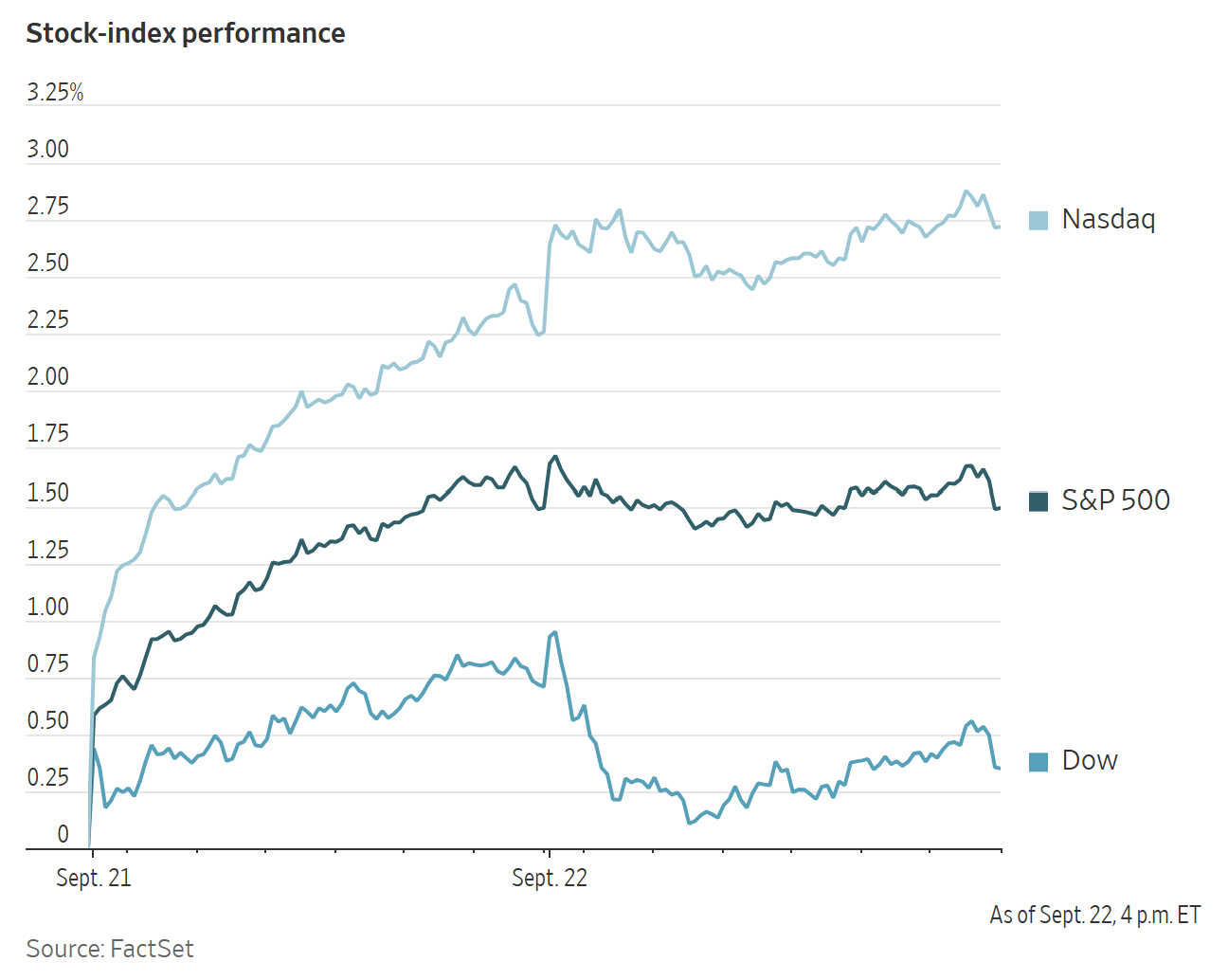
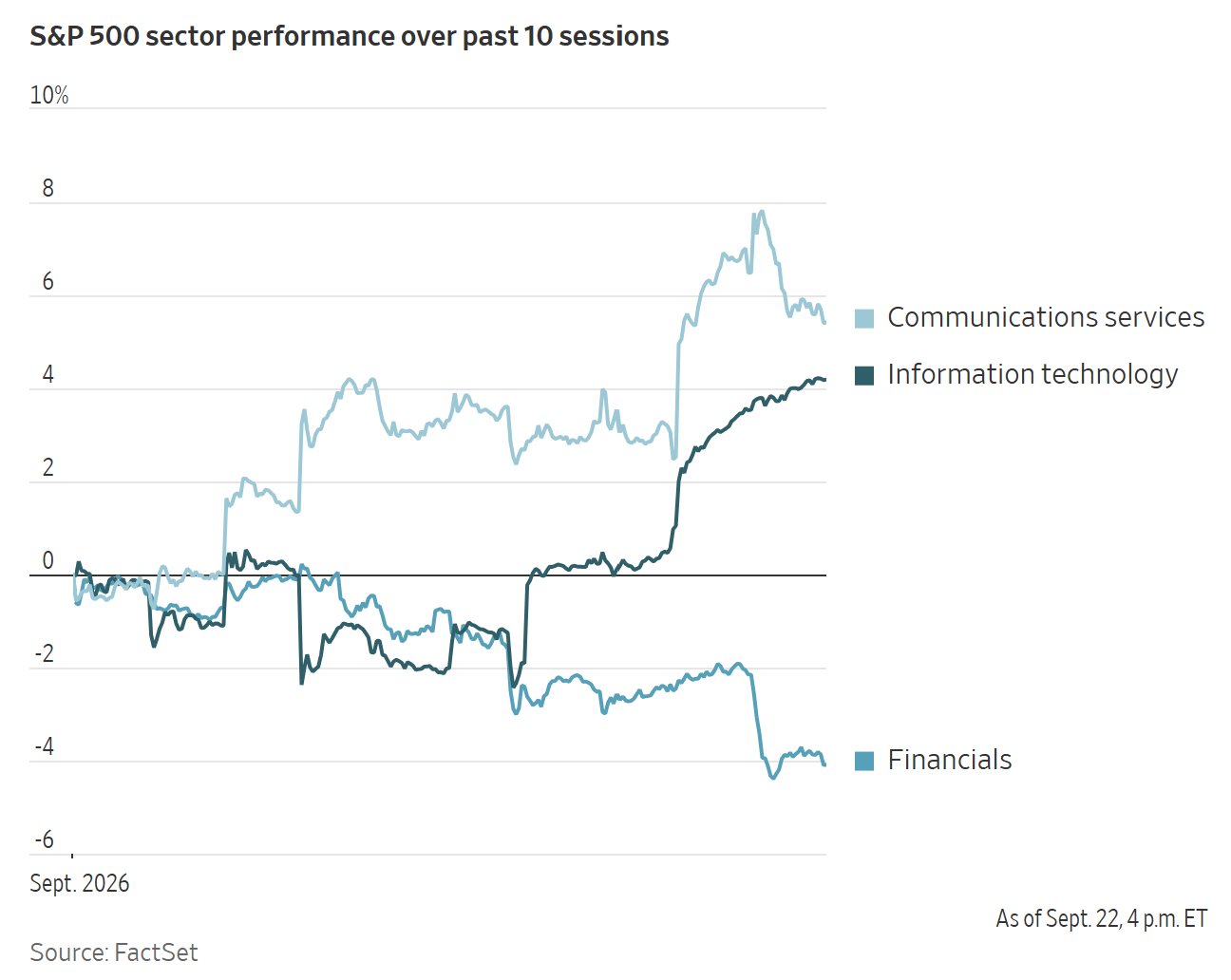
The rapid adoption of Meta Platforms’ Muse app renewed concerns that AI could disrupt the financial-services industry, contributing to Tuesday’s selloff in wealth managers, brokerages and major banks. The S&P 500 Financials sector fell -1.98%. The S&P 500 edged down only -0.06 points to 7,764.64.
The Dow Jones Industrial Average was -0.36%, or 185.14 points. Continued gains in technology shares lifted the Nasdaq Composite +0.45% to a record 27,244.28.
In corporate news, Alibaba unveiled its most powerful chip to date, reinforcing its effort to control the software and hardware underpinning its AI ambitions.
DoorDash agreed to pay $131.5 million to settle an investigation by New York City regulators after acknowledging that it had underpaid delivery workers and failed to make certain payments.
Berkshire Hathaway purchased approximately $212.4 million of homebuilder Lennar’s shares in recent days, according to securities filings. The acquisitions increased Berkshire’s ownership to roughly 10% of Lennar, with the stake recently valued at about $2 billion based on the reported share count.
Goldman Sachs emerged as the leading bidder for Palmer Square Capital Management, a credit manager overseeing $37 billion. An acquisition could rapidly expand Goldman’s presence in the collateralised loan obligation market, as Palmer Square’s CLO platform accounts for approximately $27 billion of total assets under management.
Viking Therapeutics shares surged on Tuesday after a small exploratory study showed its dual-action obesity injection helped patients lose weight and maintain the reduction. Participants receiving an intermediate weekly dose lost as much as 19% of their body weight after approximately five months, while an exploratory cohort lost 22% without reaching a plateau. After transitioning to less frequent dosing, some participants maintained 90% to 97% of the weight loss; side effects were generally mild and diminished over time.
European Stock Indices
CAC 40 +0.20%
DAX +0.02%
FTSE 100 -0.29%
Commodities
Gold spot +0.26% to $4,353.74 an ounce
Silver spot +1.62% to $67.08 an ounce
West Texas Intermediate -0.40% to $95.21 a barrel
Brent crude -1.46% to $98.61 a barrel
Gold prices edged higher on Tuesday, even as markets priced in a more restrictive Fed policy stance this year.
Spot gold rose +0.26% to $4,353.74 per ounce.
Markets remained focussed on monetary tightening after St Louis Fed President Alberto Musalem and Chicago Fed President Austan Goolsbee indicated that additional rate hikes may be needed to curb inflation driven by robust demand and rising energy prices.
Spot silver rose +1.62% to $67.08 per ounce.
Oil prices fell on Tuesday as Saudi crude flows increased following the restart of the East-West Pipeline and there was a rise in vessel traffic through the Strait of Hormuz.
Brent and US crude pared their sharpest intraday losses after the US President tempered expectations of an imminent peace agreement with Iran, saying that a deal would come only after the US midterm elections in early November.
November Brent crude futures settled at $98.61 per barrel, down $1.46, or -1.46%.
The October WTI contract, which expired on Tuesday, settled at $95.21 per barrel, down 38 cents, or -0.40%, while the November contract closed at $90.52 per barrel.
Saudi Arabia has restarted operations at its East-West Pipeline and could resume exports from Yanbu port later on Tuesday, Reuters reported, citing three sources briefed on the matter.
Iran could reopen the Strait of Hormuz within seven days if the US eases military pressure and lifts its blockade of Iranian ports, a senior Iranian official told Reuters on Tuesday. The official added that Iran’s delegation to the UN General Assembly in New York has full authority to revive diplomatic engagement with the US.
Diesel prices in Europe and the US have climbed to record highs as the wars in Iran and Ukraine sharply reduced exports from major producers, including Russia, Saudi Arabia and the United Arab Emirates.
Note: As of 4 pm EDT 22 September 2026
Currencies
EUR -0.14% to $1.1447
GBP -0.15% to $1.3342
Bitcoin -0.35% to $86,240.38
Ethereum -0.70% to $2,749.33
The dollar advanced in volatile trading on Tuesday, alternating between gains and losses after reaching a two-month high earlier in the session.
The dollar index ended the trading day +0.12% to 100.54, while the euro fell -0.14% to $1.1447. Earlier, the index had gained as much as +0.27% to 100.70, its highest level since 30 July. It had also declined by as much as -0.11%.
Against the Japanese yen, the dollar strengthened +0.04% to ¥157.32, marking a third consecutive daily gain.
Despite the BoJ’s rate hike last week, the Japanese currency remains under pressure. Investors interpreted dissent from two policymakers, who favoured a more cautious pace, as a sign that further hikes may be more difficult to implement.
Sterling weakened -0.15% to $1.3342, recording its second consecutive daily decline and its sixth loss in seven sessions.
Fixed Income
US 10-year Treasury +1.4 basis points to 4.970%
German 10-year Bund +0.5 basis points to 3.469%
UK 10-year Gilt +2.3 basis points to 5.242%
Long-term US Treasury yields edged higher on Tuesday.
The two-year US Treasury yield, which typically tracks expectations for the Fed funds rate, reached a two-year high of 4.788% before ending the day -0.2 bps lower at 4.751%.
The Fed raised rates last week for the first time since 2023 in an effort to contain inflation. Money markets remain nearly evenly divided over whether the Fed will raise rates at its 28 October meeting, assigning a 54.2% probability to a 25-bps increase, down from 57.6% in Monday’s session, according to CME FedWatch.
The 10-year US Treasury yield remained below five percent after reaching 5.041% last week, its highest level since 2007. It ended Tuesday’s session +1.4 bps higher at 4.970%.
Two-year yields briefly moved higher following the Treasury Department’s $69 billion auction of two-year securities.
The 4.787% auction yield was marginally above the prevailing market level at the bidding deadline, while the 2.63x bid-to-cover ratio was slightly higher than the 12-month average of 2.61x.
Five- and seven-year Treasury auctions are also scheduled this week.
At the long end of the curve, the 30-year Treasury yield traded +1.7 bps higher at 5.303%.
The US 2s10s yield curve stood at 21.9 bps, 1.6 bps wider than on Monday.
Eurozone government bond yields moved slightly higher across maturities and markets on Tuesday.
Germany’s 10-year Bund yield traded +0.5 bps higher at 3.469% after rising by as much as +4 bps earlier in the session. It had declined -6.6 bps on Monday.
Germany’s two-year Bund yield, which is sensitive to ECB deposit-rate expectations, advanced +2.6 bps to 3.236% after falling -8.3 bps on Monday.
French government bonds underperformed their peers as investors remained focussed on France’s budget debate and the lead-up to the 2027 presidential election.
The spread between 10-year French OAT and German Bund yields reached 105.6 bps earlier in the session, its widest level since 2012. It closed at 103.8 bps, 3.1 bps wider than on Monday.
Note: As of 4 pm EDT 22 September 2026
While every effort has been made to verify the accuracy of this information, EXT Ltd. (hereafter known as “EXANTE”) cannot accept any responsibility or liability for reliance by any person on this publication or any of the information, opinions, or conclusions contained in this publication. The findings and views expressed in this publication do not necessarily reflect the views of EXANTE. Any action taken upon the information contained in this publication is strictly at your own risk. EXANTE will not be liable for any loss or damage in connection with this publication.
本文提供給您僅供資訊參考之用,不應被視為認購或銷售此處提及任何投資或相關服務的優惠招攬或遊說。金融商品交易涉及重大損失風險,可能不適合所有投資者。過往績效不代表未來表現。







由專業人士建立。為專業人士打造。
