

A Real carry?


 S&P 500 -0.47% last week to 7,623.68 US 10-year yield -8.4 basis points last week to 5.001% Spot gold -4.07% last week to $3,995.52 an ounce DXY -0.03% last week to 101.75
What to look out for today
Companies reporting on Monday, 26th October: Alexandria Real Estate, Brown & Brown, Cadence Design Systems, Cincinnati Financial, Nucor, Principal Financial Group, Public Storage, Verizon Communications, Welltower
Key data to move markets today
EU: IFO Expectations, Business Climate and Current Assessment and a speech by ECB Board member Frank Elderson
Global Macro Updates
Priced for a pivot that never came. Brazilian assets spent September leaning towards political change. On Monday, instead, they will meet the beginning of Luiz Inácio Lula da Silva’s fourth term. President Lula took 51.8% of the valid vote, defeating Senator Flávio Bolsonaro and embarrassing pollsters who had, almost to a house, overstated the conservative wave. Abstention fell from 21.1% in the October 4 first round to 19.2%, reversing the typical runoff increase.
Unfortunately, for investors, positioning ran the other way. Receiving positions in the middle of the DI curve (the term structure of interest rates derived from One-day Interbank Deposit Futures on the Brasil, Bolsa, Balcão exchange), short-dated index calls and rate-sensitive equities effectively bet on a shift in fiscal policy. Sovereign spreads sat near decade tights and had outperformed high-yield peers since July. The asymmetry that once favoured the upside now has to be unwound by those who leaned into it. The election result will hit across rates, currency and credit, with no uniform verdict on Brazil.
The mechanics bear restating. Brazil’s nominal deficit is near 9% to 10% of GDP, but its primary deficit is below 1%, with interest costs accounting for the difference. With more than half of domestic debt indexed to the Selic, the base rate of the Brazilian economy, and maturities short, monetary policy reaches the fiscal accounts almost immediately, a testament to a powerful reinforcing dynamic between fiscal and monetary policy. Credible consolidation would permit rate cuts, which would shrink the interest bill, which would reinforce consolidation. Under the status quo, the cycle reverses. Loose fiscal policy keeps monetary policy tight, compounding interest costs and increasing the term premium. Reasonable expectations for Lula’s fourth term would suggest modest spending restraint, a heavier tax burden, a central role for the state and little structural reform, making the second cycle more likely than the first.
In equities, the most vulnerable pockets carry the most rate beta, including domestic cyclicals, utilities, financials, discretionary and small caps. State-owned enterprises are also exposed, since their governance discount tends to widen whenever the state is cast as an engine of growth. Commodity exporters in agribusiness, oil and gas and mining are better placed, with dollar revenues, firm terms of trade and a natural hedge in a softer Real. The rate-sensitive names are also where an overreaction would show most clearly. They are flat to down on the year, trade below their decade-average multiples and move two to three times as much as the index for a given change in local rates. And, as is the case with most EMs, Brazilian history cuts both ways. In 2014 equities fell between rounds, yet an orthodox cabinet briefly revived the currency. In 2022 the runoff cleared positioning before spending risk delivered a sharp correction over the following six months.
Corporate credit is unlikely to escape the sovereign’s gravity. The risk premium investors currently demand to hold Brazilian corporate bonds is unusually low, so the skew favours widening. Domestically oriented and state-linked issuers are most exposed, while exporters with hard-currency cash flows should prove more resilient. US rate volatility, which has already pushed EM spreads wider, will likely add to the pressure.
On the currency front, the Real poses a subtler problem. Its carry remains among the most attractive in EMs, and the fiscal premium accumulated during the 2024 sell-off has largely compressed. That leaves room for the fiscal premium to widen again. Carry provided little protection in 2015 as fiscal and external conditions worsened together. Paradoxically, a fiscal status quo keeps rates high and carry intact, but only by prolonging an equilibrium that cannot last. Foreign investors must therefore assess currency exposure, hedging costs and conviction in local assets separately. Strong local returns may still disappoint after translation into dollars. Sustainable carry depends on volatility and policy credibility, not just headline yields.
The key catalysts in the coming weeks are the choice of finance minister, the emergence of a credible multi-year fiscal consolidation plan and an honest assessment of campaign promises’ costs against the 2027 budget.
Beyond the left-right shorthand, the arithmetic of Congress deserves attention. The opposition Liberal Party (PL) is now the largest party in both chambers. Right and centre-right parties control 57% of the House and nearly two-thirds of the Senate, and most governors are now deemed conservative. That political backdrop could prove constructive if it produces a legislature that blocks tax-heavy adjustments and trades its support for spending restraint. But conservative does not automatically mean fiscally disciplined, as legislators also seek control over spending. The pragmatic centre has shrunk, but remains transactional, seeking ministries, budget allocations and posts in state companies. Constitutional amendments require two-thirds, and a president barred from running in 2030 has limited capital to spend.
A pragmatic coalition supporting adjustment while restraining intervention would be constructive. However, unlike most of today’s news headlines, veterans in EM recognise that the decisive distinction is governing capacity versus obstruction, not left versus right. Markets will ruthlessly price which of the two Brazil gets.
US Stock Indices
Dow Jones Industrial Average -1.23%
Nasdaq 100 -0.00%
S&P 500 -0.52%, with 8 of the 11 sectors of the S&P 500 down
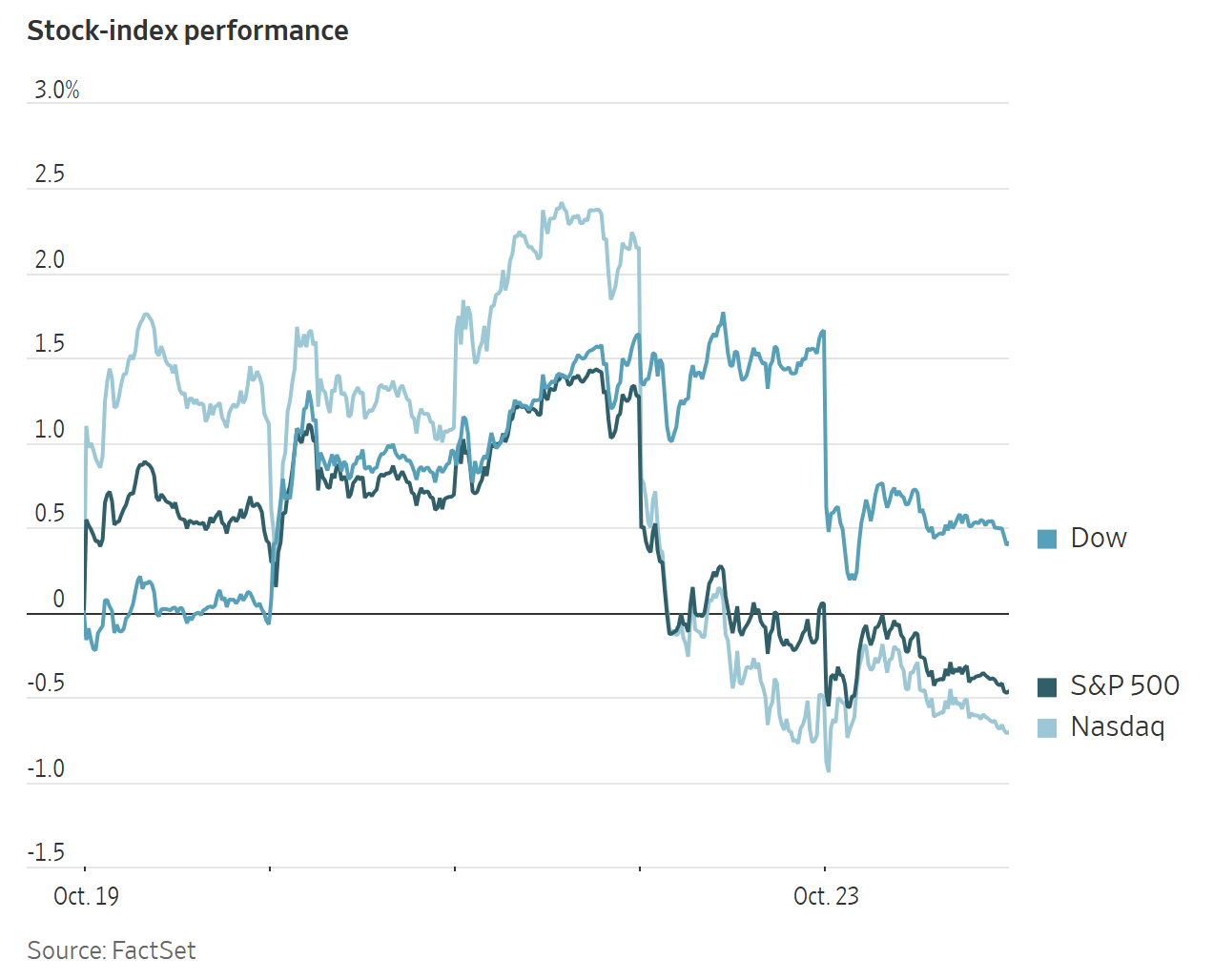
Major US stock indexes closed lower on Friday after a volatile week. The S&P 500 and Nasdaq Composite posted weekly losses of -0.47% and -0.71%, respectively, while the Dow gained +0.41%. On Friday, the Dow fell -1.23%, or 652.84 points. The S&P 500 declined -0.52% and the Nasdaq -0.21%.
In corporate news, SK Hynix shelved plans for a US listing of its memory-chip unit Solidigm, citing market conditions and share-price trends. It said the decision did not alter Solidigm’s growth prospects or investment needs. The unit operates the solid-state-drive and NAND businesses acquired from Intel in a 2020 deal.
Industry estimates suggested the IPO could raise $10 billion to $15 billion in new capital and value Solidigm at up to $150 billion, potentially making it one of the largest technology IPOs to date. Regulators and shareholders had also opposed the offering, arguing that it could dilute shareholder value and effectively duplicate SK Hynix’s listing.
Bloomberg news reported that SpaceX seeks at least 80,000 US cell sites and is negotiating with at least one major cellular infrastructure provider. Lease discussions include Crown Castle and other companies as SpaceX works to establish a fourth nationwide wireless carrier.
The deals could be worth billions, with SpaceX planning to combine Starlink satellites and other infrastructure to provide reliable connections to ground-based users.
During Wednesday’s earnings call, Crown Castle CEO Chris Hillabrant was asked about lease discussions with SpaceX, Amazon and other satellite telecom providers. He said, ‘You can assume that we’re talking to all parties,’ but declined to disclose customer-specific details.
European Stock Indices
CAC 40 -0.36%
DAX -0.75%
FTSE 100 -0.32%
Commodities
Gold spot -0.72% to $3,995.92 an ounce
Silver spot -1.27% to $53.89 an ounce
West Texas Intermediate +4.38% to $103.44 a barrel
Brent crude +3.76% to $117.38 a barrel
Gold fell to a three-month low on Friday, recording its sharpest weekly decline in more than four months.
Spot gold declined -0.72% to $3,995.52 per ounce, falling below $4,000 for the first time since mid-July after reaching a session low of $3,975.23.
Bullion lost -4.07% over the week, its largest weekly decline since June.
Gold purchases in India increased this week as lower prices during the major Dussehra festival supported demand and lifted premiums. Physical demand in China, the largest consumer, remained steady, although cautious consumers continued to limit jewelry spending.
Spot silver fell -1.27% on Friday to $53.89 per ounce, its lowest level since November 2025, extending its weekly decline to -5.46%.
Oil prices settled at their highest levels in nearly six months on Friday. Houthi attacks in Saudi Arabia heightened concerns about further disruptions to Middle Eastern energy supplies, while UAE authorities also reported an oil spill.
Brent crude futures rose $4.25, or +3.76%, to settle at $117.38 per barrel, their highest level since 29 April. US WTI crude gained $4.34, or +4.38%, to close at $103.44 per barrel.
Brent advanced +7.03% over the week, while WTI gained +1.57%. The rise can be attributed to Iran's continued attacks on ships in the Strait and Yemen’s Houthis targeting Saudi energy infrastructure. Multiple reports also indicated that the US and Israel were planning to resume attacks on Iran after the midterm elections.
Updated tanker data showed Persian Gulf exports rising above pre-war levels following a modest decline two weeks earlier, putting pressure on Gulf crude premiums. Nevertheless, crude prices strengthened ahead of the weekend as traders anticipated intensified attacks by Iran and its proxies on Gulf energy infrastructure and tankers before the 3 November midterm elections.
Unplanned US refinery outages, including at the Joliet refinery last week, appear to be driving disproportionate moves in wholesale gasoline prices. The EIA reported on Thursday that US refinery utilisation exceeded 95% from May through September, the highest rate for that period since 1998. That same day, the US President invoked the Defense Production Act and allocated $150 million to expand US refining capacity.
US crude exports remained well below their April and May highs, averaging 3.442 million bpd the week before last as record tanker rates reduced the competitiveness of US supplies. Asian refinery orders for US crude scheduled for November delivery were tracking roughly 50% lower m/o/m at 24 to 26 million barrels, putting them on course for a seven-year low.
Western Canada Select at Hardisty traded at a discount of $30 per barrel to WTI during last week, its widest in years. Record tanker rates for Canadian crude shipped from the US Gulf Coast and increased competition from Venezuelan supplies in that market contributed to the widening discount.
The US Department of Energy authorised an emergency exchange of up to 400,000 barrels of crude from the Strategic Petroleum Reserve to address a supply disruption at Phillips 66’s Lake Charles refinery in Louisiana.
The SPR was already at its lowest level since 1982 after the US President drew on reserves as the US war on Iran disrupted supply routes.
Germany’s national oil stockpiling agency, EBV, circulated a tender to sell diesel, heating oil and crude from strategic reserves. These would be Germany’s first releases since G7 countries agreed to tap reserves at the start of October under pressure from the US President.
Note: As of 4 pm EDT 23 October 2026
Currencies
EUR -0.11% to $1.1202
GBP -0.20% to $1.3372
Bitcoin +0.15% to $81,310.92
Ethereum +0.71% to $2,397.60
The euro declined on Friday and ended the week lower against both the US dollar and the yen. A selloff in French government bonds pushed the country’s debt risk premium to its highest level since the eurozone sovereign debt crisis in 2011.
The dollar index was broadly unchanged, posting a weekly decline of -0.03% after rising +0.13% on Friday to 101.75.
The euro fell -0.11% on Friday to $1.1202, bringing its weekly decline against the dollar to -0.33%. Losses against the yen were sharper, with the euro touching ¥175.08, its lowest level since October 2025. It subsequently traded at ¥175.70, down -0.06% on Friday and -1.04% over the week.
The yen weakened -0.06% on Friday to ¥156.86 per dollar but gained +0.72% over the week, its strongest weekly performance since mid-September.
Attention now turns to this week’s Fed, ECB and BoJ policy meetings. All three central banks are expected to leave rates unchanged, with investors focusing on guidance about the policy outlook.
Japanese data released on Friday showed annual core consumer inflation exceeding the BoJ’s 2% target in September for the first time in nine months. Core prices rose 2.1% y/o/y, up from 1.7% in August. Traders are pricing in a 61% probability of a BoJ rate hike in December.
The British pound declined -0.20% on Friday to $1.3372, contributing to a weekly decline of -0.04%.
Fixed Income
US 10-year Treasury +4.4 basis points to 5.001%
German 10-year Bund +0.1 basis points to 3.363%
UK 10-year Gilt +3.1 basis points to 5.369%
US Treasury yields rebounded on Friday after the benchmark 10-year yield recorded its largest one-day decline in nearly four years on Thursday.
The 10-year Treasury yield rose +4.4 bps on Friday to 5.001%, but fell -8.4 bps over the week. This marked its third consecutive weekly decline, the longest run since June.
The 30-year Treasury yield increased +3.9 bps on Friday to 5.323%, but fell -10.2 bps over the week, also recording its third consecutive weekly decline. The 2-year Treasury yield, which closely tracks Fed policy expectations, rose +4.6 bps on Friday to 4.692%, but declined -2.3 bps over the week. This marked its fourth consecutive weekly decline, the longest stretch this year.
Despite economic data signalling rising price pressures, expectations for a Fed rate hike at this week’s meeting have diminished. CME’s FedWatch put the probability of an increase of at least 25 bps at 9.4%, down from 15.5% a week earlier and 64.2% a month ago.
The US Treasury yield curve bull-flattened over the week as longer-term yields declined more sharply than shorter-term yields. The 2s10s spread narrowed 6.1 bps, from 37.0 bps to 30.9 bps.
This week’s US Treasury auction schedule includes coupon and floating-rate note sales, alongside planned operations to support market liquidity.
On Monday, the Treasury will auction $69 billion in 2-year notes at 12:00 PM EDT. A preliminary buyback announcement outlining liquidity support operations will follow at 1:00 PM EDT.
The Treasury will auction $70 billion in 5-year notes on Tuesday at 1:00 PM EDT, followed by $44 billion in 7-year notes on Thursday at the same time, concluding the week’s longer-term issuance.
Eurozone government bonds stabilised on Friday following recent volatility driven by concerns about France’s public finances.
France’s 10-year OAT yield fell -3.9 bps on Friday to 5.037% but rose +25.1 bps over the week, the largest increase among major eurozone countries and its sharpest weekly rise since late May. The spread over Bunds ended at 167.8 bps, widening 32.8 bps from the previous week’s 134.6 bps.
Germany’s 10-year Bund yield edged up +0.1 bps on Friday to 3.363%, but declined -7.7 bps over the week. At the front end of the curve, the 2-year Schatz yield rose +1.1 bps on Friday to 3.075%, while posting a weekly decline of -1.7 bps.
Italy’s 10-year BTP yield fell -0.4 bps on Friday but rose +11.1 bps over the week to 4.458%. Its spread over Bunds widened 18.8 bps over the week to 121.9 bps.
Traders were pricing in a 66% probability of an ECB rate hike in December. Investors will examine guidance on the rate outlook following ECB President Christine Lagarde’s late-September remarks that a moderate policy response to inflation was appropriate.
European and UK sovereign bond issuance for tenors exceeding one year is concentrated in the UK and Italy during this week. Germany's Deutsche Finanzagentur, France's Agence France Trésor and Spain's Tesoro Público hold no regular medium- or long-term bond auctions or debt buyback operations this week, having satisfied their standard monthly long-term supply cycles earlier in October.
The UK Debt Management Office leads issuance on Tuesday, offering £4.5 billion in conventional Treasury Gilts maturing 7 March 2032, with bidding concluding at 6:00 AM EDT. In Italy, the Ministry of Economy and Finance is scheduled to conduct its end-of-month medium-to-long term BTP auction on Thursday, typically concluding bidding around 6:00 AM EDT for an indicative volume of €6.5 billion to €8.0 billion across benchmark maturities.
Moody’s makes a heroic assumption about French politics. Moody's left France's credit rating unchanged on Friday, easing pressure on a government facing social unrest and strained public finances.
Following its periodic review, Moody's maintained the Aa3 rating and the negative outlook in place since last October.
Bond markets had priced in a downgrade that would have aligned Moody's with earlier cuts by S&P and Fitch. France has struggled to restore fiscal discipline since the 2024 snap election left parliament without a majority and stalled policymaking.
France's finance ministry said the decision affirmed the credibility of the government's proposed 2027 finance bill, intended to restore public finances.
The government faces a difficult parliamentary vote, as opposition parties could reject compromise, block the bill and bring down the government through a no-confidence vote.
Moody's said the Aa3 rating assumes passage of a deficit-reducing 2027 budget and some easing of financing costs and social tensions over the next few months.
French debt could face further pressure after the presidential election if Moody's, S&P and Fitch all lower their ratings to BBB, just above junk status, potentially triggering sales by investors subject to rating limits.
Note: As of 4 pm EDT 23 October 2026
While every effort has been made to verify the accuracy of this information, EXT Ltd. (hereafter known as “EXANTE”) cannot accept any responsibility or liability for reliance by any person on this publication or any of the information, opinions, or conclusions contained in this publication. The findings and views expressed in this publication do not necessarily reflect the views of EXANTE. Any action taken upon the information contained in this publication is strictly at your own risk. EXANTE will not be liable for any loss or damage in connection with this publication.
Tento článek je poskytován pouze pro informační účely a neměl by být považován za nabídku nebo výzvu k nákupu nebo prodeji jakýchkoli investic nebo souvisejících služeb, jejichž odkazy se v něm můžou vyskytovat. Obchodování s finančními nástroji je spojeno se značným rizikem ztráty a nemusí být vhodné pro všechny investory. Dřívější produktivita není spolehlivým ukazatelem budoucí produktivity.
 Zpět na všechny přehledy




Přihlásit se k odběru přehledů trhu
Přihlásit se k odběru
přehledů
trhu
Předplaťte si nyní Předplaťte si nyní



Založeno profesionály. Pro profesionály.
