

Can a rate check rescue a dovish hike?


 S&P 500 -0.08% last week to 7,650.50 US 10-year yield +2.1 basis points last week to 4.997% Spot gold +0.68% last week to $4,376.91 an ounce DXY +1.13% last week at 100.22
Key data to move markets today
EU: Buba Monthly Report and speeches by ECB’s President Christine Lagarde and Executive Board member Piero Cipollone
USA: A speech by Chicago Fed President Austan Goolsbee
JAPAN: Markets closed in observance of Autumnal Equinox Day
Global Macro Updates
BoJ’s decision. Friday’s BoJ meeting achieved the increasingly Japanese feat of delivering a rate rise that markets read as dovish. The Board lifted its policy rate by 25 bps to 1.25%, a 31-year high, but the 7 – 2 vote mattered more than the increment. Toichiro Asada argued that core inflation remained below 2% and the economy could not be considered strong; Ayano Sato saw insufficient acceleration in activity or prices to justify tightening now. Both were appointed under Prime Minister Sanae Takaichi, making their dissents look less like footnotes than a preview of the Board’s changing reaction function.
Governor Kazuo Ueda described a new, pre-emptive phase intended to prevent an inflation overshoot, while leaving larger or consecutive increases on the table. Yet he offered no preset cadence and warned against tightening too quickly. Markets heard the caveat rather than the threat, as the dissents and absent forward guidance diluted the hike’s signalling value.
Then came the reported rate check. Nikkei reported that the BoJ queried dealers late Friday, usually the bureaucratic equivalent of clearing one’s throat before intervention, sending the yen back towards the upper ¥156 area. The surprise arrived before Japan’s extended Silver Week break, when thin liquidity could embolden yen shorts; market discussion had generally treated ¥160 as the more obvious tripwire. The reported check, issued to several institutions and amplified by stop-losses, could keep FX desks attentive through the holidays and into the US - China summit on 24 September.
The larger contradiction sits between Kanda Street and the Kantei. Takaichi’s government is pursuing ‘responsible, proactive’ fiscal policy, yet September’s proposed two-year food-tax reduction and household payouts arrived without specified funding; fiscal-2027 MoF requests reached ¥143.1 trillion and projected debt-service costs a record ¥36.64 trillion. Tokyo promises to cap new issuance near ¥40 trillion, but markets are being asked to trust future offsets while pricing present supply. Expansionary fiscal policy is pulling against monetary restraint, leaving the FX authorities to manage the skid.
Nor does the tension stop at Japan’s shoreline. Ten-year JGB yields above 3% make domestic paper more competitive with currency-hedged Treasuries, Bunds and Australian bonds. Japanese investors had sold a net ¥3 trillion of overseas debt through late August, while a JPMorgan Asset Management survey recorded the strongest intention among corporate pensions to add domestic bonds since 2008 as reported by Reuters. Additionally, Tokyo has separately encouraged state pensions to increase domestic allocations.
The global risk is therefore less fire-sale than buyers’ strike. Japan spent decades exporting cheap duration. Its changing policy mix may now be calling that capital home and exporting higher term premia elsewhere in its wake.
US Stock Indices
Dow Jones Industrial Average -0.18%
Nasdaq 100 +0.67%
S&P 500 +0.17%, with 4 of the 11 sectors of the S&P 500 up
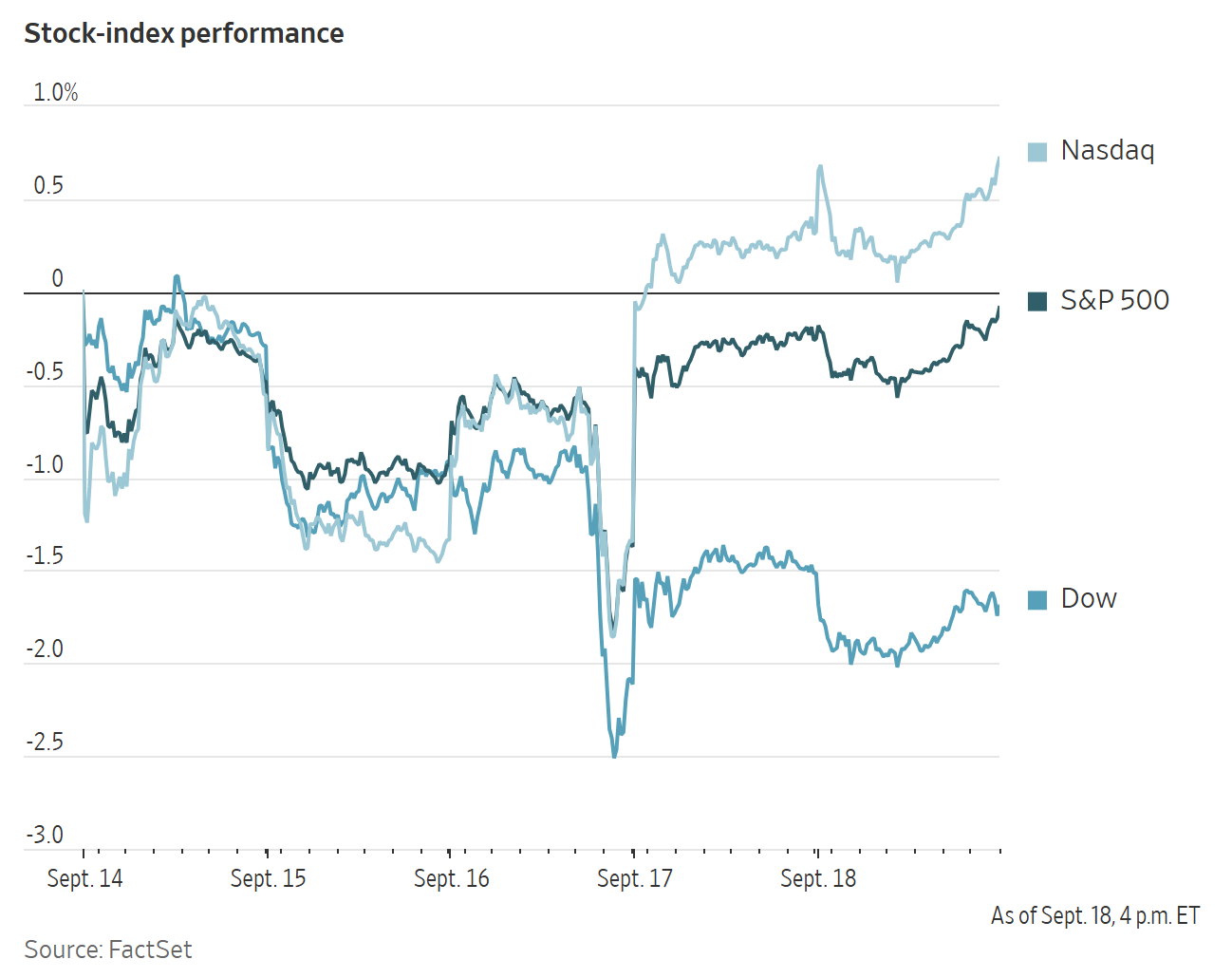
US equities rose on Thursday as investors moved past the volatility that followed a turbulent week on Wall Street. The week, marked by a steady flow of market-moving headlines, ended quietly.
AI leaders urged a slowdown, the 10-year Treasury yield reached 5% and the Fed raised interest rates for the first time in three years. Although a tech-led rally briefly lifted stocks on Thursday, the major US indexes were little changed on Friday as investors continued to assess the impact of higher borrowing costs.
The Dow Jones Industrial Average fell 95.36 points, or -0.18%, to 51,682.64 on Friday. The S&P 500 gained 12.74 points, or +0.17%, to 7,650.50, while the tech-heavy Nasdaq Composite rose 104.24 points, or +0.39%, to 26,522.54.
For the week, US indexes ended mixed: the S&P 500 slipped -0.08%, the Dow Jones dropped -1.41% and the Nasdaq Composite advanced +0.72%.
Trading volume on US exchanges exceeded 26 billion shares, ~40% above the 12-month average, as triple witching drove activity. The quarterly event involves the expiration of derivatives contracts tied to stocks, index options and futures.
Roughly $7 trillion in options notional value was due to expire, among the largest totals on record, raising the risk of amplified market volatility.
In corporate news, The Wall Street Journal reported that Paramount Skydance is in advanced settlement talks with California officials to resolve the antitrust lawsuit blocking its $81 billion bid for Warner Bros. Discovery, according to people familiar with the matter. Potential compromises include Paramount operating the companies’ movie studios separately for a period before any integration.
Anthropic told investors it expects to have about 5 gigawatts of computing power available by year-end, accelerating its expansion plans as the AI company moves toward an IPO.
Sysco is preparing a bond sale of roughly $17 billion as soon as this week to help finance its $29 billion acquisition of cash-and-carry wholesaler Jetro Restaurant Depot.
Accenture announced a partnership with Anthropic on Friday afternoon, forming a team of embedded evaluators to work with Anthropic’s internal teams on stress testing models, safeguards and alignment. Accenture said both companies expect to invest at least $1 billion each over five years in AI safety.
Volkswagen cut its full-year profit forecast after identifying about $11.5 billion in impairment charges tied to its Porsche stake, difficult trading conditions in China and restructuring efforts. The German automaker said Friday that it now expects an operating return on sales of up to 1% this year, down from its prior forecast of 4% to 5.5%.
European Stock Indices
CAC 40 -0.93%
DAX -0.92%
FTSE 100 -0.27%
Commodities
Gold spot +0.83% to $4,376.91 an ounce
Silver spot +1.23% to $66.23 an ounce
West Texas Intermediate -1.54% to $99.53 a barrel
Brent crude -0.82% to $103.24 a barrel
Gold advanced to a one-week high on Friday, securing its first weekly gain in four weeks.
Spot gold traded +0.83% higher at $4,376.91 per ounce on Friday, after reaching its highest level since 11 September earlier in the session. Bullion gained +0.68% over the week.
Spot silver rose +1.23% to $66.23 per ounce, contributing to a weekly gain of +2.73%.
Oil prices declined on Friday after China, acting at Saudi Arabia’s request, urged Iran to curb Houthi rebel attacks on Saudi oil infrastructure, which had threatened a second oil export route in the Middle East.
Brent crude futures settled at $103.24 per barrel, down $0.85, or -0.82%. US WTI futures finished at $99.53 per barrel, down $1.56, or -1.54%. For the week, US WTI declined -0.46%, while Brent fell -1.13%.
Retail diesel in the US reached a record $6.45 per gallon, according to AAA data, while retail gasoline averaged $4.47 per gallon during a period when gasoline prices typically decline.
Despite China’s reported intervention, analysts said the outlook for the coming months remained uncertain.
The Strait of Hormuz remained largely constrained, with only four commodities vessels passing through the strait on Thursday, compared with a 10-day average of about 16, preliminary shipping data showed on Friday.
Prices climbed near four-month highs earlier in the week after sources said crude loadings at Saudi Arabia’s Red Sea export hub of Yanbu had been suspended and Riyadh cancelled some deliveries to Europe following damage to its East-West pipeline in an attack last week.
Saudi Arabia and Yemen’s Iran-backed Houthis exchanged fresh cross-border strikes on Thursday, while Yemenis used boats in the Red Sea to flee the fighting, underscoring the growing supply risks created by the widening Middle East conflict.
Satellite imagery and three industry sources indicated that three pumping stations serving Saudi Arabia’s East-West Pipeline were damaged in last week’s attack, one more than previously assessed, while the repair timeline remained unclear.
Saudi Arabia sought to restore roughly half of the East-West oil pipeline’s capacity within days, although Reuters sources offered differing estimates on the timeline to reopen the pipeline and normalise crude flows.
While damage to the East-West pipeline limited Red Sea volumes, multiple reports indicated that Saudi Arabia was increasing exports from the Persian Gulf through STS transfers off the coast of Oman. With most of that crude expected to flow to China, Shanghai crude pricing fell by more than $20 per barrel in the second half of the week. Reports also indicated that as many as nine VLCCs were in or around Iraq’s Basrah oil terminal.
The US and Iran have held no peace talks since the collapse of an interim agreement reached in June. The war is expected to be discussed at the United Nations General Assembly next week, and an Iranian delegation will be permitted to attend, according to the US State Department.
Although inventory builds in several regions offered some encouraging signals, diesel remained firmly in crisis mode ahead of winter demand and the autumn harvest season. Ukraine continued to strike Russian refineries, deepening diesel shortages, while Moscow extended its diesel export ban during the week.
Additionally, Chinese data showed August refinery throughput and product exports rebounding m/o/m, while crude stockpile draws were estimated to be the second-largest on a bpd basis since the war began on 28 February.
Note: As of 4 pm EDT 18 September 2026
Currencies
EUR +0.10% to $1.1485
GBP +0.28% to $1.3393
Bitcoin +6.34% to $81,212.78
Ethereum +7.37% to $2,626.38
The dollar strengthened against the yen on Friday after two BoJ policymakers dissented from a widely expected decision to raise interest rates, prompting traders to question the likelihood of further hikes.
The dollar pared gains after Japanese authorities conducted rate checks in the currency market, a move generally viewed as a preliminary step before intervention, the Nikkei newspaper reported.
The BoJ raised rates to their highest level in 31 years, at 1.25%, but the move failed to support the yen as traders saw limited explicitly hawkish guidance. Coming after the Fed’s hawkish message earlier in the week, the decision could leave room for further dollar strength.
The US dollar traded +0.59% higher at ¥156.86, after rising as much as 1.30% to a two-week high of ¥158.05 earlier in the session.
The dollar advanced +2.16% over the week, marking its largest weekly rally since October 2025.
Traders remained alert to the risk of intervention to support the yen after Finance Minister Satsuki Katayama said Tokyo would not hesitate to take further coordinated action, following a joint US - Japan move to boost the currency in late July.
The dollar index was -0.01% lower on Friday; however, it advanced +1.13% over the week to a seven-week high after the Fed raised interest rates on Wednesday and signalled that further tightening could follow.
The euro rose +0.10% on Friday to $1.1485 but ended the week -0.97% lower.
The British pound traded +0.28% higher at $1.3393 after UK retail sales data exceeded expectations on Friday. It was little changed against the euro, with the single currency flat at 85.91 pence. Sterling ended the week -0.92% lower.
The BoE held interest rates at 3.75% on Thursday but also suggested that it could raise borrowing costs. MPC officials lifted their Q3 growth forecast after data earlier in the week showed output expanding in July at the fastest annual pace in 18 months.
Money-market traders were last pricing in an approximately 65% probability of a November rate hike and anticipated roughly four 25 bps increases by the end of 2027.
Fixed Income
US 10-year Treasury +6.0 basis points to 4.997%
German 10-year Bund +4.1 basis points to 3.530%
UK 10-year Gilt +7.9 basis points to 5.297%
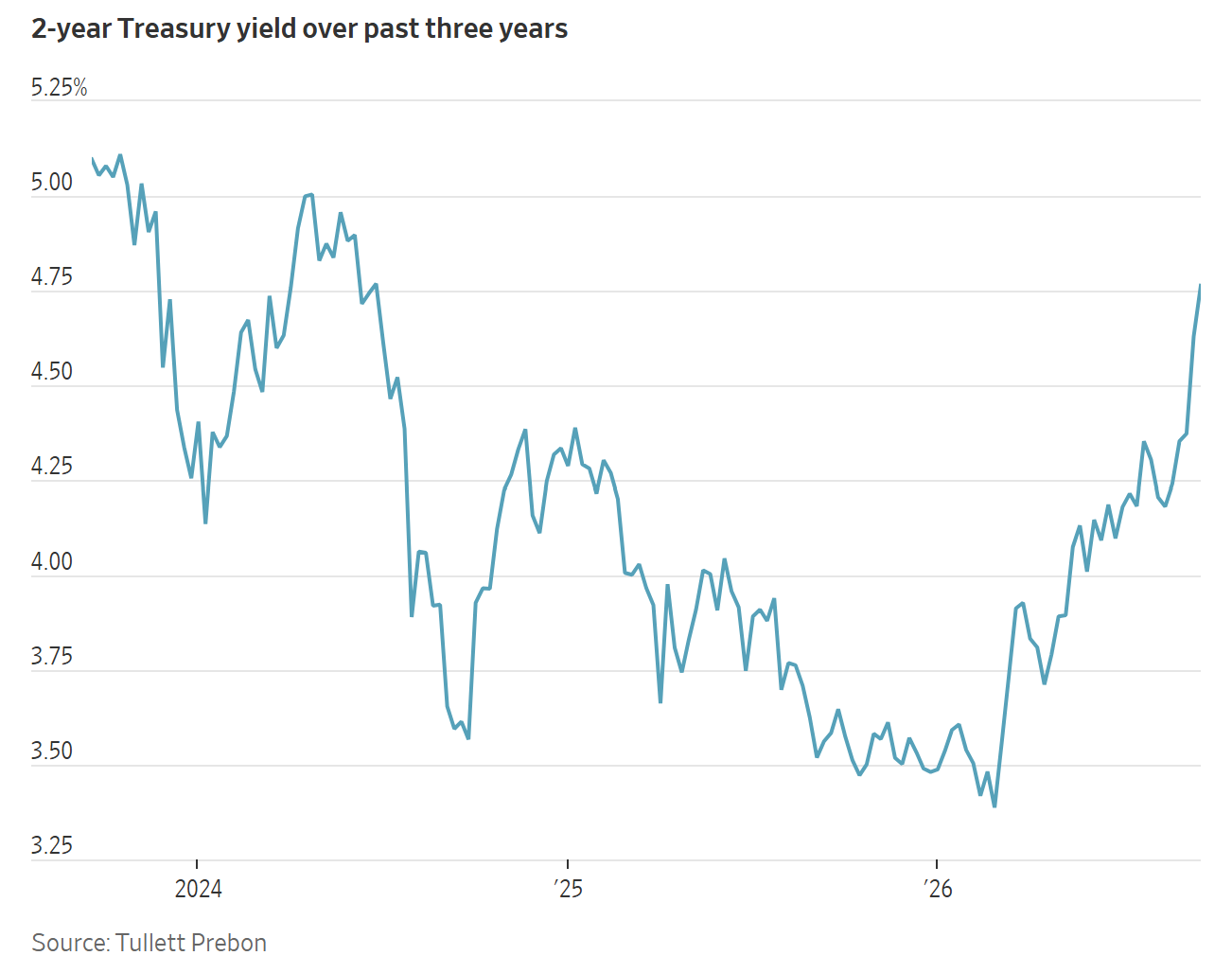
US Treasury yields rose across maturities on Friday, with two-year yields reaching their highest level since July 2024, as investors assessed the interest-rate outlook following the FOMC’s first rate hike in three years.
Traders saw a 57.6% probability of another increase when the next Fed meeting concludes on 28 October, according to CME FedWatch, up from 42.5% one week earlier. Additionally, money markets priced in 32.2 bps of monetary tightening for the remainder of the year.
The US 2s10s yield curve stood at 24.5 bps, after earlier reaching 23.8 bps, its flattest level since 25 June. It narrowed by 11.1 bps over the week, reflecting a bear-flattening bias as short-term yields rose faster than long-term yields.
The yield on the US 10-year Treasury note rose +6.0 bps to 4.997%. It reached 5.041% on Tuesday, the highest level since 2007, and ended the week +2.1 bps higher.
The two-year US Treasury yield, which typically tracks Fed funds rate expectations, traded +6.9 bps higher on Friday. It earlier reached 4.748%, the highest level since July 2024, and advanced +13.2 bps over the week.
The 30-year bond yield traded +3.4 bps higher at 5.325%, although it ended the week -3.3 bps below the prior week’s close.
Eurozone Bund yields ended the week higher, even as traders reduced ECB hike expectations after briefly pricing the deposit rate near 3.5% for late 2027 at the beginning of the week.
Germany’s 10-year Bund yield rose +4.1 bps to 3.530%, after reaching 3.572% on Tuesday, the highest level since June 2009. It recorded a +1.0 bps weekly rise.
Money markets priced the ECB’s deposit rate at 2.86% by December, implying an almost 50% probability of a second hike by year-end. By November 2027, rates were seen at 3.39%, compared with 3.55% on Monday.
The two-year Schatz yield, which is more sensitive to ECB deposit-rate expectations, traded +5.9 bps higher on Friday, contributing to a weekly rise of +8.3 bps. It reached 3.312% on Monday, the highest level since September 2023.
France’s 10-year OAT yield rose +12.2 bps to 4.574%, its highest level since September 2008, bringing its weekly advance to +12.3 bps. The yield spread versus Bunds stood at 104.4 bps, after widening by 11.3 bps over the week.
Prime Minister Sebastien Lecornu is working to finalise a deficit-reducing 2027 budget as bond-market pressure intensifies and voters become increasingly concerned about the rising cost of living.
Italy’s 10-year BTP yield rose +9.8 bps on Friday to 4.441%, contributing to a weekly increase of +8.7 bps. The yield spread versus Bunds stood at 91.1 bps, after widening by 7.7 bps over the week.
Note: As of 4 pm EDT 18 September 2026
While every effort has been made to verify the accuracy of this information, EXT Ltd. (hereafter known as “EXANTE”) cannot accept any responsibility or liability for reliance by any person on this publication or any of the information, opinions, or conclusions contained in this publication. The findings and views expressed in this publication do not necessarily reflect the views of EXANTE. Any action taken upon the information contained in this publication is strictly at your own risk. EXANTE will not be liable for any loss or damage in connection with this publication.
Tento článek je poskytován pouze pro informační účely a neměl by být považován za nabídku nebo výzvu k nákupu nebo prodeji jakýchkoli investic nebo souvisejících služeb, jejichž odkazy se v něm můžou vyskytovat. Obchodování s finančními nástroji je spojeno se značným rizikem ztráty a nemusí být vhodné pro všechny investory. Dřívější produktivita není spolehlivým ukazatelem budoucí produktivity.




Přihlásit se k odběru přehledů trhu
Přihlásit se k odběru
přehledů
trhu
Předplaťte si nyní Předplaťte si nyní

Založeno profesionály. Pro profesionály.
